Your wildly multifarious home!
Feed aggregator
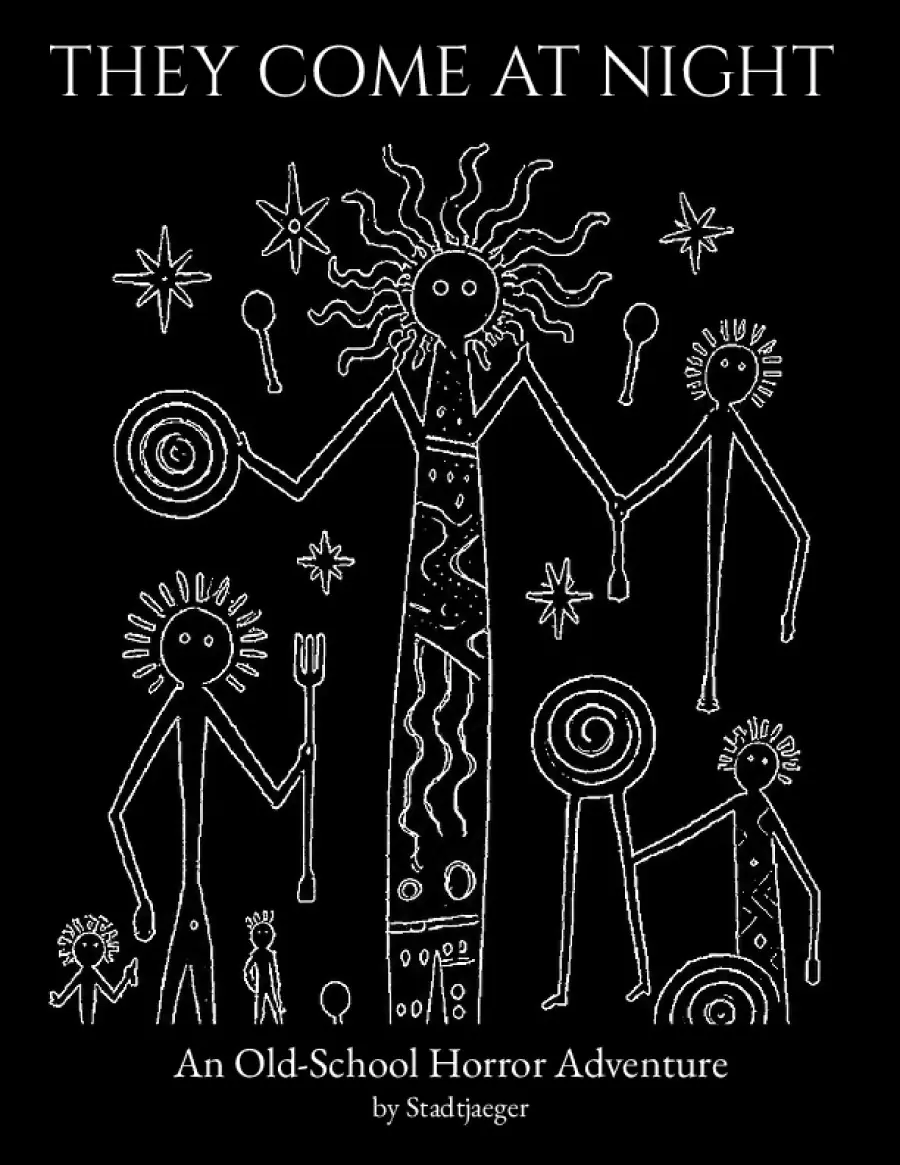
They Come at Night
By Stadtjaeger
Self Published
Generic/Universal
"Low/Mid Levels"
Self Published
Generic/Universal
"Low/Mid Levels"
Something went quiet in Frostholm. The mining outpost stopped sending word weeks ago. Company says it’s the weather. Locals won’t go check. A mother’s paying good money to anyone willing to find her son — a scholar who went up chasing some old civilization and never came back.
This thirty page adventure presents a small village investigation and a dev le in to a mine with about eight rooms, plus a couple of overland events before and after. It’s more of a scene based “Experience” than an adventure, with the designer describing it as no-win. The writing is purple and there is no loot to be gained.
This has elements of War Against the Chtorr, in that an alien organisms is trying to chtorraform the planet. You head up to a snowy mining camp that no one has heard from and have a few spooky things happen along the way. At the camp you poke around the buildings and find bodies and more eerie stuff. You survive (presumably) a night attack by a swarm of alien insects and head to the mine the next day. There you might get infected with spores in the weird crystal/plant environment and find a dude in an alien pod. If you free him then an unbeatable monster appears. Fleeing from it you fight hordes of crystal block constructs. You’re supposed to figure out to seal the mine shaft with some explosives you find. On the way back down the mountain, with the dude you found, a different unbeatable monster appears, klils the dude, and takes off for the stars. The dude you found has a book and if you perform the ritual in it then a portal opens in which armies of alien life forms come through to finish chtorraforming the planet.
The vibe here is similar to those killer LotFP adventures. You know, you delve in and try to get loot while avoiding the doomsday scenario that is sure to happen. Maybe mix in a little Call oc Cthulhu where messing with books will fuck you up. Except, there’s not really any loot here. I find this annoying and it makes me want to put this solidly in to the Modern Adventure category where you’re just fucking around together at a table instead of gaming. Yeah yeah, there are different ways to have fun, but I prefer the one where the story is the one the party makes. But, with that in mind …
This is also a generic/universal adventure. Which means a lack of stats. You get some general “there should be twice as many creatures as party members” and other story based mechanics like “the attacks last until dawn” kind of stuff with a few “they should take one hit to kill” sorts of things thrown in. This, again, contributes to the more story based approach that the adventure is taking.
It DOES do a fairly decent job with the investigation and lead in to the mine. You get a few eerie things happening on the trail to the mining town, dogs nervous, a body frozen in the snow and so on. And the town investigation is also likewise eerie. Strange scratch marks covering all of the buildings, skeletons huddled in corners stripped of their flesh or other clearly holed up and waited to die. The whole “meal still on the table” sort of thing. At one point you can’t get in to tone of the village buildings and have to go in a window to find the door blockaded. Nice.The whole preamble to the ride os decently done, in what is presented if not in its form.
Any by form, I mention that because of the writing style. It’s very much heavy with first this thing happens and then this thing happens and keep the party from doing X and so on. This is then exacerbated by a certain conversational style of writing, HEAVY with purple text. “The walls have stopped pretending to be stone. What covers them now is something else, layered thick like scar tissue over a wound that never closed — glistening, faintly pink where the light catches it, soft enough that you do not want to touch it and cannot stop noticing that you have to.” Or something like “Something is coming, but not in a hurry, It doesnt need to.” That least bit being a read-aloud line.
While this MIGHT work in in the village/investigation portion, it breaks down in the mine where it tends to continue. The mine is mostly just poking around on a museum trip, looking at the weird plant life that might infect you with something only very high level magic can cure. There are a couple of light problem solving situations, like getting down the central shaft, but you’re not doing much until you find the dude in the alien pod thingy.
At this point all of the stillness disappears. The unbeatable monster appears as well as the hordes of lesser crystal golems. You’re supposed to run away. That’s the point of the entire adventure. Run away, beat off the crystal golems while ascending the shaft and, hopefully, sealing it lest the horrors are loosed upon the world.
This is all, essentially, a railroad. It’s an experience. Follow the tracks laid down and survive and “win” by escaping with a sealed shaft,. If you don’t guess what the designer wants you you to do then die
The conversational writing style makes running it difficult, and the purple prose if so bad that I’m not sure I could read it with a straight face. Even when it’s not read-aloud the DM will need to wade through it and try to translate it to something evocative for the party, which is not going to be easy.
The generic/Universal curse strikes again. Just write it traditionally and stat it for B/X and STILL call it generic/universal. Once you get good, as a writer, THEN you can branch out to more experimental styles. But you gotta learn to walk first.
This is $4 at DriveThru.The preview is the first three pages, which are all, essentially, designer notes. A few encounters needed to be included so a potential buyer can get a sense of what they are buying before they do so.
https://www.drivethrurpg.com/en/product/578991/they-come-at-night?1892600
Categories: Tabletop Gaming Blogs
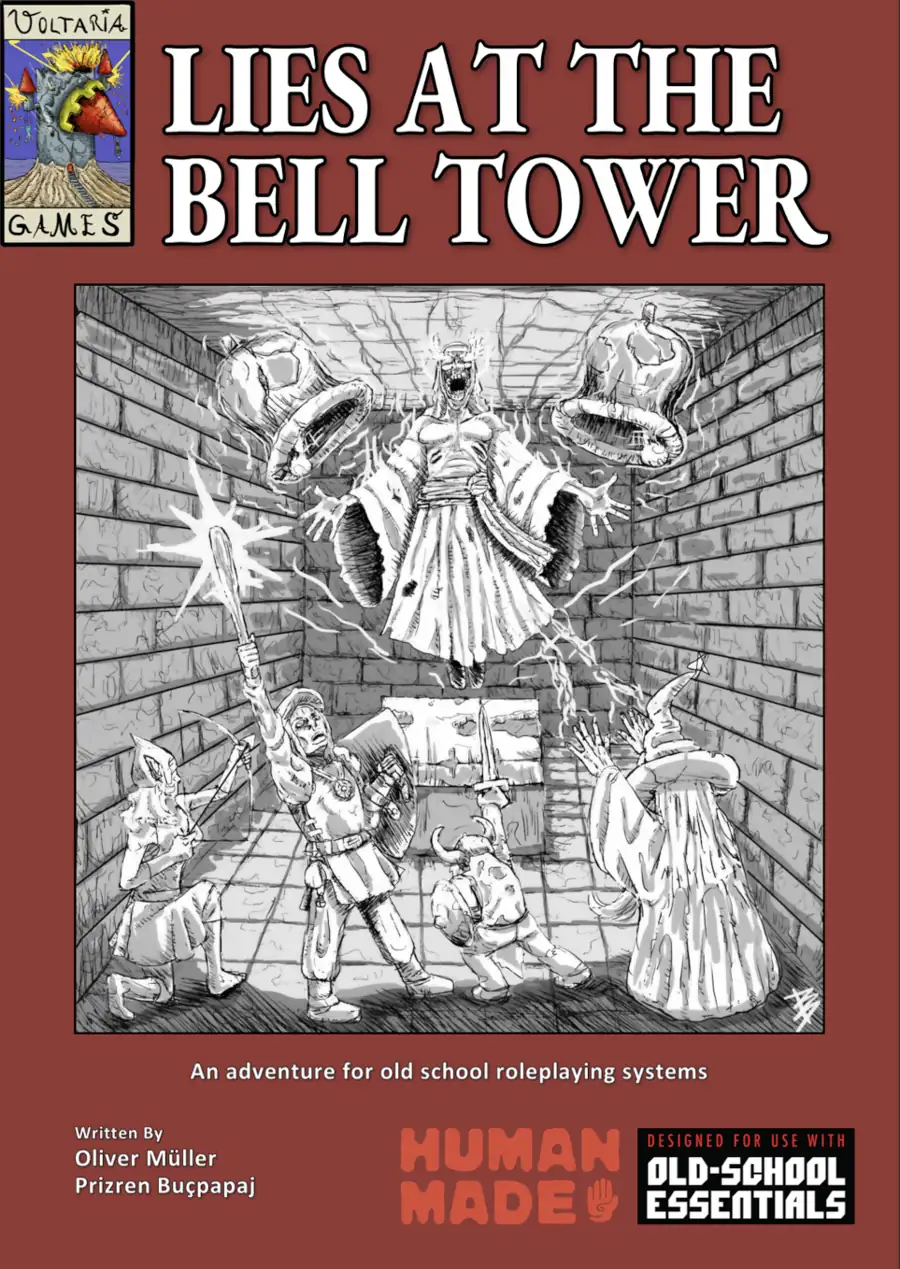
Lies at the Bell Tower
By Oliver Müller, Prizren Buçpapaj
Voltaria Games
OSE
Level 1
Voltaria Games
OSE
Level 1
A village is silent. None dares to speak out loud anymore, for fear of invoking the curse of the bell. A nun was burned 300 years ago, because she was accused of having consorted with a demon who stole the voices of his victims. The same demon who is bound to the bell of the ancient belltower in the center of the village. Will your party of adventurers brave the depths of the old catacombs to lift the curse and right the wrongs from the past, or will they accidentally unleash an even greater evil?
This twelve page adventure presents eleven rooms on two levels of a small dungeon under a ruined monastery. It’s a little dull and lacks flavour but is far from the worst things ever written.
Man, my compliments are really getting out of hand, aren’t they? But, seriously, something seems to have happened with adventures. Some of them don’t make me want to gouge my eyes out. Now, I’m not saying they are good, or even regertful, but, they don’t just absolutely suck ass. I don’t know how many times in, what, fifteen years, that I’ve seen stuff that is just Meh, but I’ve been seeing it a lot lately. Yeah! The world is getting better! “You won’t hate everything about your life if you purchase this adventure!” That’s right, I’m available for writing ad copy! If this trend continues I may be out of a non-job. Because as much as I love a good adventure the blog only exists because I REALLY hate bad ones. “Not writing crap” seems like such a simple idea, at least in theory.
You show in a village. The people won’t talk to you. They will grunt at you. They will make arm gestures. Some will write notes. (Booo literacy!) But they won’t talk. Every time someone tells a lie then the bell in the old ruined monastery rings, louder and louder. Popping on over you can go up the bell tower, which contains only the bell, or you can go down in to the dungeon and it’s small handful of rooms. Down there you will fight a few 1hp undead, a few skeletons, and meet the ghost of a chick burned alive who cursed the monks. The bell contains the essence of a demon, which is why the monastery exists. The chick was a part of the monastery, the monks lied and got her burned. The curse infected the bell. Destroy the bell and the demon gets out. Kill the ghost of the chick and the bell cracks and the demon gets out. You’re supposed to find the one-charge hammer of banishment and use it on the ghost, putting her to rest while the bell remains intact and freeing it of the “lie and the bell rings” curse.
The hooks are the usual low-effort stuff of get hired, with one having the party just arriving at the village and stumbling in to things. One of the best parts of the adventures is a throw away line in that hook that has an old woman attacking the party with a broom if they speak. That’s the kind of specificity that makes an adventure shine. It’s short and fits in perfectly with a bunch of scared villagers. Another line has advice to the DM in making the bell ring every time someone in the party tells a lie. A nice touch. Finally, n the dungeon are a number of cubbies with bones in them, catacombs like. In one cubby the skeletons still have jewelry on them! Time to get a lootin! Except it’s a cube, the remains of other adventurers in it. Very nice integration of a classic monster in to an adventure in such a way that makes it a surprise. All of those “empty” bone reliquaries pay off in a nice monster attack. That’s how you lure a party in to a classic monster.
The descriptions here are not terrible, although they are not really evocative either. The Sacrist reads “8. SACRISTY Wardrobe: There is a rotting wardrobe containing 1d4 robes for mess. They are damp and filled with holes, but they will prevent the skeletons from attacking. Box: Used to store religious tools for the mess, which have been hidden in the secret treasure room when the monastery was abandoned.” This has some line breaks in it, I’m condensing it here. It’s easy enough to follow and, while the length is not great it’s also not a burden. It comes across as rather mundane, and doesn’t really do a great job of painting an evocative picture of the room, being more fact based than impressions. Note that there is no room summary, and in some places this gets awkward, such as in one room with zombies that only show up at the last sections. These sorts of things, the most obvious thing or something likely to be of import immediately, should really ne higher up in a description. “Oh, yeah, there are also some zombies here” is not the way to run a D&D game. This means takingin the entire room description before relying it to the party rather than a descriptive style that builds with first impressions and follow on detail. Thus the text length does come to play when as being of note.
It doesn’t feel like a spooky monastery with shit going on, although thats what it is. The titular bell tower, while having the mostimportant thing in the adventure, the bell, is almost an afterthought, with the focus being the dungeon under the tower. The bell tolling helps, but it needed more build up or, interestingly, less, almost as an aafterthought. Either would have worked better, I think.
This is an EASL adventure, with some AI to help with the translation, the adventure discloses. This is probably fine. I suspect some of the mundanity in the descriptions comes from its EASL nature, but that’s to be expected. “Grave chamber: It is an undecorated tomb with a single simple grave in the middle.” is a good example. Like, a dug grave, in a catacomb? I suspect we mean a stone sarcophagus? But, also, not exactly the height of evocative writing. There’s not a whole lot wrong here, it just doesn’t stand out as something I’d like to run. Also, put the level range is IN the adventure. Put it on the cover or in the marketing blurb.
This is $3 at DriveThru. The preview is the first three pages. Another page of encounters would have been nice, to get a true sense of the adventure keys.
https://www.drivethrurpg.com/en/product/581426/lies-at-the-bell-tower?1892600
Categories: Tabletop Gaming Blogs
The Hand That Counts
Vestiges?
Self Publised
OSR? 5e.
Level 2
Self Publised
OSR? 5e.
Level 2
Every night, someone climbs down into a burial mound sealed for sixty years and declared “inactive.” He’s counting something on a wall, in chalk. No one knows who, or why — and the answer reaches far beyond one lone surveyor.
This 21 page adventure uses four pages to describe six scenes, one having five rooms. Is it AI slop? It is pretentious? You now longer have to choose, now it can be both! It’s also barely comprehensible.
This was a request, but the designer, as it turns out. I’m always a little bemused when someone wants ME to review something they wrote. Any publicity is good publicity? I mean, there are more than a handful of reviewers that will just give you five stars, why not go there?
And then there’s the statement in the request that the line drawings are AI. Sure, ok. I don’t actually care about AI. I feel about it the way I feel about Mork Borg: there’s nothing inherently wrong with it, it just turns out it’s enabling a lot of garbage. Because, you see, while the designer disclosed the use of AI art to me, the adventure has this disclaimer at he bottom of the title page: “The illustrations in this work were created using generative AI tools, under art direction. Part of the content was developed with the help of AI, which was also used for proofreading and for translation. The whole — setting, rules, text — was conceived, directed, reviewed and approved by its author.” So, you used AI to write it and then write a deceptive missive to me in order to get me to review it because, I suspect, you knew that the use of AI in writing would be a no go. Except I don/t care about the use of AI. I care about the end result, and the fact that you engaged in a deceptive practice. I know, damned if you do and damned if you don’t, right? I note that the last sentence in that disclaimer basically just says “I used AI” using different words and notably does NOT say that someone write this. Just that they directed the writing of it. Having saif all that, I don’t understand WHY someone would use AI in a creative work. Isn’t that the point, the process of creation? Isn’t that a major joy in life? If it’s not then why the fuck are you engaging in it? Like most modern shams, this is hollow. Nice art. Nice page layouts and backgrounds. The APPEARANCE of quality. And it’s all to the end of hiding the word-guesser slop underneath.
The text here just positively drips with AI mannerisms. Which is a euphemism for overwritten purple prose. It anyone wants to be a failed fantasy author, it’s the AI agents. “A Cabinet station: plain, functional, without a single ornament. It is not a tomb, it is an instrument, and it still works. At this depth nothing explains itself at first glance” Uh huh. Purple slop. “But he can read a depth, feel a draught and tell when a corridor is lying, which is worth more than a map.” Uh huh.Purple slop. “The threshold says it to anyone who looks: a sword bent double, a crushed helm, scattered iron filings — everything that carried iron and came too close” Purple slop.
It doesn’t help that this is some walking simulator. “It is also a way into Vestiges, a game of archaeological fantasy in which you do not loot dungeons: you survey what dead worlds left behind, and you decide what to do with what you have understood.” I decide to sell it for money and power. “A Guild of scholars, the League of Nyméria, funds the expeditions, buys up the finds, and decides what the world is allowed to know.” Wrong! My sword decides that. “The scenario is not won by killing Orin. It is played by deciding what to do with a man who counts in spite of himself, and to whom the count is handed.” But, it’s a lot easier, I’d say, if I just stab him? So, pretentious setting. Oh, oh, also, you get the famous “ask the party a deep question” bullshit. In this case “Why do you go underground, when sensible people stay up top?” I do it as escapism for a shitty middle class wage slave life in order to have fun and as a pretext to spend time with friends. Why the fuck did you shortcut one of the few meaningful things in life, the act of creation, and instead resort to AI slop?
With pretentious interactivity. I’m not sure you actually DO anything in this. There is certainly no conflict. There are a few die rolls, which you can’t really roll to continue with. I guess, once you walk to the end you get to decide who to seel the COUNTER out to, if anyone? It’s not meaningful though. There’s not real consequence for anything.
Bolding is used seemingly at random. The entire text is nigh incomprehensible because of the AI. I THINK I could give a somewhat accurate overview, although none of the motivations make sense. At some point in one of the railroad scenes it says something like “The real thread is pulled at a College cartographer’s, who sells copies of old surveys.” So, this is out of nowhere, I think, after you pursue the clue given to you at the start, which is a dead end/fake. How you end up at the Cartographers COllege, which has not been mentioned previously, is beyond me. At the end, during your one choice, you get this text “The return is the real fight, and it is fought without weapons. Three parties learn, within a few days, that the group went down — and each of them wants the count. Bring them in in that order” Bring them in WHAT order? The people mentioned, the table the table that follows, there is little in the way of consistency that would let you figure out what is going on here.
This is just a mess. An AI mess. A pretentious AI mess. Even if you are in to walking simulator D&D this is a shitty version of it.
This is Name Your Own Price at Itch.
https://sylkaen.itch.io/rpg-sylkaen-en-the-hand-that-counts-en
Categories: Tabletop Gaming Blogs
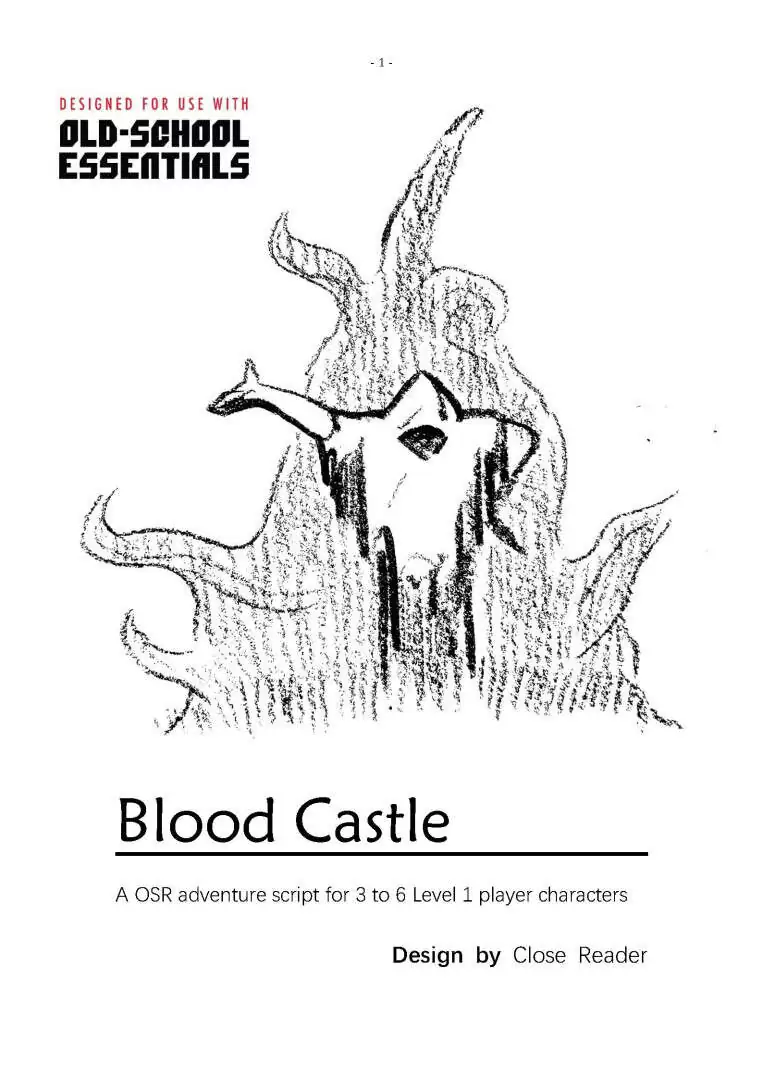
Blood Castle
By Close Reader
Oriental Mandarin Legend
OSE
Levels 1-2
Oriental Mandarin Legend
OSE
Levels 1-2
In order to thank the PC for killing the monsters in his territory, the Boold[sic] Baron invited the players to come to the bright Red castle he built on the Wild Eagle Mountain.
This 28 page adventure presents seven-ish rooms in a scripted human sacrifice ceremony dungeon/scene/event. It has both EASL issues and is overly scripted.
Disclaimer: I think this is a difficult review to write. I suspect strongly, based on the chinese characters in the text, that this is an EASL adventure and, further, an asian one. I love seeing non-tolkein fantasy and I don’t want to do anything to discourage EASL adventures, particularly from our chinese friends. But, also, there are EASL issues. The imagery in the writing doesn’t hit at all which is a problem given the subject matter and there are some areas, in the overview in particular, in which the language could be clearer on what is supposed to be going on, plot-wise. I’m not going to mention these things again in the review and encourage the designer to continue writing florid text, and, certainly, to continue writing adventures.
You’re invited to the barons castle. Except, he didn’t actually invite you. It turns out that a priest, a spy in the castle, issued you the invitation. But, a carriage from the baron shows up to pick you up and you’re let in anyway. There’s a big banquet going down, but, right at the start this priest/spy dude tells you to go to your rooms and pack, and the baron reluctantly agrees. Also, the baron has drugged all of the food and wine and he and his cultists, also present as guests,will be capturing everyone to drag them below to sacrifice to their god. Also, the priest/spy invited you because he wanted a back up plan in case HE failed to stop the cult/sacrifices. Also, something else is going on with the ceremony because if you stop it then the cthulhu monster the worship will be freed and if you DONT stop it then his bonds are strengthened … so both the Blood baron cult leader AND the priest/spy are wrong about what will happen. Got it? Barely? Ok we’re on the same page.
The set up here makes little sense, from the invitation, to the baron excusing the party to their rooms. I’m not saying every setup has to be perfect, but there’s got to be some reasonableness to it for the party to buy in and for the DM to be able to expand upon things and run the situation.
The hook, the carriage ride, arriving at the castle, the dinner, up to the party going to their rooms is all handled in a “first this and then this” kind of situation. It’s ALL hook. The presentation is not ideal and the “adventure” won’t really begin in a meaningful way until the party is in their room packing. At that point you can go explore the other bedroom on the second floor (and awfully small castle …) or go back to the main room to see the “end” of the feast and people getting hauled away, as well at the priest/spy getting gacked. Oh, and no leaving early, there’s some handwaving about there being “towers” with crossbowmen on them ready to shoot anyone who leaves. And it really is handwaving. This is not presented in any way as a tactical problem or in anyway a raid/sneak kind of thing, There are some minor notes, a sentence or two, to handle “the party eats the food” or “the party doesn’t go back to their rooms.”
The five room dungeon under the banquet hall (no maps of the upper floors/castle are provided) are the only traditional adventuring environment. Basically you fight giant worm things, a kind of body horror environment is attempted to be described, which doesn’t come across very well. I’ve generally pretty forgiving of EASL issues, but in this case the descriptions are critical to bringing about the full vibe of body horror and it’s just not present in a meaningful way. Since this is just a hack, hacking worms and finally the cultsists in their ceremony chamber, this is unfortunate.
I might call the first part just similar to an outline of an adventure and the five room dungeon portion a hack. I’m sure te language issues can be overcome with some more work, but the overall structure and flow of the adventure, getting the party in to it, the under-reliance of the tactical/free will element to the party and lack of exploration elements are just fundamental design issues. I’m excited to see more coming from asia though. And the attempts at formatting here, while not perfect, do show some understanding of layout and orienting the text to the DM who is running it.
This is Pay What You Want at DriveThru with a suggested price of $3. The preview is three pages. In chinese. Which is great for our chinese audience, I guess?
https://www.drivethrurpg.com/en/product/455035/blood-castle?1892600
Categories: Tabletop Gaming Blogs
Video of the Day – Big Finish, 2026
The post Video of the Day – Big Finish, 2026 appeared first on Blogtor Who.
Categories: Doctor Who Feeds
Doctor Who Magazine 634
A new Tenth Doctor and Rose adventure begins in Doctor Who Magazine 634, while Anneke Wills talks being the most swinging sixties companion of all!
The Tenth Doctor returns (again!) in the new issue of Doctor Who Magazine! Issue 634 a brand new comic strip adventure for Rose and him! It also has another of DWM’s Ultimate Interviews. This time Ben Cook has a wide-ranging candid chat with 1960s companion Anneke Wills about her fascinating life.
In Doctor Who Magazine 634
- Anneke Wills – an in-depth interview with the actor who, 60 years ago, was cast as companion Polly opposite the First and Second Doctors. We chat with her about her Doctors, fighting Daleks and Cybermen, being a part of sixties culture, and her life up to the present day…
- Arthur Darvill – on returning as Rory opposite River Song in a new series of audio dramas. We talk to him about being paired with his character’s wayward daughter, bringing his mum (actor Ellie Darvill) to work with him, and his passion for music
- The Patrick Troughton Years – ten things you might not have known!
- Yvonne Gallagher – concluding DWM’s interviews of the forgotten Romanas! The actor speaks for the first time about her fleeting appearance alongside Fourth Doctor Tom Baker in 1979’s Destiny of the Daleks.
- The Fact of Fiction – enter the Asylum of the Daleks!
- This Month in… 2008 – when daytime soap Doctors was inspired by Doctor Who…
- The Rani –a look at the various monstrous experiments of the renegade Time Lord
- The DWM Comic Strip – the first part of a brand-new story featuring the Tenth Doctor and Rose
Doctor Who Magazine 634. Cover by Lee Binding (c) Panini Doctor Who Magazine 634

DWM Issue 634 is on sale Thursday the 17th of September from the online Panini store, TG Jones and other retailers priced £8.99 (UK). Also available as a digital edition from Pocketmags for £7.99. You can also save with a subscription, as well as receiving exclusive, text-free covers.
The post Doctor Who Magazine 634 appeared first on Blogtor Who.
Categories: Doctor Who Feeds
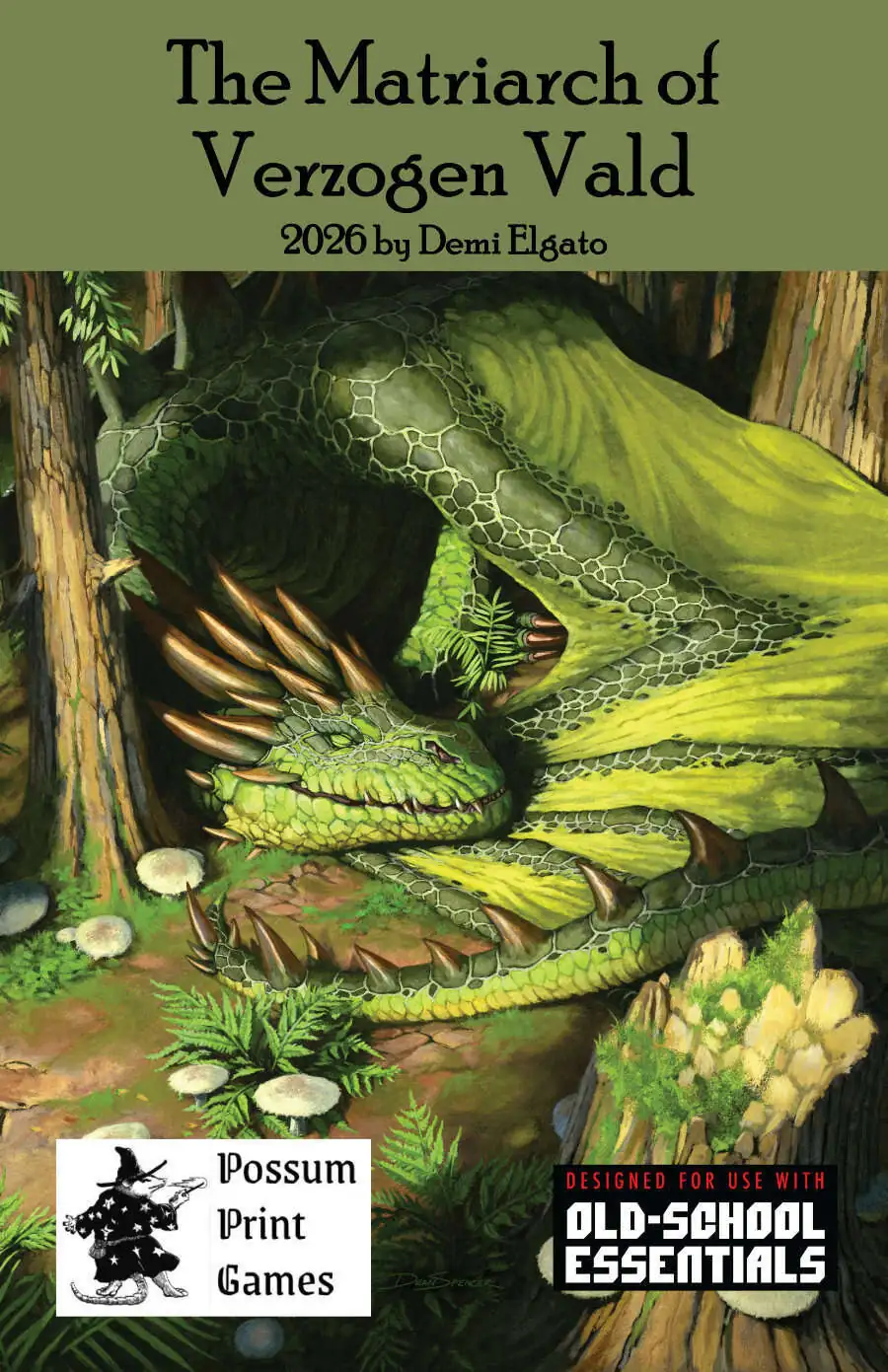
The Matriarch of Verzogen Vald
By Demi ElGato
Possum Print Games
OSE
Levels 3-6
Possum Print Games
OSE
Levels 3-6
Verzogen Vald is a twisted forest surrounded by impassable, jagged peaks. Folk that go in almost never come back out. One man has, but in his two weeks in those woods, he looks to have aged decades. His memory is not completely reliable, and his fellow lumberjacks think him insane. Though, they are disconcerted by his unnaturally fast aging, and his stories of what lurks in those woods. Every two hours, the great Green Dragon, Viridis, flies over the Vald, her domain. This is enough to keep all but the most foolish wanderers away. One of the most foolish, the heir apparent to the throne, 12 year old Prince Lukas, delved into those woods one week ago, alone. The King has posted a standing reward of 5,000gp for any brave enough to retrieve him. So far, none have been that brave…or that desperate.
This twelve page adventure uses five pages to describe ten point crawl locations in a fanciful forest. It seems a little pointless, the combination of fetch quests with a dragon at the end. But, if you’re ok with that, then fight on, it’s not bad except for the lack of adventure.
“Too Much stabbin!” or “Not enough stabbin!” Stabbing is a means to end, the ultimate way to get the treasure and remove obstacles when all else fails, or you just feel like today. A typical adventure needs a good balance. Situations and all types of conflict vs the expediency of a good stabbin. You can stab all adventure, with a good sneak in and magical plot to get in deeper and tactical assault/lair raid. You can do no stabbin with some situations good enough with nuance to for the party to work their way around … and stab their way out of. But, generally, you gotta think the whole thing through, as a designer, and work out a way for things to include the potential for stabbin and not stabbin.
This adventure don’t do that, mostly. You see from the intro that the kings kid is missing. In to the forest you go, to look for him and get the reward, while avoiding the dragon that flies overhead every two hours. Unlike Gon FIshin’, there is no stream of do gooders out for a reward; it’s just you in the forest. Not the best set up, but, we’ll forget that for the sake of expediency, while wishin for some Fishin.
Most of the adventure has you visiting points in the forest with someone who wants something and has something. The vampire (yes, vampire) has wine and wants a goat. The goatherd has a goat but wants a lot of gold and/or some nearby bears killed. The kobolds want to be vassals of the dragon again and.or some silks. They all wants something and have something. Mixed in an occasional combat like an undead dude or two and some plants, that’s about it. So, you gonna run around and give the blue key to Bob who will give you a Red key to give to Sally and so on. It’s all a little too set. Combine that with the lack of specific numbers of kobolds, etc in the adventure and its clear you’re supposed to talk to people and do some horse tradin. No stabin. Except when explicitly told you can stab, like the rando undead or plants.
Reaching the last point, the dragons lair, this all comes to a head. The dragon wants followers. Like the kobolds. The dragon has a lot of gold. And the kings son, the prince. Critically, if you get the dragon what it wants it will let you leave, but not the prince. There IS no solution here, ultimately, for the dragon and prince, except stabbin. Everything else you do accomplished nothing. Oh, sure, if the elves teach the cavemen to sing then tey will teach you to read some glyphs which will help the wizard trying to decrypt some glyphs which will cause him to toss you a gem of seeing. But that didn’t help kill the dragon. It is an adventure in two parts. Wander around the woods performing fetch quests and then stab a dragon. The two are essentially unrelated. This irks me. The kabuki.
There’s another mechanism at play here that mixes in. Every two hours the party will age ninety days. It takes, essentially, one hour to cross a tiles borders. This means that if you go straight to the dragon and stab it then you age six months, based on the initial map. But that’s not going to happen, right? The party is going to fuck around with the side quests. And then, also, the map shifts every two hours, like a maze. So you’re gonna have to figure that out, perhaps with some clues from the adventure. Figuratively, and perhaps literally, a waster of time. There is a clue, up front, that the forest ages you, but the maze situation, as well as the social commentary on the ultimate futility of the struggles of life, well, that one you entirely.
The maze, fetch quests, dragon, and aging don’t mesh well together, I don’t think. Other than the assisination, though, the play is fine. A barbed wire fence, that you can catch tetanus from! I love scary real world shit tossed in a game. Dragonpos can go fuck itself but TETNUS resonates, yeah? And, frankly, a lot of the fetch quest shit is not bad. Maybe a little simplistic and lacking, ahum, alternate solutions, but it IS there, if a little overt for my tastes. Telegraphed, I guess. The fanciful nature of them is a little off, in my opinion. A vampire that wears a sun hat out. A kobold that speaks seven languages in a kobold village that sounds more like a halfling village. A wizard who teleports in and out of the forrest every hour, but can’t do a comprehend languages. It’s just straining thinsg a bit too much. I hate to bring up comparison adventures, but THAT OTHER ONE had a somewhat fanciful nature as well. But it was clear there was some farce. And it was grounded. People were idiots. The fanciful stuff seemed to mesh well in tha the elements it used did no seem random.
I don’t know. I guess this one is ok. I mean, I hate a lot about it, but, at least you can comprehend what is going on and follow along and there IS something to do. Hmmm, I guess I mean there are situations here, even if I do think they are simplistic, and that helps a lot.
Sucker! Ain’t no stats for the dragon! Ha! Got ya!
This is Pay What You Want at DriveThru with a suggested price of $3.33. There’s no fucking preview. Put in a fucking preview that shows us some of the content before we have to spend money on the thing!
https://www.drivethrurpg.com/en/product/581381/the-matriarch-of-verzogen-vald?1892600
Categories: Tabletop Gaming Blogs
De Camp's Pusadian Cycle

Lately, I've been furthering my exploration of L. Sprague de Camp's fantasy work, with the Novarian stories, but I've also dipped into some of his earlier Pusadian series. It has sort of a similar relationship to the Howard's Hyborian Age stories that de Camp's Krishna novels have to Burroughsian Sword & Planet. That is, it's an attempt to do the same thing more "realistically" or at least in a concerted and methodological sort of way. For instance, de Camp uses current (to the 1950s) understanding of geologic change to inform his design of his landforms, and more rigorously derives his imagined countries and their names from Greek myth (mostly).
Whether any of that is necessary, every reader will have to decide for themselves, but I appreciate the thought behind it, at least. As I've said before, I find de Camp a very Gygaxian writer, though this is perhaps less true of the Pusadian series than the Novarian one. Still, the humor, and the pragmatic, if not venal characters are there. I also appreciate the less "standard fantasy" sort of setting. It's mostly a Bronze Age level of technology, with iron being the bane of magic.
I discovered that a number of the older Pusadian stories published in the pulps are available on the Internet Archive:
"The Eye of Tandyla" (1951)
"The Owl and the Ape" (1951)
"The Stronger Spell" (1953)
"The Hungry Hercynian" (1953)
"Ka the Appalling" (1958)
Categories: Comic Book Blogs, Tabletop Gaming Blogs
Video of the Day – WhoCulture, 2026
The post Video of the Day – WhoCulture, 2026 appeared first on Blogtor Who.
Categories: Doctor Who Feeds
The Princess Lies Story Game
THE PRINCESS LIES

Setup: You and at least 2 other players who have seen the movie The Princess Bride get 5 six-sided dice each. Each of you writes at least 2 agendas (goals) on note cards. The agendas should be in conflict with the goals of characters from the movie. For example, you might write “Vizzini secretly loves Buttercup and wants to get her away so he can marry her himself.”
The film’s framing device of the grandpa and kid are not included in game play, with one exception (described below). So your agendas cannot include them.
Shuffle all the agenda cards and place the stack upside down. Each player then draws 1 card. This is your narrative agenda. Outside it, you can guide the story however you wish, keeping to the movie’s story if you prefer.
Keep your agenda entirely secret! Lie to conceal it, if you must.
Play: Someone starts by describing a scene. It doesn't have to be in the movie... it can be a scene that was implied but not shown, or one that you invented that fits into the story.
For example, you say the story begins with child Wesley arriving at the Farm as an orphan. The first thing they ask him to do is muck the stalls in the barn. When he enters the barn, he sees Buttercup playing. She says something smarmy like "You're supposed to be working."
At this point, your narration ends. You set up the scene and introduced a conflict. But you cannot be the one to narrate the outcome. Another player must step up and decide what happens next.
If more than one player wants the honor, they roll 1d6 each and whoever rolls highest wins that honor. If a player strongly wants to do it, they can gamble dice from their pool of 5d6, rolling as many of them as they wish until they run out of dice or win the roll. These gambled dice rolls are added to the original total, not counted as separate attempts.
You never recover spent dice. Once you roll them, they are gone. Regardless of an empty pool, everyone gets to roll at least 1d6 when they want to compete for narrative control. The only player excluded from competition for narrative control is the one who setup the conflict. Once a different conflict is introduced, the original player can rejoin play - even if it is technically the same scene.
When you have narrative control, you can describe the outcome of a conflict and/or change scenes. If you change scenes without resolving the conflict, someone can interject in a high pitched, worried voice with “But what happens to [fill in name of character]?” When this happens, another roll-off is initiated.
Goal: Your goal is to weave and guide the narrative to achieve the agenda written on your card. If your agenda is satisfactorily completed and the game is still going, draw another agenda. If that agenda no longer makes sense due to events that have already been described (example: "make sure Inigo fails to get revenge"... but Inigo has somehow already died), then draw another card.
The game ends when a player has no agenda and the agenda bank is empty. That player then narrates the final scene. The end.
If you really want, you can count how many agendas each player achieved and whoever has the most is the best Princess Liar.
Notes: Obviously you can play this game with another movie or story. You could do Supernatural, Lord of the Rings, Buffy, War and Peace, or whatever you want. But the whole group has to be familiar with it and agree on it.
This was just a silly idea that hit me at work Friday. I'm open to questions or suggestions, but I doubt I'll do much more with it other than maybe putting it into a PDF.
Categories: Tabletop Gaming Blogs
[BLOG] News on the March! Episode XVII
This post continues the series of brief play reports I have been posting on Discord. This does not cover every single session (sometimes, recon and setup is what happens), but it covers our ongoing games.
The Subterranean Preserve
30/05/2026
FOMALHAUT

News from Fomalhaut! Seeking further answers below the city of Diomira, the company descended to the underground tunnels, and sought out the pit where they discovered two hoverpods, one operational. Entering the vessel, Pausanias, the man of Mung, worked the controls, and sent the metallic sphere sinking. Deep they went even below the underground city, into the darkness, but then it was light again, and bright daylight streaming through the orb’s single porthole. They descended from the ceiling of a massive cavern some 8 miles across, green forests, rivers, and a clear lake a mile and a half below them. In the centre stood a massive white crystal prism, some 3000’ high, radiating bright light all around. The hoverpod descended to an overgrown landing field on the western edge of the woods, disturbing a flock of large flightless birds.
They disembarked, and the forward team went off to explore. In two nearby buildings, they found only parts of old mosaics depicting elegantly attired men and women hunting various beasts – birds, great lizards, large piglike grey things with a horn on the forehead – with strange spears and bows. Climbing on higher ground to the south, they made a survey of the daylit cavern: some massive reptilian beast in the lake, and two cave entrances, one close to the tarmac. This they visited, and met a group of hunters here: five in simpler clothing, and a fighting-man in clean white plate mail, carrying a magical sword. Miru Vyltt, as he called himself, was amazed by the visitors from the sky, for he has heard of cavern worlds above this, but thought them long depopulated. Him and the others were exiles from a place called Grandiose Shield, and now living in a smaller, poor village named Redoubt. He spoke of northern caverns called Nightside, in perpetual gloom, and a land of waters where lived the Thundering Mountain, he who is called Godzylly. They parted amicably, and the expedition continued.
They travelled to the other cavern, an elegant marble entrance leading to a great hall. Oddly symbolic alabaster statues stood by the walls, and steps rose to a pool of silver-light, which spoke to Lilith: “BY WHOSE COMMAND SHALL I CARRY THOSE WHO STEP WITHIN MY CIRCUMFERENCE?” Questioning it suggested the transportation it offered was one-way, so they chose not to experiment. They headed to the southern side of the clear lake, where stood odd, abandoned buildings in conical, spherical, and hemispherical shapes, long emptied of all of interest. Following the river to the south, they met a hunting party coming from Redoubt, and joining them, followed to a tiny, poor village on a plateau, among older megalithic structures. The leader, Lycan Darl, and his companions treated them graciously but warily, particularly as Lilith and her amazons reminded them of Lady Yvin Lar of Grandiose Shield and her fighting-woman followers – the citadel was amazon-ruled, and the exile wore heavily on Redoubt’s mostly male inhabitants. They were hard pressed by the beasts and the monsters of Nightside, raiding by night: the non-men and even worse things, although the great purple worms did not come over at last. There lived also Ysfaud the Sorcerer, in a flying citadel, who worked various tricks and sought to enlist Redoubt in his schemes. Lycan Darl suggested a venture which would be of much help in hunting and scouting: Grandiose Shield held an operational hoverpod on top of one of its towers, easily stolen from before the amazons’ eyes.
Giving a noncommittal answer, they slept, and the next day, continued their expeditions. They inspected a mysterious monolith with saurian bones trapped in its translucence, and unreadable magical glyphs on its surface. Then, through a windy gap, they travelled east to a cavern even greater. Opposite, on plateaus sticking to cliffs, was a small marble temple, identified as belonging to a goddess abandoned by the people of these lands. They visited the site in an overgrown garden grazed on by seven enormous dinosaurs. It was clean but stripped of all valuables, including the cavity of the altar, and many small gems removed from the gown of its beautiful goddess. A crystal surrounded by a starburst was the only symbol, and clearly, this was not Ishtar: but they could not identify her.
From here, they journeyed across forests rich in game and fowl, to a small arena where stood two large statues of stern fighting-women. And beyond rose Grandiose Shield: white stone towers and cupolas, reinforced with connecting walls. The plateau was cultivated land, and the amazon sentries, seeing the approach of Lilith and her entourage, let them inside, through streets and plazas opening to workshops and gathering-places (all the inhabitants armed, although the men more lightly), to an assembly hall. Here stood two women from the citadel’s leadership: the Lady Yvin Lar, troubled but gracious; and one of her helpers, Dyastis Vyltt, tough and severe. As the company spoke of their origins and presented their mission – finding the masked Uttermost Masters – the amazons did not recognise them, but noted that two groups were known to be masked here: the non-men, living on Nightside, and raiding in the dark to kidnap and kill; and the agents and spies of Ysfaud the Sorcerer, whose schemes seemed to concern everything, including this citadel. They were, in turn, most curious to hear of Ishtar, a fighting goddess: they had once worshipped one whose main concern was beauty, but mostly abandoned her as she could offer no good help in fighting the encroaching dangers of this cavern world (although they still sought her for gifts of beauty, which she was known to grant).
Of the exiles, she noted that they abandoned the common good and joint decision-making of Grandiose Shield, striving to follow their own caprices – justly punished by their exile to the harsh wilderness and their village of hovels. (Dyastis Viltt suggested harsher means might have been in order, but deferred to Lady Yvin’s judgement.) After the audience, they were escorted to clean and comfortable quarters. The next morning, there was a knock on the door, and they were sought by two young men, Uljen Dyst and Amynax Ast. These two, and some others, were seeking a way out of the stifling rules of their society, and asked to be permitted to leave with the company when it came to that. Lilith slyly mentioned the flying sphere as the means of transfer, and they all saw Amynax Ast’s gaze stray to the top of the nearby tower: the spherical metallic cupola was no cupola at all, but another hoverpod – and seemingly unguarded in its tethers. Considering the possibilities, they made a noncommittal answer, and prepared for the day’s expedition – towards the monster-haunted, unlit caverns of Nightside!
A Bad Night for Chuck
04/06/2026
FOMALHAUT

News from Fomalhaut! Two adventurers, Brad’Och, a Fighter-Cleric of Dornak, and The Hound, a Fighter-Thief; as well as their six hired men descended into the Vaults of the Stone Men, a repository of strange, wondrous and dangerous things beneath the city of Pentastadion. On moonless nights, living statues walk the deserted streets of Hightown, and behind one’s place, a secret entrance is revealed. Following the advice of the magic-user Ctesiphon to retrieve a magical orb, they descended rubble-strewn stairs (the remnants of broken statues), and opened a heavy stone door to a gallery surrounding a bottomless pit. They were swarmed by flying eyes shooting magical rays, a battle which went quite badly for the group, who were weakened in the fight – and also discovered they had only brought 4 hours’ worth of lamp oil and nothing else. Looting the mouldering bodies of earlier adventures of some coin, they studied the inscriptions above further doors, when one opened and out came 4 crude living statues, killing Orastes the hoplite (Fighter 3). The most fruitful way to defeat the guardians was to lasso them and drag them into the bottomless pit, losing their rope.
Investigating this room, they found broken glassware and a floating, rotating six-sided pyramid over a pedestal, which almost hypnotised Brad’Och, after which they chose to retreat. Westwards, they entered into a larger chamber with a pulsing sphere of light which pulled light and matter towards it, and they skirted the room’s edges. To the south was a chamber with many more of the crude stone statues, for now motionless. To its west, they found a throne room with frescoes of beast-headed men burning down a city and bringing bowls of weaponry towards the throne. They could make little sense of the place, so they turned their attention north of the light chamber.
Here was another vault filled with statues, and a secret nook with broken law tablets. The next room was a steep stairway. Frescoes depicted blue-robed skeletal pilgrims climbing towards an icy summit. On a landing was a great bowl of electrum coins and a golden helmet, and at the end of the stairs, an enthroned stone colossus looking down on them, with a stone rooster by its side. They quickly noted a portcullis trap midway up the stairs too. Through a western door, they found a chamber with two exits. One broke the Hound’s lockpicks, and proved henceforth unopenable (to their great misfortune, as this was where Ctesiphon’s magic orb was to be found), and the other led to another bottomless pit gallery with mounds of earth and glowing mushrooms – not to their liking.
Returning to the stairway, two of them held up their shields, and the Hound and Raon the hoplite tried to steal the bowl of coins. The stone rooster screeched and attacked, blowing a gust of flame and striking with a petrifying beak (but to no luck). They dashed the bowl’s coins through the portcullis, where it was quickly collected, while the two at the front clambered through a gap over it, fending off the rooster’s attacks. They fled back to the light sphere chamber. Investigating the southern chamber of stone statues, they ran into two which were animated. Brad’Och (Fighter 3/Cleric 2) tried a trick to help his companions retreat, but was cornered by the statues and crushed like a rag doll. The survivors fled west, into a northwards corridor. In niches stood bloated brazen idols with terrible insect heads and mantis claws.
One claw was triggered as a trap, but it struck badly, and was bent out of alignment. Climbing behind the idol, a backplate was found, but the treasure was gone – as it was for the others. But there was a secret door to the west. Opening it up, they came to the edge of another bottomless pit, with cobwebs on the ceiling, and two bloated, sea-green spiders lit by an inner amber phosphorescence quietly stalking towards them on the ceiling. They fought bravely, but this fight with the weavers in the vault proved most unfortunate. Alcaios the hoplite (Fighter 3), Thorog Shul the barbarian (Fighter 2), Raon the bowman (Fighter 2) and the Hound (Fighter/Thief 2/3) himself all succumbed to deadly poison. The two victors stood bloody and weakened: Dio the hoplite (Fighter 3) and Tier the peltast (Fighter 2), both their masters dead or dying. But they found a cocoon on the ceiling, and splitting it open, found a corpse with more coins, as well as a filigreed opium pipe. And there were only two of them for all the treasure. Seizing all the coins they could carry with difficulty, by the last light of their diminishing lantern, they made for the exit and the lower streets of Pentastadion, richer in both coin and experience. Neither would return to the Vault of the Stone Men, which kept its secrets and treasures as it had over the centuries.
(“Even Chuck Norris had bad luck – once.”)
The Cultists of the Seal
06/07/2026 FOMALHAUT
News from Fomalhaut! Glory and death in the wastes of the Batrakasz, in the accursed city of Vermath, destroyed for its ancient blasphemies! Recovering from the previous adventure, the company once again sailed up the Xemartes, spying riders watching them from the wastelands, and deciding to take an alternate approach into the ruins under the cover of the night. This they did, but by the ancient city walls, Gendarme, Purple Rien’s elite bodyguard, fell under the sway of a malign influence, and he stumbled as if sleepwalking, repeating ”I am a servant of the Seal... I am a servant of the Seal...”
Snatching his weapons, they decided to follow where he went. Gendarme headed for the centre of the accursed place, where rose a strange flat-topped pyramid, older even than ruined Vermath. Up spiralling stairs he proceeded, until they were on the top under a canopy of stars. A large broken dais bore the sign of the Seal with the crescent moon superimposed on a hand. Gendarme suddenly lunged for a companion’s weapons, and had to be subdued to prevent him from offering himself in sacrifice. They felt a Presence here, and Ozmund, Cleric of Yol decided to step on the dais to read the stars. He was almost seized himself by another will, but he persevered, and he heard a voice speaking in his head! It was Pnakosek, the ancient high priest of the city, impressed by his strength. He invited them to his burial chamber underneath, promising the great powers of the stars. They descended to the ground, but found no entrance here – could the pyramid reach deeper, and could its foundations have been buried by time? Now that it was dawn, they headed for the city’s agora, and a building there whose stone gates bore the Seal, and which was magically locked the last time. With a knockspell, they gained entrance, and descended by spiral stairs to the underground passages.
They were in a large hall dominated by a badly defaced statue of a priest, and many more in bas-relief. As they were investigating, crossbow bolts came from hidden arrow slits, to which Purple Rien responded with a fireball that killed the nomad guards positioned in a secret chamber. They despoiled a smaller shrine nearby, then explored to the east through a network of catacombs. Using their mapping skills, they pinpointed the location of a secret entrance, leading into a small tomb. Frescoes of war and burning cities were still vivid on the walls, showing a fearsome warrior with a whip and mace in the slaughter. A slab in the ground bore the man’s image also, and cracking the resin around it, his apparition rose in varicoloured smoke. Diogenes the Thief quickly lifted an amulet of the Seal they had taken on their previous expedition, and commanded him to obey. Seeing them as fellow Servants, the spectre was friendlier; and agreed to let the visitors take his weapons, including a magical mace, into „new battles of conquest”.
They proceeded through the catacombs, emerging in the great, dry cistern. Agreeing that they were still fresh and in large numbers, they decided it was time to descend deeper and bring the battle to the Servants of the Seal. Retracing their way to a set of wide descending stairs, they triggered a tripwire trap that ran a great gong below – but they pressed on, meeting the screaming fanatics, their lieutenants, and their war dogs in battle. Only one was spared, a warrior named Bernax. Him, they interrogated about the whereabouts of the high priestess Velasca. The fellow agreed to lead them, although he was much afraid of her fiery eyes, which could burn a man to ashes with a glance. Of the pyramid, he knew little: Velasca and the high priest, Kushamesh had visited it, but alone. The man led them west, along a passage lined with the frescoes of penitents, and the statues of robed magi, their faces destroyed and their hands broken off. They walked by a decaying balustrade over a yawning great cavern, spanned by a stone bridge. But they continued, and through a tomb and a room with a tepid pool, they arrived at a chamber, bronze doors guarded by two well-armed guards.
They decided to try and lure out the priestess with a trick, and the guards entered in seeming agreement, losing them their element of surprise. Clamour rose beyond, and it was clear the cultists inside were readying themselves for battle. They decided to rush in and fight, Bloody Tusk leading the assault. They entered a makeshift dormitory in some abandoned hall; robed men drawing scimitars from below their robes, and more noises coming from doorways leading to a torchlit columned hall. The battle was furious, and the characters were trapped in a vise from both sides by armed fanatics, magi, and the lieutenants of the Seal. They could stand this onslaught, and a fireball and a wand of lightning did good work, but as they pressed inwards, they were confronted by the furious Velasca, stepping from behind a row of columns. Wearing very little beyond a very revealing outfit and a necklace of fiery rubies around her ample bosoms, the temptress’s eyes burned with terrible fire, and Ozmund fell on the ground, almost dead, while her personal guards rushed in to slay the others. Here, Mirnex the bowman (Fighter 2) was beheaded by a cultist; Claudius (Fighter 3) was slain by an elite guard, and Yusuf (Thief 5) was almost burned to ashes by Velasca’s gaze. But it was Purple Rien’s other bodyguard, Ronald, who proved his doom, slaying the unconscious thief under Velasca’s hypnotic gaze, and who was then himself slain by Bloody Tusk!
Still, the tide was turned, and Velasca fled through a secret passage under the effects of poison (at 1 Hp no less!), leaving her men to die. But Diogenes and Bloody Tusk’s Amazon companion, Iphigenia followed her relentlessly through dark corridors, and before she could turn back and destroy them, Diogenes sent a lightning arc from his electrum sceptre and ended her evil life. The Servants of the Seal slain to the last or fleeing where they could, they took Velasca’s head and jewellery, and ransacked her sumptuous quarters, freeing Zarrono the thief (a replacement PC), who had enjoyed her „hospitality” in her gem-encrusted bed. They found much gold, and documents detailing the gathering of the Servants, her pilgrimage to the city, ecstatic rites on top of the pyramid, meeting the ancient high-priest Pnakosek, and odd references to the „Benevolent Teachers”, reposing in the darkness beneath! They used speak with dead to make Velasca’s head speak, and gained the secrets of a magical command word used to open certain portals in the undercity, but not the secrets to enter the pyramid. But this was good enough. Reducing Velasca’s bed by magic (I rolled for its value, and got an absurd sum), they transported it, and their other findings, back through the dark corridors, and into the ruined city. Down the wide Xemartes, they returned by barge to the city-state of Glourm to spend their wealth (the bed bought by none other than the wizard-tyrant Tyraxus Tharg, Purple Rien’s player’s old character from the original campaign!), recuperate, and plan their new expedition against the Servants of the Seal!

19/07/2026 ARDEN VUL
Death and miraculous escape in the depths of Arden Vul! Our company, descending to the crypt level, was teleported by a magical pyramid to another level, and unfortunately to a familiar area, which was ruled by dangerous and aggressive giant baboons. As low-level adventurers, we would have had little chance against them. The staircase that would lead to the exit was close, and yet so far away. However, lost in the labyrinth, we found a secret door and arrived at the Oracle of Thoth, where Johann, a follower of Thoth, risked his sanity to receive divine guidance. Even wise Thoth himself did not know of a way out that we could safely follow, only a side route that promised escape through secret passages, other levels, and great dangers. But at least there was hope, so we set off.
Almost running into the baboons, we opened the secret door revealed by the deity, through which we entered dusty connecting passages. Here came caves, then a grotto where we fought flying manta rays beside a sarcophagus. We reached the uppermost tract of the Great Chasm, which connects several levels of Arden Vul and plunges into the depths above an underground river (we had previously found other hidden passages and gone deeper, but even there we had not reached the roaring waters). A narrow bridge arched over the rift, and we reached another grotto, a crypt of the priesthood of Thoth. Here, death overtook my follower, Thaumas the halberdier, who fell to the venom of giant centipedes. But we found valuable treasures and magic items, and, more importantly, a holy symbol that would later be key to our escape.
Another secret exit led into cavernous passages, then into ornate halls, in which frescoes depicted Thoth’s heroes defeating the enemies of the faith – wizards, warriors, and giant frogs. Another secret door led to the god’s sanctuary, where two golems with gemstone eyes and ibis heads blocked our path, but they bowed to Thoth’s sign and let us go. Here was the spiral staircase the god had mentioned, leading down, where we found valuables next to the body of an adventurer, including a magical purse, which would later gain us a fortune. As the god had said, the stairs led to his “administrative chambers”, that is, to the level of the crypts from which our expedition had started! But we were still in uncharted territory, and we knew that the middle of the level was controlled by hobbit bandits who were collecting a heavy toll from the explorers of Arden Vul, with whom we were already on bad terms.
Hobbits, demons, elementals... and a band of plucky heroes!
In the passages
we plundered the tomb of a champion of Set, obtaining magical weapons and armour,
as well as the champion’s loot, the bones of a saint. We returned to the Great
Chasm, with hobbits camped on the other side, a statue of Thoth, and a
narrow bridge. We tricked the little freaks into believing that we were slinking
back into the passages, but we returned to the scene by a side passage,
covering our lights. We knew about the statues of Thoth, and that by moving their
jointed limbs, secret passages would be revealed. Perhaps a way out could be
reached this way? There was indeed a secret door, but from the other side a
terrible Ibis demon emerged, stunning the party and hobbits alike with
its screech. We made a desperate escape, dashing across the bridge, menaced by
the demon. Fortunately, the hobbit slingers also fell under its influence, and
could not fire upon our ranks. We ended up in a dusty and undisturbed room...
but it soon became clear why hobbits don’t come here. An air elemental (?)
emerged from the dust, attacking the company. We ran on, because the fight
proved hopeless, but the bold and reckless Devara (I think) snatched a
magical halberd from the wall, which became our valuable treasure.

Escaping from here, there was a one-way secret door, but beyond that, a real ray of hope: familiar rooms near a spiral staircase leading upwards! Returning to one of the entrance levels, we crossed over to the surface (again avoiding the giant snake lurking there), and entering the ruined city, we could make our way towards the Inn of the Broken Head – losing only one follower where we could all have easily perished! And we didn’t do badly: the magic purse alone brought us 30,000 gp in the town of Gosterwick, and we also gained other treasures and good magic tools.
I’m now starting to get a deeper appreciation for the Anabasis.
Exiled to Fomalhaut
27/07/2026 EMERALD
SEAS

News from the Seas of Fomalhaut! Feted in the city of Thisium, and exiled to another world by the jealous gods for the crime of saving it, a group of adventurers found themselves on an island coast, under a foreign sun. Nearby, another group was clambering out of the broken wreckage of a large glass sphere, transported here from distant lands. Banding together, these survivors sought shelter and an indication of their whereabouts. They were on the bottom of a wide flowering valley, and up there were the ruins of a megalithic settlement, apparently uninhabited. To the north and south lay mountains, and they headed N to climb the tallest peak they saw. Through an oak forest, they climbed to a ridge, where a paved stone path led to the wind-caressed summit. Flowers grew around an old altar, and a dazzling panorama opened around them: wine-dark seas below, a distant shore to the NE, and a mountainous isle around them. Two landmarks stood out: a crater on a nearby mountaintop, and a distant tower to the SW. The altar bore the symbol of a disk with swirling protrusion, identified as a possible symbol of Derceto, and left well alone.
They descended to the abandoned village, where they made camp and shared sparse rations. The next day, they got to exploring. Up the valley was an old, walled orchard, where they picked abundant fruit; and a ruined little shrine with no symbol to identify it. Eriberto Barrella heard something skittering inside, and by the webs, suspected spiders. As the interior was empty save for a defaced altar and a looted treasure-pit, and Ser Narvi’s magic sword indicated no treasure, they did not search further. They travelled west through a pass, overlooking another valley. Forests of oak covered its terrain; they could make out the tower across, a vineyard with a tiny hut, a star-shaped mound in the middle of the woods, a grassy northern mountain valley with small mounds northwards, and to the south, an inhabited little settlement with a port!
They decided the small hut in the vineyard was less risky than the settlement, and headed across the woods to reach it. The grapes were badly tended and overgrown; a decrepit old man snored in drunken stupor by the entrance, cradling an empty jug. They roused him, and he introduced himself as Proxenos, who has been tending these vines for most of his life. They were on The Isle of the Intangibility, just southwest of the town of fair Thellas, and far northeast of Arthedon. The little settlement was new, and Proxenos did not much like its rich inhabitants, who chased him off and did not buy his wine. As for the tower, it was now inhabited by a hydra (the drunk vintner’s account was not completely reliable about its number of heads). He also told of graves in the northern valley, and this became the company’s target. The burial mounds bore memorial columns and the names of heroes; wild sheep grazed on the slopes. They made their way to a set of double stone doors in the mountainside, bearing letters: “ADRASTUS OF ARTHEDON: BY HIS HAND, EVIL WAS UNDONE”. The doors were heavy, but Giacomo and Clotilde, who had both won 18 STR in their adventures around Thisium, threw it open. They found the tomb of a hero; Brunello seized a magic sword that unsuccessfully tried to control him, and the rest carried off electrum, gold, and gemstones from brass cauldrons.
The Tower of the Labrys
(artwork by Dreadlord)
Fighting off
three mountain lions trying to attack from an ambush, they headed for the tower
they had spied from the pass. It was a round megalithic structure, bearing the
sign of the labrys above its open gate. Large tracks and scattered bones
indicated the presence of the hydra mentioned by Proxenos. The beast was devouring
its prey inside, and a stratagem was hatched. The thieves carefully climbed up
on the sides, and occupied firing positions on the top, while the rest
approached carefully. Out came the lumbering hydra, its nine heads sitting on long,
slender necks. It charged through a web spell, and would have mauled
Giacomo if not for rolling 1+1+1 on a damage roll of 3d6! But surrounded from
all sides, it was defeated, although Rembault the hoplite was only saved
by his shield, and others by magical shields also. The tower held no apparent
treasure, but Ser Narvi’s sword indicated a hoard down below. Clearing away
bones and rubble, they discovered a stone plug, and pivoting it outwards, a
hole leading to the top of a domed chamber in the tower’s foundations. Dhazmadar
the Dastard slid down boldly on a rope, and lit a torch. Behind a locked
portcullis was a short passage, then a small chamber where glittered sizeable
brass amphoras, a large gold plate, and piles of silver ingots. He called to
his companions and set to work on the lock. Something clicked in that cursed
mechanism, and counterweights creaked in the wall. A massive stone piston
slammed down, inflicting a possibly mortal wound on the thief, and sealing the
treasure-chamber with its tremendous mass. The victors of the battle considered
their next move in the ruined Tower of the Labrys...


28/07/2026 EMERALD SEAS
News from the Seas of Fomalhaut! Banished by the vengeful gods into a strange world, Aufidia Corvina and her bodyguard Dorvo found themselves on a wooded island shore. A minute later, they saw another group appear out of thin air: a group of adventurers caught while trying to plunder the villa of Flandor the Glyphic, and banished here as a form of punishment. With united forces, the adventurers explored the nearby shores, and discovered a wrecked fishing boat, seagulls feasting on its rotting catch. There were no people here, but they found a pair of sandaled tracks climbing to the wooded plateau on the northern end of the island. They followed them. To the south rose mountains too hard to climb, and nearby were cliffs with several birds’ nests. Egeria used her speak with animals spell to seek information from a songbird, who reported that beyond the mountains was a valley where lived many „big eats”, no friends to the birds. A nearby building was inhabited by a man who was no bird-friend either, and the same man also lived inside the valley, but there, he was friendlier (these, they took for twins or clones). With this knowledge, they headed for a thin plume of smoke in the centre of the plateau. They discovered a conical hut inhabited by a wretched castaway, Crabmeat, complaining of getting stranded from a ship. There were bad signs around this man: a symbol on the cottage lintel was suspiciously similar to that of Shakkur, God of Beggars, and something about his demeanour was quite off-putting. Nevertheless, they learned of a village to the south, and after resting the night, set out to learn more of this island.
On the western shores, they fought off two mountain lions, but found no path up to the mountaintops – although they spotted strange geometric structures on a tall peak. By noon, they reached a wooded plateau at the island’s southern tip. In a large clearing, they came across a pack of wild dogs around four circular pits. Half the animals were slept and half fled from their presence. The pits were deep, constructed from a dull, grey seamless stone, partially filled with rainwater, and overgrown with vegetation. „Fishing” with two coils of rope and a stone with a light revealed two pits to have carnivorous vines of some sort, and tossing in sleeping dogs confirmed the suspicion. For now, they left the place well alone. To the north, in a saddle among the mountains, they spotted what they sought: a village of crude stone huts. They marched up, and were greeted by a group of frightened villagers, who suspected pirates or slavers. These simpletons no longer went to hunt and gather food in their valley, as a year before, its patron deity, the God of Red Effigies disappeared, and strange things started appearing down there: weird red trees, and things that took those going down there. The company offered to investigate in exchange for food and shelter, and the yokels almost kissed their feet in gratitude.
There was time for a short foray that day, and they descended towards a group of red trees. They were red-leafed and spongy-trunked, with twisting roots: clearly alien in their looks. Among the trees were wailing and moaning sounds, and they saw light phenomena – fractures of space, and some great lumbering beast prowling at some distance. They crossed the area to a graven monolith. A kaleidoscopic stampede of alien animals rushed towards them out of thin air, and they stood their ground to what they believed an illusion. Alas, the things were real, or nearly so, and Skiluros the hoplite and Hara Kusunhr, Champion of Jeng were trod underfoot, never to rise again. The stone bore an inscription commemorating a beast-slaying hero, Pintias. Investigating the nearby ground, they found a patch of loose ground, and digging, a large, carved stone leg of red stone buried in the ground! On the way back to the village, Aufidia peered into the weird fractures of light, and seemed to glimpse elsewhere, a savannah of strange lights and unknown vegetation.
Among the villagers, they feasted and slept, and the next day, summoned their foreman to ask of the stone leg. The man seemed guilty as hell, dissembling and repeating only that the god disappeared from his shrine a year ago, before the strange events started. Now they grew suspicious. Examining the stone limb, it seemed relatively recently buried, and its colour was similar in colour to the patches of red trees in the valley. They descended anew, avoiding the woods, and heading for a white limestone pyramid. Peering inside through a portico entrance, they spotted a group of 8 hovering, fungus-like creatures prodding around with weird metal objects in their appendages – as they were not noticed, they withdrew quietly. They continued to a large metal gate standing near another patch of red forest. Through it, they saw a barren landscape of shar light and shadow pockmarked with craters and boulders. Shaggy grey vegetation grew on top of the horizontal beam, which Dorvo prodded with his fiery sword; it in turn moved, unfurling into a massive, flapping fungal creature with long masses of filaments. In this battle, Kron the Hard was grabbed and drained of his bodily fluids, which healed the terrible fungal thing. At last, it was defeated with concerted effort; and the survivors carried the body of their fallen comrade back to the primitive village. In two days, the valley has claimed three victims. The adventurers considered their next course of action...
An Expedition to Nightside
02/08/2026
FOMALHAUT

News from Fomalhaut! Far beneath Diomira, in the giant cavern system lit by pillars of artificial light, the company enjoyed the hospitality of the amazons of Grandiose Shield. They were summoned by one of the citadel’s military commanders, Orlane Damas, who would speak to them at a private audience. She shared that Lady Yvin Lar’s younger sister, Auwyn Lar, had led a force of amazons into the lightless caverns of Nightside, and never returned. Orlane told them Lady Yvin was privately very worried, but had to forbid a followup expedition to preserve Grandiose Shield’s strength, and out of her sense of duty – but they could be of help in finding her, alive or dead.
Thus they set out from the citadel, travelling across plains and woods to the massive gap that led to Nightside’s barren expanses. Fungus forests grew in this realm, and nameless, formless creatures skittered about. They headed westwards, eventually coming to a place with hundreds upon hundreds of statues, depicting humans but odd in their appearance. All were of white, crystal-veined marble, looking NE. Some looked intriguing, and Murat the Etunian approached one with a conical body and tapering head. As he did so, 12 more of the same statue appeared all around the company, as unmoving as before. Creeped out, they departed quickly, and followed the way the silent sentinels were looking. After more travel, they came to one of the grand pillars of light seen in these caverns, but the crystal and metal structure was dead and lightless. They went west and rested (although there was neither day nor night), avoiding eating the nearby mushrooms.
The next day, they continued, and found a marble pavilion, the nearby fungi patches hiding decaying corpses – some of weird, pale, sickly-looking men, one of a dark-clad fellow in a fancy hat, and others with flabby, doughlike bodies and weird stumpy legs. In the pavilion stood a golden statue with two faces on its head, set with four red ruby eyes. Upon approach, it let loose arrows at an incredible rate; they rushed in and destroyed it, only protected somewhat by their good armour. They took magical arrows, and some equipment from the dark-clad man’s corpse. West of this site, they came across a river which disappeared into yet deeper Underworlds. North they continued. The earth shook; there were tremors, and a massive purple worm emerged from the ground as they ran towards a patch of fungus forest, disregarded by the tremendous creature. Now they followed upstream, steering clear of the worm’s suspected domain. Beyond a fork in the river rose a crude ring of 50’ monoliths engraved with whorl-patterns of astounding, fractal-like complexity. Approaching, they spotted a stone altar too, and observed a group of the weird, flabby creatures coming from another side, bearing baskets of roots and stoneware jars of paste. Unnoticed, they watched them conduct some sort of ritual and depart, but finding nothing to do here, left on their way as well. To the west, they saw the illumination of Lightside, and headed that way, camping by night on the boundary of the two domains. From the shore of a clear lake, they heard roaring sounds, splashing, and saw flashes of light – but they were unbothered. The next day, they ventured a bit inwards, encountering a hunting party of amazons from Grandiose Shield, who had lost half their number to the flabby creatures whose corpses they saw. After exchanging news, they returned to Nightside. They trekked east now, across a land of rivers and fungus forests, lucky with the random encounters.
The fungi grew sparse, and they were on barren open plains. Far away, they spotted something: a citadel floating 600’ above the surface, its bold towers lit here and there by lights above its complicated parapets. Underneath, a garden of unknown leafy plants covered the land. The garden was a place of winding paths, short stairways, fountains, and sundials standing in this place without light. Enigmatic statues with the bodies of birds and the faces of men watched them without speech or movement – Bocephus detected them as magical. As they found no way of reaching the flying citadel, they decided to circumnavigate the general area. As they did so, winged beings descended from the parapets, circling above them at distance, and returning to their roosts. Something else approached – a hoverpod, this one of transparent crystal, bearing two figures! One was an elegantly dressed man, the other a white-armoured amazon – Ysfaud the Sorcerer and Auwyn Lar!
Ysfaud spoke to them in a sonorous, amplified voice from above, and welcomed them to his lightless lands – he knew they were from beyond the sky, and even Diomira, and he knew their names and of their coming through his channels, but not their purpose. Now they spoke of the conflict outside, and the plans of the Uttermost Masters to subjugate the surface cities. Ysfaud was visibly surprised by their mention. He had met them previously, not on entirely friendly terms, and had knowledge of them and where they resided – potentially very valuable information to the company! It turned out Ysfaud also had something he was seeking. He explained how, although he was the master of Nightside, he was trying to figure out a way to turn back on the pillars of light in his domain. While his knowledge seemed incomplete, he explained the pillars were connected by some sort of waves, unlike those of the sea, or that other sea beyond the skies of the surface world, but the unseen forces of the Underearth. There could be some way of linking back the dead pillars to the lit ones through tripod-like amplification devices. However, these were kept by the obstinate amazons of Grandiose Shield, who did not treat with one whom they deeply distrusted.
Ion suggested a stable future alliance might eventually emerge if Nightside was lit up. Here, Auwyn Lar could play a key role by convincing her sister and the war council that they could gain security as well. Lady Auwyn, previously quiet, agreed to write a letter and send her gem helmet as further proof of her identity, but warned that some around Yvin Lar were sure to reject any offer, while her sister was duty-bound to Grandiose Shield and consumed by pride. She herself only came to trust Ysfaud after her war party was massacred by the flabby creatures, and the sorcerer eventually rescued her with his hoverpod. This was not going to be easy. Still, they accepted this basic plan. Ysfaud and Lady Auwyn boarded their hoverpod, which rose towards the flying citadel, settling on the top of its tallest tower.
Embarking on the journey back towards Lightside and Grandiose Shield, the company discussed the implications. Ysfaud knew much, but it seemed his control of Nightside was far not as firm as it might be thought. The amazons would probably believe something was off – and was it? Was Lady Auwyn charmed? There were no obvious signs, but it could not be ruled out. Or did the sorcerer plan the ambush on her amazons, and mount a rescue precisely to gain her hand as his queen? Would the amazons really reject an opportunity to bring light to Nightside? However, one thing was clear: Ysfaud’s information seemed well worth it, and their primary loyalties were to the city-state of Pentastadion, and the security of the coastal cities!
The Pleasure Resort
03/08/2026 EMERALD
SEAS

News from Emerald Seas! In the Tower of the Labrys, the slayers of the hydra looked glumly upon the badly wounded Dhazmadar the Dastard, and the massive stone block that had sealed off the treasure chamber. The thief needed healing. They took him down to Proxenos’s cottage, where he hung between life and death during the night. The next day, seeing no other way, they chose to head for the small settlement they saw from higher ground. On the way through the woods, they visited a star-shaped mound they also saw from afar. It was overgrown with vivid flowers, and topped by an eroded stone patterned with several small interlocking circles. They continued east, emerging on the boundaries of a neat little colony where liveried servants were busying themselves around recently built houses.
Hoplites stopped them to inquire of their purpose, but they were convinced of good intentions, and as they sought a healer, they were escorted to Uzalton, a severe, tall man skilled in such arts. Dhazmadar survived the surgery he had to undergo, and did not even require anything more than a few hours of rest. Now, with wine from Terlank and fine food, they were introduced to the colony’s other masters, potentates enjoying the reclusive pleasures of their own retirement community. Here was Androtion of Akrasia, a gruff magnate who had just sold his shipping business (and gave them startup advice to invest in a penteconter and get hustling – they could retire like him in 10-15 years!); Lorkhan Varx, a suave fellow temporarily retired from business „but still in the business”; and Hethak of Propyla, the inheritor of a grain fortune, a regular Adonis playing a begemmed harp in the company of four tanned beauties. As for Uzalthon, he suggested that if Dhazmadar wanted to thank him, he could do so in the town of Thellas by retrieving an enchanted mask once owned by Ouvoreon the Sensualist, whose walled-up palace stood there still.
To begin their business career as Androtion suggested, they advanced a proposal to hire some of the servants and borrow tools (abundant from when the colony was constructed) to dig up the star-shaped mound. Lorkhan Varx, driving an expert bargain, agreed on terms of 2 gp per worker per day, and 15% of treasure if any were found. The work crew set out at once through the woods, excited about the possibilities. At the mound, Ser Narvi produced his sword and to the others’ astonishment, surveyed the mound for treasure, detecting none in range. Nevertheless, the crew started digging, while half the party snuck off „for some wine”, but secretly stealing mattocks and picks to head for the Tower of the Labrys. The rest of the crew worked into the evening, and finally hit a wall – there was something under the flowering earth mound! The other crew climbed up to the tower, shooing off some pterodactyls feasting on the hydra’s corpse. All but Eriberto descended, getting to work on the stone slab. Eriberto, trying to keep the pterodactyls at bay, hurled them some meat, but the evil things saw him a better morsel, and chased the old nobleman, who, wounded, had to flee to safety with his boots of speed. They worked late into the night, and broke the stone. Now able to access the tower’s treasure chamber, they found amphoras overflowing with gold; amphoras, jewels, 100 silver ingots (very heavy), and a magic ring. Content, they went to sleep among their hard-won treasures.
At the mound, after the night, the other crew broke through the wall, and Maglor cast light through the opening. There was something horrible in that well-buried chamber, a dark, tentacled monstrosity with a great maw that came charging, battering down the wall with its sheer bulk. The workers fled in panic. The partial company met the horror in battle, and slew it with some difficulty. The way in was now open. There was no treasure in there, only a dais bearing the tentacled disk seen on the altar on the mountaintop, and ancient glyphs: „THE GREAT MOTHER BURIED HER CHILDREN. IN HER GREAT VAULT THEY HAUNT STILL”. This came with interesting implications. Was another such horror buried beneath the weird red tree they saw on the mountain slopes? A dungeon beneath the place? They found nothing more here.
However, they had the workers’ discarded tools, and now they took wheelbarrows and burlap sacks to plunder the tower treasury at leisure. They brought brass amphoras with much gold down the mountainside, and buried it at the edge of the forest where the tomb treasure was hidden previously. The silver ingots, a more modest find, they took back to the hedonists’ colony in triumph, earning much fame and praise (indeed, the impressed beauties around Hethak immediately swarmed the newly arrived fighting-men), and netting the magnates a small bonus and a tale worth telling. Conferring with Uzalthon, they came to the conclusion the site was sacred to Derceto, the Dark Mother, dweller of deep underearths. This caused some disquiet among the rich residents, and except from Hethak, they got cold feet about further exploration, fearing something worse might be disturbed. But the adventurers were thinking of something else. In a few days, a supply ship would come to the colony, and they would sail with it and some of their loose funds, to buy their penteconter in the town of Thellas!
The Mysterious Valley
03/08/2026 EMERALD
SEAS

News from Emerald Seas! Heading back from the valley to the primitive ridge village, reality fractured before the adventurers, and disoriented people appeared – new companions who joineds them at once. „They have changed in the valley”, the superstitious villagers muttered as they saw them return with these unknown people, and without those slain. From the village, they climbed to a nearby peak, where they investigated a dolmen graven with constellations, and saw a panorama of the nearby islands. Large pteranodons were also spotted on a roost on the valley’s eastern cliffs, safely distant. Now they descended to the valley, and headed to the lunar gate where they fought the weird fungal creature. They entered the nearby patch of red forest. Reality was crisscrossed by fault lines, and space divided into pools of intense light and deep shadow. They found a large, gnarled red tree, and seeking among its roots, dug up a red stone leg, buried in disturbed ground. This they took with them. Back in the normal oak forest, they encountered 5 weird plant creatures, peering at them with several googly eyes from clusters of tendrils. They were not hostile, and they withdrew without issue. Returning to the village and hiding the leg from the locals, they spent the afternoon building rafts for their eventual visit to the lake.
The next day, they embarked on another foray. They were barely back in the valley when they met four weird creatures, tall humanoid moths clad in leather harness and brandishing exotic halberds. Communicating with gestures, the adventurers indicated peaceful intent, and so did the mothmen. The sides parleyed as the mothmen inched closer, then sprung to attack, shaking their winds of choking dust to immobilise much of the company. A sleep spell took care of two, and two more were killed in melee. They took their weird halberds and other odd items – bags of yellow-green crumbles and tiny brass tubes.
They made a return visit to the white pyramid in the valley centre. The floating fungus creatures exploring it were gone, leaving no trace of their visitation. The place was an auditorium, and checking the flagstones, Aufidia found loose ones, beneath which was buried treasure with gold plates, a gold-headed mace, and a block of meteorite iron, known to be useful in manufacturing magic armour and weapons. Beyond the pyramid, the old road led to an area paved with limestone blocks, demarcated by broken columns, which Aufidia believed to be a forum. There were slight tricks of light in the air, but hardly visible in intense sunlight – perhaps better for a night outing. They proceeded along the road, passing a bronze statue, then halting on the precipice of a deep chasm. The gloomy pit dropped 180’; 120’ down, a solid stone bridge crossed it between two large tunnel entrances. Ezor the Eel rappelled down, and saw that the SE one had collapsed, while the other was blocked by a pair of massive metal portals that looked immovable. He returned to his companions. Investigating a cave to the NW, they found a looted tomb with animal bones, but not more. From here, they proceeded to the northern parts of the valley. One section to the west was heavily overgrown with a mixture of the red trees and some sort of purple, clublike growths, which also clustered in a group of their own. Leaving them well alone, they headed for the eastern patch of red trees, where they had seen ruins.
In these woods, the red trees followed their movements with peering, sinister eyes, and as Dorvo waved, he heard an ominous voice in his head: „Do not interfere. You saw nothing.” Here was also one of the giant trees, but they checked the ruins first. The walls were overgrown and dilapidated, but this seemed a shrine indeed. A central chamber had an altar, an empty dais where a large statue might have sat, and walls marred by ugly graffiti depicting a rag-wrapped hand – the sign of Shakkur! The theories started to develop. Perhaps the statue would need to be reconstructed on the dais, and perhaps it was broken apart by the villagers, who were given evil advice by the hermit they had met. For now, they returned to the forest with watching trees, and dug up the roots of the largest, finding a torso and a crude, ugly head. These they hid in the ruins.
It was dusk, and they followed the road back towards the forum where there had only been figments of light before. Now there were 22 apparitions there, men and women clad in elegant if old-fashioned garb, engaged in silent debate they could not understand. The warrior Delo Phazerus stepped forward, introducing himself, and the apparitions looked back at him. Finally, one of the women stepped forward, and spoke in a sonorous voice they could hear clearly: “The God of Red Effigies, the God that shall be after us, rules the island still in your time, though he is not one, nor does he sit in his shrine, as he will after us.” Then the transparent shapes from beyond time were gone, and there was only the silence of the moonlit agora and the whispering trees. The adventurers headed back along the path, and through woods into the primitive village.
The Riders of Doom
09/08/2026
FOMALHAUT

News from Fomalhaut! Glory and death in the wastes of the Batrakasz, in the accursed city of Vermath, destroyed for its ancient blasphemies! After previous victories, 4 adventurers and 8 followers boarded Bargemaster Mulk’s vessel to sail up the Xemartes. Three days they travelled, and at night, they sailed by the ruins to lay anchor near a ford. Sneaking into the city under cover of darkness, they were beset by shadows, which left some in the company drained. Nevertheless, they descended underground, and chose to descend to the lowest level to seek the sword of Prince Philosir, lost in a lightless lake. They followed known stairs, dispatching random encounters, and on the middle level, they crossed a stone bridge above a yawning dark cavern. Shadowy priests and a spectral figure appeared to demand a token of their faith; producing an amulet of the Seal pacified them, and they passed. Beyond a sequence of meditation chambers, stairs led up to abandoned passages; some connected back to know parts, and some led to a maze of rooms, and the lair of a hermit who sought holy inspiration in this place of evil. Taking some advice, they decided not to investigate these areas further, but return to a known stairway down to the lowest level. The way led to the bottom of the cavern, and before something surprising: a smaller replica of the pyramid in the middle of the ruined city, but built of white alabaster, stairs spiralling up to its flat top. Climbing it, an invisible force attacked, hurling some off the sides, but producing an amulet and speaking the word of command learned from the high priestess’s shade let them pass. On the top, an altar was found before a bas-relief of the Seal. Ozmund sacrificed some incense, and a Presence tried to possess him, but he fought it off. Now the darkness and roof of the cavern parted before his mind, letting him view a myriad stars as if in divination: and he asked for a sign leading to Philosir’s sword. The insight pointed southeast, and there they proceeded.
The eastern end of the cavern was carved into a massive columned entrance, bas-reliefs of warriors shown sacking cities under a comet on its friezes. They entered into a great, empty hall, where stairs led up to a throne room, the desiccated husk of a cultist enthroned in the seat. Carelessly, they did not notice the fuliginous black thing lurking above them, which stunned some with a resonant moan, and tried to paralyse and dissolve others with its cilia. Putting it down, they examined the throne more closely, finding a catch to lower it to an under-chamber. This was a looted treasury. Everything was gone, except pieces of scrap armour, two stone warriors, and an empty pedestal. Yet detect magic found a snake-haired woman’s stone head, and this they carefully bagged.
From the throne room, they now went south, entering a natural cavern filled with fungi. A dark, placid lake had a small isle with a pyramidion rising in its middle, and a 15’ bronze hoplite standing before as its guardian. This was the place indicated by their treasure map! In a side-cavern, they had to fight a giant slug, which almost dissolved Ozmund with acidic spittle, and nearly crushed Bloody Tusk’s companions. The coast clear, they used detect magic to seek for the blade. There was magic down the pool, but not even a light spell could let them see anything. Iphigenia the Amazon agreed to swim down. She felt around on the bottom, seizing STRIKER, Philosir’s previously invisible sword, which burned with magical light and possessed her. She swam up, but by then, the bronze hoplite animated, wading ashore while blasting its opponents with magic rays. Fortunately, its attacks were poor rolls, and it was destroyed. Iphigenia emerged with the sword, commanding the company to obey her. A hold person held her fast, and they removed the chaotic sword from her hand, for now wrapping it in cloth. They turned to the pyramidion; a knockspell opened its secret door. The interior was the grave of an armoured warrior and a storehouse of treasure. Removing the warrior’s plate, the shade of Prince Philosir rose, pronouncing a terrible curse on Diogenes the Thief to be pursued by enemies.
They pressed on westwards from the caves, through stairs and passages, to a water channel from a waterfall. Diogenes was almost swept off, but he was saved with rope. Further on, they entered a large columned hall. Enormous, muscular marble torsos stood in deep water. Diogenes dived with the help of Purple Rien’s levitate spell. He saw the dark shape of a 8-headed hydra swimming up towards him, which surprised the unlucky thief and tore him limb from limb. Low on resources, they retreated to the throne room’s treasury to rest. Renewed, they returned to the hydra, which they lured to shore with a light spell, and then killed in combat. Diogenes’s henchman, Diomedes, who had decided to carry STRIKER, sought to impress by diving into the water after the sinking corpse, and hurling the blade into the beast’s heart, as the blade had spoken to him. The sword turned into a lightning bolt, which caught the submerged thief in a deadly electric discharge, then turned back into a sword and sunk to the very bottom, temporarily depleted of magic. The survivors retrieved what treasures there were in the pool – STRIKER, Diogenes’s kit, a magical horn, a medallion, a suit of plate, and a massive golden sun mask of incredible value. These treasures were good enough to return to town with. On the way back, they fought a weird mist monster, fireballed fanatics, but returned to the ruins without much trouble. They travelled to the ford to rendezvous with Bargemaster Mulk’s crew. They found the ship on shore, its men massacred, the bottom hacked with axes.
They began the arduous trip back home through the wastelands, but the boatmens’ slayers were there waiting. The RIDERS OF DOOM galloped across the plain with 80 nomad riders, led by the great warrior Almorik Tharg in dark plate and a horned helmet, and the Evil High Priest Kushamesh behind him. A lightning bolt fried some warriors, while their crossbow bolts did miraculously little damage. Even so, the company would have been surrounded and massacred. In a desperate bid, Bloody Tusk raised the unknown magic horn and blew. Waves blasted the front ranks of the charging horsemen, throwing mounts under each other, and blew Kushames’s head right off! A terrible melee ensued where no quarter was asked and none given. Almorik Tharg was caught by Ozmund’s hold person, fell from his horse, and was trampled underfoot. Abdul the Faceless was ridden down in the charge, while the horn blasted another column. Octavio and Horatio, veteran bowmen, were hacked down by the fury of the nomad warriors. And fair Iphigenia, Bloody Tusk’s fighting companion on so many adventures from mighty Velkos Vel to the City of the Ape-Men, was beheaded, and the barbarian took terrible revenge on her slayer. To the last, the 82 men were slain, but of the group that once numbered 12, only five now lived. They buried their own dead, building a pyre for fair Iphigenia. They took the 16 surviving horses, and rode back towards Glourm. In the wastes, they were attacked by a terrible chimera, whose breath killed Lightning the war dog, who had survived so many delves. The four survivors rode on. At night, they camped, but Bloody Tusk heard flapping wings and clucking noises at night – a group of 6 cockatrices! Leaving the horses to their fate, they quietly escaped with four mounts. Bloodied, dusty, and much decimated, they rode the whole day, until in triumph, they rode through the gates of the city of Glourm to sell their loot and be wreathed in immortal glory!
Thellas
10/08/2026 EMERALD SEAS
News from Emerald Seas! From the Isle of Intangibility, a group of adventures sailed to the city-state of Thellas on board a merchant ship. They disembarked along the long waterfront of an antique, elegant town of ancient beauty but crumbling appearance. They headed to Mighty Ellag’s Tavern, a port eatery, where they bought a round for all, and inquired about where they might buy a ship. The closest they heard was Macarias, a local shipping magnate; and they also heard some rumours – of precious musical instruments kept in Thellas’s Symposion, and the Palace of the Eternal Autocrat, found in the archipelago, from where adventurers have brough back a rich bounty. Meanwhile, the party’s thieves decided to follow a rich foreigner and his two elegantly dressed daughters through the streets, and to the agora, where a blind poet was reciting The Lay of the Nikareids, a classical epic. They made a large circle in the evening streets, observing a wealthy palace, but also buildings that looked ramshackle, and had their windows and doorways walled up. They also found a large building with no windows at all, immured portico entrances, and glass domes high up on its flat rooftop. Porters passing by indicated this was no place to bother, and they returned to their companions to have a night’s sleep.
The next day, they noticed a commotion in the harbour. One of the elegant pleasure barges, belonging to Phartasmos a venerable old man from Pentastadion, was stolen in the night, and his secretary was raising hell with the guards. After talking with the irate secretary, they visited Macarias in his warehouse. He was a jovial fellow, happy to have heard of his old business partner Androthion of Akrasia, and would help arrange the purchase of a penteconter from Eranthos the Archaist, one of the local notabilties. He was incensed by the ship theft – not local work by his estimate – and offered to waive his intermediary fee for finding the stolen vessel. They visited the port’s harbourmaster (while Giacomo was called from a high window by two beautiful women calling themselves the captives of one Meles the Mummifier). Harbourmaster Chilon proved a friendly and sharp old man. Apparently, the ship had sailed out in the darkest night, without lanterns. It was not a very fast craft, and might still be found if it was hidden on the island. He indicated three possible hiding places along the shores, and the company set out at once to the eastern one.
Beyond cart roads and a small village, they entered rough terrain, and came to windy cliffs with narrow bays. Stairs led down to a boulder with old writing, deciphered as commemorating “the Lost God Neusthyas”, and something about his funeral. A cave entrance led inside, and they descended to a grotto with large, suffering stone faces. The faces turned to be meat-hungry giant brutes embedded in the walls, emerging as flesh and blood creatures. They were fought in the tunnel, and as one was slain, they got all cowardly, babbling that they were innocent, and didn’t eat the dead god, or if they did, only a bite. They gave up a cauldron of gold, and were chased back to their rest. This was not the ship, though, and they quickly retraced their route to the island’s southwestern shores. In an oak forest, they discovered a campsite where a ship had been dragged ashore and then put back on water; but the ashes were cold, and there were no other signs. It was already dusk as they returned to Thellas to hire a ship for the third locale. They found the Cuttlefish, a swift, shifty merchant ship which Hormouz the Thief recognised as colleagues of a sort. The captain, Darak Shul, quickly understood what they were seeking, and offered to join the hunt for a cut or (on a failure) a modest excursion fee. But this excursion was in vain too, and they found no trace of the missing ship in the night. The trail was cold – but new plans were emerging for their next foray…
Categories: Tabletop Gaming Blogs
Video of the Day – SYFY, 2017
The post Video of the Day – SYFY, 2017 appeared first on Blogtor Who.
Categories: Doctor Who Feeds
Why is the Ogre there?
Joe's post on the Quantum Ogre raises an old question about sandbox play: when does moving an encounter around interfere with players' freedom to decide what their characters do?

Where I disagree is that players' choices matter. It doesn't matter to me whether they made an informed choice or the choice resulted from blind chance. What matters is the consequences of that choice.
Suppose there is a fork in the road. They know nothing about either path. They choose the left fork. Joe argues that if they know nothing about either path, then putting a prepared encounter, like an ogre, on either road doesn't cost them anything.
For me, the question is different.
Why is the ogre there?
To answer that, I look at how I described the setting and the campaign's current circumstances. But another factor is particularly relevant in Joe's post. Whether anything was prepared at all; thus, both roads could represent a blank slate.
Part of my Bag of Stuff consists of prepared encounters that aren't tied to a particular region or location. So how is using something from my Bag of Stuff any different from what Joe is doing by placing the ogre encounter regardless of which fork is taken?
The difference is that Joe's procedure allows the ogre to be placed on whichever road the players choose because nothing distinguished the roads beforehand. What I do instead is look at what I know about each road, make a short list of what could be there, and roll to see if the result is an ogre on the list, since the chosen road runs through some hills. Then I will use that ogre encounter in my Bag of Stuff.
I do this to discipline myself so that I always follow through on the consequences of the players' choice instead of changing the circumstances because I have something prepared that would be convenient to use. To be clear, rather than treating the "blank slate" as permission to use something I prepared, I treat it as an uncertain part of my setting that I need to resolve during the session.
That said, I like and agree with quite a bit of Joe's post.
There is a section where he had a goblin cave prepared. The goblins were causing trouble for some local halflings, but the players opted to deal with some orcs instead. As the campaign progressed, Joe adjudicated that the halflings took care of the goblins themselves.
Joethelawyer, Quantum Ogre
Another variation on this I’ve experienced as a GM is where the encounter is more than just a basic bullshit ogre on the road or goblin ambush. For example, I made up a large cave complex where a clan of goblins lived, and they were raiding the halfling lands around. The PC’s had a choice to go there, or to orc caves, or a couple more places. They went to the orc caves, kicked their asses. Through roleplaying later, the halfling village they saved said they’d take care of the goblins, thanks for the help.In my view, this represents World In Motion, an aspect of a Living World Sandbox. That is, as players make their choices and act accordingly, the other inhabitants aren't standing still but making decisions themselves. In this case, to finally deal with those pesky goblins once and for all.
As for the prep, it went back into his Bag of Stuff and was repurposed later with different inhabitants and circumstances, which is exactly what the Bag of Stuff is for.
The goblin caves went unused. It would be a bullshit move as a GM to have the PC’s encounter the goblin caves in the next encounter. But there’s nothing wrong with using it in the future. I reskinned it a bit, added a two-headed troll, and used it as an encounter with a different group. I could have used it with the same group once enough time had passed, and it was in a different place.
If you are interested in my ideas behind my Living World Sandbox. I have a blog post below summarizing what that type of sandbox campaign entails.
And I collected all my posts on Sandbox Campaigns on this page.
Categories: Tabletop Gaming Blogs
Doctor Who: A New Era Begins in 2028
The Doctor Who tender process moves forward, with the BBC sharing details of the brief for the 2028 relaunch
After months of anxiety among fans, a path for the future of Doctor Who is emerging as the BBC officially begins the tender process. As Blogtor reported at the time, they originally announced their plans back in June. They’ve now completed putting together the tender document, which officially invites production companies to submit their bids for making the show.
This new development isn’t really much of a surprise. While fans with longer memories may recall the early 1990s when vague platitudes about ‘exploring options’ for the show’s future were cover for a lack of will to bring it back at all, that was never going to be the case today. The tender process is now standard across the whole of the BBC. For example, Casualty and Strictly Come Dancing are also among the flagship programs to go through it. Certainly, the BBC would never have jeopardised their future relationships with other production companies, by leading them to invest money in early plans to bid for a tender that was never coming.
The cancelling of the 2026 Christmas Special may have seemed alarming. In reality, it was effectively to allow the tender process to kick off now. And, therefore, to get Doctor Who back on screens full time as soon as possible.
The new production team will be announced in March, immediately starting work on new specials and episodes for 2028/2029
The timeline the tender document lays out is as expected too, based on how long it took other shows to go through the process. Doctor Who’s new team will be announced in March 2027. They’ll immediately be working to having the show back on screens in the financial year 2028/2029. That’s a faster turnaround than the two previous times the show’s production effectively started from scratch. Work on both 2005’s Series One and 2022’s 60th Anniversary specials began two years in advance. However, the nature of the tender process itself means that the winning bidders will already have laid substantial groundwork ahead of March 2027.
By then, prospective producers will have broad plot outlines of their ideal season. This include possible episodes, and character guides for their new Doctor, companions, and any supporting cast. While not an absolute requirement, the winners will likely also have lead actors and writers already ‘attached’ to their plans. (‘Attached’ being the vague state where typically discussions have confirmed an actor’s interest in a role, and their position as the producers’ first choice, without them being officially under contract.)
Similarly, the winning bid will also have proposals in place for a production base, studio, and so on. It’s highly likely to also include details of how they’re sourcing crew, what FX houses are on standby to provide visuals and more. All in all, the winners will hit the ground running as soon as they receive the green light.
Doctor Who filming has become a regular sight on the streets of Cardiff since 2004 (c) BBC Studios Doctor Who will remain a production supporting the UK industry in the regions, but a move from Wales isn’t entirely ruled out

One of the detailed requirements in the document is that Doctor Who should remain a regional production. The BBC have a clear preference for it remaining in Wales, but are open to the possibility of using it as a hub for investment and industry growth in other regions.
Another detail worth noting is that the initial contract is for one season, and associated specials, with an option for the BBC to renew for one more. Further seasons after that will see the contracts renegotiated. It’s worth bearing in mind that the multi-season renewals given to Doctor Who over the years have always been the exception to the rule. So while fans might have welcomed the security of a longer deal, this is the treatment most shows get.
A number of production companies and potential showrunners have already expressed interest in bidding for Doctor Who. However, the tender requirements seem to rule two of them out immediately. Applicants must have experience of British television, having produced at least one television show in the UK that lasted at least three seasons, with seasons of at least six episodes each. Although prominent figures in international genre movies and television, neither Dean Devlin’s Electric Entertainment (The Librarians, Leverage) or J Michael Straczynski’s Studio JMS (Sense8) have that track record in the UK.
The two eligible production companies to go public with their ambitions so far are BBC Studios and World Productions
The two remaining companies to go public with an interest are BBC Studios and World Productions.
BBC Studios’ experience of making shows for the BBC goes without saying, and their presence in the process is basically a guarantee that Doctor Who will continue regardless of the other submissions. World is a British company perhaps currently most famous for their collaborations with Jed Medcurio, creator of Line of Duty, one of the BBC’s biggest rating hits of the past decade. With over 35 years of experience, they’ve been responsible for series like 90s vampire thriller Ultraviolet, which launched Idris Elba’s career, political dramedy Party Animals, which launched Matt Smith’s, political thriller Bodyguard, and international murder mystery Vigil.
World also very much tick the box for regional productions. Notably, they’re currently filming a seventh season of Line of Duty in its regular production home of Northern Ireland. At this stage Belfast is as familiar as Cardiff with being transformed into English cities (though if it does become home to Doctor Who, Blogtor expects the odd Translink bus to sneak into the background.) They’ve also produced three seasons of Vigil in Scotland, with the most recent run transforming the University of Stirling campus into an Arctic research base.
SNL’s George Fouracres is likely just the first of many names to be linked to the role in the media over the coming months For obvious reasons, production companies vying the the job are unlikely to share their plans until the decision is final

However, there’s no reason to think other production companies haven’t simply been working quietly away on their pitches less publicly. Blogtor Who will keep you updated as we hear more, but it’s actually possible the final winning tender next March will be a total surprise.
Indeed, fans should be aware that during this delicate phase, competitors will want to keep details of their plans under wraps. So nobody should be too alarmed by long periods of radio silence on Doctor Who between now and March. On the other hand, of course, some bidders may try and build momentum and public enthusiasm for their big by discreetly leaking things like which actors they’ve been talking to. Even if they don’t, the British tabloids will likely leap on every possible connection, so brace yourself for some wild speculation in the coming months. Recent talk of Saturday Night Live’s George Fouracres is almost certainly just the beginning of a rumour mill that will spin freely from the sublime to the ridiculous.
The new era represents the biggest reinvention of the show since 2005, but some elements will remain firmly the same
What can we say the new era of Doctor Who will be like, based on the tender document? Well it will involve a season of episodes and at least one special, to be broadcast sometime between April 2028 and March 2029. There’s nothing more specific about timing than that, but it wouldn’t be surprising if the new era launches with a 2028 Christmas Special before a full season in early Spring 2029. There’s a strong implication that there must be at least six episodes in the season, but that doesn’t mean contenders won’t pitch for a longer run. The BBC are open to pitches for both runs of individual, standalone episodes or one serialised story across the season.
There will be the Doctor and at least one, possibly more, companions. As in the past few decades, the companion will be the “access point for audiences.” This doesn’t mean that they have to be a human from contemporary Earth, but it seems likely we’ll still have to wait for the next robot dog, alien, or astrophysicist from the future. Another way the next generation of companion will keep to recent precedent is in being definitely a co-lead of the show. They will be “distinctive, authentic characters in their own right, whose lives, relationships, ambitions, and personal journeys enrich the series”
The TARDIS is returning, with a mission to be “relevant, surprising,brave, and inspiring” (c) BBC Studios The new version of the show will feature a mix of high concept science fiction, emotion, and behind the sofa scares for a family audience

The new Doctor Who will strike a balance between keeping the familiar concept and tone, and not just being more of the same. There’s disappointment for anyone hoping for a shift to a more ‘adult’ show, and the new era will still target a broad family audience. Individual stories will continue, too, to focus on human emotion amid the alien invasions, and celebrate traditional Doctor Who values like intelligence and compassion.
In places the tender invitation still sounds striking similar to Russell T Davies’ own proposal document back in 2003. The new description reads:
“Stories should balance high concept science fiction with strong emotional narratives, ensuring that spectacle is always grounded in character and human experience. Episodes should transport audiences to extraordinary times and places, ranging from historical settings to distant futures, alien worlds, and contemporary Earth. Successful pitches will deliver ‘back of the sofa’ scares, jeopardy and tension, whilst remaining suitable for a broad family audience. Doctor Who embraces themes that celebrate curiosity, courage, intelligence, and compassion, themes that interrogate the human condition.”
Against that, pitches are also “an exciting opportunity to innovate and surprise,” while offering “a new perspective that ensures Doctor Who remains relevant, surprising, brave and inspiring for both long-standing fans and new audiences.”
In short, the BBC want a mix of horror, character drama, high concept science fiction, and inspiring values comparable to that of the Davies, Moffat, and Chibnall eras. But they invite would be showrunners to deliver that in a new way the BBC themselves would never have thought of.
The process will move quickly, with the deadline for submissions on the 2nd of October, and more detailed proposals to be in by the 23rd
The next milestone in the rebirth of Doctor Who will be at 2pm on Friday the 2nd of October, a mere two weeks from now. That’s the deadline for any interested parties to submit their tender applications. A week later, on Friday the 9th of October, the BBC will notify all those who’ve met its eligibility requirements. Those candidates will then have just another two weeks to prepare their initial proposal of their vision for the show, with a deadline of 2pm the 23rd of October. (You can see why Blogtor Who suggested companies probably already started developing their ideas back in June, if not before).
That’s when the fun really begins as applicants begin working up their season plans in detail across November and December, ahead of parallel production meetings with the BBC in January, and a final decision on the winning bid in March.
Again, even as these milestones pass behind closed doors, expect very little information to reach the public domain. However, Blogtor Who will make sure to keep you up to date with all the news about this bold new future for Doctor Who, as we hear it.
In the meantime, you can read the invitation, and the entire tender document, for yourselves at the official BBC site here.
The post Doctor Who: A New Era Begins in 2028 appeared first on Blogtor Who.
Categories: Doctor Who Feeds
The Unleashing of St. Nimuanne
Lixu
Lixuni Gaming
OSE
Levels 1-6 (ha!)
Lixuni Gaming
OSE
Levels 1-6 (ha!)
Centuries ago, a mortal Myrenean queen named Nimuanne used forbidden rites at a sacred menhir field to transcend death, splitting her essence into three fragments upon her final death: Body, Mind, and Spirit. Grave robbers broke open the funerary urn containing these fragments, plunging the region into a desperate crisis.
This 79 page adventure presents four or five dungeons with ten to twenty locations each, plus a few small towns in a small region that is having some troubles. Its abstracted text seems out of place given the page count, with a lack of anything specific going on in the adventure.
Ok, so, I got some things to say. And this adventure probably doesn’t deserve to be the one I go off on. It’s not a disaster.
But, also, this sentence appears in the adventure: “That independence became its undoing: no walls, no militia, no warning before its own monks were the first to fall when the Mind Stone took root beneath them, spreading house to house until the entire town turned in what may have been a single night.” I have a blind spot when it comes to spotting AI. But, the triple negative is a a hallmark of AI. I’m not even going to mention the end of that sentence, just focusing on the triple negative. It stands out like a sore thumb. And it’s listed as human created with no AI. I’m no “AI is the bogeyman and everywhere!” kind of person, but this sticks out.
I think, though, what stood out the mot for me in this adventure was the page count vs the dungeon content. I’m not sure how to frame this so people will understand. The dungeons here are relatively small, ten to twenty rooms. The room descriptions are rather minimal, a sentence or two. “Cell 3. A single unlabeled potion of climbing, tucked behind a loose stone, easy to miss without a search.” Or, for a longer room “Storeroom. Broken crates, moldering sacks, the smell of old grain gone to rot. 2 Shambling Husks stir. Loot: a locked strongbox (30gp), and a scroll of protection from undead, wax seal still faintly intact.” Even that is pretty light. And there’s nothing wrong with that. But, that also means that the dungeon keys fit on a page or maybe a little more, for a ten room dungeon. And there are only, I don’t know, four or so dungeons in this? That’s only a small number of pages. But this is an eight page adventure. I have no idea, honestly, no idea, what those pages are being used for. Stat blocks at the end, tables at the end, maps, I guess. It’s just so offputting. To see a large page count and then see the size of the dungeons and the minimal room descriptions.
Because the rest of the content, those in between pages, are not exactly stellar. The local lord is having a dream about three locations. Go check em out and defeat the evil one. I know, I know, i’m hyperbolic, but this is almost the extent of what you get to help launch the adventure. Go ahead and get the party moving based on that. Because that’s about all you’re getting. Oh, there’s a fuck ton of explaining and backstory and so on, but I think thats being confused for gaeable content. The actually hooks in, the specificity, is not there at all. This is supposed to be a sandbox like thing. Do the three in any order and then end up at the final dungeon. But its all so very loose. Maybe, I mean abstracted. “Hey, there’s a ransacked village with some pod people in it. You need the party to en up at the local monastery.” Again, hyperbolic, but not by much. But, then, also, augment that with a whole lot of backstory that isn’t really relevant to the game at the table.
The emphasis here is on the wrong things. You can, as Stonhell demonstrated, get away with some minimal keying. But you do this by adding context and specificity around the general situation in the area. There are things going on, the place is alive, as noted in the general notes for the level/area. This allows for a rather shorter dungeon key entry. But, importantly, we cannot mistake historical background for “current situation.” Or even, the current situation for “this shit will impact game play.” If it’s not impacting game play then it’s just padding. A line or two od padding, thrown in here or there, might be fine. You can’t lose sight of the goal: supporting the game at the table. In looking at a page long NPC description, does it matter that dude grew up an orphan? Almost certainly not.
This misses the mark with nearly everything. Yes, it does have some interconnected dungeons that are coherent enough to run. But any specificity, in town, in the hook, in the wilderness, outside the dungeon, inside the dungeon, is essentially absent. Anything that could tie things together well and help the DM create the feelings of immersion that a ten session adventure would rely upon is not present.
Also, it’s mostly stabbin.
There is supposed to be a whole pod person thing going on in one area that can bleed over in to others. None of that comes through well. The interconnections and theming between the sites, doesn’t come across. And, finally, the last dungeon has three separate version, only one of which will be used. This would seem to be a waste.
It’s just weird, in the way it abstracted the content and yet is STILL quite lengthy.
This is $10 at DriveThru. The preview is fifteen pages. You’ll get some general overview, and none of the dungeons. That overview is, honesty, the most information you’re going to get about the hook and linking things together.
https://www.drivethrurpg.com/en/product/580488/the-unleashing-of-st-nimuanne?1892600
Categories: Tabletop Gaming Blogs
Video of the Day – Doctor Who: Highlights of Series 6, 2026
The post Video of the Day – Doctor Who: Highlights of Series 6, 2026 appeared first on Blogtor Who.
Categories: Doctor Who Feeds
Let's Do the GRIDSHOCK Again!

Paul Vermeren's game of futuristic, super-powered resistance fighters on the run is back in a new edition! The standalone game GRIDSHOCK ZERO, powered appropriately enough by Free League's Year Zero Engine is being crowdfunded now on Gamefound.

I've talked about my appreciation for GRIDSHOCK before. Paul has a familiar-but-fresh vision not really like anything else out there and he's assembled artists for this version (Simon Roy, Giannis Milonogiannis, and the returning Steven de Waele) to really give a great visual style.
I may even get a chance to pitch some adventure scenarios for it, so back it and stay tuned!
Categories: Comic Book Blogs, Tabletop Gaming Blogs
Video of the Day – BARK and Josh Horowitz, 2026
The post Video of the Day – BARK and Josh Horowitz, 2026 appeared first on Blogtor Who.
Categories: Doctor Who Feeds
REVIEW: Doctor Who: The Kaleidoscope
The Kaleidoscope is Jo Martin’s stunning debut novel, with the actor’s deep understanding of the Fugitive Doctor creating a compelling tale of memory and identity
Circuit Breaker is Doctor Who’s third epic cross-media event, following 2020’s Time Lord Victorious and 2023’s Doom’s Day. It was already head and shoulders above those efforts, but new full length novel The Kaleidoscope establishes it as one of the most compelling and significant Doctor Who stories of recent years. In many ways it calls to mind the old New Adventures credo. Like them it tells a story too deep and too broad for television. Time Lord Victorious’ concept of the Tenth Doctor going off the rails was enticing on the surface. But it could never really take that idea very far. Meanwhile, Doom’s Day asked for a lot of in investment in a brand new character. Both contained some great stories, but Circuit Breaker really shines in taking advantage of the Fugitive Doctor’s mystery and rougher edges.
Circuit Breaker is already the strongest of these events so far, and the new novel gives it true heart
The actual plot throughline of this arc has been looser than ever. All summer the Doctor’s been on a reverse scavenger hunt – returning items to their proper place in space and time. But that’s been the perfect way to give more breathing room to the storyline’s emotional core. The Kaleidoscope brings this to the forefront. Its novel format allows more access than ever to the Fugitive Doctor’s thoughts and feelings. Traditionally, few Doctor Who novels are told in the first person from the Doctor’s perspective, in order to help preserve their sense of unknowable mystery. But this Doctor is a mystery to herself, and more closed off than most to sharing with others. In addition, she’s an incarnation we barely spent any time with on screen, so she benefit from this chance to know her better.
The Kaleidoscope’s greatest asset in this is Jo Martin herself. The actor takes up the challenge of exploring her own character’s interior life with thoughtful precision and deep emotional intelligence. While this is her debut novel, Martin has written for stage and screen before and the result stands apart from other recent celebrity Doctor Who novels. It’s telling perhaps that the acknowledgements don’t suggest an established co-author. Instead, there’s merely thank to MG Harris and Steve Cole for editing and for providing details of Doctor Who lore. Meanwhile, the author’s notes make it clear that Martin has thought deeply about her version of the Time Lord. Far more than just tough and ruthless, this is the Doctor about as vulnerable and uncertain as we’ve ever seen them.
The Fugitive Doctor gains more depth and shades, as Jo Martin grants us a view behind the gruff exterior
The Fugitive Doctor series over at Big Finish tries its best to keep to Chris Chibnall’s suggestion of a vague placement for this incarnation. However, Martin herself obviously feels entitled to her own strong ideas about that. The result is the most satisfying and emotionally impactful story for her yet. It reframes the tale told in The Timeless Children, from one of a Division agent mind-wiped at retirement, to something more like Marvel’s Winter Soldier. A weapon to be reset and rebooted whenever, inevitably, she rebels again and again against their cruelty and cowardice.
This element skillfully unfolds from the Doctor’s initial boasting of her ‘Great Reserve’ – a Sherlockian mind palace of information and experience she doesn’t remember acquiring – to growing concern about why she doesn’t remember it. Why does she keep encountering people she’s never met but who definitely know her face? And why does she have such an instinctive affection for a second rate backwater planet like Earth anyway? These questions bring her from confidence through self-doubt, to ultimately a new determination to reclaim her own life.
In its closing chapters, The Kaleidoscope similarly redefines one of the most important relationships in the whole of Doctor Who. In doing so it also provides a compelling and heartbreaking new understanding of just why, as Amy Pond observed, the one thing the Doctor can’t do is leave a crying child.
Their quest takes the Doctor and Martha from London to modern Jamaica to a Jamaican space colony in the distant future, infused with Martin’s clear love for the island
All this character development for the Fugitive fits beautifully with the details of her and Martha’s latest mission. The supposed ‘kaleidoscope’ itself is actually an alien device for grounding memory at both at a cultural and personal level, designed to ensure a society never loses touch with its history. Appropriately, the main villains here to stop our heroes unlocking its secrets are the Silence. After all, another way to stop the Doctor ever speaking their name is to make sure they can’t remember it…
The Doctor’s personal journey and mission intersect in Jamaica. In the future, an isolationist colony world tries to hold a nostalgic notion of Old Earth Jamaica in amber forever. In the present, the Doctor and Martha travel to the real Jamaica and encounter a woman claiming to the Time Lord’s mother. Throughout both, Jo Martin’s love for her own parents’ homeland shines through. The novel is full of fond observations about the island’s people, language, and unique character. It’s this, as much as the author’s closeness to the role she played on television, that gives Kaleidoscope a sense of deep authenticity.
All the chapters in Circuit Breaker stand alone as well as being part of the wider arc, but if you only pick up one it should be The Kaleidoscope
The science behind the kaleidoscope may be questionable even by Doctor Who standards. Clues about a particular character, presumably to pay off in Circuit Breaker’s finale, may be laid on so thickly you could hang wallpaper with them. But this is a blisteringly good Doctor Who novel. It’s also an astonishing debut novel in its own right, if one likely to be overlooked by critics due to its TV tie-in nature.
Big Finish provide the climax of Circuit Breaker with next week’s Full Circuit. Yet The Kaleidoscope will likely prove to be its real heart. Even if you only pick up one entry in this year’s event, make it this one.
Doctor Who: The Kaleidoscope. Cover by Lee Binding (c) Penguin Books Doctor Who: The Kaleidoscope

When memories lie, the truth can be fatal.
In the aftermath of an improbable mission, the Fugitive Doctor and Martha realise that something is interfering with their minds. Something that doesn’t want to be found.
Their investigation leads to a curious artefact in the British Museum: an apparently medieval toy known as the Kaleidoscope. But the object refuses to stay in one place, one time – or one identity. And when the Doctor is repeatedly mistaken for someone she’s never met, fragments of unfamiliar memories begin to surface.
Across the Earth, a hidden pattern emerges; evidence of a secret that someone has gone to extraordinary lengths to conceal. As ancient enemies close in and innocent lives are put at risk, the Doctor learns the hard way that some truths were buried for a reason…
The Kaleidoscope is out now, and you can buy your copy at all good bookshops or at the links here.
The post REVIEW: Doctor Who: The Kaleidoscope appeared first on Blogtor Who.
Categories: Doctor Who Feeds
Pages
