Your wildly multifarious home!
Feed aggregator
Video of the Day – Doctor Who: Making History, 2024
The post Video of the Day – Doctor Who: Making History, 2024 appeared first on Blogtor Who.
Categories: Doctor Who Feeds
Doctor Who Matt Smith Stars in Quinn Erotic Drama The Wolf
Doctor Who’s Matt Smith performs the new Quinn erotic drama The Wolf, available now
Doctor Who and House of the Dragon star Matt Smith has joined the roster of talent at Quinn. The world’s leading producer of erotic audio dramas has been growing in popularity, particularly among female listeners, since it launched in 2021. Along with high production values, this has helped it attract celebrity readers such as Andrew Scott and Jamie Campbell Bower. Smith performs three episode noir thriller The Wolf. He takes on the role of private investigator James Pierce, lured to the villa of ruthless billionaire Gregory Barclay under false pretenses. Pierce quickly develops a passionate connection to Barclay’s wife Rosalind. But can he really trust her, or anyone else?
As with most Quinn stories, in The Wolf the reader performs in character, with Smith addressing the listener directly as if they were Rosalind.
Matt Smith describes The Wolf as “a dangerous, sexy, seductive murder mystery. The listener is dropped into a very glamorous world. I think this series is for anyone who loves a good murder mystery, and also loves a bit of eroticism in their murder mysteries.”
On the “interesting challenge,” of working in Quinn’s trademark format, Smith said “There’s a great team around you at Quinn. I think there’s something really liberating about telling a story in this way, in this form, and in this tone.”
All three episodes of The Wolf are available now on the Quinn app to subscribers. As of writing, no choice quotes have been mischievously repurposed by Eleventh Doctor cosplayers on TikTok. But Blogtor Who presumes it’s only a matter of time.
Meanwhile, Smith fans can also catch the actor as Daemon Targaryen in the third season of Game of Thrones prequel House of the Dragon, with new episodes every Sunday.
The post Doctor Who Matt Smith Stars in Quinn Erotic Drama The Wolf appeared first on Blogtor Who.
Categories: Doctor Who Feeds
Dead Wizards Design Log 01

Dead Wizards is a sword and sorcery RPG set in a sandy land. A bit of sand and sorcery, if you will.
The idea came up about ten years ago as an OD&D hack inspired by Corben, Howard, and Tanith Lee. Revamped it later and it changed into something completely different, becoming GOZR.
But now I'm back to the original concept. I started with GOZR mechanics as a base and I've been working from there. I stripped a few things away, added other things.
I'll try to do this as a series of posts over time, just talking about one aspect of the game or another. If you read this, feedback is greatly appreciated.
First up, the core character "stats": Prowess and Cunning. Prowess for all things physical and Cunning for everything else. Why just these two? Because in all the sword and sorcery tales I enjoy, characters deal with their world through only these two modes. I don't think any more are needed.
You roll for your stats. But like GOZR, lower is better because the stat is the target number to meet or beat on a 1d20 roll.
The roll to set the stat is 1d4+2 for each, so you can only get 3-6. A very narrow range, which is extremely on purpose and I spent a lot of time thinking about it, running simulations, and all that. It means the guy who gets a 3 and the guy who gets a 6 are still fully compatible in terms of skill.
The rolled target number is for a Basic level of difficulty. Then each level higher adds 3 to that target number. The difficulties are Basic, Arduous, Grueling, and Epic.
So if your Basic Prowess is 5, then you'd have a spread like this:
Basic 5
Arduous 8
Grueling 11
Epic 14
As with GOZR, this simply means you look at your sheet to see what your target number is. Quick and dirty. But here the Judge has options for increasing difficulty. The Judge can decide case-by-case how difficult a task is.
Bonuses to rolls are low. In most cases, you're not getting one. But you can get a +1 for some things and maybe even +2. That makes those target numbers more challenging, but not daunting. You are playing heroic, capable sword and sorcery characters... not farmers and zeroes.
Once your target numbers are set, they do not easily change. There's a way you can swap points between adventures, making Prowess 1 better and Cunning 1 worse, for example. But 3 is the hard limit. Nobody has a stat target lower than 3.
Characters are more differentiated by their histories and their special traits. More on that later.
Categories: Tabletop Gaming Blogs
REVIEW: Doctor Who: Adversary of the Daleks
The Fugitive Doctor starts her quest across time and space in a fun and engaging comic
Opening chapter Calling the Doctor set out the parameters for what to expect from Doctor Who’s latest multimedia event Circuit Breaker. Someone is messing with time, removing objects from vital pivot points in history and relocating them to UNIT’s Black Archive. It’s bad enough these objects are giving off dangerous energies, threatening to rip time and space apart in modern London. But more than that, they’re all related somehow to the Doctor. Their absence from their proper place may well have corrupted the Time Lord’s timeline. In fact Osgood fears it may have even erased their existence all together. Osgood and her assistant Andrew have realized that only an incarnation from before the earliest object can help them. An incarnation known as… the Fugitive.
Titan Comics’ Adversary of the Daleks picks up the action in comic book form. The Fugitive Doctor selects a Dalek gun-stick as her first object to return. It’s basically a random choice, with her asking “What’s a Dalek?” when Osgood and Andrew show concern. Improbably, her quest takes her to ancient Greece, where local villager know for a fact the Olympian gods are real… because they’ve seen them in person. The Doctor decides to get to the truth. Before long, though, humans, gods, and Time Lord alike must face the power of the Daleks.
The underlying character tensions between the Doctor and UNIT never quite convince, due to the Fugitive never really being as badly behaved as their reactions suggest
Beyond this basic action, Adversary of the Daleks establishes some of Circuit Breaker’s underlying tensions. The Fugitive is only here reluctantly, and perfectly prepared to walk away if pushed too hard. From her point of view, her future isn’t set, and she’s not convinced the fate of her potential future incarnations are her concern. Besides which, she’s not even sure she likes the sound of these soppy do-gooders she allegedly becomes.
Meanwhile, Osgood and Andrew are shocked by this regeneration’s seeming callousness and blunt manner. Unfortunately, this aspect isn’t entirely convincing. It’s a good concept in principle. The Fugitive Doctor is after all described as a more ruthless, violent, and cold-blooded version than the ones we know. However, like the War Doctor before her (or after her… well, you know what Blogtor means), she’s limited by the fact the BBC naturally don’t really want to show any Doctor doing too immoral.
The result is a great deal of talk about how different, even horrible, the Fugitive is. She’s impatient, and has no time for whimsy, while ready to berate stupid pudding brained apes when they mess up her plan. But she’s neither cruel nor cowardly. Her first instinct when she sees people in trouble is to help, and when she sees a bully she drops what she’s doing to stand up to them. On the scale of these things, she’s no more brusque or judgemental than the Sixth or Twelfth Doctors.
As a result, it makes the UNIT team’s criticism seem more like a plot device, rather than something flowing naturally from anything she’s actually done.
As a one part Dalek comic, Adversary is a fun time spent in the company of this most mysterious incarnation
That said, the one part story is a fun, if straightforward, Dalek tale. Dulce Montoya and Dan Watters’ scrip also does a credible job of establishing in just a few pages the character dynamics that will carry Circuit Breaker into all the full length novels and audio plays to follow. Roberta Ingranata’s art, meanwhile, is as stylish and imaginative as ever.
As with most of Circuit Breaker, Adversary of the Daleks works well both as a standalone comic and part of the wider arc. It’s not compulsory reading, or likely to challenge Christopher Nolan’s Odyssey for hit Greek myth of the summer. But it’s nevertheless a fun read, and time spent with the Fugitive Doctor is never wasted.
Circuit Breaker Cover A by Jay Anacleto (c) Titan Comics Doctor Who: Circuit Breaker #1

The Doctor arrives in Thessaloniki in ancient Greece where she discovers that even the gods fear strange visitors from across the universe.
You can find links to order your copy here.
Circuit Breaker continues with The Honourable Society in the pages of Doctor Who Magazine 632, out on the 23rd of JulyThe post REVIEW: Doctor Who: Adversary of the Daleks appeared first on Blogtor Who.
Categories: Doctor Who Feeds
TRUMPY 2.0 #64
Categories: Comic Book Blogs
JUST IMAGINE! July 1964: Going Commando
Charlton Comics apparently had a thing against the letter G. The publisher’s titles included Fightin’ Air Force, Fightin’ Army, Fightin’ Marines, Fightin’ Navy and Fightin’ Five. But since my interest…
Categories: Comic Book Blogs
Dynamite Kids Extends License With Nickelodeon For Titles Featuring PAW Patrol, Rubble & Crew and Blue’s Clues & You
July 17, Mt. Laurel, NJ: Dynamite Entertainment’s new juvenile imprint, Dynamite Kids, announces an extension to their ongoing licensing partnership with Nickelodeon through 2027. This update will ensure even more exciting…
Categories: Comic Book Blogs
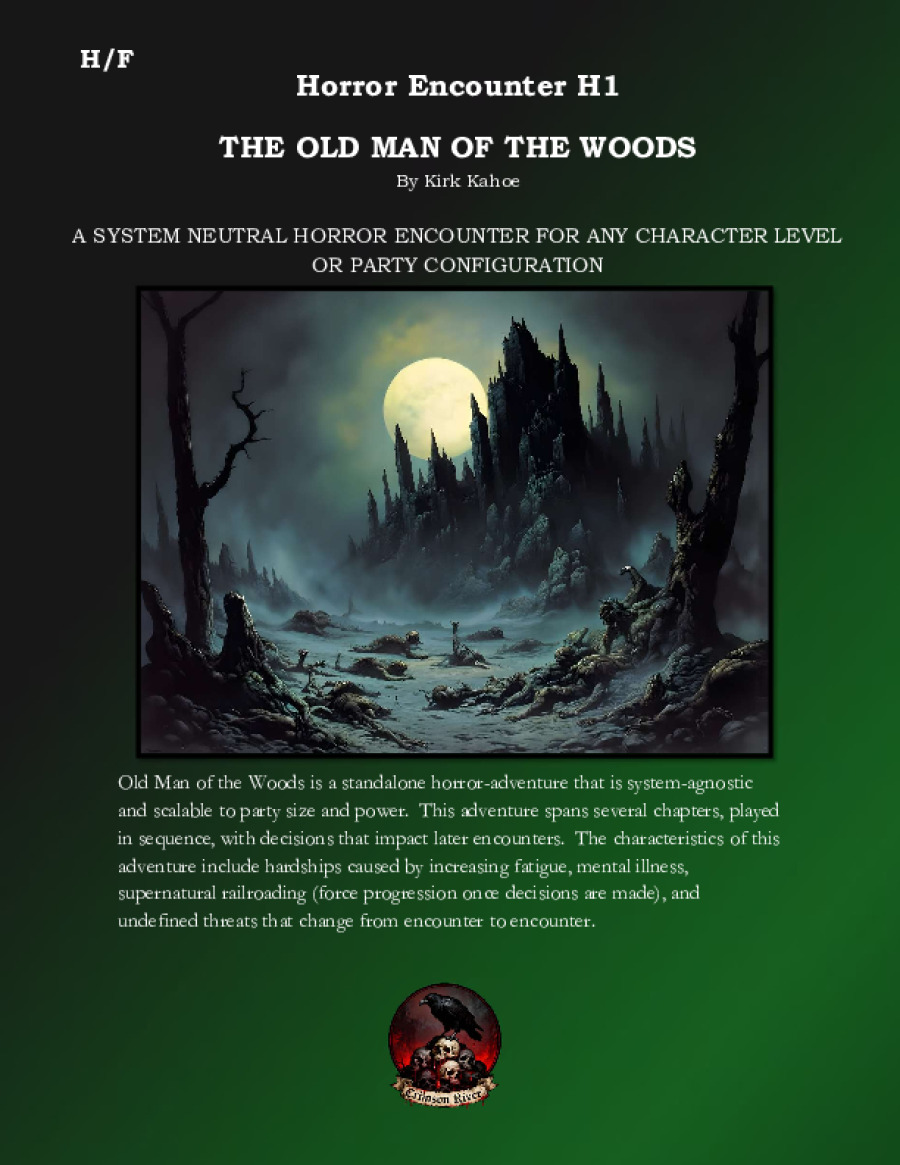
The Old Man
By Kirk Kahoe
Crimson River Games LLC
Generic/Universal
Levels: Any
Crimson River Games LLC
Generic/Universal
Levels: Any
Warning! This is as close as you can get to being a Heartbreaker without actua;;y being a Heartbreaker.
An eternal horror haunts the woods, reaping an endless harvest of woe from those foolish or desperate enough to travel through them. Tired and injured, the party will have to not only face an endless onslaught from the horror but fatigue and madness as well, for there is no sleep in the Old Man’s realm other than the sleep of death.
This 169 page adventure is an overwritten railroad in which the best solution is leaving the table to have explosive bloody diarrhea in your hosts bathroom and then going home. Ok, that was mean. It’s a 169 pages of railroaded atmosphere in which you have no choices to make as a player and the DM must wade through an excruciating amount of text to run even the simplest encounters.
Page twenty of the intro text tells the DM that they should Describe, not define and then follows this statement up with “A shambling and decaying humanoid creature that stinks of ammonia is scary. Labeling this creature “Zombie” and adding specific statistics is a game mechanism. It is thus no longer a scary monster but a set of numbers to crunch and probabilities to consider.” This is 100% correct. Not only does it follow the show and don’t tell mantra, but it adds that air of mystery that RPGs thrive on. I’m a big big fan of this attitude and it bolstered my spirits seeing it.
Oh! Oh! I forgot! You can get Hep! That’s right! Hep! That’s BAD AZZ! “So, what did I get? Another plague? Yellow squirting zombie fever or something?” “No, you got Hep.” Fucking christ ma! That’s great! I love it! Next time you roll through a village you find out 15% of them are dead from cholera. That’s nicely visceral and I do love a reaction from the players. Which, I might note, is exactly what the adventure is trying to do with its horror.
Great, I’ve said something nice, even if I did include the backhanded “page twenty” reference.
There’s a dude who is the only worshipper of a god and he’s constructed this obtuse parallel reality death trap in a forest to select sacrifices worthy of his god. As the adventure tells us “Due to the depth of role-playing required to deliver the Old Man and the complexity of fatigue’s impact on gameplay …” It’s a test/challenge dungeon. That’s it. 169 pages of test/challenge dungeon. You know how those things work. It’s an alternate reality blah blah blah, you can’t leave, blah blah blah, he controls everything blah blah blah. “In the event (which happens often) that the Old Man (or his copies) are somehow killed in any of the encounters before the final encounter at his hovel, he is instead fully healed and moved to the subsequent encounter.” Cause hes wearing this fucking ring that brings him back. Worry not, DM afraid the railroad will stop, “In all cases, the presence of the ring should not be noted due to the grime and darkness until the last encounter.” Ain’t nothing like having no choices that really brings home the immersion. Time and again we see this. This reliance on a test/challenge environment as a pretext for all of the setup the baddie has done. Time and again we see these mechanical contrivances, like the ring, used as an excuse to justify an effect. Time and again we see these railroads as an attempt to tell a story and get an effect. You can’t fucking do it that way. One of the keys to a roleplaying game is the ability to make choices. Once you take that away you might as well be watching a movie with a predetermined outcome. Sure, I can roll a die. Will the DM let me die or force me to suffer through the entirety of their story? Players check out when they can’t do anything. When they can’t make a decision. Sure, there’s a time and a place for “the RPG adventure as an Activity” instead of “the RPG adventure as a Game”, but, Baron Munchhausen did this a long long time ago.
In spite of the adventures words implying it’s a show don’t tell piece, it relies on mechanics and read-aloud to bring the horror, telling instead of showing. A fatigue mechanic. Mountains and mountains and mountains of read-aloud. No one wants to listen to your half page read-aloud man. You don’t set a mood by using a lot of read-aloud. Yes, the writing should be evocative, but it should not be lengthy. You get a few sentences, three or four, and that’s it. You need to really work those sentences to bring the effect, the impact you are going for. Yes, it is not easy. It is, I think, the hardest part of adventure writing. More is not better. Player attention drifts. You make it harder on the DM to focus. You can’t use mechanics to fill in either. Sanity, in CoC, is just another pull of hit points, campaign hit points, as to say. It is up to the designer to put something together that FEELS like fatigue without relying on mechanics to accomplish that.
So, yeah, railroad. The adventure starts at a little trade town. Caravans leaving, to go over the pass. Wanna join? SURE you don’t want to join? Ok, so, no, you decide to wait at the trade town over the winter? Ok, then bandits keep attacking. Eventually you see over a 100 bandits about to attack and the entire town, whats left, flee in to the hill. Along the caravan route. Heh. So, yeah, you’re going on the adventure. Then you’re in the alternate reality shit where the dude controls everything and you’ve got exactly one path to go on. Just follow it and make skill check after skill check as: there’s a rock fall. There’s a bridge collapse. The wagon is stuck. Blah blah blah. I don’t know, there’s about fifty locations, between the overland and like a manor and such.
There is an EXTENSIVE amount of information presented for each area. There’s a section for environment, then a section for topography. Then a boxed text section for the read-aloud, then a section for monsters/traps, then a section for encounter mechanics, then a section for notes, and a section for treasure, and a section for game master notes. There is EXTENSIVE repetition, which is great because with so much information, a long paragraph or more for each section, the area is then spread across multiple pages. There is NO WAY a DM can keep this shit together for a meaningful encounter. And this stuff is present for almost every area. Time and again, DO NOT use such a rigid format. Leave shit out if you don’t need it. Do NOT do shit like tell us the door, walls, light, smell, taste for each and every room. The purpose of formatting is to help bring clarity and help a DM when they scan the adventure looking for pertinent information. Used in mechanical fashion though, as it is here, is instead obfuscates and works against the goals it is trying to achieve.
It’s just weird, the way things come together in this. In one read-aloud section it says “They have knowledge of the mountains and what supplies are needed, and they can provide basic information about the mountain road. This sound slike DM notes, not read-aloud. And that’s not an isolated example, I’m not cherry picking. In another section there is a Treasure heading that reads “Treasure – Supplies from the abandoned wagons (See Treasure section).” Isn’t THIS the treasure section? (Turns out, no. It’s _A_ treasure section. FLipping to an appendix we can find a Treasure appendix with a listing for “Wagon Contents” which is full of mundane supplies.)
It’s just crammed with so much extraneous and repetitive information. And then the encounters are so humdrum. Oh, make a skill check! Ok, get a fatigue. Yawn. The final battle with th dude is anticlimactic as fuck. He attacks, eventually you drive him off. You find him in his hut and kill him there. End. Given this is 170 pages long and like almost fifty railroad encounters I would have expected just a little more in the way of flavour than a couple of sentences saying “he attacks you.” The horror element here just doesn’t work, hardly anywhere in the adventure. Mechanics and read-aloud doesn’t do it. The Hep C cant save an overwritten adventure in which the horror element is reduced to mechanics.
This is $5 at DriveThru. The preview is the first seventeen pages. Which doesn’t show any of the encounters because there’s a LONG intro and background info and so on and so on and so on. A preview needs to show some of the encounters so a buyer can make an informed decision about the purchase. That’s the purpose of the preview.
https://www.drivethrurpg.com/en/product/564568/the-old-man-of-the-woods?1892600
Categories: Tabletop Gaming Blogs
Kull-era Atlantean campaign Random Encounters table For Sword of Cepheus 2nd edition
Here is a 2d6-based random encounter table for a Kull-era Atlantean campaign utilizing the mechanics of The Sword of Cepheus 2nd Edition. This blog post picks right up from D100 Kull Era Atlantean Relics and Monster Encounter Tables For A Sword & Sorcery Sword of Cepheus 2nd edition Part IIIn the Thurian Age, Atlantis is not yet a sunken realm; it is a harsh, mountain-ringed Needleshttp://www.blogger.com/profile/11243274667834930867noreply@blogger.com0
Categories: Tabletop Gaming Blogs
Video of the Day – Gaydio: Russell T Davies Interview, 2026
The post Video of the Day – Gaydio: Russell T Davies Interview, 2026 appeared first on Blogtor Who.
Categories: Doctor Who Feeds
Building The Red Planet Empire - Mixing Warriors of the Red Planet (WotRP) with the Domain-level Architecture of ACKS II Rpg - Using Space Noble PC Within The ACKII rpg
In ACKS II, managing an estate and a private army is a core part of the game. For a planetary romance or space opera setting, the standard medieval ruler translates into a Space Noble. Instead of managing medieval peasants and wooden castles, a Space Noble commands high-tech orbital fiefs, handles interplanetary trade logistics, and maintains a private standing army of high-tech infantry orNeedleshttp://www.blogger.com/profile/11243274667834930867noreply@blogger.com0
Categories: Tabletop Gaming Blogs
Doctor Who: The Kaleidoscope – Smith & Jones Together Again!
The Fugitive Doctor and Martha Jones team up to battle the Silence in a new installment of Circuit Breaker
Back in January, Blogtor Who brought you news that the Fugitive Doctor herself, Jo Martin, would be penning her debut novel. It’s part of this year’s multimedia Doctor Who event Circuit Breaker, and more details on the book are now available.
The Kaleidoscope continues the Fugitive Doctor’s quest to save the Earth by returning mysterious objects to their proper place in the timeline before time and space themselves fall apart. This earliest incarnation has already encountered classic foes like the Daleks – enemies this incarnation has no memory of due to not having met them yet. However, this time she has a whole other reason for the gaps in her memory. Because the Silence have plans of their own…
Fortunately, the Doctor has a new old friend to help: Dr. Martha Jones. Martha’s never been afraid to call out the Doctor on their bad behaviour. So what will she make of the Fugitive? The book also features the debut of the Fugitive’s very own sonic screwdriver.
Though this is Jo Martin’s first novel, she has previously written stage plays and audio dramas, as well as co-writing television scripts. The Kaleidoscope may be the most exciting entry yet in the Doctor Who celebrity author range. It arrives at all good retailers on the 3rd of September, and you can find pre-order links here.
Doctor Who: The Kaleidoscope. Cover by Lee Binding (c) Penguin Books Doctor Who: The Kaleidoscope

When memories lie, the truth can be fatal.
In the aftermath of an improbable mission, the Fugitive Doctor and Martha realise that something is interfering with their minds. Something that doesn’t want to be found.
Their investigation leads to a curious artefact in the British Museum: an apparently medieval toy known as the Kaleidoscope. But the object refuses to stay in one place, one time – or one identity. And when the Doctor is repeatedly mistaken for someone she’s never met, fragments of unfamiliar memories begin to surface.
Across the Earth, a hidden pattern emerges; evidence of a secret that someone has gone to extraordinary lengths to conceal. As ancient enemies close in and innocent lives are put at risk, the Doctor learns the hard way that some truths were buried for a reason…
Circuit Breaker continues with The Honourable Society in the pages of Doctor Who Magazine 632, out on the 23rd of July
The post Doctor Who: The Kaleidoscope – Smith & Jones Together Again! appeared first on Blogtor Who.
Categories: Doctor Who Feeds
Fantasy Superheroes

A common criticism of later editions of D&D from fans of older editions is that they produce "fantasy superheroes." I don't agree with that characterization. In fact, I wonder why we don't see many rpg examples of fantasy superheroes because, like Stargazer here, I think it could be an interesting idea.
For clarity, I don't mean characters in a fantasy world that have secret IDs and codenames and fight crime wearing costumes--though I think a Zorro or Iron Monkey sort of frame of masked fighters for justice could easily fit what I am thinking of. Mostly, though, I'm just thinking of comic books like Battle Chasers or Dreadstar (the latter is really space fantasy, but its basic setup is a useful example) and animated series like He-Man and the Masters of the Universe (2002, particularly). Epic fantasy stories featuring super-powered characters.

So what makes those examples "superheroic" in a way a 4e campaign isn't necessarily? In Superhero: The Secret Origin of A Genre, Coogan lays out his "MPI" definition of a superhero. That is, a superhero is a person with Mission, Powers, and Identity. He also has the fallback of "generic distinction" to catch characters (like the Hulk) that might fail by the initial test and to exclude characters that might seem at first blush to fit but are better accounted for in another genre.
Regardless of whether the fantasy heroes I'm thinking of would be superheroes in Coogan's estimation, I'm think about characters that:
- Have a mission, which might be something like "defeat Sauron," but could be something more like "overthrow the God-King who betrayed us." This wouldn't be the place for picaresque wanderings or "get rich or die trying."
- Have powers that are beyond reach of regular folks to a notable extent. Those powers would tend to require explanation and come with an origin of sorts. That could be as simple as "born an air bender," but whatever it is, it would set a character apart from most people. While this pillar is where there is the most overlap with modern D&D, I think D&D's approach to powers that largely makes then originless (other than being a particular class) and outside of spells, more an artifact of game rules than a setting element, fails to place it within the proposed genre.
- Have an identity, in the sense of being distinct, likely from other heroes in the party, but certainly from broader humanity. The difference between characters a normal D&D party is something like the difference between the members of the Fellowship of the Ring, but here the difference would be more like the differences between the members of the X-Men or Legion of Super-Heroes. I feel like a lot of identity is in a distinctive visual, but that probably comes from this subgenre being mostly a thing of visual media. Still, I feel like it would be something to think about in an rpg.
Categories: Comic Book Blogs, Tabletop Gaming Blogs
A d100 Kull era Atlantian Artifacts table for Castles & Crusades rpg Campaign Set in Kull's Thurian Age
Here is a d100 Atlantean Artifacts table tailored for a Castles & Crusades campaign set in Robert E. Howard’s pre-cataclysmic Thurian Age (the era of Kull of Atlantis). This blog post picks right up D100 Kull Era Atlantean Relics and Monster Encounter Tables For A Sword & Sorcery Sword of Cepheus 2nd edition Part IIIn thisNeedleshttp://www.blogger.com/profile/11243274667834930867noreply@blogger.com0
Categories: Tabletop Gaming Blogs
Video of the Day – Doctor Who: Third Doctor Adventures, 1970
The post Video of the Day – Doctor Who: Third Doctor Adventures, 1970 appeared first on Blogtor Who.
Categories: Doctor Who Feeds
'I'll Swallow Your Soul '- The Necronomicon Ex-Mortis (also referred to as "Naturom Demonto" and "Book of The Dead") for Sword of Cepheus 2nd edition & Adventure Encounter
The Necronomicon Ex-Mortis (loosely translated as "Book of the Dead"), also known as the Naturom Demonto, is an ancient, sentient tome of ultimate black sorcery. Bound in human flesh and inked in human blood, it acts as a gateway to the dark, chaotic dimension of the Kandarian Demons (or "Deadites"). This blog post picks right up 'Hail To The King Baby!' Ashley 'Ash' Williams From The Needleshttp://www.blogger.com/profile/11243274667834930867noreply@blogger.com0
Categories: Tabletop Gaming Blogs
A Sword & Sorcery d100 Serpent Men Encounters & Ruins Table For The Castles & Crusades rpg
Here is a d100 table designed for Old School Renaissance (OSR) campaigns. It blends classic science-fantasy, cosmic horror, and ancient, decaying civilizations—perfect for dropping straight into your wilderness hexes, deep under-empires, or forgotten jungle ruins.The encounters are divided into active Encounters (01–50) and strange Ruins & Relics (51–00).d100 Serpent Men Encounters &Needleshttp://www.blogger.com/profile/11243274667834930867noreply@blogger.com0
Categories: Tabletop Gaming Blogs
Video of the Day – Past & Present: Doctor Who, 2026
The post Video of the Day – Past & Present: Doctor Who, 2026 appeared first on Blogtor Who.
Categories: Doctor Who Feeds
Integrating Adventurer Conqueror King System II (ACKS II) with the legendary, chaotic, and maximum-gonzo DNA of Dave Hargrave’s Arduin Grimoires - Arduin Caravan ACKS II rpg
To run a caravan in an Arduin campaign using ACKS II, you must merge David A. Hargrave's gonzo, trans-dimensional trade items with Alexander Macris's strict logistical and economic simulation. This blog post picks right up from Integrating Adventurer Conqueror King System II (ACKS II) with the legendary, chaotic, and maximum-gonzo DNA of Dave Hargrave's Arduin Grimoires - ACKS II Needleshttp://www.blogger.com/profile/11243274667834930867noreply@blogger.com0
Categories: Tabletop Gaming Blogs
Pages
