
Your wildly multifarious home!
Feed aggregator
Crochet and Catch Up with Moogly - August 19, 2026
As summer winds down, it's the perfect time to settle in with a cozy project! Join me for another Crochet and Catch Up with Moogly as we chat about new patterns, upcoming events, fall crochet plans, and a few sneak peeks. I'll be answering your questions live, too! You'll find links to everything mentioned during […]
The post Crochet and Catch Up with Moogly - August 19, 2026 appeared first on moogly. Please visit www.mooglyblog.com for this post.
0
Categories: Crochet Life
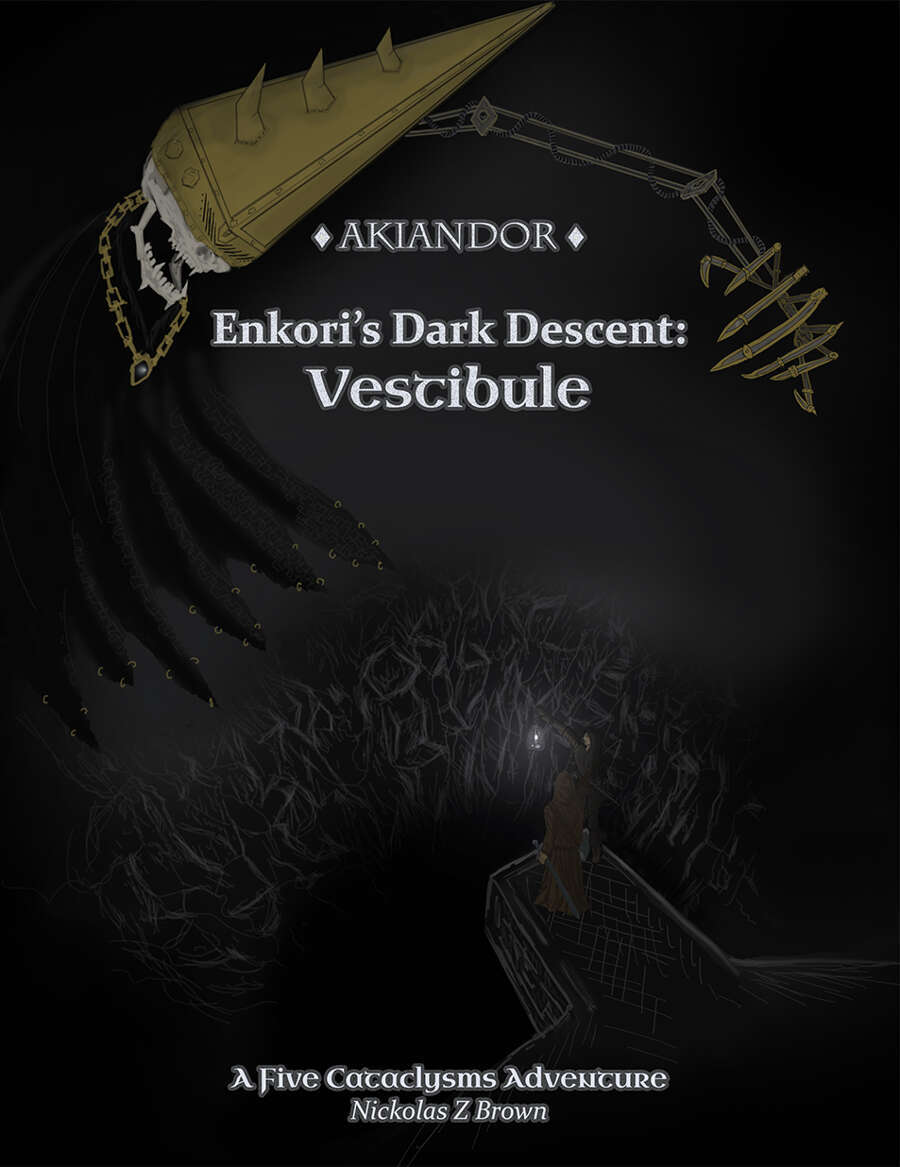
Enkori’s Dark Descent – Vestibule
By Nickolas Zachary Brown
Five Cataclysms
Five Cataclysms
Level 1
Five Cataclysms
Five Cataclysms
Level 1
Souls trespassing into the rogue plane of Akiandor are captured and trapped here, doomed to be tormented by the dark denizens of this place, their souls slowly whittled down to fuel distant engines of preposterous design. This dark and terrible place is full of necromantic monsters built to instill terror, and vicious mechanical traps wrought to imbue fear in every step. Flesh will be torn. Limbs will be severed. Lives will come to a brutal end again and again, only to be cruelly revived by the light of Tirazen, locked in an eternal loop until the day their soul is so tattered from repeat sunderings that their quivering essence joins the chorus of mournful wailing in the chasm of souls.
This 72 page adventure presents a single dungeon level with about 120 rooms in a touch dungeon with lots of challenges, varied and interesting. Imaginative and creative, as is usual with Five Cataclysms, it’s also more than a little askew with a strong funhouse vibe that never turns in to farce.
This is a classic Tower of Gygax dungeon. You’re on another plane, and each time you tie in the dungeon you get brought back to life in the lobby area, perhaps with a little signal degradation, so to speak. You’ve met a black blog in the lobby who has a key to level two, but it’s only giving it to you if you bring it The MacGuffin, somewhere on level one. This is the absolute barest of pretexts for a dungeon designer to be a “starter dungeon for a group of master-level players.“
Ok, sure. And that differs from White Plume how? And thusly we come to everyone’s relationship with funhouse dungeons and/or how much pretext we need to adventure. How much verisimilitude do you need to get going? Is that even a designers job? Isn’t it YOUR job, the players, to find a reason to adventure? Fuck if I know the meaning of life, but we’ll take my attitudes towards it as the norm for players and dms and run with it while examining adventures.
And thusly, how much pretext do I need? How much funhouse can be in the funhouse? How much should the map be an exploratory map and how much is it allowed to be a pointcrawl map? This is not a zany dungeon. I’m not even sure it’s fair to call this a funhouse dungeon. There is not the meta or snark that, say, Tomb of Tog had. I think, maybe, it’s more classic dungeon encounters, over and over again. Maybe an analogy would be Dragon’s Lair?
The individual encounters here are pretty damn nice. There’s a degree of real life to them. Not just verisimilitude but something both simpler and more complex than that. I’m remembering one of the rooms, let me go find it. Ok, so, it’s a tenfoot wide hallway, forty feet long, door on both sides. The door opens only slightly, revealing charred and dented crates just beyond the door. There’s a fucking heavy crate in front of the door. And/or a hallway full of them. This is nuts. I can’t tell you how many times this has happened to me in real life. Well, ok, maybe not the dented and charred part (IE: pay the fuck attention to the trap that was just telegraphed to you Excellent work there!) But the whole “a fucking spatula has gotten out of place and now I can’t open the fucking utensil fucking drawer.” It’s so simple. It’s so immensely relatable.
And it feels like that’s what this adventure, and most stuff by Brown, does. Over and over and over again. There is this ability to create a relatable situation, as if the situation was imagined first, by someone who has never played D&D or heard about it, and then it’s put in the adventure and maybe a mechanic or two attached. Imagination without the influence of the weight of Tolkien and all of that fantasy literature and media since then that has standardized it. I would normally refer to this as “the OD&D way”, but I think it’s a little different here. “Barbed Pillar Atop a multi-tiered pillar is a scepter that radiates magical power. However, the pillar is covered in sharp iron spikes and barbs, many of these strung up with strings & chain with little brass bells suspended upon them. The pillar itself rests on a platform surrounded by the dark streams of liquid. “ This is not a full on 4e set piece, but it is a Special, I think, if we were looking at this from a dungeon population table.
I frequently draw analogies to the Tower of Gygax for some funhouses. It is, I think, because of the ratio of specials to other rooms. When the ratio gets too high then you’re trending to funhouse. There is some kind of middle ground where we find Dungeon of the Bear and other entries like it.
I like almost every encounter in this. They are unusual, varied, many are relatable. I am envious of Browns ability to come sup with these and hit time and time again. And it’s not just the encounters. When it comes to monsters we’ve got “A ramshackle blob of corpses stitched and bolted together, bound with chains and hooks and cords. Stands 8’ tall and roughly 6’ wide, hobbles on 3 stumps of rotten flesh. As it shambles, the clanking of its chains resonate down the halls.” Well, there you go! Great description! But,also, hey, it’s an abomination. How about something more mundane? “A humanoid skeleton whose hands have been replaced with rusted meathooks, or similar. Curiously, they smell like, really bad.” Well, yes, duh, of course! Rusted metal claw hooks for hands. That hits in the imagery department and it hits HARD! Why didn’t you think of that? I guess I’m just a 4e DM and don’t deserve love since I have no creativity at all.
Formatting is good enough, terse and easy enough to follow. Writing is quite evocative, even with a more than a few second person thrown in. Map is decent, large, lots of loops, lots of features. Blah blah blah
I am fascinated by this. Or, perhaps, the question raises. While I admire the raw creativity here and think Brown is one of the best, there is something else going on that I can’t get ahold of. I suddenly realize my own mortality: the line of pretext. Every room a special? Ok. Not much of a setup, or, one that doesn’t make sense? So what. How grounded does an adventure have to be for you to buy in to it? And, if you don’t buy in to it then is it then that arch-heretic: an activity? Damn you Nickolas Zachary Brown! Damn you all to hell!
Meh. Encounters are great. Imagery and creativity is great. I love it them to death. I must also condemn thee to Regerts. Maybe it’s a zones issue?
This is $9 at DriveThru. The preview is eleven pages. You get to see about seven rooms at the end and all the intro. You’re going to have to make a determination from that, and you should be able to.
https://www.drivethrurpg.com/en/product/574403/enkori-s-dark-descent-vestibule?1892600
(Actually, I do know the meaning of life, so, you know,)
Categories: Tabletop Gaming Blogs
Wednesday Comics: DC, November 1985 (week 4)
I'm reading DC Comics' output from January 1980 (cover date) to the end of Crisis! This week, I read the comics on sale on August 22, 1985.
Detective Comics #556: Moench and Colan/Smith continue their story from this month's Batman. It's very much set under the red skies of the Crisis, but it's not labelled as a crossover. We find out, as Night Slayer keeps murdering them, that the False Face Society leftovers hadn't actually been working with Nocturna yet--but as of this issue, she takes command.
Robin tries to tell her how he feels and lean on her for support, but Nocturna is preoccupied with what's happening to the night skies. However, when Batman tracks her down after an encounter with Night Slayer, she makes time for a kiss. Meanwhile, Bullock reveals to Commissioner Gordon his theory that the current Robin isn't the original (something Gordon had noticed as well) but is actually Nocturna's son!
In the Green Arrow backup, we get back to the story by Cavalieri and Moore that had been left dangling. Ollie agrees to help Onyx battle Lars, a renegade monk at the monastery where Ollie himself once trained, who has killed the Exalted Master and taken over. Ollie recalls a run in he had with Lars when they were both students, where the guy confided that he sought a "wisdom key" that would unlock the power of an ancient book. As soon as Green Arrow and Onyx arrive at the monastery, they are confronted by Lars's goons.
All-Star Squadron #51: A Crisis crossover, but that bit only amounts to a cameo, really. The Thomases and Clark/Jones/Coletta have the passing of Harbinger and Firebrand give Mr. Mind a way to find Earth--or at least an Earth. That leads to the events of this issue, where Hourman and Dr. Fate arrive at the JSA brownstone to find most of their team members missing and Hawkgirl a captive of a group of former JSA-member villains banded together as the Monster Society of Evil. This group is the brainchild of Mr. Mind, who came to Earth to meet his hero Charlie McCarthy only to find out he was just a puppet. He then decided to meet his other heroes the JSA, and when he could find them, he decided to be a super-villain.
Hourman, Dr. Fate, Hawkgirl, and late arriver Sandy battle the likes of Oom the Mighty, Ramulus, Mr. Who and Nyola. Unfortunately, they're going to need more help to defeat them. Elsewhere, Liberty Belle and Johnny Quick have apparently fallen through the reverse of the portal Mr. Mind came through and find themselves facing Captain Marvel.
Nathaniel Dusk II #2: MacGregor and Colan pick up just at last issues cliffhanger. Dusk survives the falling unicorn statue, but the gunman who shot at Cranston gets away. As Dusk continues his job of trying to keep Cranston out of trouble, he gets the idea that the older man knows who is trying to kill him and is playing some dangerous game. Amanda's stepfather leans on Dusk to drop the case, and her husband takes him flying. He gets another piece of the puzzle when he finds out Cranston borrowed a camera from Amanda and that he visited her new family on the one day he slipped Dusk's surveillance.
Before he can put any of this together, a drive-by with a tommy gun seems to take Cranston's life. This leads to one of those (for me) jarring aspects of the story, where it moves from conventional detective story to 80s action. Dusk pursues the shooter. The getaway car gets wrecked, and the shooter takes a bus. The issue ends with Dusk on top of the bus as the shooter blows holes in the roof trying to ventilate the detective, too.
Omega Men Annual #2: Klein and host of artists (including McManus, Colon, Smith, Giffen, and O'Neil) give us Primus's backstory, the events leading up to his marriage to Kalista and the founding of the Omega Men, his apparent death in the Spider Guild war, and how he came to be bonded with Artin. When she has heard the whole story Kalista accepts that this being is indeed her husband (at least in part) and the two reconcile. This issue pretty much closes the gap between the previous run and the time jump when Klein took over.
V #10: After all the setup and schemes last issue, it resolves pretty quickly. The mayor reveals herself to our heroes as one of the Visitors but tells them she is actually a triple agent and on their side. She gives them a device that can extend the New York winter, keeping the red dust active and at least postponing a renewed invasion. They're overheard, though, and the mayor is captured, interrogated, and executed. Still, the resistance has the device. Big, bad Walter sent to kill Donovan, gets in a fight with him, but before things resolve he's killed by friendly fire from an overzealous Visitor fighter. The device works, spring is forestalled, and our heroes return to L.A., presumably assuming the nascent New York resistance they were starting up can take care of itself.
World's Finest #321: Cavalieri and Delbo pit our heroes against the Atom villain, Chronos. Coerced by the mysterious Powerbroker, Chronos uses time travel in a plot to destroy Batman. After sending Superman off chasing bombs in the timestream, Chronos forces Batman to journey to the past and watch his parents get murdered--or save them and alter history. Batman resists the temptation to save his parents, using the experience of again reliving their deaths to strengthen his crimefighting resolve, and he's rescued by Superman. Chronos, in a desperate attempt to evade capture, uses his time machine to become one with the timestream.

Detective Comics #556: Moench and Colan/Smith continue their story from this month's Batman. It's very much set under the red skies of the Crisis, but it's not labelled as a crossover. We find out, as Night Slayer keeps murdering them, that the False Face Society leftovers hadn't actually been working with Nocturna yet--but as of this issue, she takes command.
Robin tries to tell her how he feels and lean on her for support, but Nocturna is preoccupied with what's happening to the night skies. However, when Batman tracks her down after an encounter with Night Slayer, she makes time for a kiss. Meanwhile, Bullock reveals to Commissioner Gordon his theory that the current Robin isn't the original (something Gordon had noticed as well) but is actually Nocturna's son!
In the Green Arrow backup, we get back to the story by Cavalieri and Moore that had been left dangling. Ollie agrees to help Onyx battle Lars, a renegade monk at the monastery where Ollie himself once trained, who has killed the Exalted Master and taken over. Ollie recalls a run in he had with Lars when they were both students, where the guy confided that he sought a "wisdom key" that would unlock the power of an ancient book. As soon as Green Arrow and Onyx arrive at the monastery, they are confronted by Lars's goons.

All-Star Squadron #51: A Crisis crossover, but that bit only amounts to a cameo, really. The Thomases and Clark/Jones/Coletta have the passing of Harbinger and Firebrand give Mr. Mind a way to find Earth--or at least an Earth. That leads to the events of this issue, where Hourman and Dr. Fate arrive at the JSA brownstone to find most of their team members missing and Hawkgirl a captive of a group of former JSA-member villains banded together as the Monster Society of Evil. This group is the brainchild of Mr. Mind, who came to Earth to meet his hero Charlie McCarthy only to find out he was just a puppet. He then decided to meet his other heroes the JSA, and when he could find them, he decided to be a super-villain.
Hourman, Dr. Fate, Hawkgirl, and late arriver Sandy battle the likes of Oom the Mighty, Ramulus, Mr. Who and Nyola. Unfortunately, they're going to need more help to defeat them. Elsewhere, Liberty Belle and Johnny Quick have apparently fallen through the reverse of the portal Mr. Mind came through and find themselves facing Captain Marvel.

Nathaniel Dusk II #2: MacGregor and Colan pick up just at last issues cliffhanger. Dusk survives the falling unicorn statue, but the gunman who shot at Cranston gets away. As Dusk continues his job of trying to keep Cranston out of trouble, he gets the idea that the older man knows who is trying to kill him and is playing some dangerous game. Amanda's stepfather leans on Dusk to drop the case, and her husband takes him flying. He gets another piece of the puzzle when he finds out Cranston borrowed a camera from Amanda and that he visited her new family on the one day he slipped Dusk's surveillance.
Before he can put any of this together, a drive-by with a tommy gun seems to take Cranston's life. This leads to one of those (for me) jarring aspects of the story, where it moves from conventional detective story to 80s action. Dusk pursues the shooter. The getaway car gets wrecked, and the shooter takes a bus. The issue ends with Dusk on top of the bus as the shooter blows holes in the roof trying to ventilate the detective, too.

Omega Men Annual #2: Klein and host of artists (including McManus, Colon, Smith, Giffen, and O'Neil) give us Primus's backstory, the events leading up to his marriage to Kalista and the founding of the Omega Men, his apparent death in the Spider Guild war, and how he came to be bonded with Artin. When she has heard the whole story Kalista accepts that this being is indeed her husband (at least in part) and the two reconcile. This issue pretty much closes the gap between the previous run and the time jump when Klein took over.

V #10: After all the setup and schemes last issue, it resolves pretty quickly. The mayor reveals herself to our heroes as one of the Visitors but tells them she is actually a triple agent and on their side. She gives them a device that can extend the New York winter, keeping the red dust active and at least postponing a renewed invasion. They're overheard, though, and the mayor is captured, interrogated, and executed. Still, the resistance has the device. Big, bad Walter sent to kill Donovan, gets in a fight with him, but before things resolve he's killed by friendly fire from an overzealous Visitor fighter. The device works, spring is forestalled, and our heroes return to L.A., presumably assuming the nascent New York resistance they were starting up can take care of itself.

World's Finest #321: Cavalieri and Delbo pit our heroes against the Atom villain, Chronos. Coerced by the mysterious Powerbroker, Chronos uses time travel in a plot to destroy Batman. After sending Superman off chasing bombs in the timestream, Chronos forces Batman to journey to the past and watch his parents get murdered--or save them and alter history. Batman resists the temptation to save his parents, using the experience of again reliving their deaths to strengthen his crimefighting resolve, and he's rescued by Superman. Chronos, in a desperate attempt to evade capture, uses his time machine to become one with the timestream.

Categories: Comic Book Blogs, Tabletop Gaming Blogs
Doctor Who: Corruption of the Daleks – Panini Exclusive
Panini will have an exclusive alternate cover for next month’s comic strip trade paperback, Corruption of the Daleks
The Fifteenth Doctor’s adventures continue in Corruption of the Daleks, a new trade paperback out next month from the makers of Doctor Who Magazine. The mass market edition of the new collection features a cover by John Ross. That will be available wherever you buy your books or comics from the 20th of October. However, Panini, publishers of DWM, will also have an alternative cover available exclusively through their online shop. David Roach and Emily Roach’s art pays homage to the title story’s setting in 1920s Paris, and the art style of the period’s iconic posters advertising the night life of the French capital.
This second volume of comic strip adventures for Ncuti Gatwa’s incarnation of the Time Lord reprints the strips from DWM issues 613 to 631. It includes the stories:
- Run
- Dance Till You Drop
- No Signs of Life
- His Mad Pranks
- Field Trip
- A Ghost Story for Christmas
- Corruption of the Daleks
Along the way, the Doctor’s joined by his television companions Belinda Chandra and Mel Bush. He also reunites with classic DWM comic strip companion Fey Truscott-Sade!
You an get your copy of this exclusive edition of Corruption of the Daleks here on the Panini store.
Doctor Who: Corruption of the Daleks. Panini exclusive cover by David Roach and Emily Roach (c) Panini Doctor Who: Corruption of the Daleks

From the pages of Doctor Who Magazine, join the Fifteenth Doctor as he hurtles through time and space in this action-packed collection of comic strip adventures!
From a deadly game of ‘It’ on the planet Grey Grieving to battling a skeletal Ossurian at the Museum of Natural History, the Doctor faces thrills, chills and unexpected dangers at every turn! Impish enemies, disco delinquents and spine-chilling spooks are bad enough, but there’s even worse on the horizon for the Doctor when he encounters his deadliest foes, the Daleks, in 1920s Paris – and discovers they may have struck a deal with the devil!
Also includes a full behind-the-scenes commentary section on the making of these incredible stories.
The post Doctor Who: Corruption of the Daleks – Panini Exclusive appeared first on Blogtor Who.
Categories: Doctor Who Feeds
RPG a Day 2026 – Day 19: Desire
Welcome to Day 19 of #RPGaDay2026. As I explained in my Day 0 post, I’ll be creating NPCs based on the day’s prompts and the week and day modifiers presented in the infographic below. Check out that post for further details.
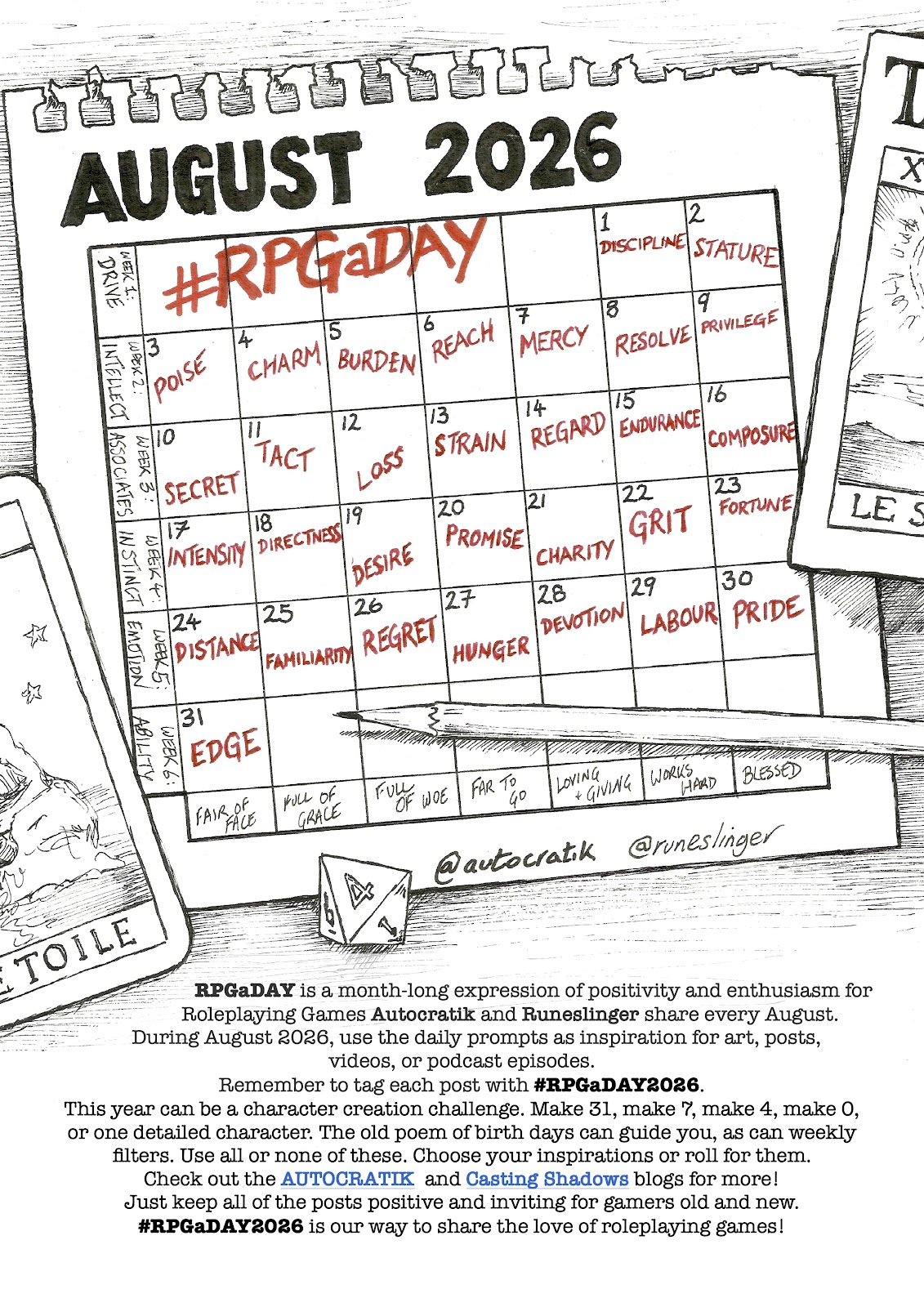
Today’s combination: Desire (Prompt) + Instinct (Weekly Modifier) + Full of Woe (Weekly Modifier) + Fantasy (Genre)
Here is today’s NPC.
Dinis “Whispering Din” Silveira (Fantasy Name Generators used for the name: Portuguese name generator and Bandit name generator)
Whispering Din is a big fish in a small pond. As the local crime lord of an insignificant trading town, he runs rackets and extorts merchants, traders, and beggars alike, while the small local thieves’ guild pays him tribute. Although the bandits on the nearby roads owe formal allegiance to no one, more than one bandit leader is safely in his pocket. Very little illicit business happens in these parts without his knowledge.
In turn, however, Whispering Din owes allegiance and coin to bigger bosses: the Shadow Barons and Counts in the neighboring cities. The Guild of Weights and Measures holds a dark secret over him that keeps him from meddling in their affairs, and he owes heavy debts to the corrupt captains whose ships waylay vessels and sell captives at the southern oasis ports. It is a precarious balancing act, but Din has always possessed a sharp instinct for handling shifting allegiances and navigating the criminal underworld.
Yet, Whispering Din is deeply unhappy. Above all else, he desires respectability and peace—two things that have eluded him his entire life. His ambitions have always guided him, tempered only by his survival instincts, from his early years as a young cutpurse to his dangerous days raiding tombs. Physically, he is a wiry, weaselly man with a thin mustache and thinning, slicked-back hair. He always wears a scarf and speaks with deliberate purpose, though his voice never rises above a harsh whisper.
The scarf hides the ragged scars on his neck, left behind when the claw of a lich ripped open his throat. Dinis and his former companions managed to destroy the undead sorcerer, but not before the creature cursed them to a life full of woes. It is a curse of endless sorrow, ensuring their dreams will never be fulfilled and that every victory will inevitably turn to defeat. Thus, Whispering Din toils ceaselessly, chasing unachievable goals while desperately searching for a way to break the magic that binds him.
Thanks for reading; I am looking forward to your RPG a Day 2026 post, comments, and conversation. If you want further information about #RPGaDay2026, be sure to check out Autocratik’s blog.
A Spanish version of this post is available at the Desde la Fosa Facebook page.
See you all tomorrow!
Categories: Tabletop Gaming Blogs
Doctor Who Magazine 633
The Tenth Doctor reunites with a familiar face as his new companion as David Tennant returns to Big Finish for more adventures
In the latest issue of Doctor Who Magazine, David Tennant discusses his extraordinary career. He also reveals details of The Tenth Doctor and Rani from Big Finish, a new series of audio adventures co-starring Anjli Mohindra as Rani from The Sarah Jane Adventures.
Also this issue
- Tom Baker – The Fourth Doctor meets his fans in Rye.
- Karen Gillan and Arthur Darvill – Fourteen years after playing Amy and Rory, the stars reunite to talk about those times on their new podcast: the Pondcast.
- Tom Chadon – A tribute to the City of Death and Trial of a Time Lord actor.
- The New Sonic Srewdriver – prop maker James Sutton reveals the story behind the creation of the Fugitive Doctor’s new sonic screwdriver.
- The Forgotten Romanas – Lee Richards speaks for the first time about her fleeting appearance alongside Tom Baker in 1979’s Destiny of the Daleks.
- As Time Goes By… – the connections of this classic Casablanca song to the history of Doctor Who…
- The Fact of Fiction – The Sontarans make their move in The Poison Sky
- This Month in 1984 – were the Tripods a credible rival for the Daleks?
- The Zygons – Are the shape-shifters the unbeatable force they claim to be?
- The Tudors – The Tenth Doctor and Amy married them… but what place do the Tudors have in Doctor Who?
- Brief Encounters – Original short story by Nicola Bryant that sees the Sixth Doctor’s companion Peri with a new friend…
- The Daleks’ Master Plan: Interlude Part Two – The concluding part of the comic strip set during the events of the classic William Hartnell serial
- Gallifrey Guardian – The monthly news round-up. Plus Doctor Who brand manager JAMES PAGE explains how the TARDIS ended up at the Commonwealth Games…
- Reviews – This month’s audio dramas from Big Finish and the new Fifteenth Doctor action figure release.
- Other Worlds – The essential guide to new stories in Doctor Who’s expanded universe.
- Competitions – Prizes to be won include the new series of Twelfth Doctor audio adventures.
Doctor Who Magazine 633 (c) Panini Doctor Who Magazine 633

DWM Issue 633 is on sale Thursday the 20th of August from the online Panini store, TG Jones and other retailers priced £8.99 (UK). Also available as a digital edition from Pocketmags for £7.99. You can also save with a subscription, as well as receiving exclusive, text-free covers.
The post Doctor Who Magazine 633 appeared first on Blogtor Who.
Categories: Doctor Who Feeds
Textured Huggable Amigurumi - Review and Giveaway
Textured Huggable Amigurumi by Kristi Simpson features "Crochet Patterns for 6 Snuggly Animals!" Take a peek inside, and enter to win your own copy of Kristi's newest release below! Disclaimer: I was given a copy of this book for review; all opinions are my own. This post includes affiliate links. Textured Huggable Amigurumi Review A Bit […]
The post Textured Huggable Amigurumi - Review and Giveaway appeared first on moogly. Please visit www.mooglyblog.com for this post.
0
Categories: Crochet Life
[NEWS] Gamemaster’s Guidelines: Announcement and Preview
Worlds of High Adventure
(Non-Final Mockup Using Cameron Hawkey's Cover Art)
“Heavy is the head that wears the crown! In role-playing games, the position of the gamemaster carries the most responsibility, as it is a formidable task to entertain and challenge an entire group of players from session to session while preserving the game’s continuing appeal and mystery. Fortunately, the tricks and techniques required for gamemastering are easily learned with a little practice, and perfected through continuous play. All it takes is a lively imagination, sound judgement, and a pinch of ambition.
This volume provides guidance and time-tested techniques emphasizing the practical side of gamemastering to assist in fulfilling these ambitions. Building on the philosophy of classic adventure gaming, and focusing on player agency, gamemaster creativity, and fast, open gameplay, it offers comprehensive guidance for running old-school games, and designing adventures, campaigns, and game worlds. The book provides not only advice, but also a rich toolset to help both during preparation and at the table: procedures of play to facilitate a smooth game experience, a broad selection of monsters and magic items, as well as a large set of random generation tables to inspire gamemastering creativity.”
After all kinds of delays that took a year and then some, I am happy to announce the forthcoming release of my book, Gamemaster’s Guidelines Beyond Fomalhaut. This is going to be a large, comprehensive guidebook focused on providing practical advice on designing and running old-school adventures and campaigns, from basic philosophy to tested design methods and a whole lot of supplemental material (including optional rules, monsters, treasure, and random generation tables). You may have seen some of the book’s contents on this blog in less polished form; this volume has a lot of that, but most of it would qualify as new for the international reader.
The book will be a 292-page, illustrated hardcover retailing for $60. We are currently at the point where final proofreading is coming in, the cover design is being finalised (what you see above is my sorry mockup superimposed on Cameron Hawkey’s outstanding cover art), and we are gearing up for printing and binding. It is expected that copies will be available in mid-October, and if things go well, as a debut release at Cauldron Con 2026.
Antique Mysteries and Dark Magic
What it isIn modern old-school gaming, despite a generous supply of solid materials, there is a conspicuous absence of reference books to help people learn gamemastering from the ground up, or pick up additional techniques beyond the basic level. There is solid guidance out there, but an accessible, detailed how-to is mostly missing. The main game systems in circulation are rather laconic on this matter, focusing on rules and “stuff” rather than guidance in their GM sections. The reasons for this are partly historical: when this thing started in the 2000s, the people involved were assumed to be old hands who knew the AD&D DMG and the B/X rulebooks inside out, and didn’t really need more than what those works and some forum discussion couldn’t provide. Over 20 years later, this is no longer the case – there is a lot of information out there, but much of it is disorganised or tucked away on obscure sites; likewise, as old-school gaming lost its focus, a lot of its assumed knowledge base became muddled and uncertain. OSRIC 3 is an excellent game aid where explaining the rules are concerned, but it is not a book focused on telling you how to be a GM, or how to improve your skills.
Gamemaster’s Guidelines, whose first version was released in 2008 as the GM’s booklet for my old-school RPG, Sword and Magic, seeks to fill this gap. It is intended to supplement your ruleset of choice (OSRIC by default, but easily applicable for other old-school systems), and focus on the practical side of gamemastering – the nuts and bolts of running a game, creating various types of adventures, managing a larger campaign, and designing fantastic settings. It gives readers the basic and advanced techniques, as well as a complex view of how the pieces fit together, and how to make it your own (which is the natural and really fun part of it). It follows the philosophy of Classic Adventure Gaming with its focus on campaign-level play and high player agency, and the Judges Guild tradition of sandbox campaigns and sword & sorcery-flavoured adventure gaming with a hint of weirdness. It is not exhaustive, but it is intended to provide a full picture.
As all good things, it is also something with a personal stamp – not entirely the D&D of Gary Gygax and Bob Bledsaw, although indebted to both and standing on these giants’ shoulders. It is what we have made of it over years of play. Therefore, the book also presents optional rules that have stood the test of time in our campaigns, discussions on world design the way we have enjoyed them, and creatures and magic items that came from these games too, along with a bunch of random tables which served me and my friends in numerous campaigns. Ultimately, your game is yours, and it is up to you where you take it. This is where we did.
"A-ha! I knew it had a section on
summoning the Colour Invisible to Man!"
What’s in itGamemaster’s Guidelines is organised into nine chapters as follows:
I. Guiding principles: A primer for CAG-style play, thoughts on sword & sorcery as a distinct style of fantasy, and sources of inspiration (calling it “Chapter I” is a bit less mysterious than “Appendix N”, but we will live).
II. Gamemastering: This chapter offers an introduction to basic and advanced GMing techniques. It discusses “invisible” issues such as effective descriptions, questions of time management at the table, improvisation, and so on. It offers advice on common problems cropping up in a game, as well as different game styles and how individual player preferences can impact the campaign. It considers issues of simulation and verisimilitude (along with their limits), how to run NPCs, and matters of game balance and the level of challenges. Finally, it offers simple, robust tools for harnessing randomness for creativity.
"Now was that Blade Venom, Type III, or Purple Worm Extract?"
III. Optional rules: The chapter is a collection of rules drawn from our games. These are fairly small, modular rules that can be adopted piecemeal into your own game. The section adds simple combat options including abstract positioning and pursuit rules, and a simple mass combat system (with naval and siege options). It offers options for experience and magic, including notes discussing the interpretation and extension of common spells, the role of divinations and illusions (both prominent in our campaigns), as well as magic item creation. Survival rules, poisons, disease, and a bunch of traps round out the chapter.
IV. Adventures and campaigns: The book’s largest section, encompassing the adventure styles you can find in classic adventure gaming. It offers a general discussion on open—ended scenario design and player agency. It offers guidance and procedures for location-based adventures including dungeons, wilderness exploration (with a variety of approaches from journeys to point-crawls and hex-crawls, and procedures which interface with them), and cities. In all cases, it focuses on what is gameable, and how to focus design work on actual play. It also delves into the conundrum of situation-based adventures, which tend to have an often justifiable bad rep in old-school circles, and discusses how they can be used well in our paradigm. The chapter closes with an in-depth discussion on constructing and running larger-scale campaigns, and how to do so without being overwhelmed. This section thus discusses issues like the information economy, why you need STRICT TIME RECORDS, and bottom-up sandbox design.
V. Fantastic worlds: This chapter delves into creating game-friendly settings, the implications of fantastic societies, with a discussion of level demographics, civilisation vs. wilderness, the role of magic in a fantastic society, the dreaded magic shop issue (something the book supports), and so on. A larger section deals with religion, and how characters can sacrifice to, defeat, and perhaps become gods. A shorter section rounds out the chapter with a discussion of variant fantasy settings, from prehistoric milieus to the weirder end of the post-apocalypse.
VI. Taxes & death: This is a slightly more complex rules module offering basic domain management guidelines. It comes with procedures for taxation, regional development, construction, and army upkeep. It is not a “deep” system (as they say, “ACKS already does that”), but it is one which can be run in a reasonably pain-free way if your players happen to become the lords of a small city-state or satrapy.
The Floating Fungus is Introduced
to a Company of AdventurersVII. Monsters: Again, one of the book’s larger chapter. It offers a large section of 255 monsters, about half familiar, and half new. Some of the new monsters have appeared in my zines and modules; others are bound to be new to anyone who did not play in all my campaigns, and I don’t think any of you have. The chapter duplicates some entries from OSRIC and Monsters of Myth (so there are stats here for orcs, mothmeres and gelatinous cubes, although it takes liberties with common monsters like ghosts or dragons, and introduces variants for others).
The reason for this duplication (which I ruminated over a lot during development) is to offer a complete on-hand resource, but particularly because the book also includes a very large, complex set of random encounter tables which use this particular monster selection. In the proud tradition of AD&D’s Appendix C, it includes tables for wilderness encounters for various climates and terrain types, as well as ruins, seas, cities, and the Underworld (as in the kind of massive megadungeons which stretch deep downwards into the depths of the earth). We have played the hell out of these tables over some 20 years (and they have developed gradually), and this together forms the “implied setting” of the campaign.
The chapter also includes a large section of typical NPC stats for human encounters, a fun one-page section for generating adventurer parties (which I am incredibly happy with), and notes on monster customisation.
VIII. Treasure: As the name implies, this is a whole bunch of magic items, again mixing old and new, and rounded out by a bunch of random tables. These items are usually on the lower and middle part of the power scale, with an emphasis on “tricky” items with odd powers and interesting drawbacks – even some cursed items which can be fun and useful! There is a lot here, from the sword of lions (which rusts in the hands of a cowardly user, but is restored in the hands of the bold) to the figurines of the lesser lords (tribal fetishes offering their own idiosyncratic advice) and the pendulum of graves (which divines a grave’s contents when swung above it). Of course, this book would not be an EMDT production without a selection of technological devices, so those are here, with rules for laser pistols, but also the weirder edge of sinister future technologies such as reversal, a horrible serum inducing rapid reverse evolution, and the doctrinator, a device implanted in the skull to compel correct behaviour. The chapter includes its own treasure generation system, and tables for jewellery and exotic goods.
What is Over here?IX. The omniscient oracle: The book’s final chapter is a selection of random inspiration tables, all of them thoroughly tested. There are tables for adventure locations (e.g. “Desolate Crypt of the Damned City”), dungeons (both subsections like “the Hiding Place of the Gloomy Horror” and individual rooms like “the Grandiose Garden”), and wilderness sites (such as “the Scintillating Ravine” and “the Hidden Grove”).
Tables are offered for exotic ruins (such as a ruined step-pyramid once used as a garden, and now as a refuge), islands (such as an island with a lake and several streams, covered by strange mists, and hiding plantations and lost statues, as well as a garrison), and weird civilisations (such as a depopulating, militaristic society striving to achieve a bucolic utopia, plagued by mysterious disappearances and ruled by a cadre of philosophers).
Tables for curiosities include some usable to stock places like laboratories or temples (e.g. with drapes, an orb, and braziers), some to generate archaeological rubbish (going from broken pottery to the wreckage of great machines), and some to discern the functions of magical things (e.g. a benevolent oracle), or random teleporters and gateways (e.g. to a similar, but subtly different reality).
There is a table of 100 curses (including the Curse of the Fire-Worshippers, which draws the character towards all manners of fire, and compels their worship), carousing complications (e.g. gaining an influential, but very temporary friend), and downtime events for missing characters (e.g. being challenged to a duel, or finding a trail to a treasure).
How it can be orderedThere are simple answers and, regrettably, complicated answers.
Outside the US, the book will just be available from my Bigcartel store, as well as partnered stores. If you are in the EU, there is a small but non-zero chance that the EU has effectively destroyed its single market and all small, independent webshops therein with a retarded environmental regulation a few days ago. If this is the case, and the regulation gets enforced instead of withdrawn, then EMDT is a dead company walking, and so are most small RPG publishers in Europe, along with all other small creators selling custom jewellery, art prints, or handmade baby clothes. I sincerely hope it is not enforced. It is some insane shit, the kind that defines modern Europoor politics, and makes you wish for the return of the Habsburgs.
No! Don't Do It!
There Will Be Ways to Buy the Book!Inside the US, things are a bit more complicated. As you might be aware, the US introduced postal tariffs on foreign countries late last August, which, as a side-effect, basically eliminated commercial mail from Europe in a way that has not been restored in the one year since. My working assumption is that it is gone for good. Commercial packages became available again earlier this year, but the only affordable shipping option in this category is EMS, which has a lower threshold of $75. I will be opening up my store to US orders with the publication of Echoes From Fomalhaut #15 in late August, but it will be a flat $75 whether you buy this book, you buy one zine, or you buy every damn thing I have for sale. (I’ll cover the difference if it is higher – EMS scales up decently well, and arrives quickly). That’s not great, but what can you do.
Furthermore, the book will be available from Dark Future PDX in Portland, OR. They are a small, friendly old-school game store who have accumulated a good rep, and I am happy to note that they carry my stuff. So buy with confidence – if you buy from them, you are eligible for free PDFs as always. There may be other distribution partners too in the future.
If you come to Cauldron Con, I may have advance copies available through the organisers. See you there!Preview – Dungeon adventuresFinally, after all this long talk, here is a 12-page preview of Chapter IV’s section on dungeon adventures, discussing mapping, encounters, and gamemastering procedures. Enjoy!
Gamemaster’s Guidelines Beyond Fomalhaut – PREVIEW (11 MB PDF)
"I ain't afraid of no Level V encounter table!"

(Non-Final Mockup Using Cameron Hawkey's Cover Art)
“Heavy is the head that wears the crown! In role-playing games, the position of the gamemaster carries the most responsibility, as it is a formidable task to entertain and challenge an entire group of players from session to session while preserving the game’s continuing appeal and mystery. Fortunately, the tricks and techniques required for gamemastering are easily learned with a little practice, and perfected through continuous play. All it takes is a lively imagination, sound judgement, and a pinch of ambition.
This volume provides guidance and time-tested techniques emphasizing the practical side of gamemastering to assist in fulfilling these ambitions. Building on the philosophy of classic adventure gaming, and focusing on player agency, gamemaster creativity, and fast, open gameplay, it offers comprehensive guidance for running old-school games, and designing adventures, campaigns, and game worlds. The book provides not only advice, but also a rich toolset to help both during preparation and at the table: procedures of play to facilitate a smooth game experience, a broad selection of monsters and magic items, as well as a large set of random generation tables to inspire gamemastering creativity.”
After all kinds of delays that took a year and then some, I am happy to announce the forthcoming release of my book, Gamemaster’s Guidelines Beyond Fomalhaut. This is going to be a large, comprehensive guidebook focused on providing practical advice on designing and running old-school adventures and campaigns, from basic philosophy to tested design methods and a whole lot of supplemental material (including optional rules, monsters, treasure, and random generation tables). You may have seen some of the book’s contents on this blog in less polished form; this volume has a lot of that, but most of it would qualify as new for the international reader.
The book will be a 292-page, illustrated hardcover retailing for $60. We are currently at the point where final proofreading is coming in, the cover design is being finalised (what you see above is my sorry mockup superimposed on Cameron Hawkey’s outstanding cover art), and we are gearing up for printing and binding. It is expected that copies will be available in mid-October, and if things go well, as a debut release at Cauldron Con 2026.
Antique Mysteries and Dark Magic

What it isIn modern old-school gaming, despite a generous supply of solid materials, there is a conspicuous absence of reference books to help people learn gamemastering from the ground up, or pick up additional techniques beyond the basic level. There is solid guidance out there, but an accessible, detailed how-to is mostly missing. The main game systems in circulation are rather laconic on this matter, focusing on rules and “stuff” rather than guidance in their GM sections. The reasons for this are partly historical: when this thing started in the 2000s, the people involved were assumed to be old hands who knew the AD&D DMG and the B/X rulebooks inside out, and didn’t really need more than what those works and some forum discussion couldn’t provide. Over 20 years later, this is no longer the case – there is a lot of information out there, but much of it is disorganised or tucked away on obscure sites; likewise, as old-school gaming lost its focus, a lot of its assumed knowledge base became muddled and uncertain. OSRIC 3 is an excellent game aid where explaining the rules are concerned, but it is not a book focused on telling you how to be a GM, or how to improve your skills.
Gamemaster’s Guidelines, whose first version was released in 2008 as the GM’s booklet for my old-school RPG, Sword and Magic, seeks to fill this gap. It is intended to supplement your ruleset of choice (OSRIC by default, but easily applicable for other old-school systems), and focus on the practical side of gamemastering – the nuts and bolts of running a game, creating various types of adventures, managing a larger campaign, and designing fantastic settings. It gives readers the basic and advanced techniques, as well as a complex view of how the pieces fit together, and how to make it your own (which is the natural and really fun part of it). It follows the philosophy of Classic Adventure Gaming with its focus on campaign-level play and high player agency, and the Judges Guild tradition of sandbox campaigns and sword & sorcery-flavoured adventure gaming with a hint of weirdness. It is not exhaustive, but it is intended to provide a full picture.
As all good things, it is also something with a personal stamp – not entirely the D&D of Gary Gygax and Bob Bledsaw, although indebted to both and standing on these giants’ shoulders. It is what we have made of it over years of play. Therefore, the book also presents optional rules that have stood the test of time in our campaigns, discussions on world design the way we have enjoyed them, and creatures and magic items that came from these games too, along with a bunch of random tables which served me and my friends in numerous campaigns. Ultimately, your game is yours, and it is up to you where you take it. This is where we did.
"A-ha! I knew it had a section on

summoning the Colour Invisible to Man!"
What’s in itGamemaster’s Guidelines is organised into nine chapters as follows:
I. Guiding principles: A primer for CAG-style play, thoughts on sword & sorcery as a distinct style of fantasy, and sources of inspiration (calling it “Chapter I” is a bit less mysterious than “Appendix N”, but we will live).
II. Gamemastering: This chapter offers an introduction to basic and advanced GMing techniques. It discusses “invisible” issues such as effective descriptions, questions of time management at the table, improvisation, and so on. It offers advice on common problems cropping up in a game, as well as different game styles and how individual player preferences can impact the campaign. It considers issues of simulation and verisimilitude (along with their limits), how to run NPCs, and matters of game balance and the level of challenges. Finally, it offers simple, robust tools for harnessing randomness for creativity.
"Now was that Blade Venom, Type III, or Purple Worm Extract?"

III. Optional rules: The chapter is a collection of rules drawn from our games. These are fairly small, modular rules that can be adopted piecemeal into your own game. The section adds simple combat options including abstract positioning and pursuit rules, and a simple mass combat system (with naval and siege options). It offers options for experience and magic, including notes discussing the interpretation and extension of common spells, the role of divinations and illusions (both prominent in our campaigns), as well as magic item creation. Survival rules, poisons, disease, and a bunch of traps round out the chapter.
IV. Adventures and campaigns: The book’s largest section, encompassing the adventure styles you can find in classic adventure gaming. It offers a general discussion on open—ended scenario design and player agency. It offers guidance and procedures for location-based adventures including dungeons, wilderness exploration (with a variety of approaches from journeys to point-crawls and hex-crawls, and procedures which interface with them), and cities. In all cases, it focuses on what is gameable, and how to focus design work on actual play. It also delves into the conundrum of situation-based adventures, which tend to have an often justifiable bad rep in old-school circles, and discusses how they can be used well in our paradigm. The chapter closes with an in-depth discussion on constructing and running larger-scale campaigns, and how to do so without being overwhelmed. This section thus discusses issues like the information economy, why you need STRICT TIME RECORDS, and bottom-up sandbox design.
V. Fantastic worlds: This chapter delves into creating game-friendly settings, the implications of fantastic societies, with a discussion of level demographics, civilisation vs. wilderness, the role of magic in a fantastic society, the dreaded magic shop issue (something the book supports), and so on. A larger section deals with religion, and how characters can sacrifice to, defeat, and perhaps become gods. A shorter section rounds out the chapter with a discussion of variant fantasy settings, from prehistoric milieus to the weirder end of the post-apocalypse.
VI. Taxes & death: This is a slightly more complex rules module offering basic domain management guidelines. It comes with procedures for taxation, regional development, construction, and army upkeep. It is not a “deep” system (as they say, “ACKS already does that”), but it is one which can be run in a reasonably pain-free way if your players happen to become the lords of a small city-state or satrapy.
The Floating Fungus is Introduced

to a Company of AdventurersVII. Monsters: Again, one of the book’s larger chapter. It offers a large section of 255 monsters, about half familiar, and half new. Some of the new monsters have appeared in my zines and modules; others are bound to be new to anyone who did not play in all my campaigns, and I don’t think any of you have. The chapter duplicates some entries from OSRIC and Monsters of Myth (so there are stats here for orcs, mothmeres and gelatinous cubes, although it takes liberties with common monsters like ghosts or dragons, and introduces variants for others).
The reason for this duplication (which I ruminated over a lot during development) is to offer a complete on-hand resource, but particularly because the book also includes a very large, complex set of random encounter tables which use this particular monster selection. In the proud tradition of AD&D’s Appendix C, it includes tables for wilderness encounters for various climates and terrain types, as well as ruins, seas, cities, and the Underworld (as in the kind of massive megadungeons which stretch deep downwards into the depths of the earth). We have played the hell out of these tables over some 20 years (and they have developed gradually), and this together forms the “implied setting” of the campaign.
The chapter also includes a large section of typical NPC stats for human encounters, a fun one-page section for generating adventurer parties (which I am incredibly happy with), and notes on monster customisation.
VIII. Treasure: As the name implies, this is a whole bunch of magic items, again mixing old and new, and rounded out by a bunch of random tables. These items are usually on the lower and middle part of the power scale, with an emphasis on “tricky” items with odd powers and interesting drawbacks – even some cursed items which can be fun and useful! There is a lot here, from the sword of lions (which rusts in the hands of a cowardly user, but is restored in the hands of the bold) to the figurines of the lesser lords (tribal fetishes offering their own idiosyncratic advice) and the pendulum of graves (which divines a grave’s contents when swung above it). Of course, this book would not be an EMDT production without a selection of technological devices, so those are here, with rules for laser pistols, but also the weirder edge of sinister future technologies such as reversal, a horrible serum inducing rapid reverse evolution, and the doctrinator, a device implanted in the skull to compel correct behaviour. The chapter includes its own treasure generation system, and tables for jewellery and exotic goods.
What is Over here?IX. The omniscient oracle: The book’s final chapter is a selection of random inspiration tables, all of them thoroughly tested. There are tables for adventure locations (e.g. “Desolate Crypt of the Damned City”), dungeons (both subsections like “the Hiding Place of the Gloomy Horror” and individual rooms like “the Grandiose Garden”), and wilderness sites (such as “the Scintillating Ravine” and “the Hidden Grove”).

Tables are offered for exotic ruins (such as a ruined step-pyramid once used as a garden, and now as a refuge), islands (such as an island with a lake and several streams, covered by strange mists, and hiding plantations and lost statues, as well as a garrison), and weird civilisations (such as a depopulating, militaristic society striving to achieve a bucolic utopia, plagued by mysterious disappearances and ruled by a cadre of philosophers).
Tables for curiosities include some usable to stock places like laboratories or temples (e.g. with drapes, an orb, and braziers), some to generate archaeological rubbish (going from broken pottery to the wreckage of great machines), and some to discern the functions of magical things (e.g. a benevolent oracle), or random teleporters and gateways (e.g. to a similar, but subtly different reality).
There is a table of 100 curses (including the Curse of the Fire-Worshippers, which draws the character towards all manners of fire, and compels their worship), carousing complications (e.g. gaining an influential, but very temporary friend), and downtime events for missing characters (e.g. being challenged to a duel, or finding a trail to a treasure).
How it can be orderedThere are simple answers and, regrettably, complicated answers.
Outside the US, the book will just be available from my Bigcartel store, as well as partnered stores. If you are in the EU, there is a small but non-zero chance that the EU has effectively destroyed its single market and all small, independent webshops therein with a retarded environmental regulation a few days ago. If this is the case, and the regulation gets enforced instead of withdrawn, then EMDT is a dead company walking, and so are most small RPG publishers in Europe, along with all other small creators selling custom jewellery, art prints, or handmade baby clothes. I sincerely hope it is not enforced. It is some insane shit, the kind that defines modern Europoor politics, and makes you wish for the return of the Habsburgs.
No! Don't Do It!

There Will Be Ways to Buy the Book!Inside the US, things are a bit more complicated. As you might be aware, the US introduced postal tariffs on foreign countries late last August, which, as a side-effect, basically eliminated commercial mail from Europe in a way that has not been restored in the one year since. My working assumption is that it is gone for good. Commercial packages became available again earlier this year, but the only affordable shipping option in this category is EMS, which has a lower threshold of $75. I will be opening up my store to US orders with the publication of Echoes From Fomalhaut #15 in late August, but it will be a flat $75 whether you buy this book, you buy one zine, or you buy every damn thing I have for sale. (I’ll cover the difference if it is higher – EMS scales up decently well, and arrives quickly). That’s not great, but what can you do.
Furthermore, the book will be available from Dark Future PDX in Portland, OR. They are a small, friendly old-school game store who have accumulated a good rep, and I am happy to note that they carry my stuff. So buy with confidence – if you buy from them, you are eligible for free PDFs as always. There may be other distribution partners too in the future.
If you come to Cauldron Con, I may have advance copies available through the organisers. See you there!Preview – Dungeon adventuresFinally, after all this long talk, here is a 12-page preview of Chapter IV’s section on dungeon adventures, discussing mapping, encounters, and gamemastering procedures. Enjoy!
Gamemaster’s Guidelines Beyond Fomalhaut – PREVIEW (11 MB PDF)
"I ain't afraid of no Level V encounter table!"

Categories: Tabletop Gaming Blogs
Adapting North West of Earth By C.L. Moore - Orbital Decay (MicroRed version) From The Red Room & The New Flesh Rpg - a detailed room-by-room map layout and hazard guide for a derelict orbital station hosting a Shambleau infestation.
ORBITAL STATION: LEKTRA-09 (DEEP-SPACE BIO-RESEARCH & RECREATION HUB)Lektra-09 is a decaying, medium-class orbital habitat slipping out of a stable Lagrange point. The environmental controls are failing, coating everything in hot, humid moisture, crimson bio-gel, and suffocating neon haze. The station operates on low auxiliary power, creating severe visibility limits and fluctuating Needleshttp://www.blogger.com/profile/11243274667834930867noreply@blogger.com0
Categories: Tabletop Gaming Blogs
RPG a Day 2026 – Day 18: Directness
Welcome to Day 18 of #RPGaDay2026. As I explained in my Day 0 post, I’ll be creating NPCs based on the day’s prompts and the week and day modifiers presented in the infographic below. Check out that post for further details.
Today’s combination: Directness (Prompt) + Instinct (Weekly Modifier) + Full of Grace (Weekly Modifier) + Cyberpunk (Genre)
Here is today’s NPC.
Omen (Fantasy Name Generator used for the name: Cyberpunk (nick)name generator)
Omen’s reputation as a jacker who can slice through any corporate security node is almost as legendary as her lack of tact. She calls it directness; those who deal with her call it rudeness. She only began taking contracts a few years ago, but her reputation quickly grew as she completed increasingly daring jobs. She never goes on physical runs and is rarely seen out in the city, but when you need a system cracked, “Omen is your gal.” Or so she constantly reminds everyone.
She will point out the flaws in your plans, your lack of forethought, or your poor choice in cybernetics with little regard for social norms or your feelings. However, she rarely fails at a job. She chalks her success up to unfailing instincts and the blessing of whatever higher power might be listening. Omen is quick to tell you that she’s “just that good, and being full of grace never hurts!”
With clients she doesn’t know or trust, she communicates exclusively via encrypted messages. When her instincts give the green light, and you’ve earned her trust—not an easy feat—Omen might welcome you to her “sanctum sanctorum,” a heavily secured ops center where she practices her digital sorcery.
Omen has scrubbed her real identity from all digital records and answers to no other name. Her base of operations is protected by a heavily chromed bodyguard she affectionately calls “her brother,” though they obviously share no actual relation. The place is rigged with state-of-the-art neural computers and servers, its walls covered in religious imagery and paraphernalia from dozens of faiths. As she puts it, “One or more of these has to be blessing me at any given point.”
Thanks for reading; I am looking forward to your RPG a Day 2026 post, comments, and conversation. If you want further information about #RPGaDay2026, be sure to check out Autocratik’s blog.
A Spanish version of this post is available at the Desde la Fosa Facebook page.
See you all tomorrow!
Categories: Tabletop Gaming Blogs
Video of the Day – Doctor Who: The Two Doctors, 1985
The post Video of the Day – Doctor Who: The Two Doctors, 1985 appeared first on Blogtor Who.
Categories: Doctor Who Feeds
REVIEW: Doctor Who: Dawn of the Daleks
Doctor Who: Circuit Breaker #2 doesn’t reach the idea’s full potential, but is another chapter of strong emotional growth for the Fugitive
There’s a recurring problem for viewers and readers of pretty much everything. Among other things, it effects detective novels, big screen movie series, and, yes, Doctor Who. It’s where, amid all the anticipation as the plot unfolds, sometimes even just from a trailer, they begin to predict how it will all play out. Only to express disappointment when, at least to them, the reality isn’t as good as the version in their heads. Usually, that’s a failure to embrace a piece of art for what it is, rather than it’s not. However, in the case of Dawn of the Daleks from Titan Comics, in refusing to follow the obvious path laid out by Circuit Breaker so far, it risks not making sense at all.
To recap this year’s multimedia epic so far, various objects connected to the Doctor have been materialised in modern London. UNIT’s Osgood has realized that not only does their strange energy pose a threat to reality, but their removal from where their proper place has corrupted, perhaps even erased, the Doctors’ very existence. Only a Doctor from before the earliest timeline meddling can intervene to put things back where they belong. Enter Jo Martin’s Fugitive, on a reluctant mission to save both 21st century Earth and her own future selves.
The Daleks, Kaleds, and ancient Skaro of Dawn of the Daleks is scarcely recognizable as the versions from Genesis
Within those parameters, her latest mission, to return a Time Ring to its proper place on ancient Skaro, promises to be compelling. After all, this must surely be the one the Fourth Doctor depended upon to escape in Genesis of the Daleks. Where the small acts of its theft would have had a massive impact on the entire future history of the universe. Instead, writer Dan Watters goes in a completely different direction. That wouldn’t be a problem, though, if his alternative was more satisfying.
The Time Ring is treated as a simple McGuffin. How and why it wound up on Skaro isn’t important, nor are the consequences of it being there, or not. Moreover, this ancient Skaro is barely recognizable as the one we saw before. Our setting is within a generation of the genesis of the Daleks, since many of the characters still remember it, yet Daleks are everywhere rather than entombed for a thousand years. Those characters are Kaleds living in a high tech utopian bunker beyond Davros’ wildest dreams. They’re also remarkably lovely people, the script forgetting that even the pre-Dalek Kaleds were a deeply racist, fascist society.
The Fugitive’s reverse scavenger hunt is increasingly incidental to Circuit Breaker, as it continues the awakening of the Fugitive’s compassion
These changes are all in service of Dawn of the Daleks’ real focus. Even though the Doctor completes her actual mission early on, she finds she can’t simply leave the Kaleds to die. Instead, she does everything possible to save them, and begins to earn her own personal reasons for hating the Daleks. If Circuit Breaker generally hasn’t done as much with the reverse scavenger hunt aspect as it might have, it’s the Fugitive Doctor’s personal evolution that has been this series’ greatest success.
As brusque as the Fugitive can be, she always finds some excuse to help others. She simply makes increasingly unconvincing claims that it’s just part of her self-serving agenda. But here, particularly after her experience in The Deadliest Weapon, she’s beginning to set aside that pretence and admit that she just thinks it’s the right thing to do. It’s her first time even admitting that to herself, perhaps.
This more sensitive side is supported by Sami Kivelä’s art, which is the best he’s done for the Doctor Who titles so far. It’s as vibrant and energetic as ever, but swaggers with added confidence. He beautifully captures Jo Martin’s likeness too, complete with the subtle contradictions in this incarnation. A woman who, like in the early days of Peter Capaldi’s run, perhaps tries not to care because once she starts, she’ll care so much it will devastate her.
Relatively speaking, Dawn of the Daleks is the weakest entry in Circuit Breaker so far. It’s also the weakest book among recent Titan Comics. But so long as you’re prepared to not worry too much about missed opportunities, it’s still a worthwhile, imaginative step along the Fugitive’s difficult road to becoming the Doctor we know.
Doctor Who: Circuit Breaker #2. Cover by Nipuni (c) Titan Comics Doctor Who: Circuit Breaker #2

The Doctor Travels To The War-Ravaged World Of Skaro As She Battles The Daleks With The Fate Of Their Kaled Forebears At Stake!
You can find links for buying in the US, or from Forbidden Planet in the UK here.
Circuit Breaker continues with Don’t Blink, free to read on the UNIT website from the 17th of August
The post REVIEW: Doctor Who: Dawn of the Daleks appeared first on Blogtor Who.
Categories: Doctor Who Feeds
OSR Commentary - Running T1-4: The Temple of Elemental Evil (AD&D 1E) by Gary Gygax With Frank Mentzer using Adventurer Conqueror King System II (ACKS II) Rpg
Running T1-4: The Temple of Elemental Evil (AD&D 1E) using Adventurer Conqueror King System II (ACKS II) creates an extraordinary sandbox campaign. ACKS II excels at domain building, mercenary armies, economic mechanics, and granular dungeon crawling—making it a perfect fit for Hommlet, Nulb, and the massive mega-dungeon beneath the Temple.
Categories: Tabletop Gaming Blogs
HIT DYSTOPIAN WHITE SKY, VOL. 1 TRADE PAPERBACK WILL HIT SHELVES THIS FALL
PORTLAND, Ore. 08/17/2026 — White Sky, Vol. 1 by longtime, critically-acclaimed comic book and video gamewriter William Harms (two-time BAFTA nominated Mafia III, International Horror Guild Award finalistImpaler), fan-favorite artist…
Categories: Comic Book Blogs
LIMITED SHI: SENRYAKU 30TH ANNIVERSARY OMNIBUS ZOOP EXCLUSIVE LAUNCHES TOMORROW!
SIGN UP FOR THE CAMPAIGN’S PRELAUNCH PAGE BY CLICKING HERE! Crusade Comics’ groundbreaking miniseries is now collected into a premium-formatted, oversized, 240-page hardcover Omnibus edition featuring the Art of War’s…
Categories: Comic Book Blogs
It Came From The Radio: Jay Huwer
At our 107th live show (courtesy of the East Meadow Public Library), Comic Book Creator Jay Huwer joins Mark as our guest
Categories: Comic Book Blogs
TARANIS: THE THUNDERLORD #7 – Cover by Luis Rivera
TARANIS: THE THUNDERLORD #7 In “Reflections,” a brand-new foe takes a swing at the God of Thunder as Mirror Man makes his grand debut! What are this mysterious villain’s true…
Categories: Comic Book Blogs
Outline
OutlineWriter/Artist: Michèle FischelsPublished: 2024 by Reprodukt The art, while I guarantee it won’t be something everyone appreciates, often manages to carry the story through wordless panels and pages. That is…
Categories: Comic Book Blogs
JUST IMAGINE! February 1911: A Surreal Source for the Superhero
If you’re tracking the origin of the American superhero genre, you’ll find that one path inevitably winds back to Paris. Much of American popular culture seems to have been anticipated…
Categories: Comic Book Blogs
DISNEY LEGENDS AWARDS CEREMONY HONORS THE STARS AND VISIONARIES OF DISNEY’S ENDURING LEGACY ON THE FINAL DAY OF D23: THE ULTIMATE DISNEY FAN EVENT
Disney CEO Josh D’Amaro opened the Disney Legends Awards Ceremony in a sold-out arena event filled with memorable tributes, musical performances, and moving moments from iconic creative talent and visionaries.…
Categories: Comic Book Blogs
Pages
