Your wildly multifarious home!
Feed aggregator
Cuddly Crochet Pets - Review and Giveaway
Cuddly Crochet Pets by Glory Shofowara features "30 Easy Plushie Patterns to Create Adorable Cats, Dogs & More!" Take a peek inside, and enter to win your own copy of this sweet new book below! Disclaimer: I was given a copy of this book for review; all opinions are my own. This post includes affiliate links. […]
The post Cuddly Crochet Pets - Review and Giveaway appeared first on moogly. Please visit www.mooglyblog.com for this post.
2
Categories: Crochet Life
OSR Deadly NPC - The MOLCOS (Maintenance Of Law Cybernetic Organism Suit) From Yoshiaki Kawajiri's 1990 cyberpunk OVA Cyber City Oedo 808 For The Cepheus Engine rpg
The MOLCOS (Maintenance Of Law Cybernetic Organism Suit) appears in Case 02 (Psychic Trooper) of Yoshiaki Kawajiri's 1990 cyberpunk OVA Cyber City Oedo 808. Designed by the military as a ruthless heavy-assault cyborg law enforcement suit, it consists of a recently deceased subject’s amputated torso and brain housed inside a massive armored frame. Chemical brain stimulation unleashes latentNeedleshttp://www.blogger.com/profile/11243274667834930867noreply@blogger.com0
Categories: Tabletop Gaming Blogs
RPG a Day 2026 – Day 25: Familiarity
Welcome to Day 25 of #RPGaDay2026. As I explained in my Day 0 post, I’ll be creating NPCs based on the day’s prompts and the week and day modifiers presented in the infographic below. Check out that post for further details.
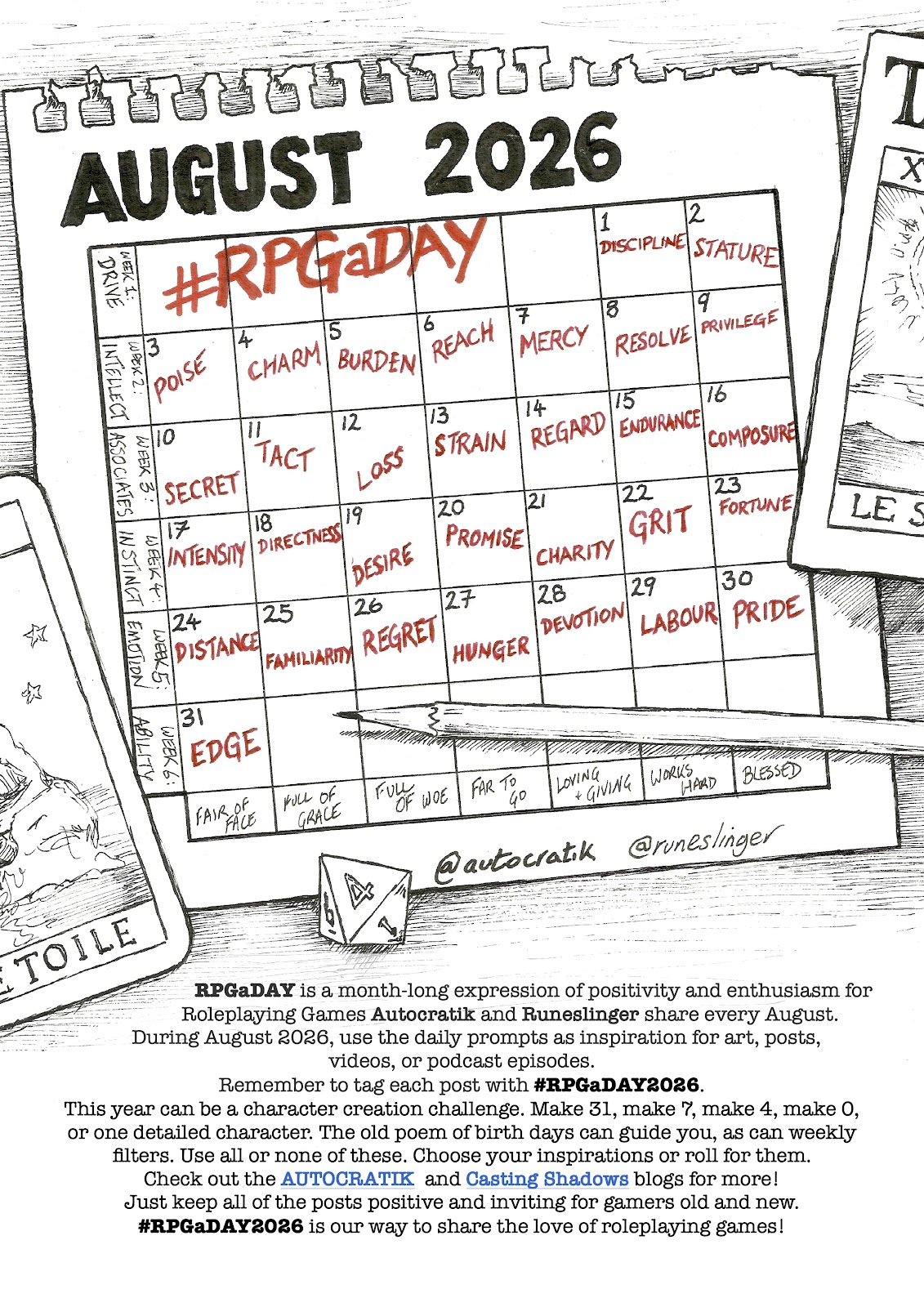
Today’s combination: Familiarity (Prompt) + Emotion (Weekly Modifier) + Full of Grace (Modifier) + Fantasy (Genre)
Here is today’s NPC.
Babrio Araya (Fantasy Name Generator used: Basque name generator)
From a humble hut on the outskirts of town, Babrio Araya works as an herbalist and healer. He rarely ventures into the settlement itself; instead, those who need his talents come to him. Whoever visits Babrio—whether noble or beggar—is always welcomed with a smile, greeted with warm familiarity, and never met with suspicion or ill intent.
Tall and broad, with a wild mop of black hair, Babrio wears his heart on his sleeve. His vividly expressive face rarely hides a thought, and his emotions are neither contained nor measured. This intensity is part of why he avoids the town proper. His sudden emotional outbursts frightened some of the populace, while his joyous insistence that the Gods speak to him directly completely enraged the local religious authorities.
The priests petitioned the town’s noble lord to punish the supposed heretic. However, the many people Babrio had healed over the years rallied to his defense, truly believing the man was full of grace. To keep the peace, the local lord agreed to leave the healer alone, provided he stayed outside the town borders.
The priests were not satisfied, and rumors spread that some even paid mercenaries to raid his hut. Yet, no attack ever came, and no one has managed to harm him. Instead, Babrio continues to help anyone who comes to his door, asking only for enough alms to feed himself and maintain his humble life. If you ever pass through this town and need your wounds tended, you know exactly where to go.
Thanks for reading; I am looking forward to your RPG a Day 2026 post, comments, and conversation. If you want further information about #RPGaDay2026, be sure to check out Autocratik’s blog.
A Spanish version of this post is available at the Desde la Fosa Facebook page.
See you all tomorrow!
Categories: Tabletop Gaming Blogs
Video of the Day – House of the Dragon Season 3, 2026
The post Video of the Day – House of the Dragon Season 3, 2026 appeared first on Blogtor Who.
Categories: Doctor Who Feeds
Pearl Mackie is ‘Baby’ at Brixton House
Doctor Who’s Pearl Mackie stars as Baby in a powerful new play about motherhood, prison, and the fight to survive
Pearl Mackie, the Doctor Who actor who the Doctor’s companion Bill Potts opposite Peter Capaldi, will star in a new one woman play at Brixton House in October. Baby is a new play by Gurpreet Kaur Bhatti (Behzti, A Kind of People, Marriage Material), directed by Milli Bhatia (Blue Mist, SPEED, seven methods of killing Kylie Jenner). It opens at the London venue at the start of October.
The Doctor Who star says she’s “admired [theatre company] Clean Break and the amazing work they do for a long time, so being cast as Baby means a great deal to me. I am incredibly excited to get stuck into this powerful and pertinent story, which comes at such a vital time when the injustice that mothers face in our prison system is finally getting the attention it deserves. Coming home to Brixton to play this fiercely unique character feels right and makes the experience all the more special.”
Baby
“They name me Baby. Means you’ll never seem old, even when you are. You’ll always bring hope, even when there is none. And you can always pretend you’re wanted, even when you’re not…”
Baby’s bright and beautiful. Baby’s trouble. Baby can do things nobody else can and why not? Britain’s got talent, hasn’t it?
Baby’s had it tough and she wants to keep Bliss. That’s all she wants. But something terrible stands in her way.
Now Baby has to solve a problem….and you’re part of her solution. Because you’re proper people. You must be, to be reading this. Plus, there’s nobody else she can ask…
Baby is coming…
The play opens with previews on the 8th of October. You can buy tickets now through the Brixton House site.
The post Pearl Mackie is ‘Baby’ at Brixton House appeared first on Blogtor Who.
Categories: Doctor Who Feeds
Kid Stardust
I think it started with watching Lanterns episode 2 last night. That must be it. It got me thinking about cosmic-powered supers, and that ultimately led to Stardust the Super Wizard. This morning I awoke after a dream where I was back in college playing Ali Hakim in a production of Les Miserables that had to be moved to a library after the theater was closed. My college friends were all there, mad at me that I didn't understand how my part fit into the story.
Over coffee, I started thinking about what would happen if Stardust the Super Wizard handed a fragment of his power to a young Peter Parker, gave him one cryptic clue, and then disappeared. You'd end up with Kid Stardust, who believes that with untold power comes untold responsibility.
Over coffee, I started thinking about what would happen if Stardust the Super Wizard handed a fragment of his power to a young Peter Parker, gave him one cryptic clue, and then disappeared. You'd end up with Kid Stardust, who believes that with untold power comes untold responsibility.
Categories: Comic Book Blogs, Tabletop Gaming Blogs
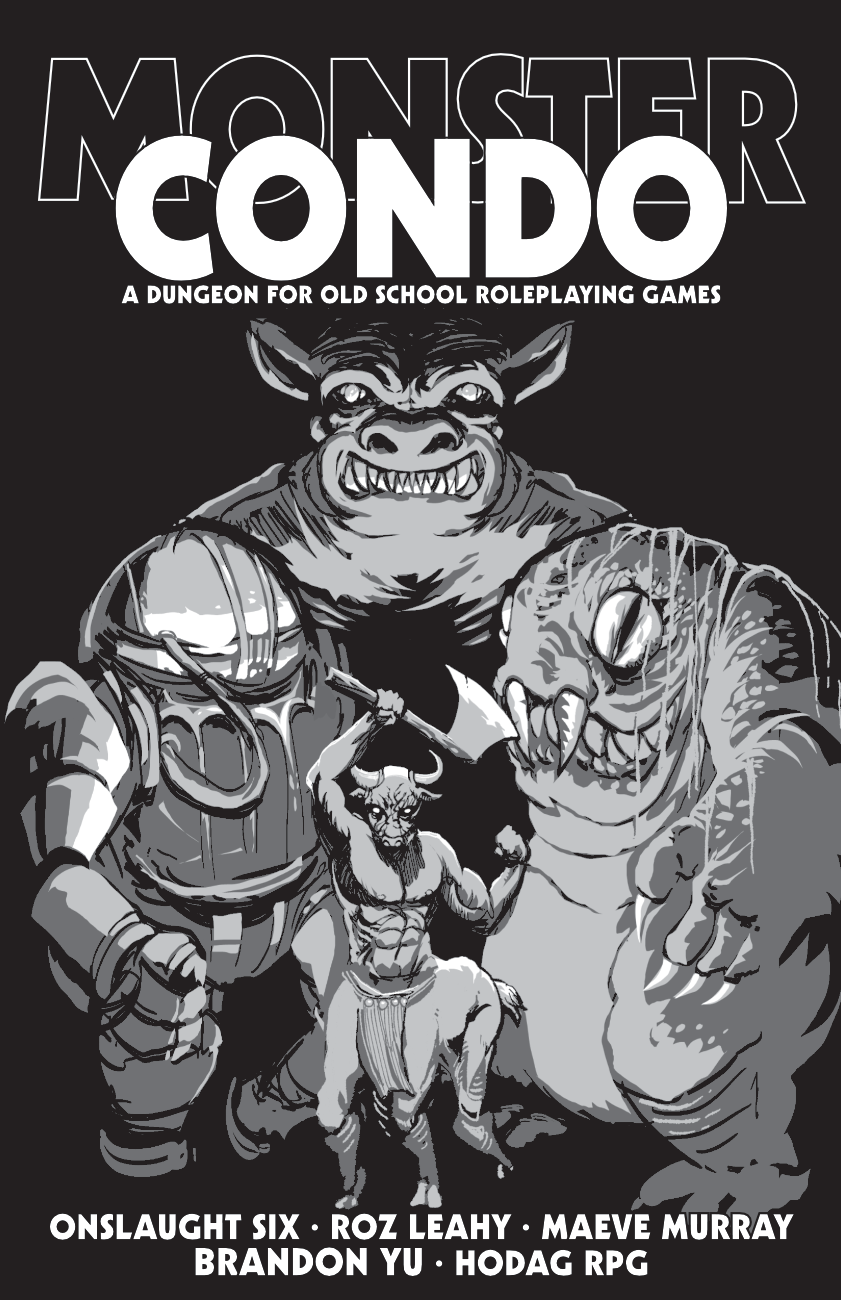
Monster Condo
By Onslaught Six, Roz Leahy, Maeve Murray
Tidal Wave Games
OSE
Level 2?
Tidal Wave Games
OSE
Level 2?
Engage with multiple factions of orcs, beastmen, rodentia, and cults. Infiltrate the followers of a doomed machine. Fall prey to a vampiric lord. Escape from the moat monster. Fight deadly monsters of chaos. Get treasure. Get out alive.
This 44 page digest presents one level of a dungeon with seventeen lairs comprising about 120 rooms. It’s a weirdly worded and padded out hack with secret doors being your only exploration, in spite of a balrog AND demon lord both being present.
There’s this old template complex and blah blah blah a year ago something happens and monsters move in. There are now seventeen different “zones” in this dungeon, each with about five or rooms in them. Yeah man, like I said, a year. And seventeen zones worth of monsters. So, you know, they’re motivated, I guess?
So, the map. One level. It’s got loops? No? Maybe? The seventeen or so zones are all like little mini-maps. Imagine you took seventeen dungeon geomorph tiles, each of which had five or six rooms on it. Then, connect those geomorph tiles with, like, a hallway in to it and a hallway out of it. I think a few of them actually have a THIRD hallway leading in/out of them. Pretty cool stuff, eh! No? Not? Not. And, then, I want you to use the TINIEST fucking font on earth to label each room. Chill? Sounds like a great idea. Yeah yeah, “bryce has old eyes” Fuck you. Well, maybe. But, also, more than one thing can be true at the same time. The fucking font here is TONY for the map keys. There is absolutely no way someone looked at this and said “yup, looks great!” which means that no one looked at it. Also, the map lists “0.1, 0.2” and so on but the text lists “a.1 and a.2.”
How about the room entries Mrs Lincoln? “This room contains a library of tomes purported to contain magical secrets. Taking the time to read the books reveals they are all hoaxes or inaccurate. Empty hooks, designed to hold shields and weaponry, line the walls of this room.” That is a typical room entry. If there’s a monster in the room then there would be a stat block also. So it’s not really read-aloud. And I’m not sure it’s really DM text either. The concept of a room? The concept of 120 rooms? How about “Rotting wood shelves endure upon the walls Hurrath “ Nice and purple, yes? Or “The Beastlord resides here, commanding his underlings to capture the Muroids and put them to work.”
This is a kind of interesting style of abstraction that pops up from time to time. It’s not the normal generic abstraction that shows up usually but more of a, oh, I don’t know, I think I’ve compared it to writers note for an episodic tv series. “Kirk is a brash officer, a ladies man born in iowa who was the only person ever to pass the blah blah blah.” So, it’s kind of painting a general picture of what’s going on. And, to a degree, that is the point of writing a room, you want to give the DM an idea of what is going on there so the DM can then take the reigns and run it. But it’s almost as if the room is forgotten, the specifics of playing a D&D adventure are forgotten. If we look at the room descriptions “The Beastlord resides here, commanding his underlings to capture the Muroids and put them to work” then you get a decent idea. Yes, that is what is going on here, in general, as in that is the kind of activities that take place here. Maybe we could summative it as “throne room” or “command center. “ That tells us the same thing. But, also, not, what the fucking is going on in the room? If he directing his legions and the the party runs in ala New Hope? Does he have a sand table he is standing over? What the adventure has provided are some very general writers notes. As if it were then to be handed to a different writer who would then create a room, the specifics, from it. “Lou! I need two paragraphs by Tuesday about a room that some dude called the Beastlord oversees his attempts to capture the Myredions.” That’s not a room description. It’s the IDEA for a room description. Not chill.
Let’s see. We’ve got a zombie ogre in this place. He has a pot on his fireplace bubbling away. Can zombies do that? He’s smart? I guess He’s got a pet gelatinous cube. Wait, what?! Nothing means anything anymore. My kobold has a pet Zeus on a leash. The LG Lich is fighting against the forces of Nirvana and their commander Asmodeaus. Look, man, bend things is you will but you gotta have SOME kind of logic to them. And why the fuck do we need to know that the zombie dude feeds the cube limbs and pieces of its victims. That’s backstory. Better if the cube is guarding something, some passage or some way its stuck, and there’s a crate of limbs and bodies in another room with obvious limbs hacked/torn off. Then it makes some kind of sense.
Essentially each room is just a combat. The various zone leaders DO have some goals. Like “Bob wats the eye of moloch” but the roleplaying notes and faction issues really are not present much, except maybe in an occasional note like “Mary hates everyone. Thus, each room is just the concept of a room. You go in and kill something. You pick up some genero treasure. “An unusual hat made of peculiar material.” YES. Not why the fuck is the hat unusual and what’s it made of?!!?!!!?!?!? A foppish beret made of liquid jade. There, done. See how I named the hate and why it was unusual, instead of just saying its a weird hat made of something unusual? That’s the fucking difference.
Hack hack hack. Abstracted text.
Oh, also, 2d6 wizards are summoning a balrog in this, who WILL show up, as well as some cultists summoning Moloch Archduke of Hell. Who will then go on a tear killing like every following of Tenebrous in the dungeon and then the world. So, you know, better to just kill everyone then talk to them anyway, about their goals and what their needs are.
Little to no interactivity beyond stabbing. Abstracted room and treasure descriptions. Move along move along nothing to see here.
This is $10 at DriveThru. Taint got no preview. Boo! Boo I say! Show us what the fuck we are buying, a sample of it, before I spend my assistant crack whore trainee monies on it.
https://www.drivethrurpg.com/en/product/562586/monster-condo?1892600
Categories: Tabletop Gaming Blogs
The Mismatch in Appendix N

One of the things about Appendix N in the AD&D Dungeon Master's Guide is that, in the main, the protagonists of the works featured don't really represent the typical PC in the old school mode, at least in the way players first meet them at lowly first level. "You're no heroes" has become a cliched marketing line in newer games wishing to evoke the old school D&D vibe, but the fantasy protagonists of Appendix N are heroes, at least in terms of capabilities.
In older D&D, characters get by cleverness (player skill) or by luck (die rolls), but even when we first meet them, the likes of Conan, Fafhrd & Gray Mouser, Ganelon, and Skafloc are skilled, puissant sorts. One might quibble regarding Fafhrd and Gray Mouser. Tthey are presented in the chronologically earlier but written later Leiber stories "Snow Women" and the "Unholy Grail," as youths, but they seem to be pre-hero (call it 0 level) in those, to me. We are told that Conan, in contrast, was formidable even at a young age: "I was one of the horde that swarmed over the hills. I hadn't yet seen fifteen snows, but already my name was repeated about the council fires."

There is fiction more representative of these early level adventurers perhaps as likely to come to ruin as to succeed, but we don't find it as much in heroic fantasy as in other genres. Fairytales and legends with their less competent protagonists often have heroes escaping by cleverness or luck or Providence --or not escaping and meeting a bad end. Picaresque adventure novels and some novels in the Gothic tradition often have protagonists buffeted from one predicament to another and seldom do they get out of them due to their adventuresome capabilities!
While not as violent as D&D or as some older fairytales, the Oz novels have protagonists engaging in exploration, encountering dangers, and mostly having combat being a fail-state.

This sort of plot where characters either narrow escape (or fail to escape) does show up in fantasy, too. Lord Dunsany (who is in Appendix N) and Clark Ashton Smith have stories of this sort. Mignola and collaborators have created some stories in the style of these two masters in Bowling for Corpses and Other Strange Tales from Lands Unknown and Uri Tupka and the Gods.
Are there any of the most frequently cited Appendix N authors and works that depict these sort of characters? I think so. Jack Vance with Eyes of the Overworld and Cugel's Saga, certainly, and Tolkien's The Hobbit.
Categories: Comic Book Blogs, Tabletop Gaming Blogs
OSR Module Commentary Adapting Gary Gygax’s classic 1980 TSR module S3: Expedition to the Barrier Peaks to Adventurer Conqueror King System II (ACKS II)
Adapting Gary Gygax’s classic 1980 TSR module S1: Expedition to the Barrier Peaks to Adventurer Conqueror King System II (ACKS II) transforms a gonzo sci-fi/fantasy dungeon crawl into a high-stakes Expedition with domain-level, military, and tech-securing implications.In ACKS II, the crashed starship is not just a loot run—it is a repository of Ancient Tech capable of disrupting regional Needleshttp://www.blogger.com/profile/11243274667834930867noreply@blogger.com0
Categories: Tabletop Gaming Blogs
RPG a Day 2026 – Day 24: Distance
Welcome to Day 24 of #RPGaDay2026. As I explained in my Day 0 post, I’ll be creating NPCs based on the day’s prompts and the week and day modifiers presented in the infographic below. Check out that post for further details.
Today’s combination: Distance (Prompt) + Emotion (Weekly Modifier) + Fair of Face (Modifier) + Western (Genre)
Here is today’s NPC.
Emogene Covington (Fantasy Name Generator used: Old West name generator)
The Widow Covington is a young woman from the East Coast who traveled to this frontier town to marry Booker Covington, the proprietor of the Covington Hotel. The grand Victorian-style building is the largest in town, built when Booker invested the profits from a silver strike to rebuild his original establishment.
A lifelong bachelor, the older Covington sent for the beautiful young woman and her little son after exchanging letters with her family. Her striking features and fair complexion quickly became the talk of the town. Women jealously commented on her fair face. The significant age difference was a popular subject of gossip, but the fact that she was already a young widow with a child fueled the most chatter.
When Booker passed away just a few weeks after the wedding, the local rumor mill truly went into overdrive. Emogene displayed the appropriate emotions as her new husband was buried, donning widow’s weeds and strictly observing mourning conventions. Dressed entirely in black with a veil obscuring her face, she kept her distance from most of the townsfolk.
Today, the Widow Covington is still officially in mourning, remaining distant and stoic while her young son runs about the hotel. She continues to oversee the establishment’s day-to-day operations, alongside her other, less-public ventures: hiding wanted criminals for a steep price and acting as a fence for stolen goods. Whether she inherited these illicit side businesses from her late husband or started them herself remains unclear. However, if you are part of the local criminal underworld, this distant, veiled widow is someone you will inevitably have to deal with.
Thanks for reading; I am looking forward to your RPG a Day 2026 post, comments, and conversation. If you want further information about #RPGaDay2026, be sure to check out Autocratik’s blog.
A Spanish version of this post is available at the Desde la Fosa Facebook page.
See you all tomorrow!
Categories: Tabletop Gaming Blogs
Video of the Day – Doctor Who Night: A Trip into the Future, 2026
The post Video of the Day – Doctor Who Night: A Trip into the Future, 2026 appeared first on Blogtor Who.
Categories: Doctor Who Feeds
TSR's module A2, Secret of the Slavers' Stockade (Dungeon Level)
After a long hiatus, during which my role-playing table defeated all that A2 had to offer, I probably should wrap up with a critical review of the dungeon part of the module.
Like the fort level, the dungeon is built around two "railroad" sequences of rooms which are shaded on the TSR map. Each is similar in structure, leading the players at first through a sequence of traps, trick ambush fights, and difficult problem environments. Each sequence culminates in a boss-group fight that (like the climax of the fort level) is laid out tactically for the GM in a then-innovative detail map showing the location of each foe and furnishing.
Also like the fort level, these tricks and traps are for the most part shamelessly silly. This is D&D funhouse material with no care for naturalism. There's a magnet trap in the wall, punishing plate mail and capturing blades while hobgoblins run out and hit you with wooden clubs. There's a gauntlet of oily grille-bars through which a colony of boggles, the dimension-hopping menaces used as hound dogs in the fort, will stab and pickpocket you. There's a cave that can only be traversed by finding the sawn-off tops of stalagmites that cross an abyss filled with obscuring and sometimes scalding steam. There's a room with beehives, but no flowers; a room for cheesemaking, with nothing remotely milkable.
Indeed, if the module's dungeon were laid out just with the two railroads connected end-to-start, the whole ordeal would be a ridiculous way for the bad guys to run their operations - tortuous, snaky, running visitors and reinforcements through deadly steam, giant spiders, and bees. But in the first improvement over the fort level, the published edition of the dungeon adds sensible secret passages that both make more sense of its layout and allow more discovery and choices in play. There's a secret shortcut around the boggle grille that can be deduced by watch the scary but harmless ghost of an elf act out its last actions on Oerth. There's another that allows bypassing the steam and bee perils, leading from the first boss fight to the newly developed back area of the second boss fight -- an area that itself is laid out in a branching, not railroad, way.
Some of the other trickery works remarkably well in play. The boggles in their grille-gauntlet get to use their limb-phasing ability for good effect, not wasted as it is in the fort level. I played it like this: for each 5 x 5' wall, floor or ceiling surface a player is exposed to, they have a 1 in 6 chance of being spotted by a boggle (and can then attack its face, if they are watching and ready in that direction), once spotted, they have a similar chance of coming under attack from each surface they're close to, with an even chance of being stabbed or pickpocketed. I was able to drive the players to some truly wild levels of spell-based problem solving to get the more vulnerable members across. One even had a prized weapon stolen from him, which in the bounce-back world of 5th edition stings much more than 10 or 20 hit points damage would. The hives and their honey-bucket trap, as silly as they are, also lead into creative solutions (5th edition makes it easy to talk to the bees and that's the way my nature-loving players went.)
The end-of-railroad fights, like the one in the fort level, show off principles of a good tactical challenge that would become codified in advice to Dungeon Masters over the coming decades - variety of opponents, terrain features and obstacles (stairs, balconies, tables), and weaponized hazards (falling chandeliers, brine vats, caged monsters). By the early 80's it could no longer be taken for granted that DMs had a devious wargamer mind, so each fight comes with a detailed playbook of the foes' positioning, moves, and spells. These instructions may have been created out of a wish to standardize the running of the combat in tournament situations, but they also came to serve as examples for DMs who wanted to write and run their own memorable combats at home.
In the fort level, many of the added areas beyond the tournament gauntlet seem like dead ends or afterthoughts. In the dungeon, the added areas are much better done. They include the living quarters and operations of a varied group of slavers, led by Markessa, the boss of the final fight. As in the preceding module, there is an area of cages, as well as living quarters for the slaver NPCs. In full realism mode they include a kitchen, mess hall, and latrine.
We also find the lair of Markessa and areas supporting her operations. This evil elf is already memorable as a mad scientist -- she is responsible for many of the mutant creatures in the dungeon, and the fight takes place in her lab. Her home area has the details that establish her as one of the best villains in the TSR modules. There's a cloned body double, a surgically enhanced perfect lover and bodyguard, plenty of secrets and tricks, and a whole cave complex full of mutant humanoids, the cavelings, who worship her as a goddess.
The caveling area is the most underdone part of all this. The map places their caves in a tightly arranged 100' square, but the description of their environment deserves a more sprawling, abstracted or procedurally generated maze of tunnels to live in. The cavelings also are meant to fuel the unruly-stronghold dynamic. Not only are they subject to various mental derangements, but they steal and eat slaves from the cells from time to time (how exactly?), and they explicitly can be turned against the slavers and even their creator Markessa. How the rabble-rousing is supposed to happen, when to get to the caveling area you will have to fight through both the slavers and, probably, Markessa, is not clear. Still, the intention is there.
When you run out of space in the corner of the graph paperA better unruly element is the gang of slavers nominally allied with Markessa, whose leader, Blackthorn, is an ogre mage who affects a creepy-barely-human shape. Like his name-alike in James Clavell's Shogun (Japanese ogre, get it?), Blackthorn is ambitious and might work with the party to betray Markessa. In his barracks are some werewolves and a group of slavers who mostly embody the banality of evil - an architect, an accountant, an alchemist, all keeping the wicked operation running.
Blackthorn is a more credible early encounter, as his area can be reached through one of the secret passages early on. But Markessa has a way of spying on him -- a telepathic potted plant with hidden mutant eyes and ears which, although absurd, is memorable and perfectly in character for the mad scientist.
Overall, the dungeon level presents a fun challenge marred by implausible excess and less-than fluent strategic design. I have to also mention the obvious repetition of elements from the fort level. This is understandable if the level was designed to be run in parallel, but it creates jeopardy if the whole place is run as one adventure. These repeats include:
- Were-creature henchmen (boars above, wolves below)
- A kitchen with a grumpy cook
- A trap with a rolling danger (bear on wheels, pile of logs) and a pit behind
- A slave gone insane (escaped in the fort, caged in the dungeon)
- An apparition tied to the trauma of its death - represented by two different monster types, the haunt and the less dangerous phantom, both intended to be less difficult than the official high-level Ghost monster.
- An NPC found sitting behind a desk, who pretends to chat with the PC's in good faith for a while, then flips the desk and attacks
As well, there's material that repeats well-known beats from other TSR modules of the era. There's a wholly gratuitous delegation of drow and a tunnel leading down to the underdepths. Obviously, this calls back to the culmination of the Giants series, but tends to undermine Markessa as the most evil elf-type around. The masquerading ogre mage is maybe just a good use of the monster type but recalls a similar climax at the end of one of the railroads in White Plume Mountain.
As a whole, A2 is a more ambitious, unbalanced, and overstuffed experience than A1. The unruly elements don't quite rule out the danger of a total party kill on the fort level, while the dungeon level is both less railroaded and less amenable to a complete mobilization of the defenders. The creative and naturalistic challenges of A1 take a turn for the worse, into absurdist funhouse territory. Markessa is a much better final boss than the underwhelming Sturm Bluchholtz of A1 (who's not even named in the first printing). As proof of her appeal, in the Slavers sequel module from 2000, the idea of a self-obsessed villain who creates a line of clone henchwomen led to some righteous excess, with different color-coded Markessas roaming the Flanaess.
The Stockade can be said to outdo the Undercity, but that's not always a good thing. In any event, we are past the high-water mark of the series now, as we prepare for the least worthwhile module of the quartet, A3 - Assault on the Eyrie of the Slave Lords.
Categories: Tabletop Gaming Blogs
Adapting North West of Earth By C.L. Moore - Orbital Decay (MicroRed version) From The Red Room & The New Flesh Rpg - Sci Fi Adventure Locations D100 Old School Solar System Random Graves, Tombs, & Dungeon Table
In the classic planetary romance tradition of C.L. Moore and Leigh Brackett, the Solar System is littered with the bones of forgotten civilizations. These ancient burial sites, sealed vaults, and subterranean ruins hold immense power, cosmic terror, and unimaginable wealth for bold rogues and spacers.Below is a d100 Random Graves, Tombs, & Dungeon Generator Table tailored for old-schoolNeedleshttp://www.blogger.com/profile/11243274667834930867noreply@blogger.com0
Categories: Tabletop Gaming Blogs
RPG a Day 2026 – Day 23: Fortune
Welcome to Day 23 of #RPGaDay2026. As I explained in my Day 0 post, I’ll be creating NPCs based on the day’s prompts and the week and day modifiers presented in the infographic below. Check out that post for further details.
Today’s combination: Fortune (Prompt) + Instinct (Weekly Modifier) + Blesses (Weekly Modifier) + Post-Apocalyptic (Genre)
Here is today’s NPC.
Malahki (Fantasy Name Generators used: Futuristic name generator and Scientific device name generator)
Malahki is the proprietor of a gambling den in a crossroad settlement. His establishment, The Blessed Fortune, is a wooden two-story building with a sign bearing its name in large, gaudy letters. Jugglers, fire-eaters, and exotic mutants perform outside, inviting passersby to come in and try their luck.
Malahki was once a scavenger, surviving by rummaging through the ruins of the past out in the wastes. Stories tell of how he found a powerful artifact from before the fall and used the riches it brought him to start his enterprise. The owner of The Blessed Fortune not only runs card and dice games but also hosts pit fights and animal races. He loans money to his den’s patrons, as well as to merchants and traders in town. Everyone knows Malahki has a sharp instinct for business and games.
What only a few trusted associates know is that the relic Malahki found was the Harmonic Twister—a box of dull metal with dials and controls that shift locations across its surface every time it is used. Only Malahki understands how it works. To those he trusts, he explains that the Harmonic Twister whispers to him.
The artifact controls luck and probability, warping reality to produce outcomes that benefit Malahki. Simple, small adjustments, like ending a client’s lucky streak, have little visible effect on the world; perhaps someone’s eye color shifts, or they suddenly have a new name that everyone seamlessly accepts. Larger adjustments, like causing the failure of a debtor’s plans or eliminating a rival, impact the world in major ways, profoundly changing the people around him or even rearranging buildings across town. Regardless, thus far, only Malahki notices these shifts in reality, and most work to his benefit.
Thus far.
Thanks for reading; I am looking forward to your RPG a Day 2026 post, comments, and conversation. If you want further information about #RPGaDay2026, be sure to check out Autocratik’s blog.
A Spanish version of this post is available at the Desde la Fosa Facebook page.
See you all tomorrow!
Categories: Tabletop Gaming Blogs
[ZINE] Echoes From Fomalhaut #15: The Gardening Issue (NOW AVAILABLE!), US Shipping Options

I am pleased to announce the publication of the fifteenth issue of my fanzine, Echoes From Fomalhaut. This is a 64-page zine dedicated to adventures and GM-friendly campaign materials for OSRIC and other old-school systems. The cover art was provided by Graphite Prime, and the interiors by Ferenc Fabian, Cameron Hawkey, Jason Blasso, and the Dead Victorians. The current issue features a larger wilderness scenario, a port town, two smaller articles, and plenty of gardening advice! The following materials are included:
The Hanging Gardens of Pasquino Babilonio (levels 4–6, 32 keyed areas), a large wilderness scenario set in a mysterious hanging garden left behind from the late days of the Empire. A masterwork of garden design, this place is more than it seems, and hides a long-lost secret which reveals Pasquino Babilonio’s true design.
Pellagris, Port of Plenty (35 keyed areas). A pleasant coastal town on the borders of fair Frabotia, Pellagris has survived centuries of turmoil without much destruction. An orderly mafia town and noble resort, it is a fine place to rest and plan new adventures – but there is enough local intrigue to keep a group occupied or send them on far-flung adventures.
Significant Ships: A collection of 20 ships to be encountered in port, or on the high seas.
The Garden of Punches (levels 2–4, 9+18 keyed areas), a fighting school which has taken over an abandoned village. What conflict lurks among the school’s pugilists? What is the secret of the old lighthouse? And what can we learn about gardening in this place? Find out HERE!
The Illustrious Index of Incline: A catalogue of Echoes #01 to #15, also available here.
Two foldout map sheets with player and GM maps.
* * *
The print version of the zine is available from my Bigcartel store; the PDF edition will be published through DriveThruRPG with a few months’ delay. As always, customers who buy the print edition will receive the PDF version free of charge.
US Shipping Options
Freedom is Coming!
(But Freedom Ain't Free)I am happy to report that US shipping is once again
available through my storefront. I am less happy to report that these shipping
options are not yet a return to the normal shipping possibilities that were
available previously. What we have for now are substandard solutions and
workarounds.

Option #01 – Postal Shipping: Currently, due to the elimination of postal De Minimis exceptions last August, commercial mail, which was a cheap and reliable shipping option, is not yet available, and after a year, it is doubtful if it will be. I can currently ship to the US through commercial EMS packages. These start at a high threshold at the equivalent of $75. They scale up well, so a very large box containing most of my books is not much more expensive than one containing a single zine. Therefore, all US orders will ship for $75. I will make up the difference as a form of discount, but I cannot charge less. This is not a good way to order a single zine (for that, I may recommend Option #02), but it may make sense for a larger batch. On the upside, EMS packages ship fast, usually arriving within a week of postal dispatch.
I will keep investigating alternate shipping options; unfortunately, those I have found on the Hungarian market have not been better than the Post.
Option #02 – Ordering Through Dark Future PDX: As a shipping alternative, I can recommend checking out Dark Future PDX, where this product will be available in a few weeks. Dark Future are a small store, so they may not have everything in my catalogue all the time, but they restock regularly, and they have amassed a good reputation. They will also be carrying the forthcoming Gamemaster’s Guidelines Beyond Fomalhaut. Orders through Dark Future are also eligible for free PDFs.
The Perfidious Port of Pellagris

Categories: Tabletop Gaming Blogs
RPG a Day 2026 – Day 22: Grit
Welcome to Day 22 of #RPGaDay2026. As I explained in my Day 0 post, I’ll be creating NPCs based on the day’s prompts and the week and day modifiers presented in the infographic below. Check out that post for further details.
Today’s combination: Grit (Prompt) + Instinct (Weekly Modifier) + Works Hard (Weekly Modifier) + Pulp and Two-Fisted Adventure (Genre)
Here is today’s NPC.
Ernest “Ernie” Chase (Fantasy Name Generator used for the name: 20th century English name generator)
Ernie is a twelve-year-old newsboy whose father died in the war. After his mother disappeared, he and his young sister were left to live with their grandfather. The old man is often drunk, so Ernie works hard to keep himself and his sister fed despite life’s hardships.
Short and scrawny for his age, Ernie has learned to trust his instincts to survive the city’s dangers. While he lacks a formal education, he possesses a sharp mind. He reads better than he writes, but above all, he prides himself on never forgetting a face or a name. His sheer grit keeps him alive on the streets.
Because newsboys are a ubiquitous sight, and most adults pay little attention to children anyway, Ernie is perfectly positioned to see and hear what people try to keep hidden. He has cultivated a network of clients who pay him to keep an eye out for specific targets, listen in on conversations, and report on the comings and goings across the city. Policemen, smugglers, and gumshoes alike all know to slip Ernie a coin for a vital piece of information.
Thanks for reading; I am looking forward to your RPG a Day 2026 post, comments, and conversation. If you want further information about #RPGaDay2026, be sure to check out Autocratik’s blog.
A Spanish version of this post is available at the Desde la Fosa Facebook page.
See you all tomorrow!
Categories: Tabletop Gaming Blogs
OSR Adventure Fodder - A D100 Random Sword & Sorcery Lovecraftian Encounter Table for Castles & Crusades rpg
To run a Lovecraftian Sword & Sorcery adventure in Castles & Crusades, lean heavily into cosmic dread, decaying sorcery, alien geometry, and sanity-draining horrors. Use the D100 Random Encounter Table below to stock wilderness travels, subterranean crawls, or city ruins with eldritch threats.D100 Sword & Sorcery Lovecraftian Encounter Tabled100Encounter Description01–04The Needleshttp://www.blogger.com/profile/11243274667834930867noreply@blogger.com0
Categories: Tabletop Gaming Blogs
TWO OF A KIND! GAMBIT TRADES HANDS WITH HIS AGE OF APOCALYPSE COUNTERPART IN GAMBIT: GONE!
Get a first look at GAMBIT: GONE, the five-issue series by Steve Orlando, Edoardo Audino and Gerado Sandoval spinning out of X-MEN OF APOCALYPSE, on sale September 23. New York,…
Categories: Comic Book Blogs
ABSOLUTE GREEN ARROW WRITER PORNSAK PICHETSHOTE & UNKNOWN SOLDIER ARTIST ALBERTO PONTICELLI JOIN FORCES FOREXQUISITE CORPSES: LONE GUNMAN THIS NOVEMBER
This third spin-off miniseries will explore haunting past, foreboding future of The Golden Masked Killer PORTLAND, Ore. 08/21/2026 — Eisner Award winning writer Pornsak Pichetshote (The Good Asian, Absolute Green Arrow)…
Categories: Comic Book Blogs
Pages
