Your wildly multifarious home!
Tabletop Gaming Feeds
Mayday! Mayday! Happy Traveller Day
“Mayday! Mayday! This is Free Trader Beowulf! Calling anyone! Our ship has suffered a catastrophic systems failure and is drifting in space. We are in grave and imminent danger!”
Today is May 1st, and in the TTRPG community, we celebrate Traveller Day. This classic sci-fi game was created by Marc Miller 49 years ago—which means next year is the massive 50th anniversary!
Traveller is near and dear to our hearts here on the blog. Just look at all the posts we have written and how often we’ve mentioned it. Seriously, go ahead and search the archives!
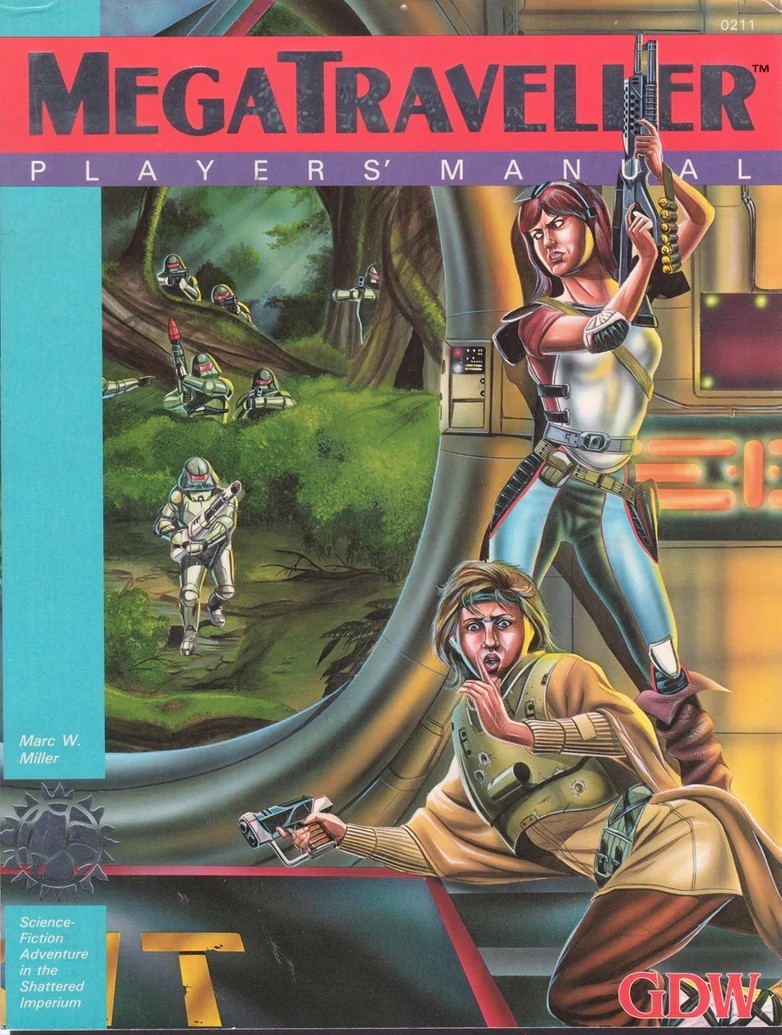
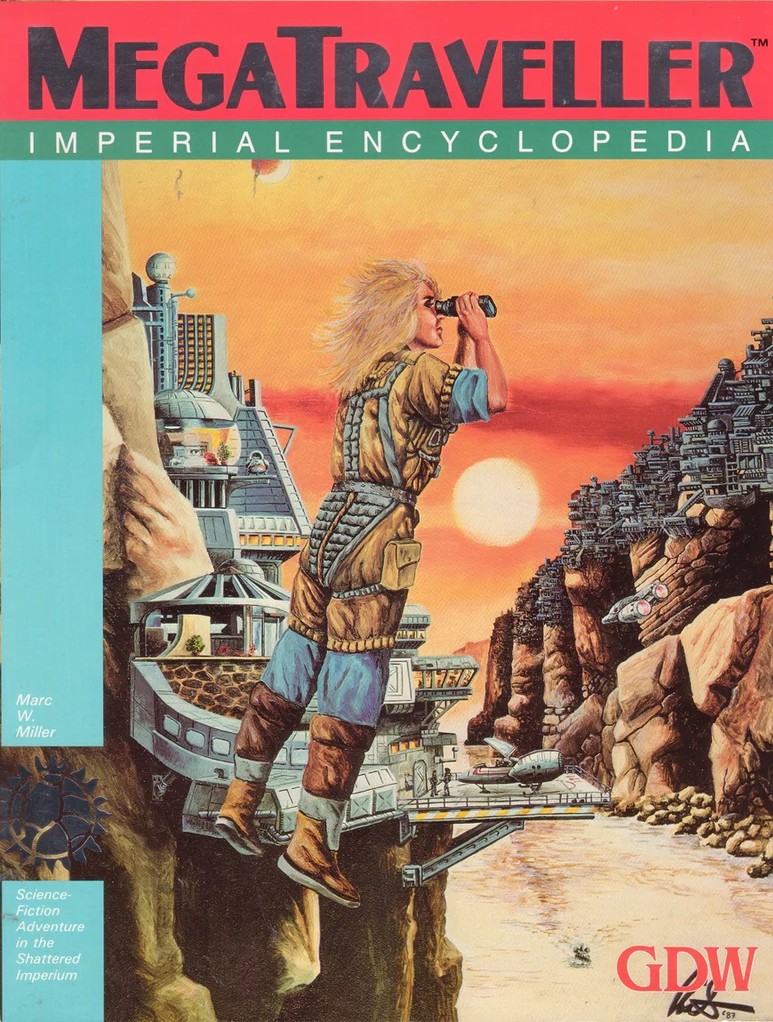
I originally discovered the game via MegaTraveller after seeing the ads in Dragon Magazine. I ordered it from Wargames West, and while the rules weren’t the easiest for me to follow back in 1988, the Imperial Encyclopedia grabbed me immediately. I read entry after entry, and I was completely hooked on the Imperium.
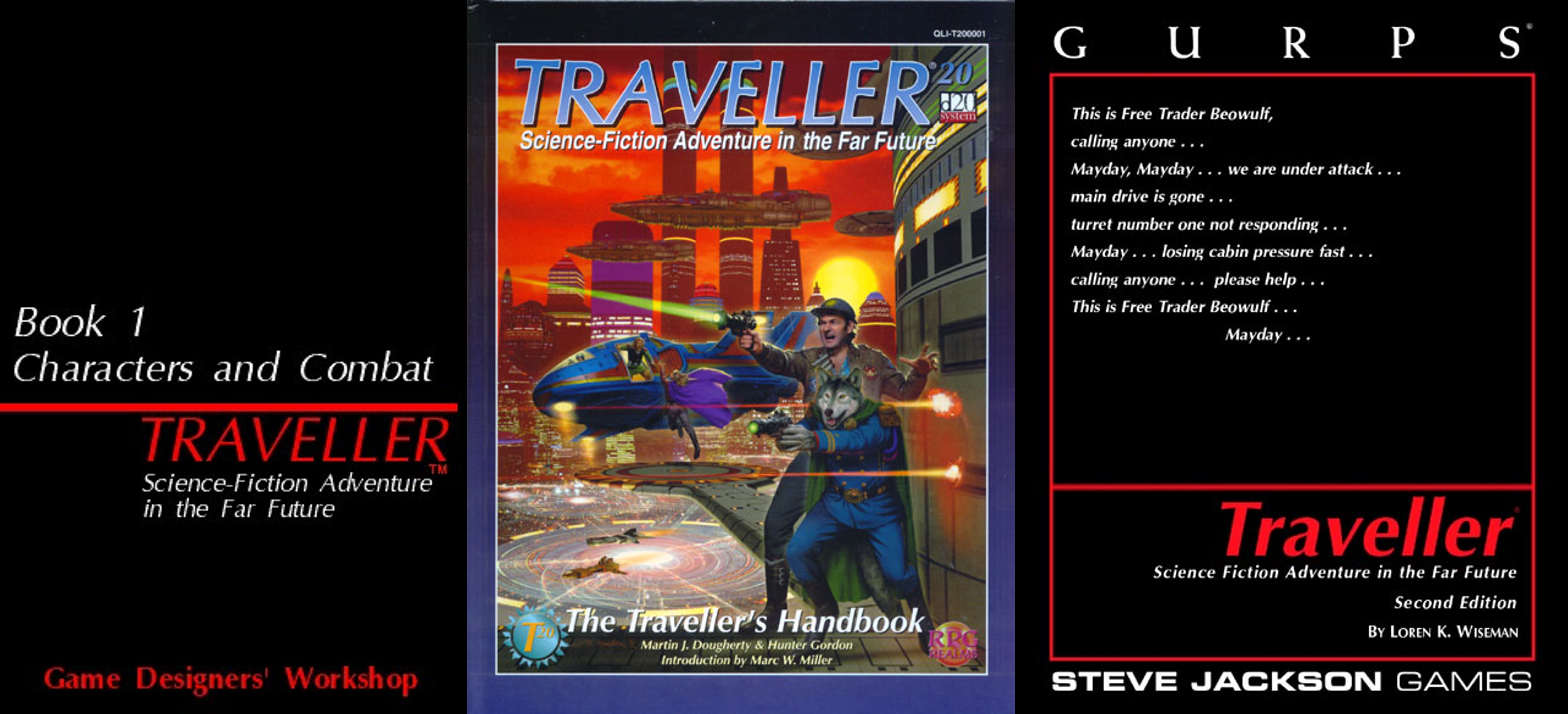
From there, I hunted down every Traveller book I could find. I picked up the Little Black Books (LBBs) second-hand, a boxed set in Spanish, and nearly every subsequent rulebook version—including the original d20 book, Traveller: The New Era, and GURPS Traveller. I’m pretty sure that after D&D, Traveller is the game system I own the most versions of.
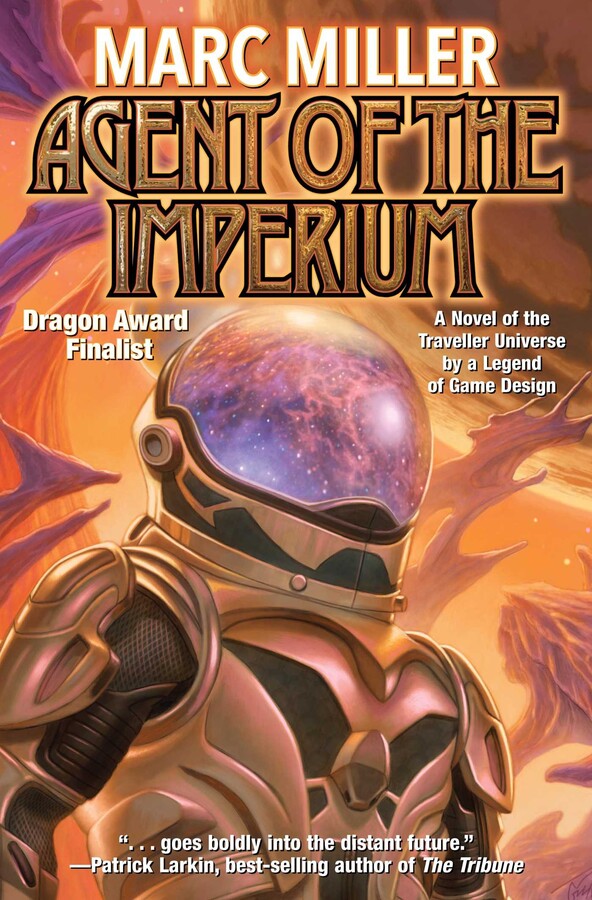
I also have the Far Future Enterprises CD-ROMs, and I absolutely loved Marc Miller’s novel, Agent of the Imperium.
Today, I believe Mongoose Publishing is a fantastic steward for Traveller and Miller’s other games. I own their 1st edition, 2nd edition, the 2022 revised versions of their core rules, and a myriad of supplements. Add to the mix the various retro-clones such as Cepehus, and additional editions out there, and even though Traveller is turning 50 next year, it is an incredible time to be a fan.
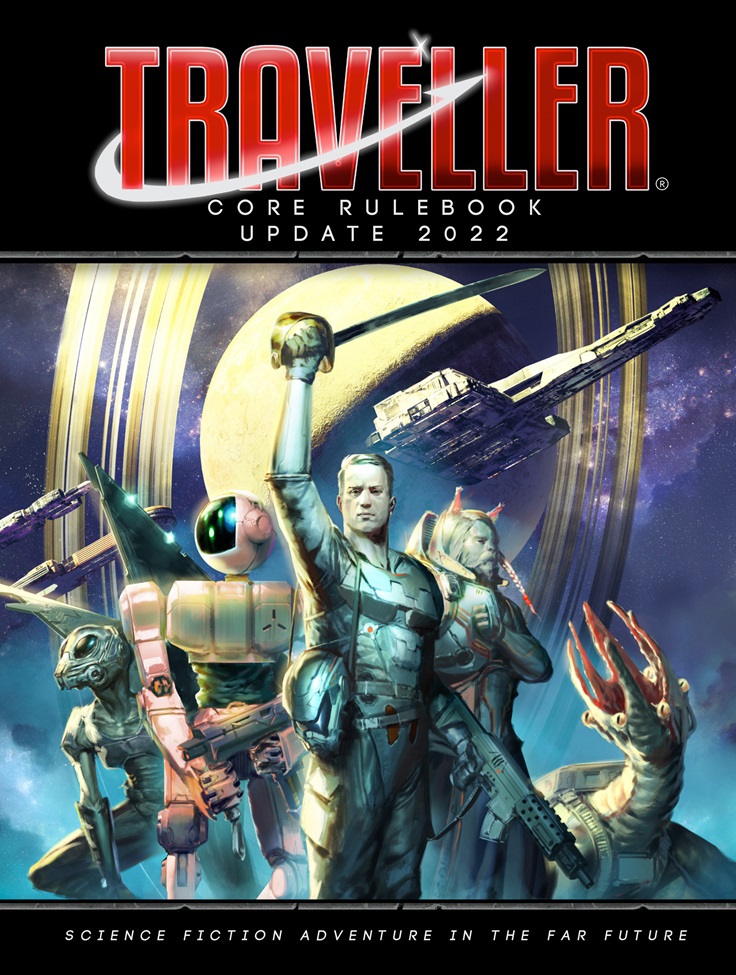
While Traveller is a robust sci-fi ruleset you can use to run your own homebrew games, for me, it truly shines when exploring the rich setting of the Third Imperium.
If you want to dive deeper into the history of the game, I wholeheartedly recommend This is Free Trader Beowulf by Shannon Appelcline (also available digitally).
Since it’s Mayday, there are some great Bundle of Holding offers you can take advantage of right now to start playing:
- The Traveller Update (featuring the latest iteration of the Mongoose rules): https://bundleofholding.com/presents/TravUpdateR1
- Traveller Mercenaries: https://bundleofholding.com/presents/TravMercs2026
- Traveller Imperial Navy: https://bundleofholding.com/presents/ImperialNavy
- The Little Black Books bundle: https://bundleofholding.com/store/TravellerLBBs
You can also try out the rules for just $1 with the Traveller Explorer’s Edition.
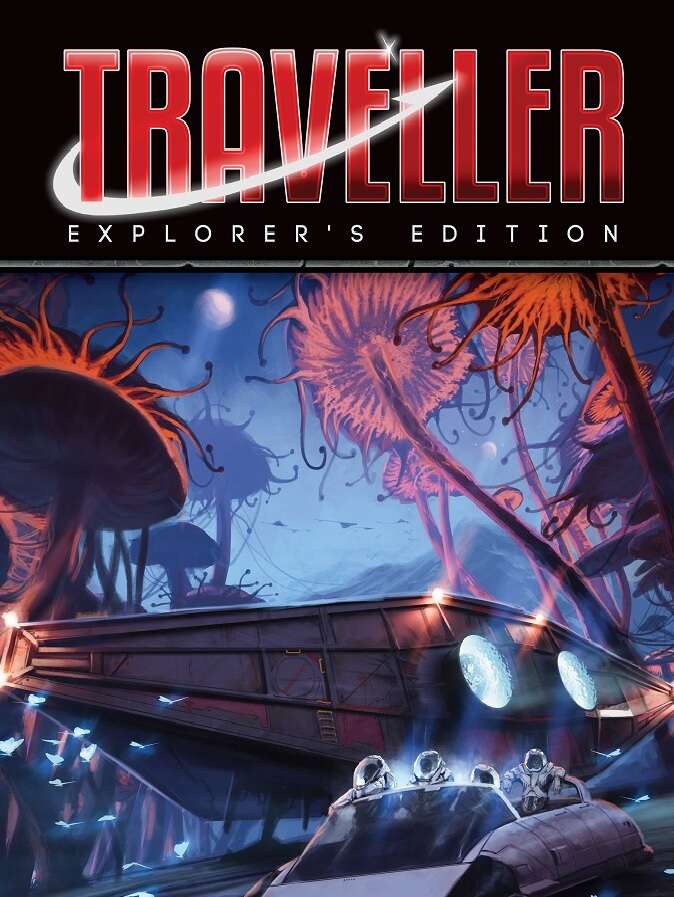
Now there is even a digital companion, Traveller Nexus. The easiest comparison is D&D Beyond for Traveller.It seems that the Explorer Edition rules are free on Traveller Nexus.
What else can I say? It is a great time to be a Traveller fan. Begin your journey into the Third Imperium!
Categories: Tabletop Gaming Blogs
D100 Random Urban Encounters For the Hostile rpg Table
In the gritty, industrial sci-fi world of Hostile, urban environments are rarely just "cities." They are pressurized hubs of corporate greed, neon-soaked decay, and desperate spacers.Here is a D100 table of urban encounters, ranging from minor flavor to potential campaign-ending catastrophes.The Hostile Urban Encounter TableD100Encounter TypeDescription01-05AtmosphericA sudden acid rain Needleshttp://www.blogger.com/profile/11243274667834930867noreply@blogger.com0
Categories: Tabletop Gaming Blogs
Into the Majestic Fantasy Realms: The Northern Marches has been released!
Last year, I launched the Kickstarter for Into the Majestic Fantasy Realms: The Northern Marches. Over 800 backers brought my projects to life, and now it is time to let the rest of the hobby into this project and experience the Northern Marches and the freedom that a well-supported sandbox campaign offers. At 8pm EDT tonight, April 30th, on the Vlog of Many Things I will be releasing the guidebook and maps for public purchase.
Vlog of Many Things Live Stream
Into the Majestic Fantasy Realms: Northern Marches
- Premium Color Hardback ($59.99)
- Standard Color Hardback ($49.99)
- Standard Color Softback ($39.99)
Maps of the Northern Marches and selected towns
- 18 printed 12" by 18" Maps ($19.99)
What if your players could shape a world that remembers them? From the frostbitten ruins of the Wild North to the magical storms of the Ring Islands, the Northern Marches await.
The Northern Marches expands my Blackmarsh setting into new lands: the cold taiga and icy rivers of the Wild North, the wilderness frontier of the Southlands, the conquered Viking realm of Vasa, and the westernmost duchy of the Grand Kingdom, Northport.
Each region of the Northern Marches brims with ancient ruins, forgotten magic, and factions fighting to shape the future. The Ring Islands, the Forsaken Desert, the forest of Les Gigantov, the Great Glacier, the Black Marshes, and the underwater realms of the Grey Sea all await adventurers willing to brave their dangers and plunge into their mysteries.
Together, the Northern Marches span over 100,000 square miles, divided across four 12" by 18" maps overlaid with a numbered hex grid for easy reference. Its factions, characters, histories, ruins, lairs, and cultures form a rich tapestry, creating a living world that players can visit as their characters while seeking adventure.
It is a world that remembers those who stood, fought, and changed destiny.
The Northern Marches contains the following items.
- Guidebook to the Northern Marches
- An editable markdown document of the Guidebook to the Northern Marches licensed for reuse under the CC-BY 4.0 license.
- 6 reference PDFs summarizing Encounters, Travel, Merchant Adventures, and a blank map outline for notes.
- 4 12" by 18" referee maps of the Northern Marches
- 4 12" by 18" player maps of the Northern Marches
- 2 combined player and referee maps of the Northern Marches
- A layered PDF of the map of the Northern Marches
- A layered SVG file of the map of the Northern Marches
- 5 Town and City Maps for referees.
- 5 Town and City Maps for the players.
Categories: Tabletop Gaming Blogs
Tracker Session Zero
Meh. I have now tried three times to record a video of this process, but each time something has gone wrong, and I ended up having to start all over. I am going to chalk that up to a learning experience, and go back to the way I usually do this - sorry you don’t have any video to watch.
My actual setup as I'm working (along with my Hellfire Club gift pack from Christmas I haven't used - and my camoflage lanyard):

Anyhow, I feel like making an ant and taking him on some adventures. I’ve been doing some Army Ant writing, and I have some ideas for things to do with that IP (ooh, look at me. I have an IP).
When I was ten, my first three GI Joe action figures were Flash, Breaker, and Stalker. I didn’t like Flash too much, because the whole sci-fi thing didn’t fit with GI Joe to me. I didn’t want my GI Joe getting into my Star Wars. Breaker was kind of boring, because he was a communications officer. Stalker was cool. He was the team leader. He had camo.
As you might have noticed, some of my Army Ants are inspired by some GI Joes, but I’ve never built my homage to Stalker. Time to fix that. I like that history ties Stalker and Snake Eyes, and that both Tracker and Zak are black ants - gives them a bit of kinship.
I ended up in the hospital for a few days this weekend (I'm doing much better now), and ended up channel surfing (which I never do). This gave me a chance to watch the History of the Navy Seals on A+E (as well as some wrestling documentaries), so it was an entertaining day. That also inspired me in this direction.
While the rules state that you start at level 2, I’m going to start Tracker here at level 3, so that he can survive solo for a bit. This gives him the following:
Level 3
100 Mission Points
D8 Action Die
I have 30 points to distribute among traits. I’m going to make him a Ranger, which means he has to have at least D8 Spirit (and he’ll get +1 edge with Spirit checks)... I don’t want to go less than D6 anywhere, because he’s solo, and I don’t want any glaring holes. I’m going to lean heavily into Spirit (since he’s going to have to sneak past a lot of foes to survive on his own), and I’ll lean towards Reflex over Body (small and fast is his game)...
Body D6
Mind D6
Reflex D8
Spirit D10
The character I made for the core rules has very different Traits, even though they are both Rangers. This makes me feel good - you could put together a team of Rangers and have them be versatile.
As far as skills, he has 8 points (since his action die is D8), and must have Nature +1 and Stealth +1. Random thought - Nature should include swimming. If I’m trying to swim against a current, I would roll Might + Nature to do it. I sense some house rules (or GM guidance) coming up…
Going through the list, I also like Aim, First Aid, and Infiltrate for him. All are needed on some level. Aim is important for everyone, but first aid/infiltrate are secondary to my character. I go back and forth between Aim or Stealth for the +3, but end up with Aim - the higher die and automatic +1 edge give me a lot of power already in Stealth without the extra +1 point allocation, but that +1 aim might be really important.
Tracker, Ant Ranger
Level 3 (Action Die D8) 100 XP
BODY D6 | MIND D6 | REFLEX D8 | SPIRIT D10
+1 Edge SPIRIT Checks
Aim +3 | First Aid +1 | Infiltrate +1 | Nature +1 | Stealth +2
As far as rank, I roll D6+0 and get 1. He started as an A-1 Private. He got an automatic bump in rank at level 3, but he might have advanced during level 2. He would roll D6+2 after each mission, and he’d have completed an average of 7 missions (since a typical mission grants 10 MP). I’ll roll D6+2 seven times and see what happens…
5+2=7. He moved to A-2 after his second mission.
3+2=5. Nothing.
3+2=5. Nothing.
6+2=8. Moved to A-3 after his fifth mission.
5+2=7. Nothing.
1+2=3. Nothing.
5+2=7. Nothing.
Upon turning level 3: 5+3=8. He gets to move to Corporal, 2nd Lieutenant, or Petty Warrant Officer. The reality is that with his lower Mind, he’s unlikely to get higher results, and staying as an enlisted soldier is going to be his best bet. Besides, the character he is based on is a sergeant, so I kind of have to go that route… A-4 Corporal he is!
This gives him 30 Clout (from being level 3) +15 (from his rank), for a total of 45. He starts with a basic kit (free). I’ve decided to add a weapon to the game, so I’m having him take an AM-3A spitfire rifle, with more damage but compact range:
AM-3A Spitfire Rifle
(20 Clout | D6+1 | Range 20)
This powerful, short-range weapon was designed for use in tunnels.
This is 20 clout, leaving him with 25 to go. I really want him to have a silencer (6 clout; 19 left). He’s got camouflage fatigues (4 clout; 15 left), and I’ll get 2 field grenades (2 clout), 2 smoke grenades (2 clout), 6 aid kits (6 clout). He now has 5 clout left. I go with binoculars (4 clout), and use the extra clout point to get another field grenade.
Standard Issue Gear
AM-3A Spitfire Rifle + Silencer
Camouflage Fatigues
3 Field Grenades
2 Smoke Grenades
6 Aid Kits
Binoculars
I now have to work out my other stats, based on what I’ve done so far:
3 Actions Per Round (from being level 3)
Defense: 7 (half of his Reflex is 4 + his level of 3)
Armor: 0 (because he's not wearing anything)
Grit: 18 (because of D6 Body x level)
Move: 3 (everyone starts here)
Moxy: 3 (from his level)

My actual setup as I'm working (along with my Hellfire Club gift pack from Christmas I haven't used - and my camoflage lanyard):

Categories: Comic Book Blogs, Tabletop Gaming Blogs
An Interview with Elias “Gambit” Meléndez
Today’s post is a fortuitous confluence of two topics I’ve been writing about recently: comics as TTRPG inspiration and talented Puerto Rican creators.
Gambit is a friend. I don’t recall exactly when we met, but I suspect it was while I worked at Metro Comics back in the 90s. We were both part of the Puerto Rico TTRPG community and have many friends in common. In fact, he created a local comic book with our mutual friend AJ, with whom we’ve both played TTRPGs. I’ll also never forget that Gambit invited me onto his streaming radio show years ago to talk about tabletop gaming.
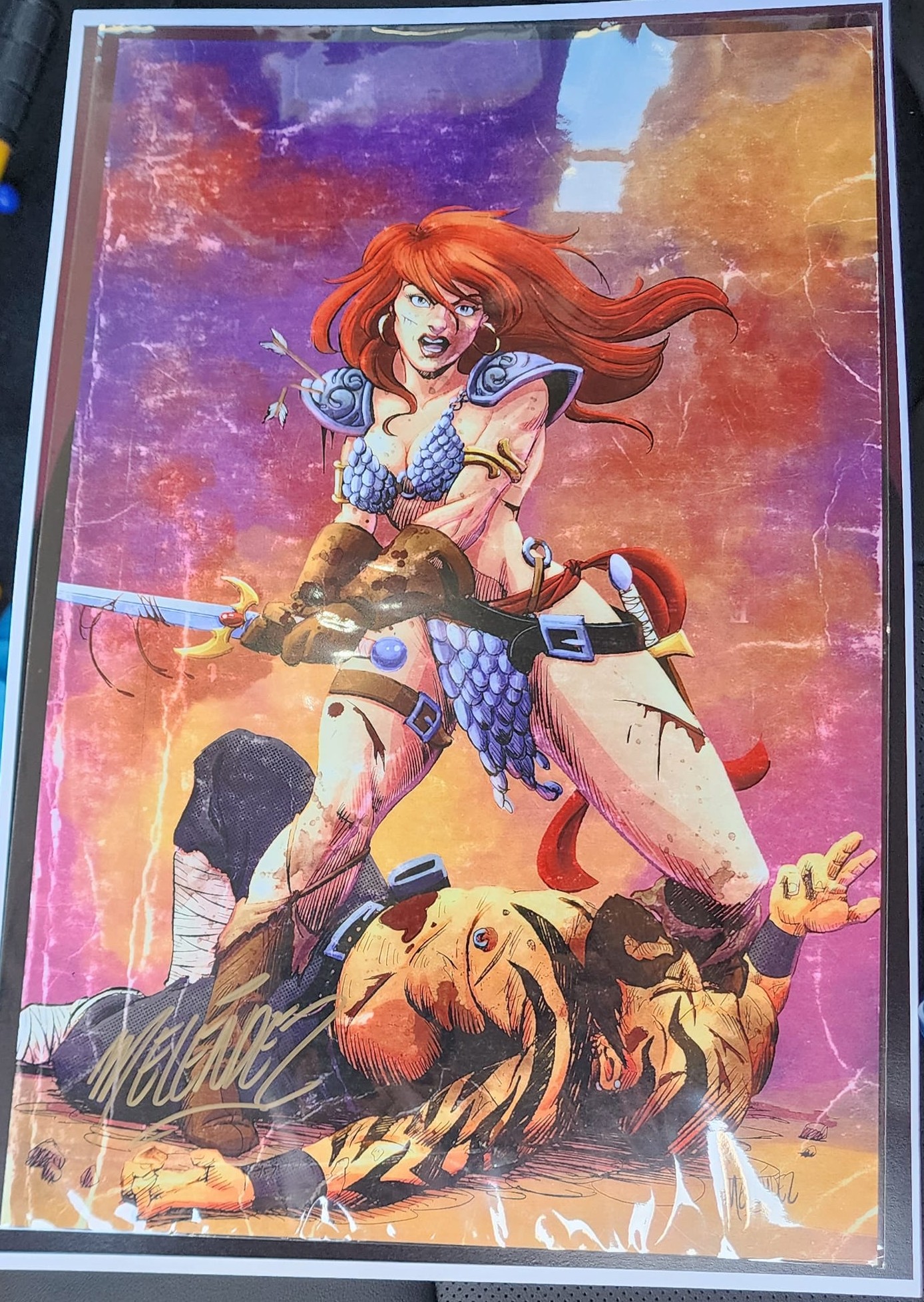
We don’t see each other often enough now that he lives in Florida, but we stay in touch via social media. We did get to catch up in 2025 at the Puerto Rico Comic Con, where I picked up an incredible Red Sonja print from him. My son met him there and still always asks me about my “friend with the horns!” (See the picture below for context!)
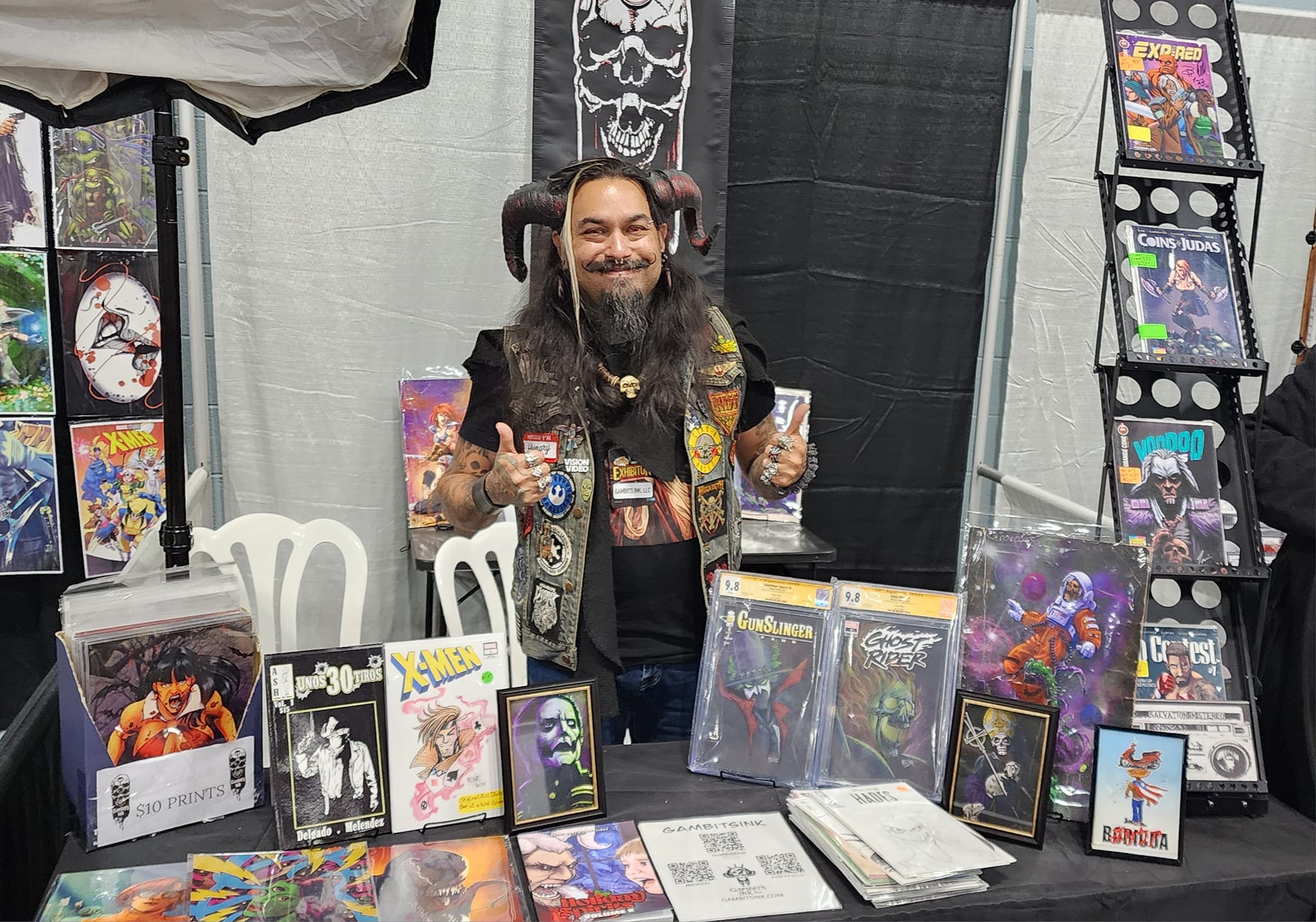
He was also the cover artist and did interior illustrations for the Dungeon Crawl Classics Purple Planet adventure/supplement, Random Acts of Violet. I proudly own a copy; you can see the pictures I took of it below.
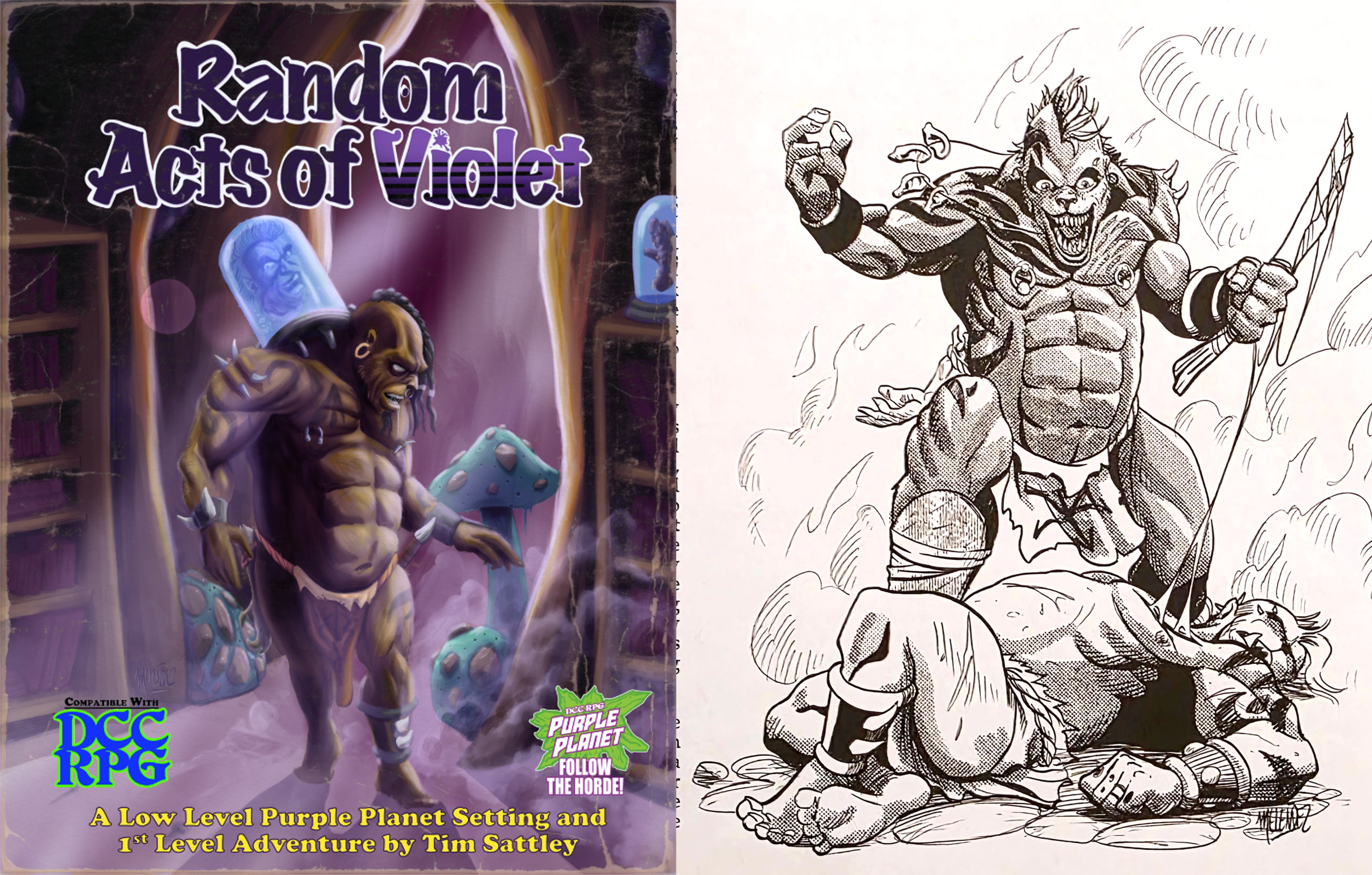
All of this preamble is to say that Gambit is a very cool artist with a deep TTRPG background, working across games and comics. He is also the co-creator of a new comic currently being funded on Kickstarter. I wanted to interview him so you can all get to know him better, learn about this exciting new project, and, if you can, support him in his creative endeavors. He graciously agreed to sit down with me, and here are the results!
Introduction & Art
Introduce yourself! We know you as Elias “Gambit” Meléndez, the creative force behind Gambit’s Ink, but for our readers here at Stargazer’s World, who are you, and what kind of worlds do you create?
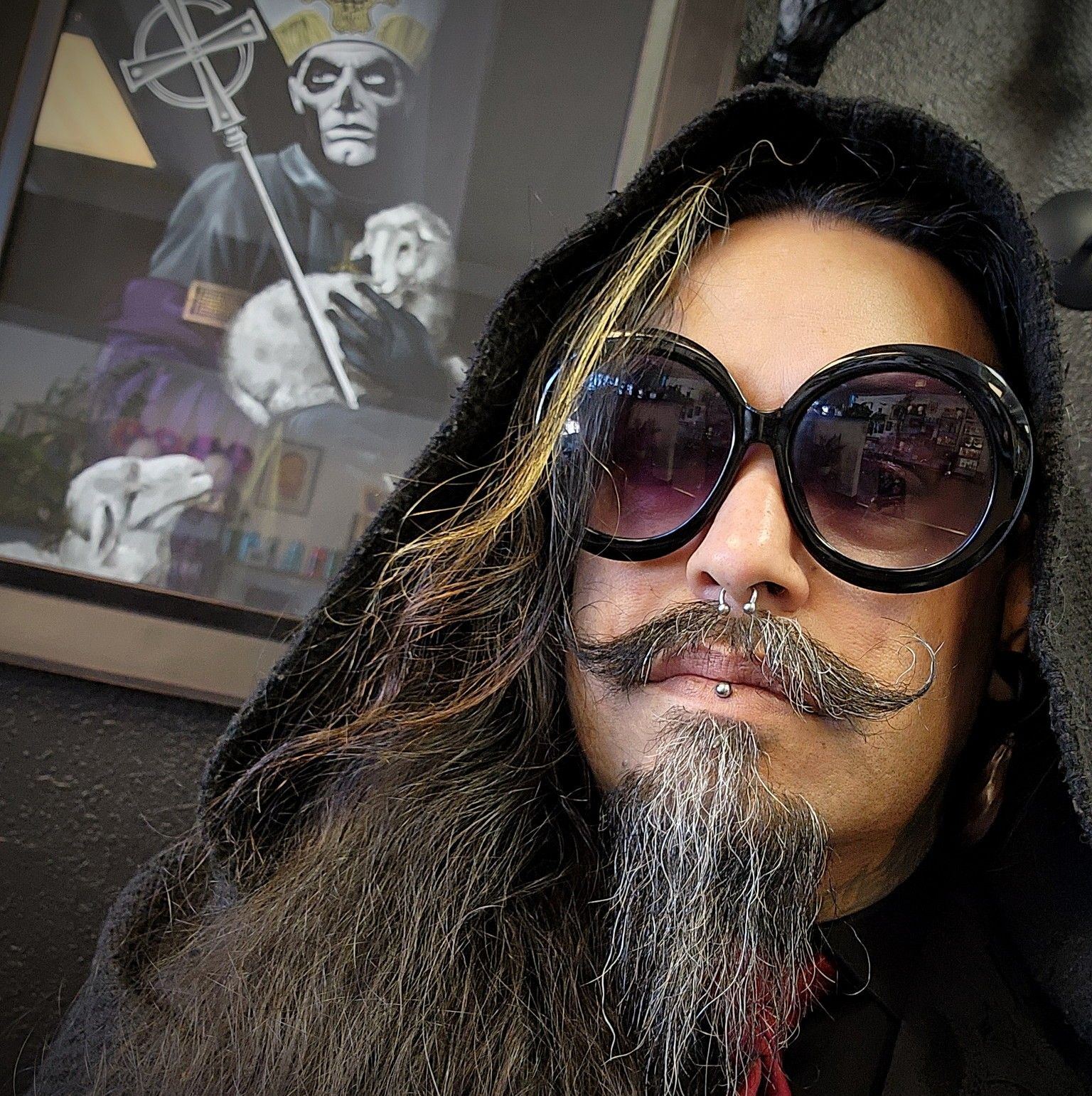
Hello! I’m Elias “Gambit” Meléndez. I go by Gambit, and I’m a tattoo artist, a comic book artist, and sometimes a musician. I’m from Puerto Rico and currently reside in FL. I like creating dark fantasy and superhero worlds.
How would you describe your art? You work across several mediums—from sequential art and sketch covers to tattoos and custom prints. How does your creative process shift when jumping between these different styles?
I honestly have trouble describing my art. As you mentioned, I work across different media, and with each, I try a different technique or style. Lately, I’ve been making my personal comic work look retro, using coloring techniques similar to those from the golden age of comics.
I work on various projects at the same time, so I constantly and seamlessly shift from one to the other. The creative process changes depending on what I’m working on. For example, if I’m working on a comic page, I follow a script, and that gives me the direction I need. If I’m working on a cover, I think of it as a scene—I think of the before and after of that moment I’m working on. So even though I’m not making a sequential comic page, I’m still thinking of it as one. I even apply that to some of the tattoos I do.
Tabletop Gaming
How did you discover TTRPGs? We are all about tabletop gaming here, so we have to ask about your origin story! What was your introduction to the hobby?
I was 14, I think, around 14 to 16, and two friends came home one day with a Dungeons & Dragons box and said, “Let’s create you a character.” They helped me create a thief and gave me the basics to start playing. We played a short session and were immediately hooked!
Ah, I remember now, I was 14! I was so fascinated by the game that I wanted to play it again. When I learned a year later that I could buy the same box at Toys ‘R’ Us, I got some friends together, drove to the store, and got us a box. For the next few years, I played for hours every weekend! As an adult, I took a break for a few years, but I couldn’t stay away for long, lol.
Do you actively play TTRPGs right now? If so, what games, systems, or campaigns are keeping you busy at the table?
I am not playing anything at the moment, but I still buy games that interest me. “Recently,” I read Hellguard: Curse of Caina. It’s a miniature roleplaying game designed for one-session adventures, perfect for game groups that can’t play long campaigns. I am also currently waiting for the new edition of Mutants & Masterminds. Writing this, I realized that my taste in games is similar to my work: Hellguard is dark fantasy, and M&M is superheroes!
What do you want to play next? Is there a specific game, setting, or class on your bucket list that you are just dying to try out?
I’m excited for the new M&M edition. I don’t really have a bucket list, honestly. Usually, I decide what I’m playing based on what the party needs or on something specific that sparks creativity.
Summit Comics & The Cobalt Cricket
Tell us about Summit Comics and your new project! You are currently part of the Kickstarter for The Cobalt Cricket #1. For those who haven’t seen the campaign yet, what is the story of Glenn Fielding, Karl’s Bay, and your role in bringing this corner of the Summit Comics universe to life?
Summit Comics is a new superhero shared-universe comic publisher that emerged when a few friends and collaborators wanted to make comics together. Cobalt Cricket is just one of the many comics planned to be released this year.
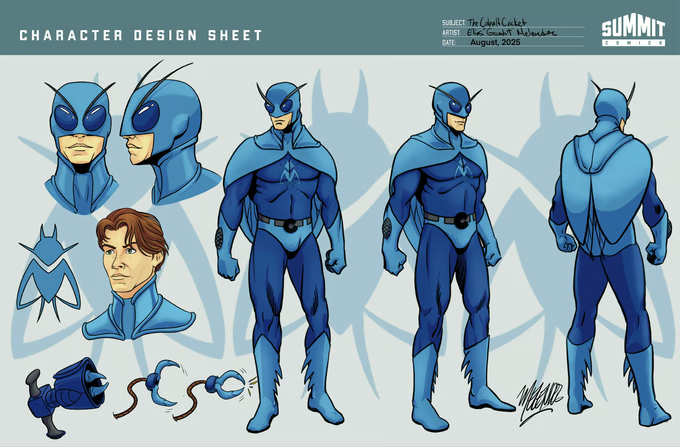
Our hero, Glenn Fielding, is a messenger in Karl’s Bay, FL, and he is involved in an accident that exposes him to radioactive goop and crickets. Next thing you know, cricket powers! With his friend’s help, he becomes The Cobalt Cricket. Sebastian, the co-creator, messaged me to ask if I could help him design a character, and I said yes. He gave me the concept and his idea, I made a few sketches for him, and he loved them so much that he made me a co-creator.
I understood his concept and his idea for a fun book, and I was there when he called. Since then, we’ve bounced ideas for the book and discussed its direction and tone. This book is a love letter to characters like Blue Beetle and Spider-Man. We are making a fun, colorful comic, with over-the-top “science” and heroics. Glenn knows he is not Wolverine or Batman, lol. My role is to give Sebastian’s ideas and concepts a visual style. I know Seb very well now, and I can visualize his thoughts pretty well.
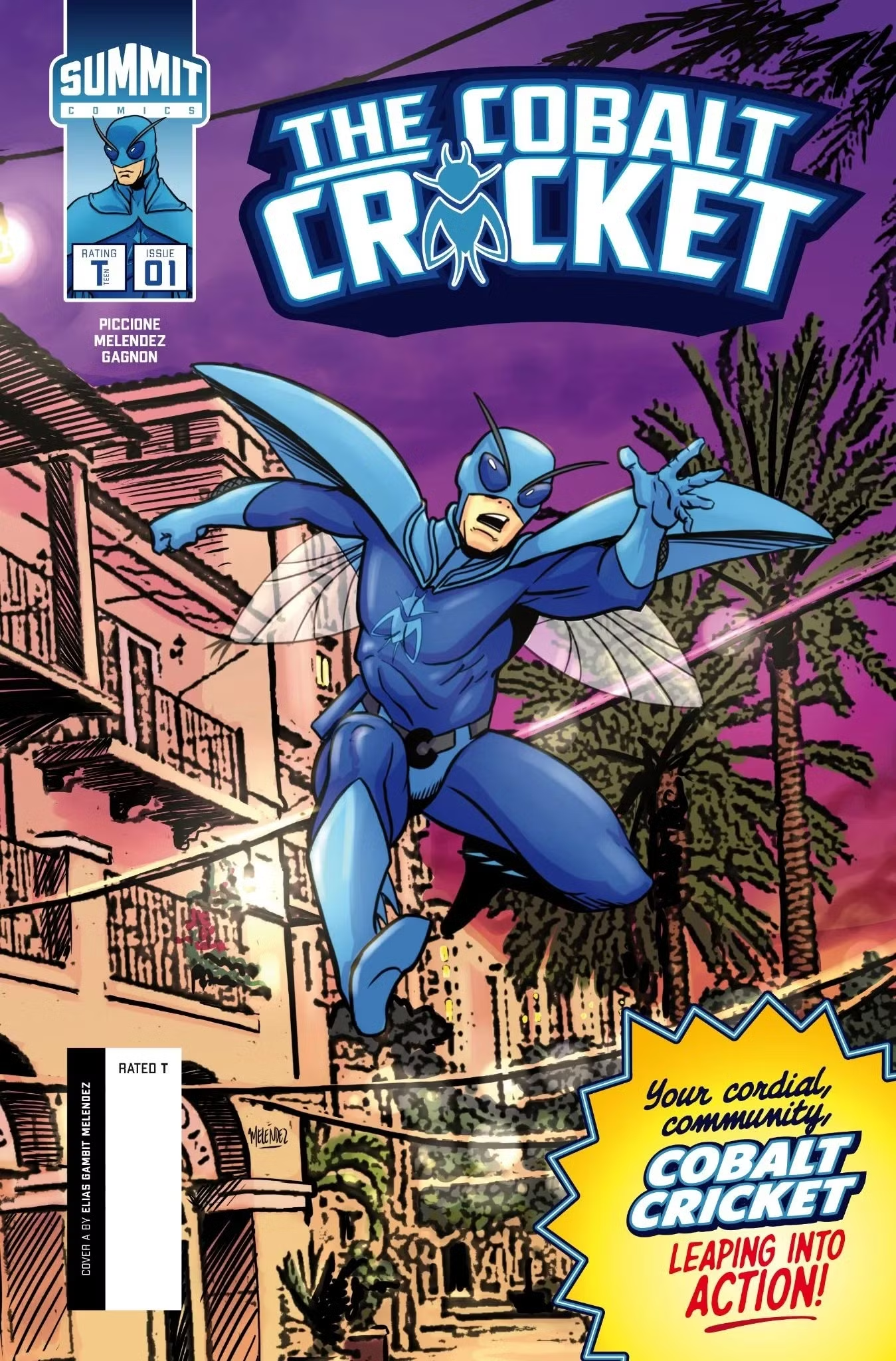
What superhero game would you use to create The Cobalt Cricket? If we wanted to bring Glenn and his insect-proportional abilities to the gaming table, how would you build him and his rogues’ gallery?
As I mentioned before, Mutants & Masterminds by Green Ronin Publishing is one of my favorite RPGs, so I would definitely use that system. In fact, as I was answering these questions, I was talking with one of my friends about creating CC and his rogues’ gallery for the new edition. I’m now planning to do that and make them available for fans and players to use!
(Roberto’s note: I’m incredibly excited about this idea. Imagine a Summit Universe Mutants & Masterminds supplement! A GM can dream…)
Do you have a personal preference for a particular superhero system? When it comes to capturing that classic 60s, 70s, and 80s comic book feel, which TTRPG system does it best for you?
I think M&M is versatile enough to capture the feel of any era of comics and any genre.
How can people support you? Where is the best place for the Stargazer’s World community to back The Cobalt Cricket Kickstarter, and where can they find your original art and projects over at Gambit’s Ink?

You can get The Cobalt Cricket #1 via our Kickstarter: https://www.kickstarter.com/projects/948324172/the-cobalt-cricket-1-summit-comics
And if you want to support me directly, you can do so through my Ko-fi page: https://ko-fi.com/gambitsink
Or my Redbubble page for merch like t-shirts, hats, and other products: https://www.redbubble.com/people/gambitsink/shop
Any closing thoughts? Any final advice for aspiring artists or gamers out there looking to jump into the creative space?
To anyone who is itching to create but is afraid to do so, or thinks they don’t know how, or is waiting for the right moment: That moment is now. All you have to do is create. Don’t think about putting it out for the world to see; you’ll know when to do that. Just do, create, write a short story if you have the idea, draw it if that’s what you do. There is no perfect moment, and there is no shortcut; you have to do it. Write, draw, compose, whatever you love to do or want to do, do it. It’s a rough life sometimes, but the rewards of creating compensate for the bad days.
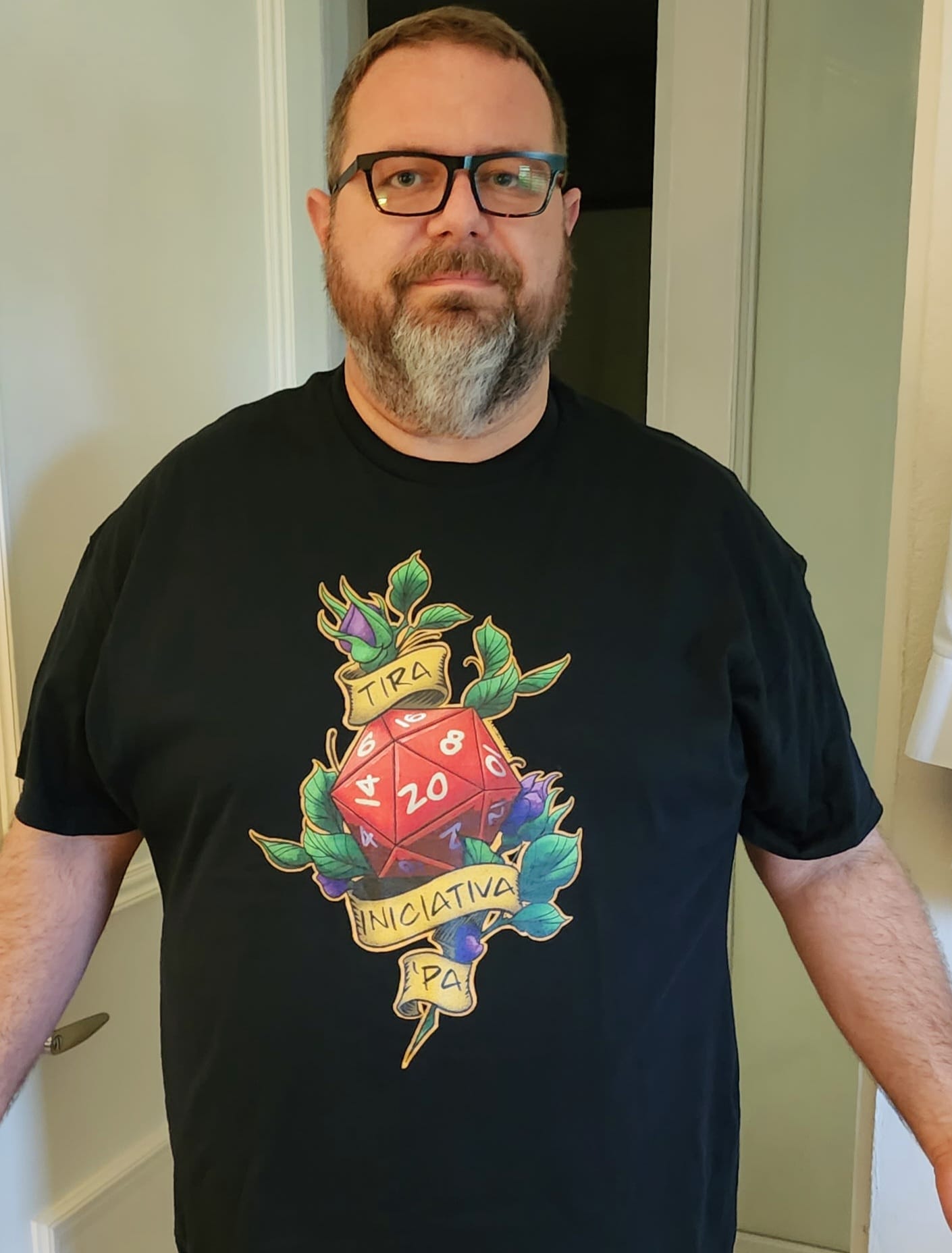
I have a closing thought to add to that closing thought! I want to mention that Gambit actually designed my absolute favorite TTRPG t-shirt. I got it off his Redbubble page—it’s his “Tira iniciativa’ pa” shirt, and you can see me modeling it below!
Thank you, Gambit, for taking the time to do this interview.
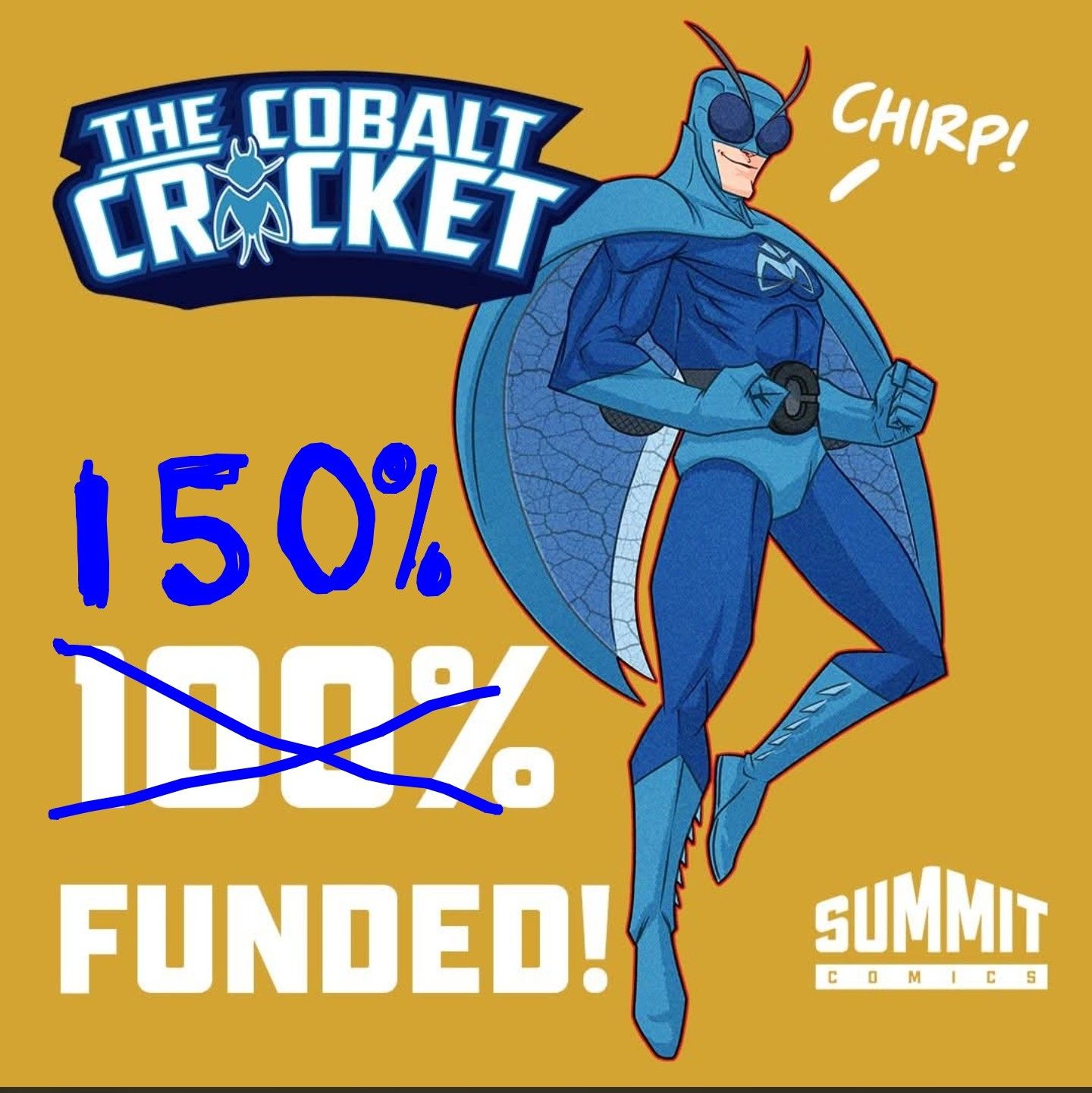
Everyone, please don’t forget to check out The Cobalt Cricket Kickstarter before it ends: https://www.kickstarter.com/projects/948324172/the-cobalt-cricket-1-summit-comics
The project is funded. I’m a backer!
Categories: Tabletop Gaming Blogs
OSR Commentary Adapting B10 Night's Dark Terror For Castles & Crusades Rpg Campaign
Night’s Dark Terror (B10) is widely considered the crown jewel of the mid-80s D&D modules. Written by Jim Bambra, Graeme Morris, and Phil Gallagher of TSR UK, it serves as a bridge between "Basic" (dungeon-focused) and "Expert" (wilderness-focused) play.Because Castles & Crusades (C&Needleshttp://www.blogger.com/profile/11243274667834930867noreply@blogger.com0
Categories: Tabletop Gaming Blogs
The Ghost of Hong Kong by Steve Miller Pulp Hero and the Trail to San Moros, CA - Very Evil & Very Nice
The PC's happened to run into two high powered wrestlers who happened to be having an event right about the lair of the Green Lizard at the San Mos Dome! This session picks right up from The Ghost of Hong Kong by Steve Miller Pulp Hero and the Trail to San Moros, CA (1996). The twin corporate super powered enforcers the Crimsiki brothers squared off. These brothers are able to Needleshttp://www.blogger.com/profile/11243274667834930867noreply@blogger.com0
Categories: Tabletop Gaming Blogs
Aethelberd’s Tomb
By Scott_M
First Era Adventures
OSRIC
Levels 1-3
First Era Adventures
OSRIC
Levels 1-3
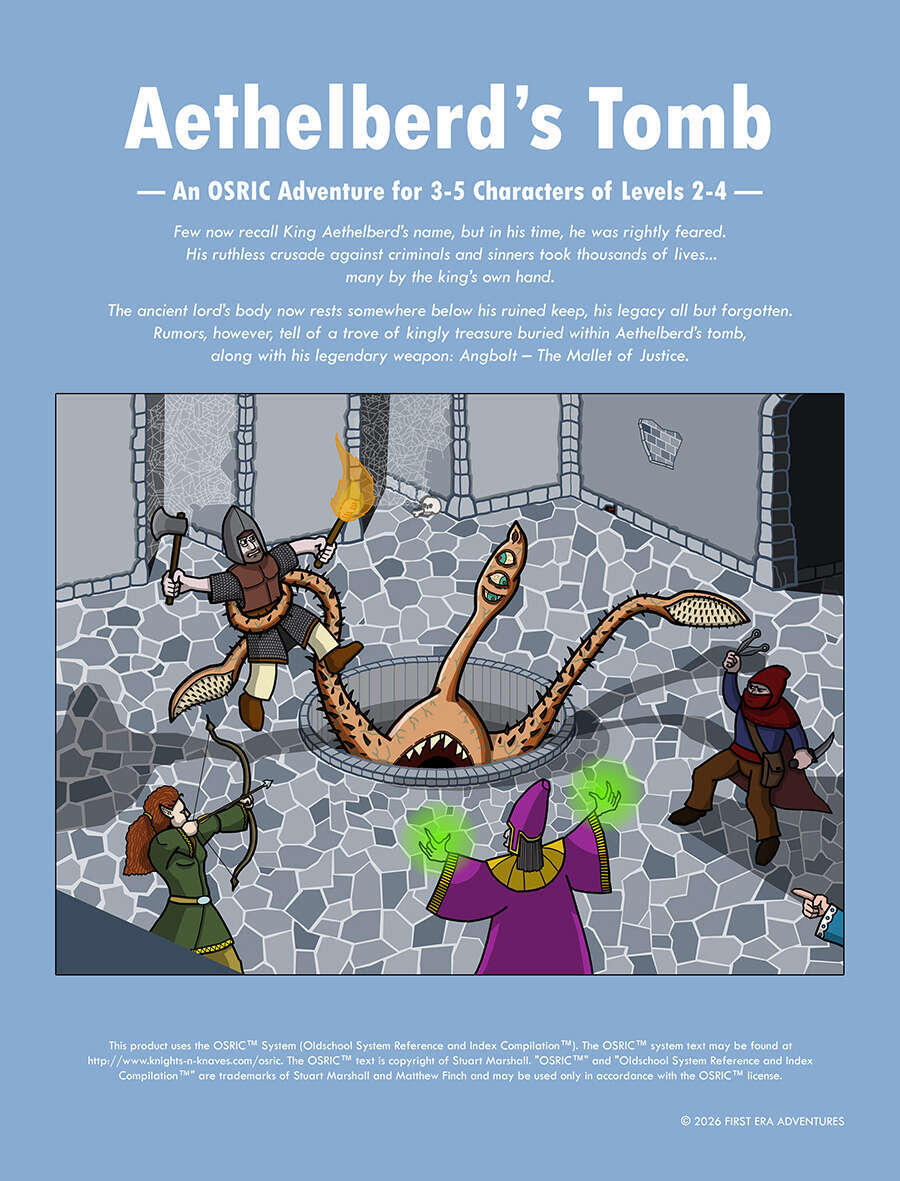
Few now recall King Aethelberd’s name, but in his time, he was rightly feared. His ruthless crusade against criminals and sinners took thousands of lives… many by the king’s own hand. The ancient lord’s body now rests somewhere below his ruined keep, his legacy all but forgotten. Rumors, however, tell of a trove of kingly treasure buried within Aethelberd’s tomb, along with his legendary weapon: Angbolt – The Mallet of Justice.
This thirteen page adventure presents a dungeon/tomb with about twenty locations. A ‘standard dungeon’ with a few different situations going on, it is relatively wordy for the degree of content present, coming out to about four keys per page or so for a mix of vermin, undead, and bandits.
I’m rather fond of the setup of this one, or, perhaps, the framing. There are some ruins on a hill in a wood. And I mean ruins; almost nothing left but a few walls. Once the tomb of majestic figure,eons past and nothing is left of Ozymandius (by Shelley you cetin! God how I love Frisky Dingo.) but two legs. And, now on the road through the wood you come upon a dying man and a ransacked cart. “Tracks in the dirt indicate that three humans in boots led a woman and child off into the woods, along with a heavily-laden mule or pony.” Low bandits, now hold up in the topside walls of the tomb of a lord known for justice, too scared to venture down the stairs. I find this framing rather poetic. No highborn rebels or a bandit-king with airs and plans, just the meanest and most low of ruffians, picking on a man and his woman/child brutally. Too common to even venture in to the hole in the ground in search of gold, camped in a place of utter ruin, of former majesty that they have no knowledge of. This is all handled rather briefly.
The rest of the adventure is not bad, but it doesn’t come close to that poetry. It is a relatively standard dungeon crawl, perhaps a bit above the usual average, with not a lot to distinguish itself and a few things that could be done better. This is not an Orcs in a Hole problem, but perhaps a sign of a hobby in which every adventure ever written is available immediately to you. How does one stand out in a crowded marketplace? [By each adventure having the unrealistic expectations of being a masterpiece, duh! If the premise of the blog is that common mistakes are repeated time and again then the secret hope is that those eventually get resolved and concentration can be done on more in-depth stuff.]
The bandits are huddled in the upper ruins, little more than a few crumbling walls. They’ve set a slack guard during the day and wall themselves in at night by moving boards. There’s a nice earthiness to this. They see the stairs, and have stuffed the women and child in a cellar room, where they whimper, but are too scared to venture any further. I might emphasize their condition, of both the captives and … beastiality? of the bandits a bit more, but the quick mentions of their fear and how they wall themselves in to the ruins is good.
The map supporting this is fine for it’s size. The hill, ruins and wood around it are covered fine, and the dungeon proper has a variety of features, caves, water, worked areas, streams, statues, same level stairs. It is clear and has creature notations on it, which I always find very useful when running an adventure to keep the surrounding dungeon context front and center when running an encounter/noise in a room. Good job, and something I wish more adventures did to help me out at the table.
The dungeon entries, proper, are where my hang ups mostly lie. And I have no idea how to describe what I think is wrong about them. They do tend to be a bit long, four paragraphs is not uncommon. There’s an occasional bolded words or ALL CAPS monster reference, which shows some awareness of trying to call the DMs attention to things. But, for all the world, I can’t figure out why the entries are long. Typical problems in other adventures might be backstory embedded in them, or victorian laundry lists of contents, overly describing, trap & door porn or explaining WHY. None of that really seems to be present here, and yet the entries tend to the long side, particularly for what they are.
I’m looking at an entry for room eight, The False Tomb, which I think is fair representation of the other rooms as well. There’s three paragraphs of general description. The first is the overall room, then one touching on some alcoves and frescoes, then one about the body in the room under a shroud, and its treasure, and the skeletons it triggers, and then one about a bronze chest and its loot. I can’t really fault any one of them for being there. The first paragraph reads “The shrouded body of a long-dead warrior is laid out upon a stone bier. The floor surrounding it is covered with various burial offerings: Ratgnawed baskets, sealed crockeries of seed oil and spoiled wine, moldering furniture and tapestries, graven idols of old gods, etc. (no value). Among the funeral goods stands a squat bronze chest” This is not the most evocative thing ever, but it’s trying and I recognize that. It’s also, I think, not lingering too much on the mundane. I can’t particularly fault the description of the body and chest and their treasures either.
So the descriptions are not in and of themselves problems. And the formatting is not terrible. It’s certainly not wall of text and there is an occasional bolded word to direct the DM to more information. The closest I think I can come is that there seems to be a disconnect between the length and the … mundanity of the interactivity. There are some traps here that are more than just a pit. (Flaming oil jet!) Rats, centipedes, skeletons, wraiths, shadow, zombie dog. The more special undead have a note or two to bring them to life. And there’s an otyugh in a well, ala Moria.
I don’t know why, but maybe the absence of more exploratory interactivity, but it feels plain to me. I’m not excited by this. It’s not bad. I just don’t look at it and and can’t wait to run it. Specificity? I’m going to assume this is a me thing.
This is $3 at DriveThru. The preview is six pages, which shows you the setup, the maps, and a few dungeon rooms. Good preview. Take a look and see if you can nail the descriptions thing.
https://www.drivethrurpg.com/en/product/561573/aethelberd-s-tomb?1892600
Categories: Tabletop Gaming Blogs
Chess is not about the rules (D&D isn't either) (new substack post)
Already five posts published and there's a shitload of Notes out as well. Just to give you guys an impression what's going on over there. Already more engagement then I have here or on X. All good and positive, so make sure to join the party. My latest post is about what rules are and what the must do in order to work properly. A lot of it is explained via chess, but I'm eventually making my way to D&D and role-playing games in general.
Here's the first paragraph:
Rules are a prerequisite to play. But it is not so much about using the rules to play, it is about playing the game within the restrictions the rules are offering. That is such a key difference that not seeing it will lead to wrong design choices when writing your own rules. Or, a more subtle point, you’ll put the wrong focus when explaining how your game works. This very much applies to role-playing games, but let me explain it using chess first, as it makes the better point without trying too hard.
That's four essays linked here in April, including my introduction over there (three proper, then). There's another meaty one for those with at least a free subscription for the Substack. I'll try to have one for paying members up soon, too (they don't exist yet, but will eventually and they will have something to discover).
Among my next essays will be stuff about looting (bad) movies for their content and one with setting up a sandbox for ORWELL, hopefully with some play-reports building on that (it has to come together on the play side, but I'm working on it).
The Substack will focus a lot on my publishing endeavors, but that usually brings up a lot of adjacent topics and the lively community over there will do its own inspiring.
First time in a long time that blogging brings me joy again.
Categories: Tabletop Gaming Blogs
Wednesday Comics: DC, August/July 1985 (week 1)
My mission: to read DC Comics' output from January 1980 (cover date) to the end of Crisis. This week, I'm looking at the comics that were on stands in the week of May 2, 1985.
Sword of Atom Special #2: This issue actually has a July cover date, but there is some discrepancy in the sources regarding when it came out. Anyway, Strnad and Kane are back with another Lost World/Sword & Planet-ish tale. A bird-riding group of raiders called Skul-Riders attack New Morlaidh and kidnap women, including Laethwen. At around the same time, Paul Hoben and Norman Brawler have arrived with an accidentally shrunk Jean, intending to find Atom and get his help to restore her, but she too is kidnapped by the raiders. Atom, Voss, and Paul join forces to track the riders to their city where it turns out a dictator using mind control technology is responsible for the raids as he seeks breeding stock to bolster his cities ranks to realize his dreams of conquest. When his people are freed from control, they kill the tyrant themselves, and our heroes return home. Atom gives Jean and Paul the shrinking belt as he can't use it anymore.
Atom will appear in several issues of Crisis but that's it until 1988.
DC Comics Presents #83: Rozakis is the writer on this team-up of Superman and the Challengers of the Unknown. The artists are a bit of a puzzle: We have both Kirby and Toth, both with inks by Theakston. Toth's work only appears over a couple of pages in a flashback sequence. It seems weird to engage two such celebrated artists in this way, which makes me think the issue as we got it was a "plan B." Anyway, this is Kirby's last major work for DC, though his last actual work (a cover) won't come until after Crisis.
Zo-Mar, a Kryptonian criminal from the pre-Phantom Zone days, escapes from a prison space capsule and infiltrates the Earth with a mystic card that gives him the power of mind control--including those of Superman and the Challengers of the Unknown. It also (handily) keeps him from developing Kryptonian super-powers. Our heroes manage to get the card from him, but then he gains powers! They ultimately use a trick to defeat him and destroy the card. Zo-Mar is sent to the Phantom Zone.
Shadow War of Hawkman #4: The limited series comes to a close just as it seems it was getting started, but Isabella makes it clear at the end that this was merely the first battle in a potentially longer war. We open with several examples of the Absorbacon being used to still secrets from humans, and thus economic and political spoils. The Shadow War is to be an infiltration and covert coup rather than a fledged-fledged invasion. The Hawks are still in the fight, though. They sneak back onto their own ship, defeat the Thanagarian agents, then destroy the ship so it can't be taken again. They track down the Absorbacon, but fate takes a hand as Rab Mekir, enslaved to the machine, takes his revenge on Fell Andar, leading to his own death. This vanguard defeated, Katar and Shayera can return to their secret IDs and cover lives, but we see there are still Thanagarian deep cover agents on Earth.
Wonder Woman #326: This one has a July cover date, too, though likely released in May. Newell takes over as writer with Heck still on art, and we're back to the stuff that was going in back in issue 316. Wonder Woman follows Keith Griggs and Lauren Haley back to the Central American nation of Tropidor and again encounters the Aztec god Tezcatlipoca. Also, Etta is really angry with Diana for some reason.
V #6: This is another issue with a July cover date. Bates and Infantino/DeZuniga wrap up the whole Meagan arc. The rebellion rescues Meagan, ironically to keep him from blowing up the alien mothership as they fear the severity of reprisals, and they are helped by a scheming faction of Visitor leadership looking to undercut Diana. Unfortunately, Meagan's head-bomb starts to malfunction, so he takes a ship and heads back toward the Mothership on his own. He explodes before he gets there, though, taking out some Visitor fighters and thwarting Diana's plans to recapture him. She remains unaware of the bomb throughout the whole incident.
On Earth, the Visitor experimentation facility is taken out, and Ham and friends force the lead scientists to inject themselves with their own mutagen.

Sword of Atom Special #2: This issue actually has a July cover date, but there is some discrepancy in the sources regarding when it came out. Anyway, Strnad and Kane are back with another Lost World/Sword & Planet-ish tale. A bird-riding group of raiders called Skul-Riders attack New Morlaidh and kidnap women, including Laethwen. At around the same time, Paul Hoben and Norman Brawler have arrived with an accidentally shrunk Jean, intending to find Atom and get his help to restore her, but she too is kidnapped by the raiders. Atom, Voss, and Paul join forces to track the riders to their city where it turns out a dictator using mind control technology is responsible for the raids as he seeks breeding stock to bolster his cities ranks to realize his dreams of conquest. When his people are freed from control, they kill the tyrant themselves, and our heroes return home. Atom gives Jean and Paul the shrinking belt as he can't use it anymore.
Atom will appear in several issues of Crisis but that's it until 1988.

DC Comics Presents #83: Rozakis is the writer on this team-up of Superman and the Challengers of the Unknown. The artists are a bit of a puzzle: We have both Kirby and Toth, both with inks by Theakston. Toth's work only appears over a couple of pages in a flashback sequence. It seems weird to engage two such celebrated artists in this way, which makes me think the issue as we got it was a "plan B." Anyway, this is Kirby's last major work for DC, though his last actual work (a cover) won't come until after Crisis.
Zo-Mar, a Kryptonian criminal from the pre-Phantom Zone days, escapes from a prison space capsule and infiltrates the Earth with a mystic card that gives him the power of mind control--including those of Superman and the Challengers of the Unknown. It also (handily) keeps him from developing Kryptonian super-powers. Our heroes manage to get the card from him, but then he gains powers! They ultimately use a trick to defeat him and destroy the card. Zo-Mar is sent to the Phantom Zone.

Shadow War of Hawkman #4: The limited series comes to a close just as it seems it was getting started, but Isabella makes it clear at the end that this was merely the first battle in a potentially longer war. We open with several examples of the Absorbacon being used to still secrets from humans, and thus economic and political spoils. The Shadow War is to be an infiltration and covert coup rather than a fledged-fledged invasion. The Hawks are still in the fight, though. They sneak back onto their own ship, defeat the Thanagarian agents, then destroy the ship so it can't be taken again. They track down the Absorbacon, but fate takes a hand as Rab Mekir, enslaved to the machine, takes his revenge on Fell Andar, leading to his own death. This vanguard defeated, Katar and Shayera can return to their secret IDs and cover lives, but we see there are still Thanagarian deep cover agents on Earth.

Wonder Woman #326: This one has a July cover date, too, though likely released in May. Newell takes over as writer with Heck still on art, and we're back to the stuff that was going in back in issue 316. Wonder Woman follows Keith Griggs and Lauren Haley back to the Central American nation of Tropidor and again encounters the Aztec god Tezcatlipoca. Also, Etta is really angry with Diana for some reason.

V #6: This is another issue with a July cover date. Bates and Infantino/DeZuniga wrap up the whole Meagan arc. The rebellion rescues Meagan, ironically to keep him from blowing up the alien mothership as they fear the severity of reprisals, and they are helped by a scheming faction of Visitor leadership looking to undercut Diana. Unfortunately, Meagan's head-bomb starts to malfunction, so he takes a ship and heads back toward the Mothership on his own. He explodes before he gets there, though, taking out some Visitor fighters and thwarting Diana's plans to recapture him. She remains unaware of the bomb throughout the whole incident.
On Earth, the Visitor experimentation facility is taken out, and Ham and friends force the lead scientists to inject themselves with their own mutagen.
Categories: Comic Book Blogs, Tabletop Gaming Blogs
Uprising on Antares-9
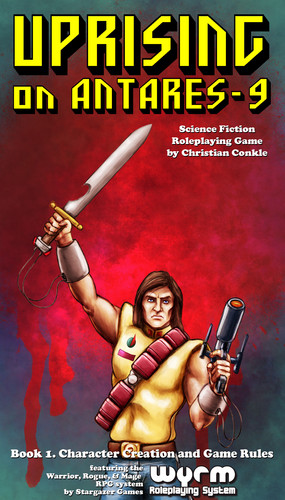
Back in 2010 (wow, has it been 16 years already?) I released a little game called Warrior, Rogue & Mage. It had some modest success and quite a few people have high regards for it because it’s simple, easily hacked and dirt cheap since it’s free. I also released the rules portion under a Creative Commons Attribution license so everyone can create new games using these rules as long as they give credit.
One of the games created using these rules is Christian Conkle’s Uprising on Antares-9. It’s a roleplaying game based on a TSR Sci-Fi minigame called Revolt from Antares designed by Tom Moldvay. I have to admit that I never even heard about this minigame before Christian told me about his project. The game consists of six small booklets available for free on itch.io but you can also order physical copies from Lulu. You’ll find all further information on the game’s itch.io page.
The whole project started as a thread on the rpg.net forums back in 2021 when Christian asked for help finding a system suited for a Revolt on Antares RPG. The thread is still active and if you enjoy Uprising on Antares I recommend you go there and post about it.
If you are either a WR&M fan looking for more stuff to play with or someone who has fond memories of Revolt from Antares you should definitely check out Christian Conkle’s game.
Categories: Tabletop Gaming Blogs
New OSR Monster - The Devil Monkey For Burrows & Borderslands Rpg
In the world of Burrows & Borderlands, the Devil Monkey isn't just a myth—it’s the primate nightmare of the northern woods. While most beasts in the Kingdom are relatable mammals, the Devil Monkey represents an ancient, uncanny lineage that feels "wrong" to the average adventurer. The Devil MonkeyThe Shadow in the CanopyThe Devil Monkey is a lean, powerful simian roughly the Needleshttp://www.blogger.com/profile/11243274667834930867noreply@blogger.com0
Categories: Tabletop Gaming Blogs
OSR Commentary & Deep Dive Into the Castles & Crusades Adventurers Armory For Castles & Crusades rpg System
The Adventurers Armory is a staple supplement for the Castles & Crusades RPG, designed to expand the horizon of equipment, weaponry, and specialized gear beyond the standard listings in the Players Handbook. It serves as a comprehensive catalog for players looking to customize their characters and for Castle Keepers (CKs) aiming to add flavor to their world's economy.### Core Contents &Needleshttp://www.blogger.com/profile/11243274667834930867noreply@blogger.com0
Categories: Tabletop Gaming Blogs
Moldvay Basic finally available in Print on Demand

Great news: The "B" of "B/X", the rulebook of the 1981 D&D Basic Set, commonly known as the Moldvay Basic, is finally available in print-on-demand (POD) from DrivethruRPG, 13 years after it originally appeared in PDF, and three years after its partner "X" (the Expert Set rulebook) POD was released.
Find it here:
Moldvay Basic rulebook on DrivethruRPG
(all links to DrivethruRPG include my affiliate number)
The B/X ruleset has become extremely popular in recent years as the source of rules for the Old School Essentials retroclone, but now you can get an official reprint of the original.
While this site is primarily devoted to the Holmes Basic set, I am also a big fan of the Moldvay Basic rulebook, which took Holmes' pioneering work as a base and developed it further. And I love the Sample Dungeon, The Haunted Keep, which I've written about here.

The module that was included in the Moldvay Basic Set, the 1981 revision of Gary Gygax's B2 The Keep on the Borderlands, is already available in POD, so together these products constitute the printed contents of the 1981 Basic Set (no dice and crayon, of course).
Find it here:
B2 The Keep on the Borderlands on DrivethruRPG
While this is great news for availability of this particular rule set, the Holmes Basic rulebook frustratingly remains completely unavailable, either in PDF or print, for unknown reasons. The newly available Moldvay Basic POD means that they are still releasing/updating the available products, so this does give a bit of hope. Perhaps they are saving it for the 100th anniversary in 2077?
See also these previous posts on the Zenopus Archives related to Moldvay Basic:
Original Known World Campaign Documents (2022)
Chronology of D&D Sample Dungeons: The Haunted Keep by Tom Moldvay (1981) (2020)
M1 Blizzard Pass: Dungeon Design (2020)
Zargon Beckons (2015)
Ur-Known World (2015)
Expert Set rulebook: PDF notes (2013)
Categories: Tabletop Gaming Blogs
The Herculoids & Crew NPC Adapted To Sword of Cepheus 2nd Edition Rpg
Adapting the classic 1967 Hanna-Barbera series The Herculoids into the Sword of Cepheus (2nd Edition) system requires a blend of high-fantasy tropes and "lost world" science fiction. This blog entry picks right up from Thundarr the Barbarian & Crew NPC Adapted To Sword of Cepheus 2nd Edition RpgIn this setting, the Herculoids function as powerful, sentient "Monstrous Allies" or Needleshttp://www.blogger.com/profile/11243274667834930867noreply@blogger.com0
Categories: Tabletop Gaming Blogs
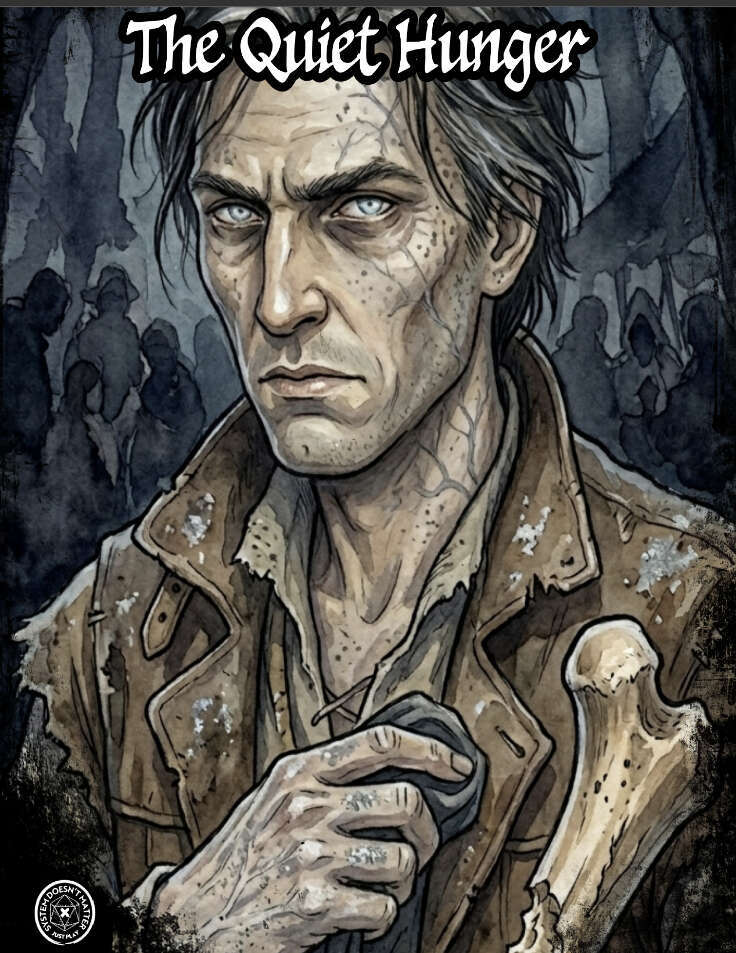
The Quiet Hunger
By Craig Turner
Aspire2Hope
Generic/Universal
Levels: Ghouls as an ememy
Aspire2Hope
Generic/Universal
Levels: Ghouls as an ememy
In Faynford at the Staple, tension simmers beneath the smell of hearth smoke and fresh bread. Old fears stir as food grows scarce, livestock go missing, and whispers spread—of sickness, of shadows, of the dead no longer resting easy. Beyond the river bends and chalk downs, the Hundred is holding its breath. The boundaries between custom and survival, welcome and warning, are wearing thin. Something hungers in the dark, and the quiet strength of this land may not be enough to hold it back. Your road has led here. Whether by duty, kinship, or necessity, you have arrived on the edge of a story that will not wait. Will you uncover the truth before Faynford at the Staple falls to fear—and to what walks in its shadow?
This twenty page horror-ish adventure describes a bucolic village, and the refugee situation that is unfolding as they absorb villages who have been displaced by war. It is quite long-winded and verbose for what is essentially an outline of an adventure. The outline part is ok, but the long-windedness results in confusion of the overall situation. Too much time on vibes and not enough time on specifics.
I’m a sucker for Harn-like settings for adventures. Call something A Hundred and I’m drooling, for some reason. I guess it was 100 Bushels of Rye. Whatever. We’re here today because of that. And, then, we mix in, from the marketing blurb, what appears to be a horror element. I think horror translates well because of the emphasis on situations that it fosters. I can restart a monster, but the vibes and plot and horror elements are for the designer. I love my classic exploratory dungeons, but the journey to and from the dungeon, and shit going on in town, has always been a part of D&D and these little situations are great for dropping in to spice up the “downtime.”
So, we got this village. Humans, halflings. The halflings were refugees about fifty years ago and have settled in. More war has caused an influx of new refugees. The locals kind of recognize kinship to them, accents, mannerisms, far less alien than the halflings were. Then a lamb goes missing. And a couple of people die from a new disease, ashskin. Things are tense. The local sheriff wants to relocate the refugees a little farther down the valley. This is the pretext for the adventure. It turns out that a local seedy patriarch is an agent for a foreign power and ashskin? That’s people turning in to ghouls. Did you recognize it by the name ashskin? I didn’t at first. And I love that kind of shit .Where you describe something to peoples faces and they don’t get it. They drop some gnawed bones and bodies here and there, and once you get to the graveyard and find out the graves were dug out from the INSIDE, well, the undead is up, so to speak.
The adventure wants to outline a situation. It’s trying to present a map with various locations on it and then explaining what is going on at those locales. It provides some NPC overviews with mannerisms and goals, for the DM to drop in to the game and use as the party comes across them or seeks them out. It flirts with doing the right thing. And then it fucks everything up.
The NPC descriptions fit, maybe, two to three to a column. There’s a bullet for Appearance, Personality, Goal/Motivation, Quick, Disposition, and What they know. Maybe somewhere from three words to a dozen or so, and then the person ends with a little quote. This is all too much. It’s on the right track, a quick, a goal, what they know, but then it muddies it up with too much information that one needs to dig through. And this is going to be a theme here.
The locales, a half dozen or so, stretch on for a column or page, and then have their NPC’s, in the same format as above. It starts with a setting prompt, in bullet form: Light, Sights, Sounds, Smells. This is too much. Shortening this to a sentence or two, including all of them in it, to give a little vibe would have been better. There’s a brief couple of paragraph description of the locations “the fields are well tended, it’s maintained through diligence.” Again, too much. The diligence comment it meta, and the whole location description is hard to sort through, I suspect, during play. Terse. Hit. Get out. We want a quick vibe if its not super-important to the location to have details. Then we have a section called Plot. I’m looking at seven paragraphs, one or two just a sentence, like “Corwin is dead” or “Pip knows what that means, even if he struggles to say it properly.” The plot section, what is happening, the meat of the location, what the party can find out and do and so on, is all muddled by this. This is NOT the time to get flowery with your language and clever with your descriptions. And yet it does, over and over again. This is a nightmare to dig through. This would have been the PERFECT time for all of those bullets.
The overall plot, what leads to what and who’s doing what, is confused because of all of this. Cognitively it’s a problem. After a couple of times through this I’m still not sure I can explain the hows and wherefore and whats connected. I THINK
The elements it wants to emphasize, the contention between the refugees, the more established refugees from fifty years ago and so on, these are not well handled at all. There’s little to bring these to life. The tension that should be going on isn’t added to by specifics. We’re not looking for everything spelled out and scripted, but vignettes, specificity, to drop in to make that tension come alive. Even the spying, it’s not really brought home.
This was a good idea. Blaming The Others should be relatable to the players. The mixing in of the ghouls and people turning. Great potential there. But this would need a lot of effort to bring to the table. It knows to outline a situation, and it knows the major elements to hit, it just fails in doing that in a way that can be run or in bringing it truly to life.
This is $4 at DriveThru. The preview is four pages, not quite enough to get a good vibe check on it. Only the last page really gives you an idea of what to start to expect in terms of writing and presentation.
https://www.drivethrurpg.com/en/product/562279/the-quiet-hunger?1892600
Categories: Tabletop Gaming Blogs
Using Original Dungeons & Dragons rpg with The Barrows & Borderlands Rpg
Barrows & Borderlands (B&B) is a "Weird Science Fantasy" tabletop RPG designed specifically to bridge the gap between the Original 1974 Dungeons & Dragons (OD&D) and 1st Edition Advanced Dungeons & Dragons (AD&D).While it is heavily inspired by the "Little Brown Books" of the 70s, it isn't a mere clone; it's a "Needleshttp://www.blogger.com/profile/11243274667834930867noreply@blogger.com0
Categories: Tabletop Gaming Blogs
Adapting Fel As an NPC From Campfire Cooking in Another World with My Absurd Skill For The Primal Order Rpg
Bringing Fel (Fenrir) from Campfire Cooking in Another World with My Absurd Skill into The Primal Order (TPO) requires translating his overwhelming "cheat-level" power into the language of Primal Base, Divine Rank, and Essence. This entry picks up from OSR Commentary - Can Castles & Crusades rpg be played with The Primal Order Rpg?!In TPO terms, Fel isn't just a high-level monster;Needleshttp://www.blogger.com/profile/11243274667834930867noreply@blogger.com0
Categories: Tabletop Gaming Blogs
In Alignment

Mostly discussions about alignment (probably since time immemorial) seem to circle around 3 opens about it: it is just a suggestion for roleplay; it represents cosmic teams of some sort and isn't about character morality; and most commonly its bad and we just ignore it.
Gareth Hanrahan's The Gutter Prayer suggests to me an interesting tweak to idea 2, one I haven't seen before. I mention previously the saints in that world who were empowered by the gods not due to faith or ideals, but rather due to be somehow psychic compatible with the deity, making passing divine power through them possible. You might say the saints are in alignment with the deity.
So, what if alignment was a bit like that? It does present being on a cosmic team but not a team the character chose, a team that they were born into. This connection would allow the character to speak alignment language and to be recognized as "marked" by that team, perhaps. Characters are free to behave whatever way they want, but they can't (or at least can't easily change) this affinity any more than they could change their bloodtype. It should probably be randomly generated or determined by class, I suppose.
For most characters, a lack of affinity with the ethics of the deity wouldn't be an issue under most circumstances, though for people like clerics and paladins who get more out of the connection, it would matter.
The metaphysical implications for a setting with this would be really interesting, I think. There are a lot of ways it could be operationalized.
Categories: Comic Book Blogs, Tabletop Gaming Blogs
40 Years a Gamer: The Artists Who Inspired Me – The Four Horsemen of TSR
In my early years as a gamer, four artists truly defined my conception of D&D and tabletop fantasy art: Larry Elmore, Jeff Easley, Clyde Caldwell, and Keith Parkinson.
I first recall them being referred to as the “Four Horsemen” in the excellent 2019 documentary Eye of the Beholder. Since I’ve been writing so much lately about the artists who inspire my games, I recently sat down to rewatch it. You can find where to stream it from the official website here. If you’re curious, here is the trailer:
But back to the artists. Elmore, Easley, Caldwell, and Parkinson completely defined D&D for me as a teenage gamer. Little by little, I discovered the early artists who originally shaped the game (and they’ll get their own post!), but when I first started playing, these four were the absolute pillars of fantasy TTRPG art. You probably know them, so I won’t recount their entire careers—others have covered them far more thoroughly than I ever could. Instead, I want to focus on how they left an impression on me and inspired my campaigns.
Larry Elmore
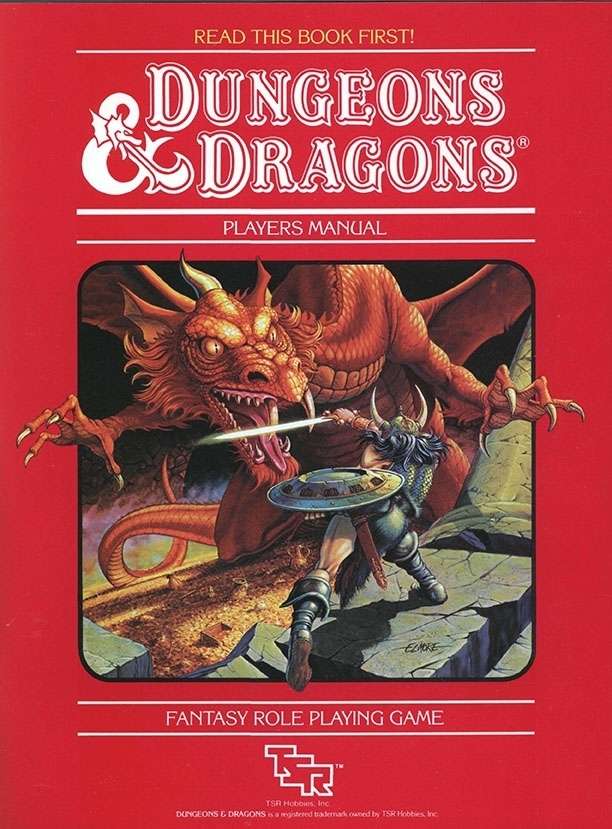
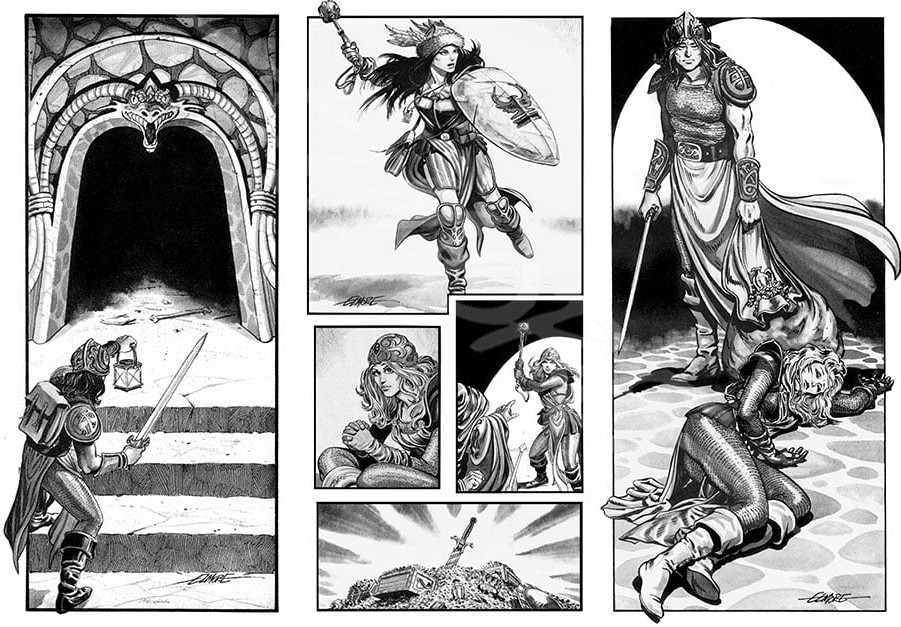
For a long time, Elmore was my absolute favorite fantasy artist! He drew the cover for the very first TTRPG book I ever bought. That archetypal red dragon of the Mentzer Red Box (and yes, it only has one horn, look closely at the art!) beckoned me into gaming. But his influence went far beyond the cover. He drew most of the art in the Players Manual inside that box, accompanied by some amazing standouts by Easley. The images of the adventurer entering the dungeon in the solo tutorial, the illustration of Aleena, Bargle attacking her, and the adventurer acquiring equipment—these visuals were fundamentally tied to learning the game, and they remain with me to this day.
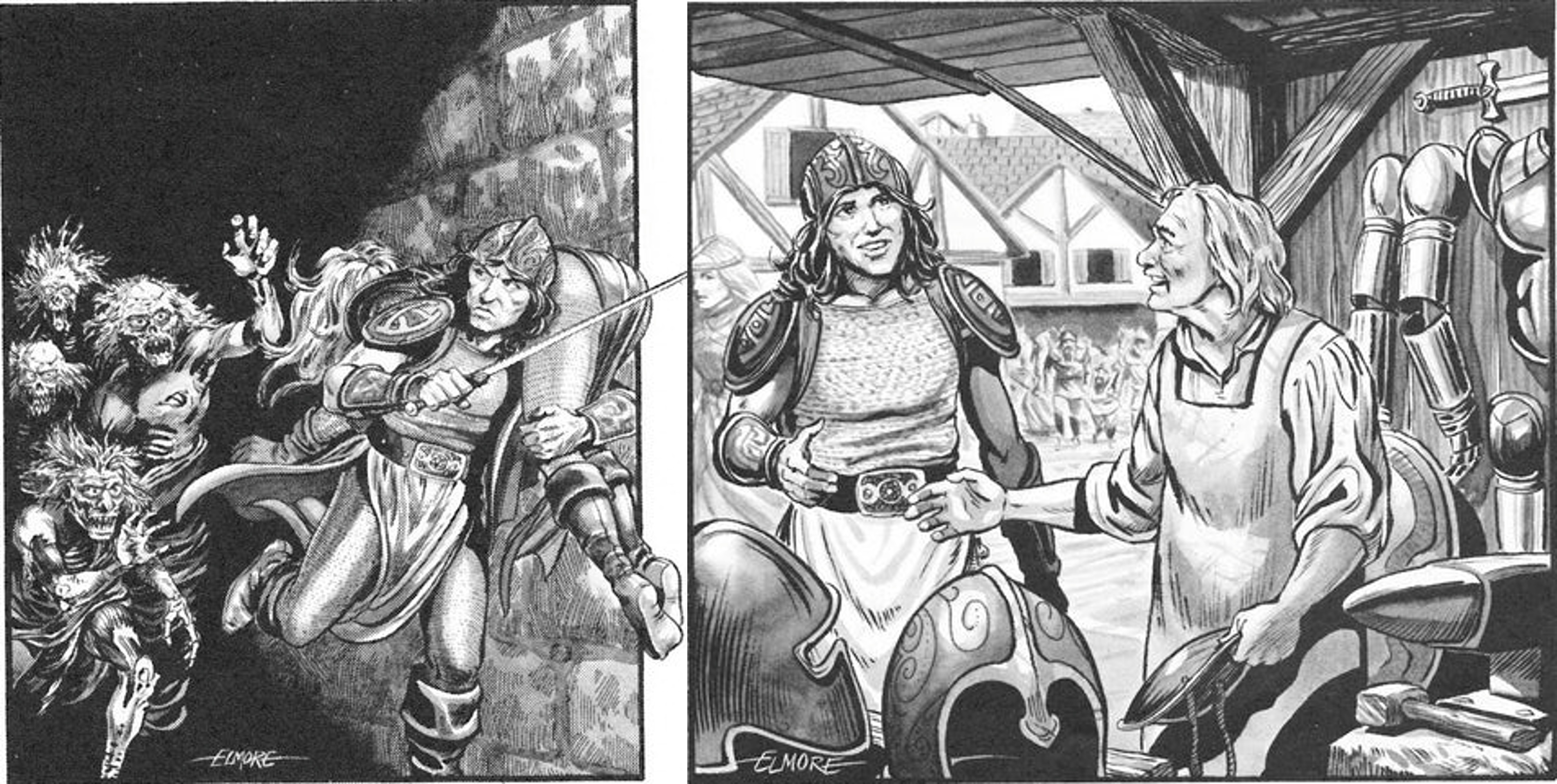
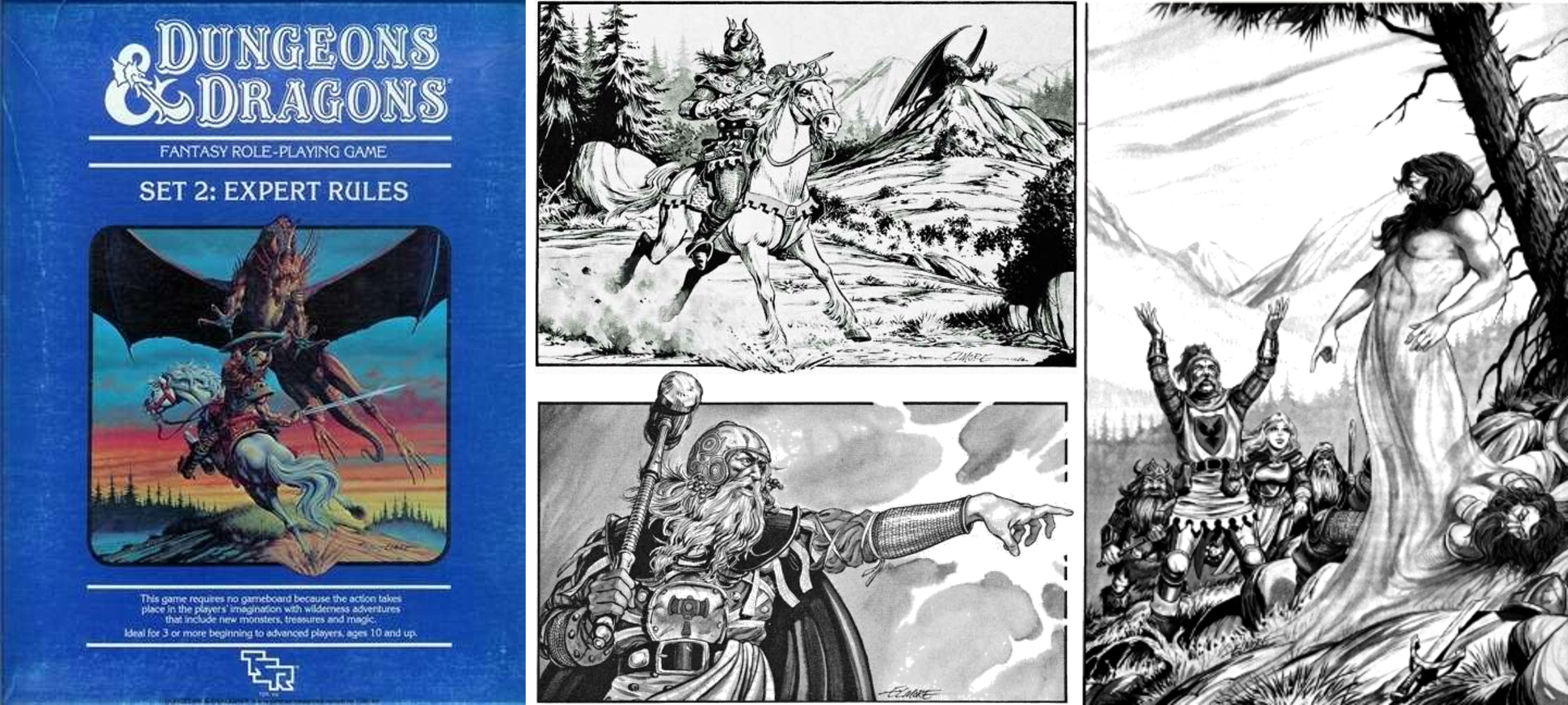
His art also graced the Expert set cover and most of the interior illustrations. I particularly love the one-page illustration of the duel.
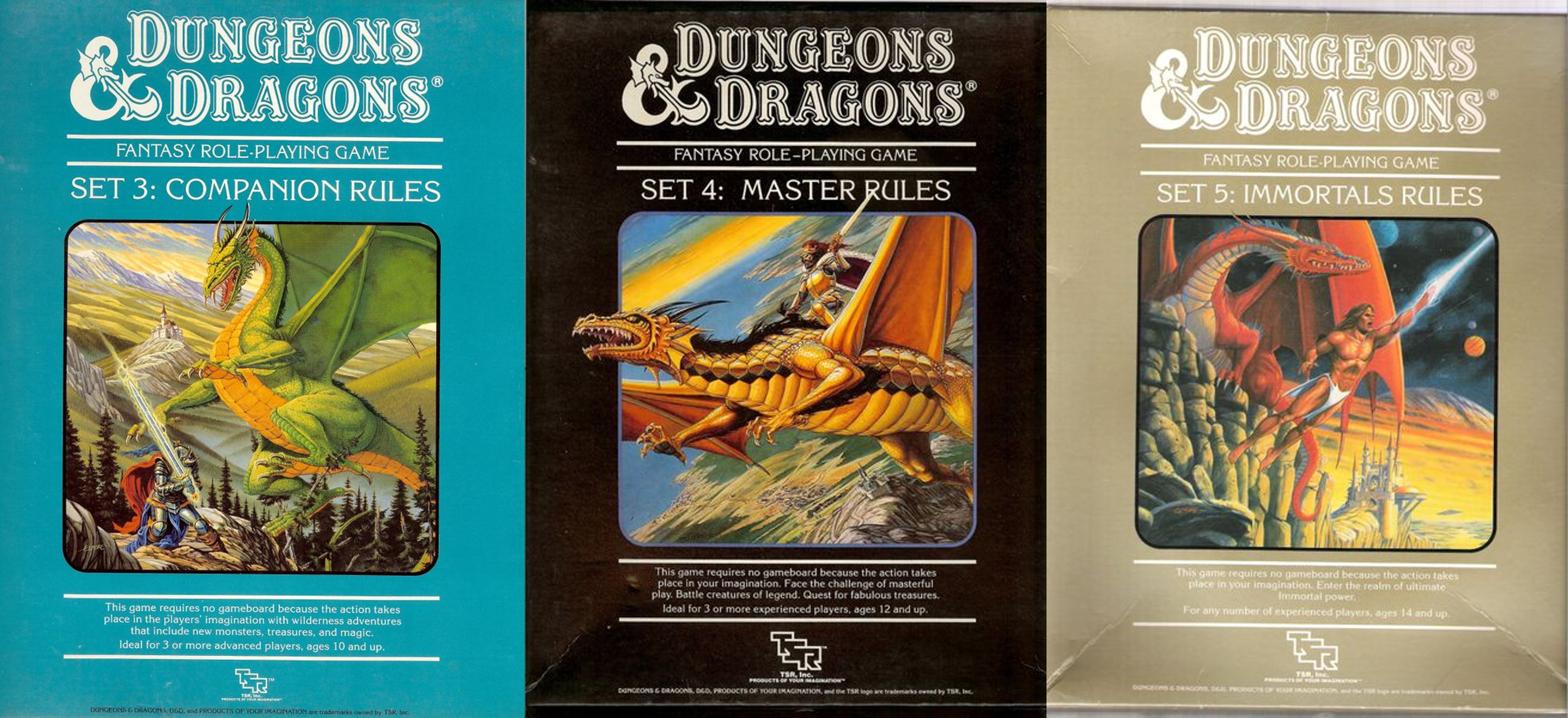
He went on to do the covers for the Companion, Master, and Immortal sets, and I vividly remember the weapons illustrations in the Companion rulebook.
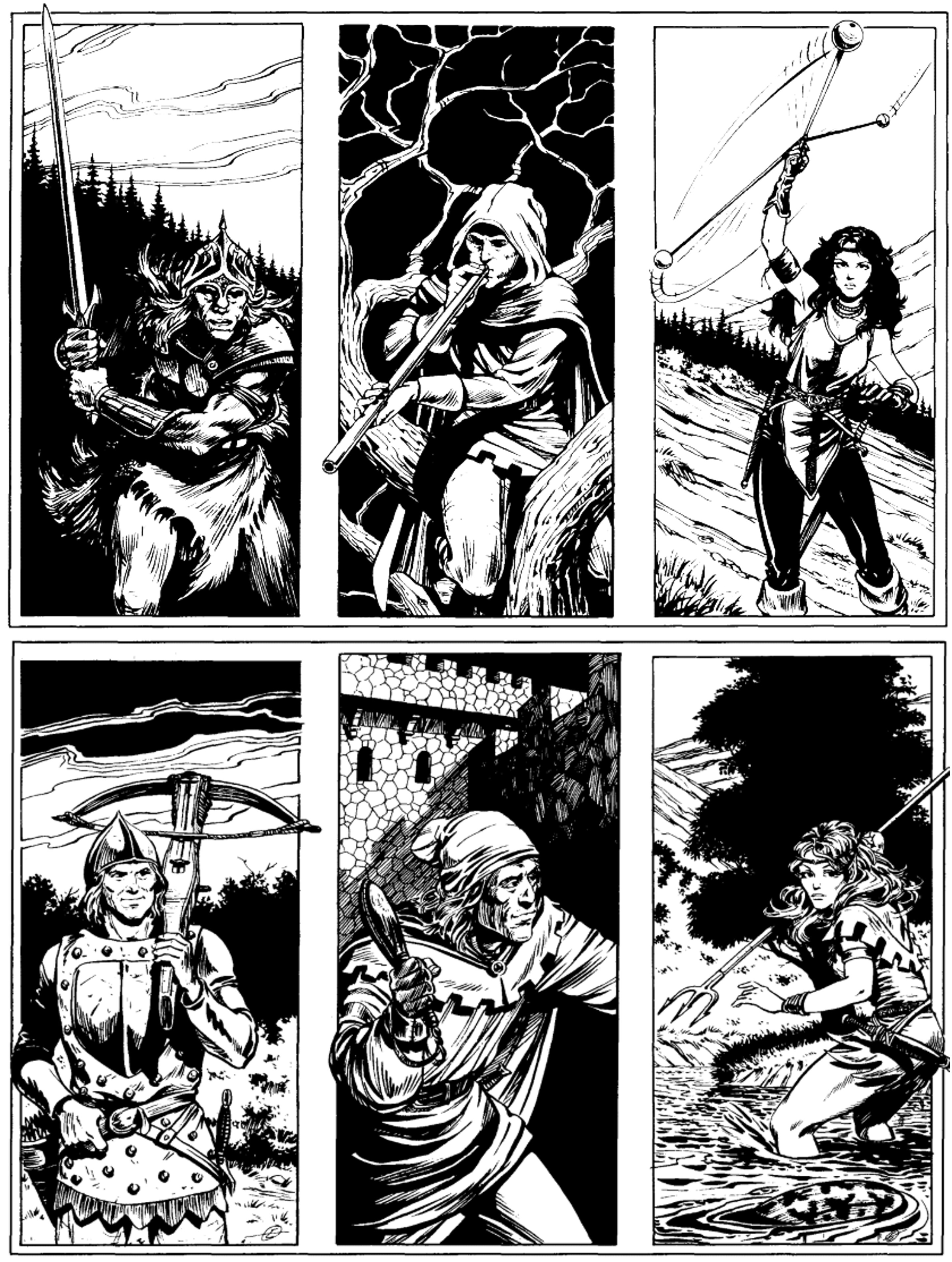
Whenever I saw Elmore’s art, I was entranced. His covers for the Dragonlance Chronicles and the Star Frontiers boxed set were undeniably a huge part of why I purchased those products. His aesthetics and clean lines defined civilization in D&D for me. When I thought of the classes and ancestries, I pictured them exactly as Larry Elmore painted them.
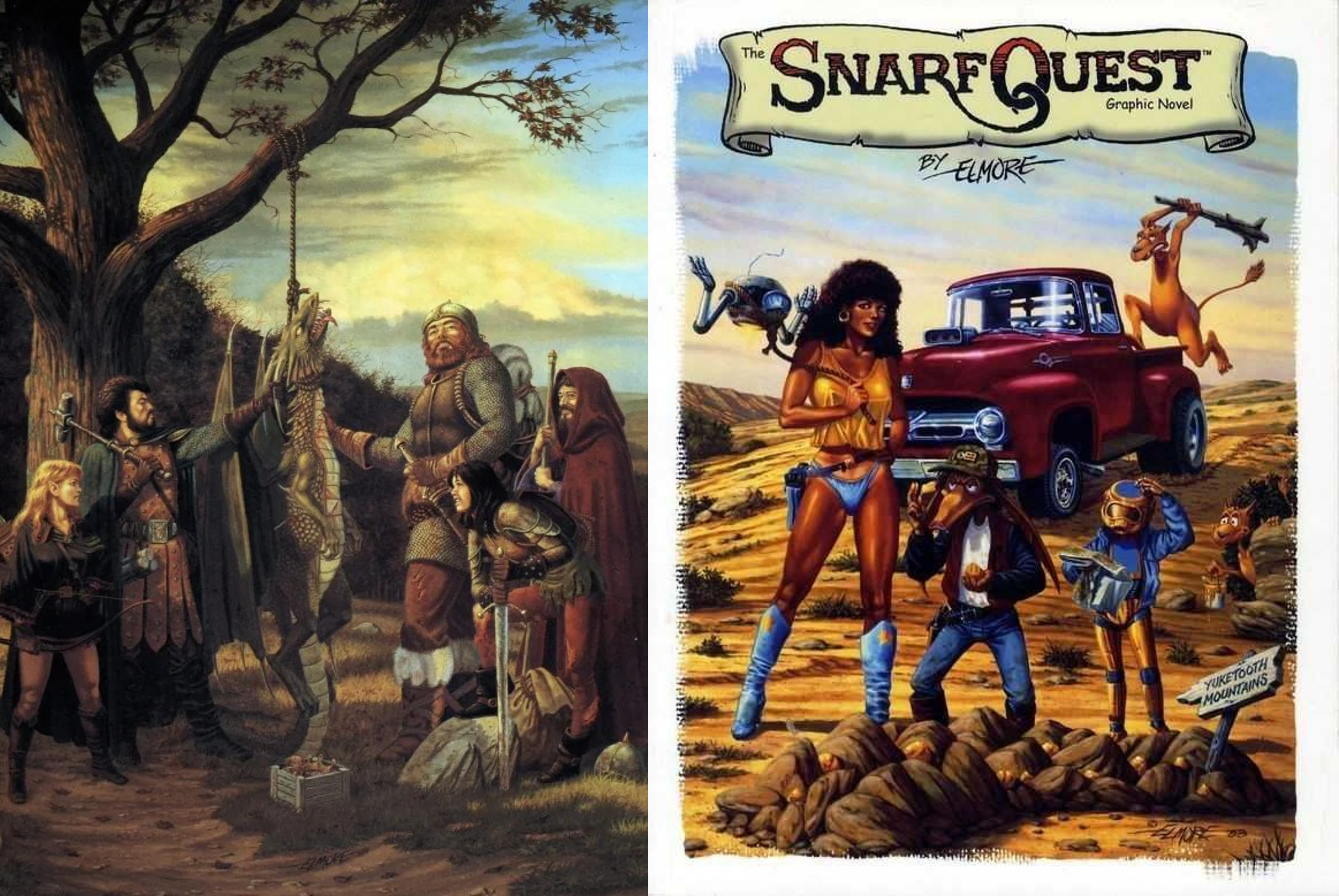
I know many people love his Dragonslayers and Proud of It piece from the AD&D 2nd Edition PHB, but I honestly wasn’t a fan. I understand what he tried to convey with the new heroes slaying a small dragon, but it didn’t catch my eye the way his other work did. I did, however, love a lot of his Dragon Magazine covers from this period. I read SnarfQuest, too, though I wasn’t a massive fan.
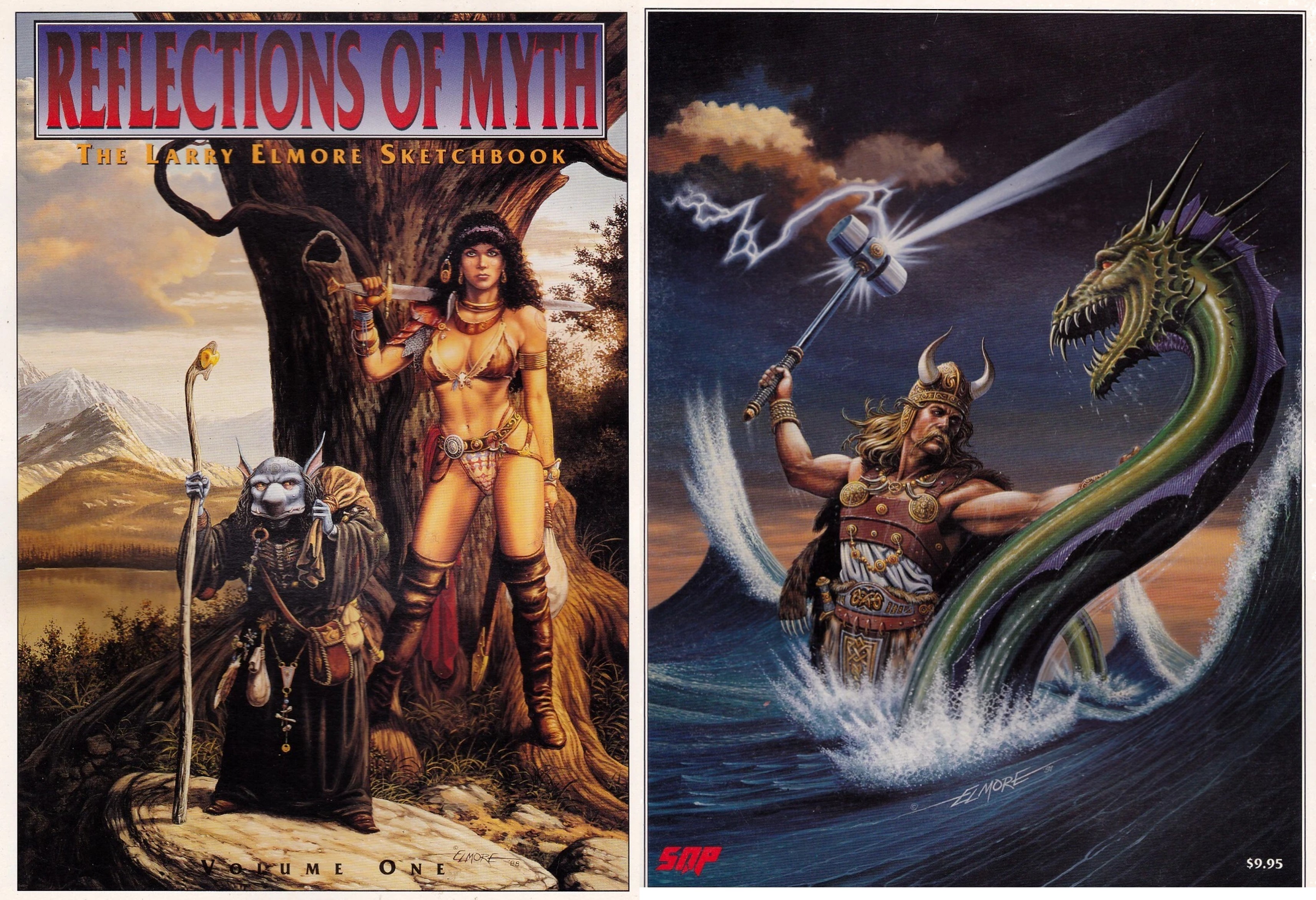
I still own a copy of Reflections of Myth: The Larry Elmore Sketchbook. I loved that book! I would often turn to a specific drawing in it and tell my players, “This NPC looks exactly like this.”
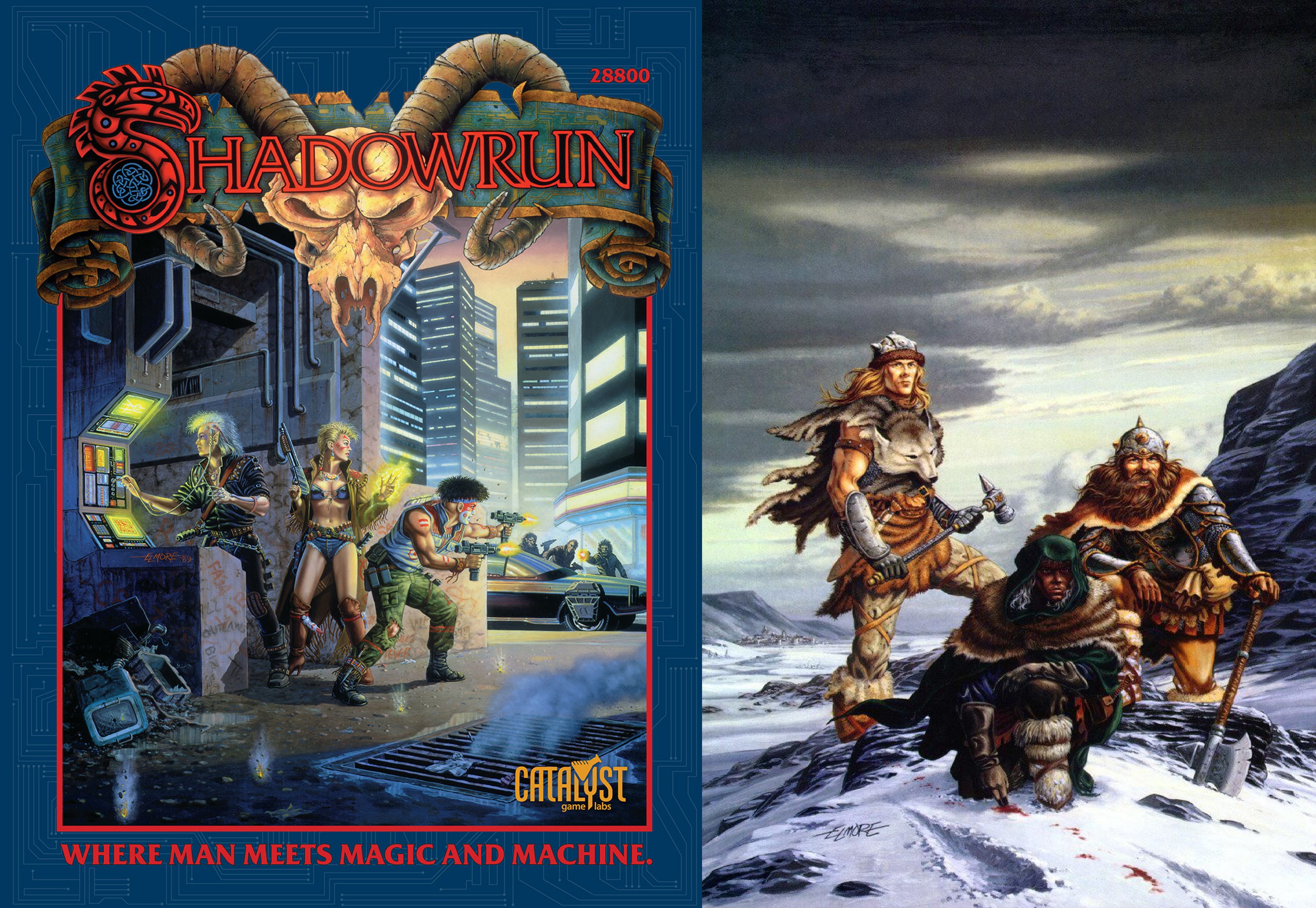
I probably would not have looked twice at Shadowrun if it hadn’t featured a cover by Elmore, and the same goes for The Crystal Shard novel. Larry Elmore’s art was my true gateway into Dungeons & Dragons and fantasy TTRPGs in general. In my imaginary, perfect D&D book, all the class and ancestry illustrations are drawn by him.
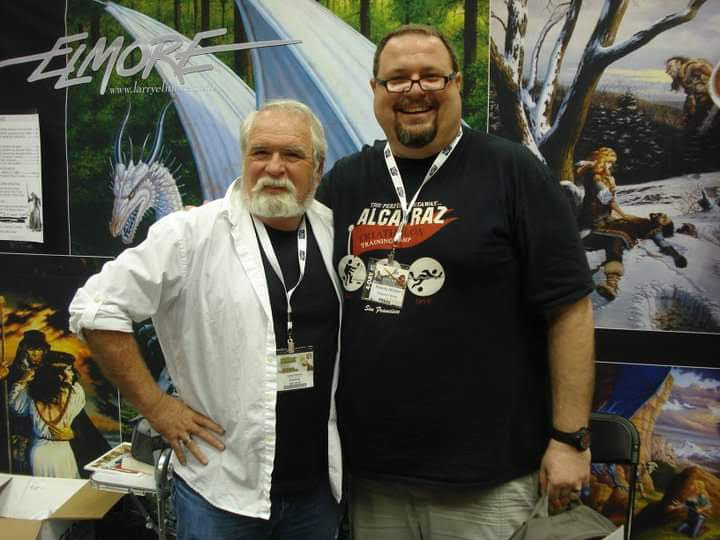
I was lucky enough to meet him and take the photo you see above at Gen Con 2010.
Jeff Easley
Elmore did all the covers for the BECMI boxed sets, but when I “graduated” to the Advanced version of D&D, all the covers for the orange-spine books were painted by Jeff Easley. While I later acquired copies of the original PHB, DMG, MM, and Deities and Demigods covers, when I first got the core books, it was Easley’s art gracing them.
His art seemed darker, more grown-up, and much more foreboding. This was definitely the “advanced” game. While his covers for the AD&D 2nd Edition books rarely come to mind as my all-time favorites, they were so prevalent that they heavily influenced the aesthetics of my growing fantasy world.
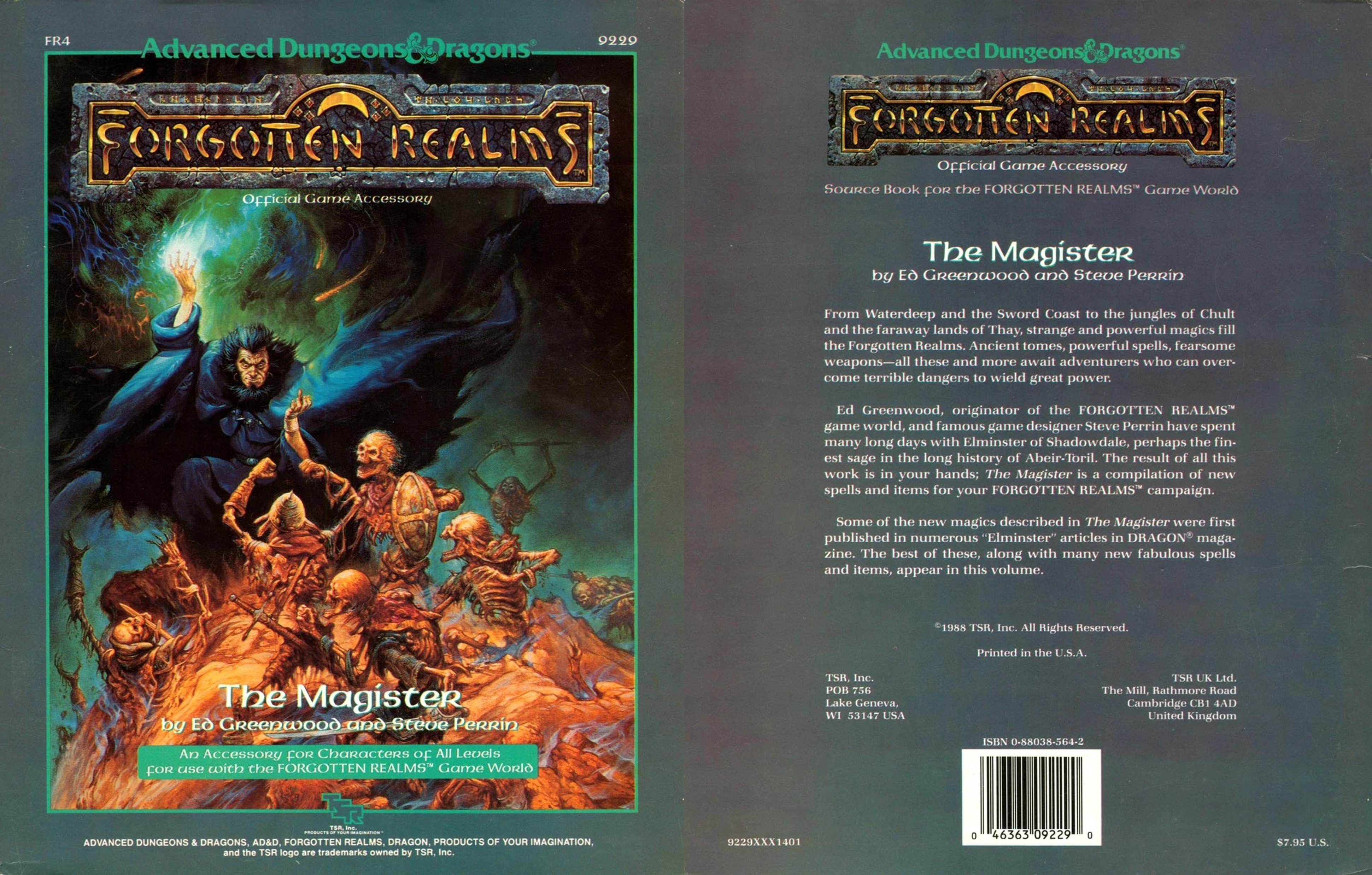
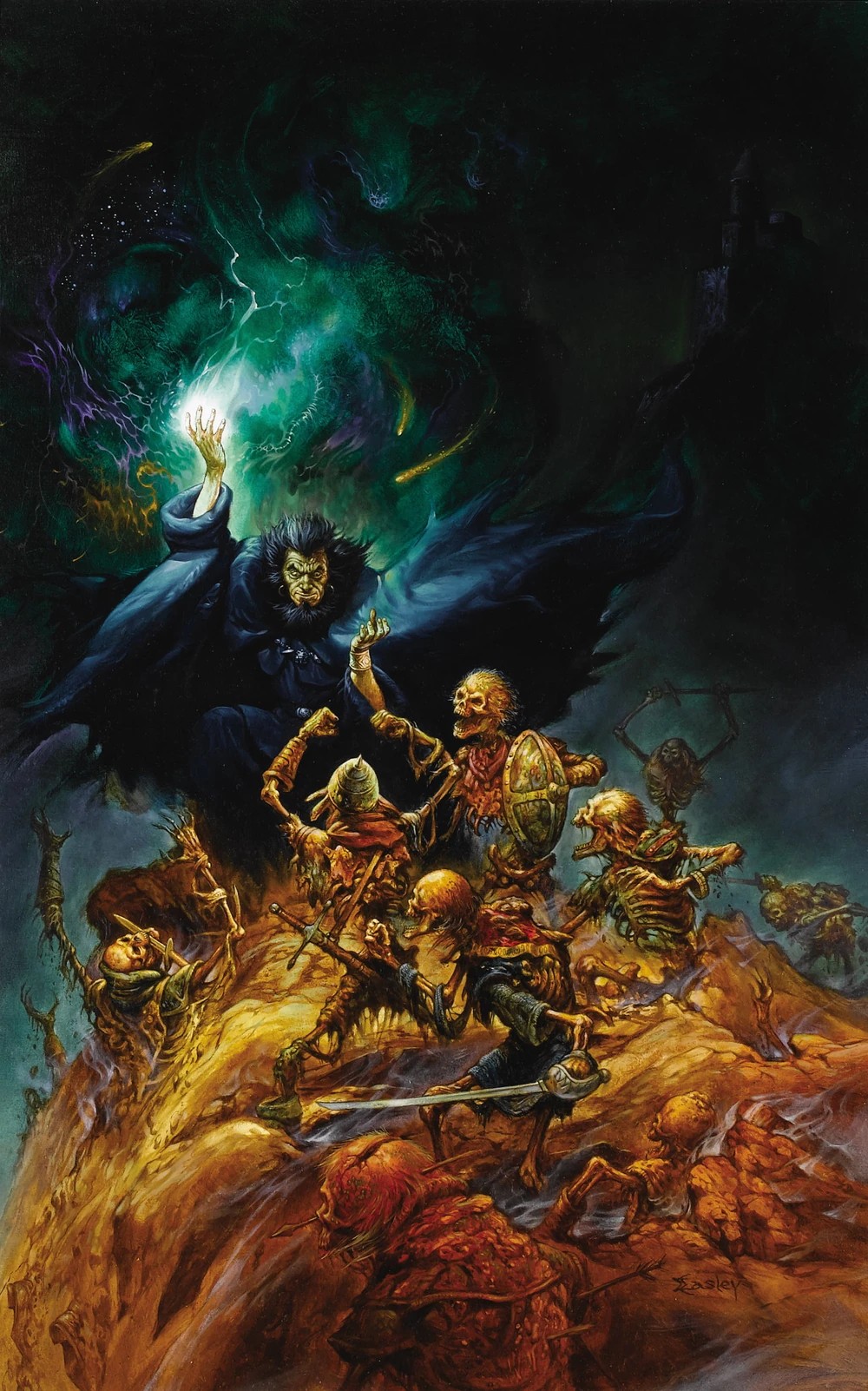
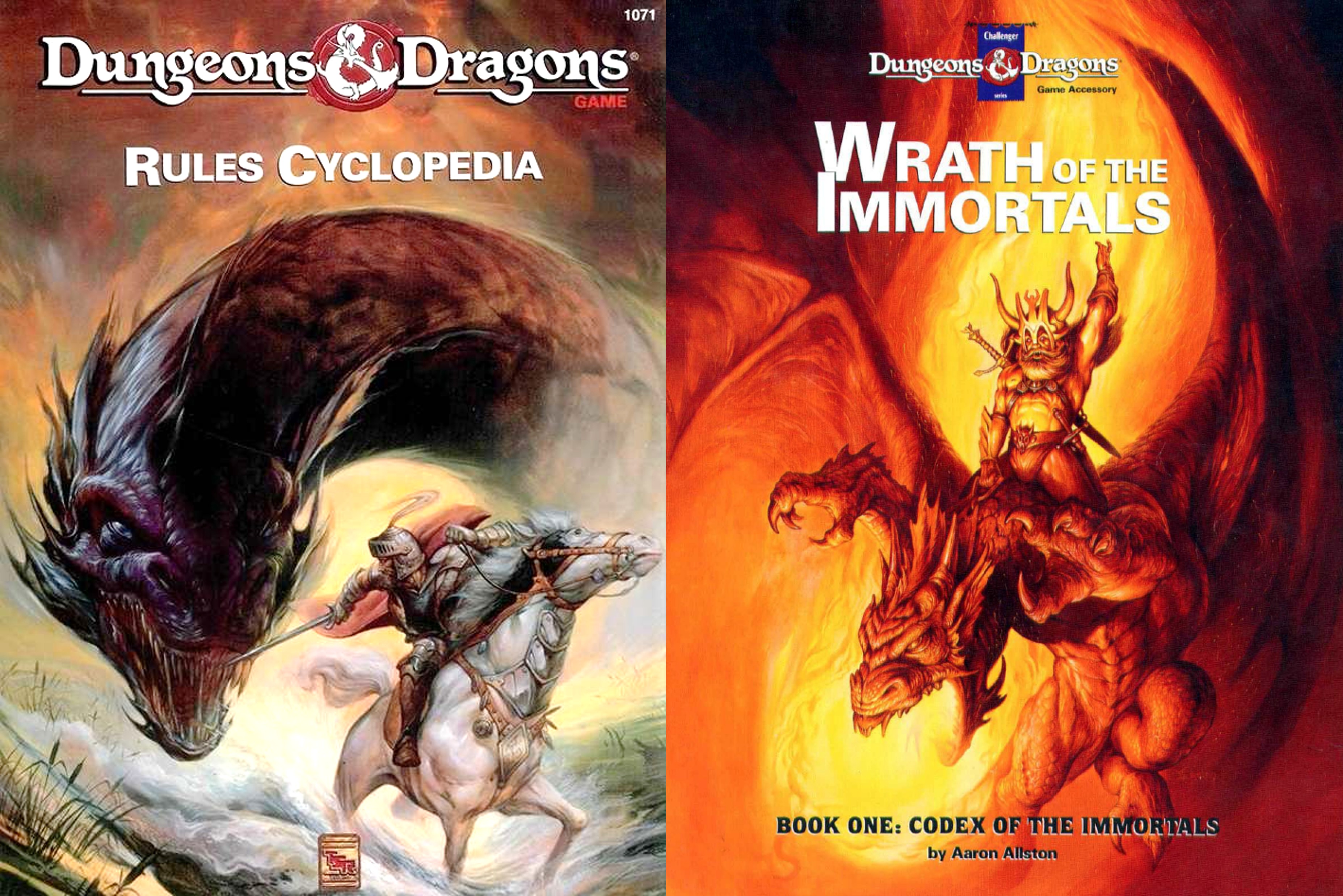
I loved The Magister supplement for Forgotten Realms, and Easley’s cover for it. That specific piece of art became the appearance of a major NPC in my campaign. His covers for the Rules Cyclopedia and Wrath of the Immortals are also pieces I treasure because of their connection to my favorite TSR-era campaign world, Mystara.
Clyde Caldwell
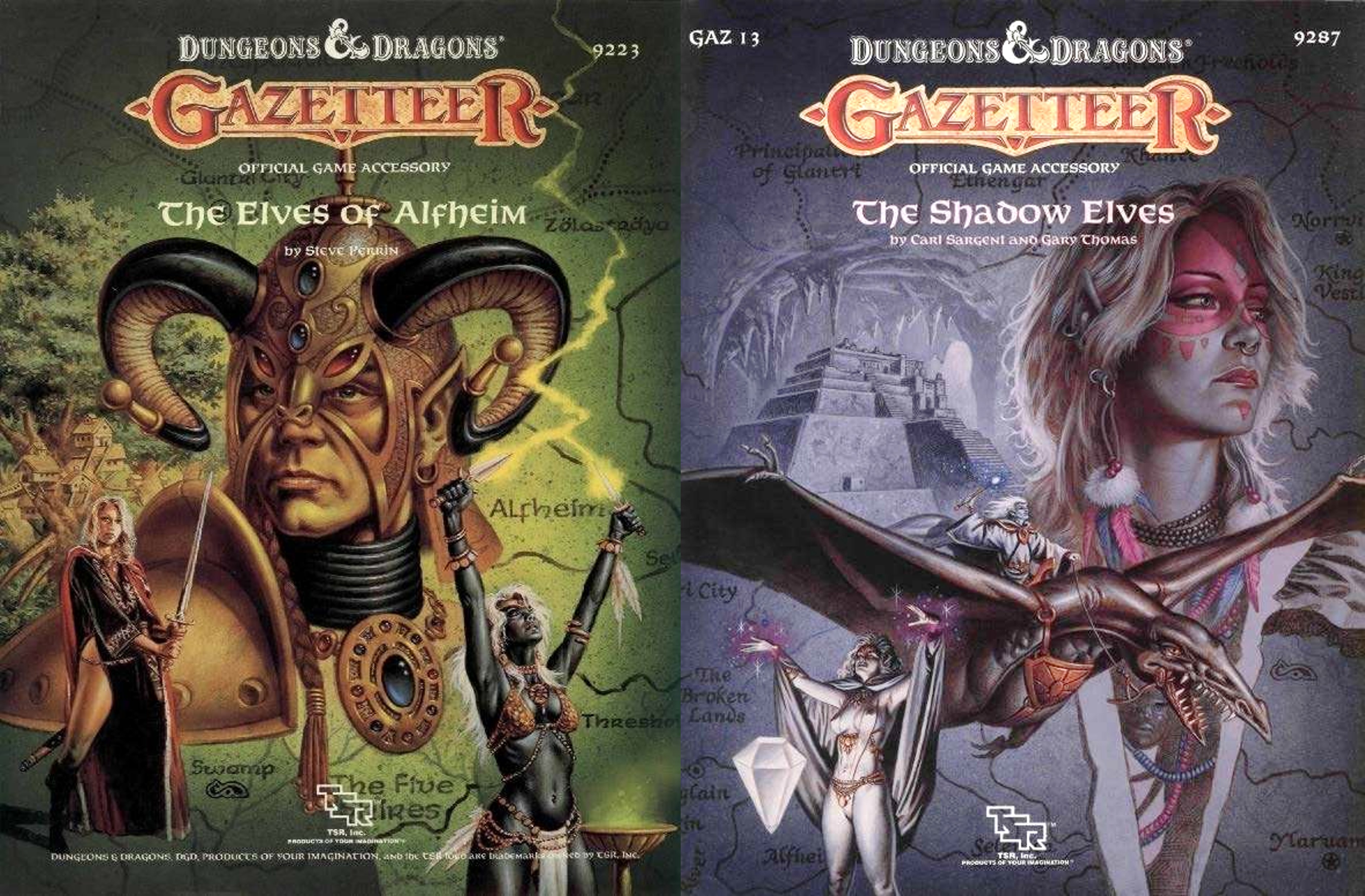
Caldwell is perhaps best known for his Ravenloft cover, featuring Strahd looking like a classic movie vampire, and that recognition is well deserved. But for me, he will always be the artist who drew the covers for my favorite series of supplements: the Gazetteer series.
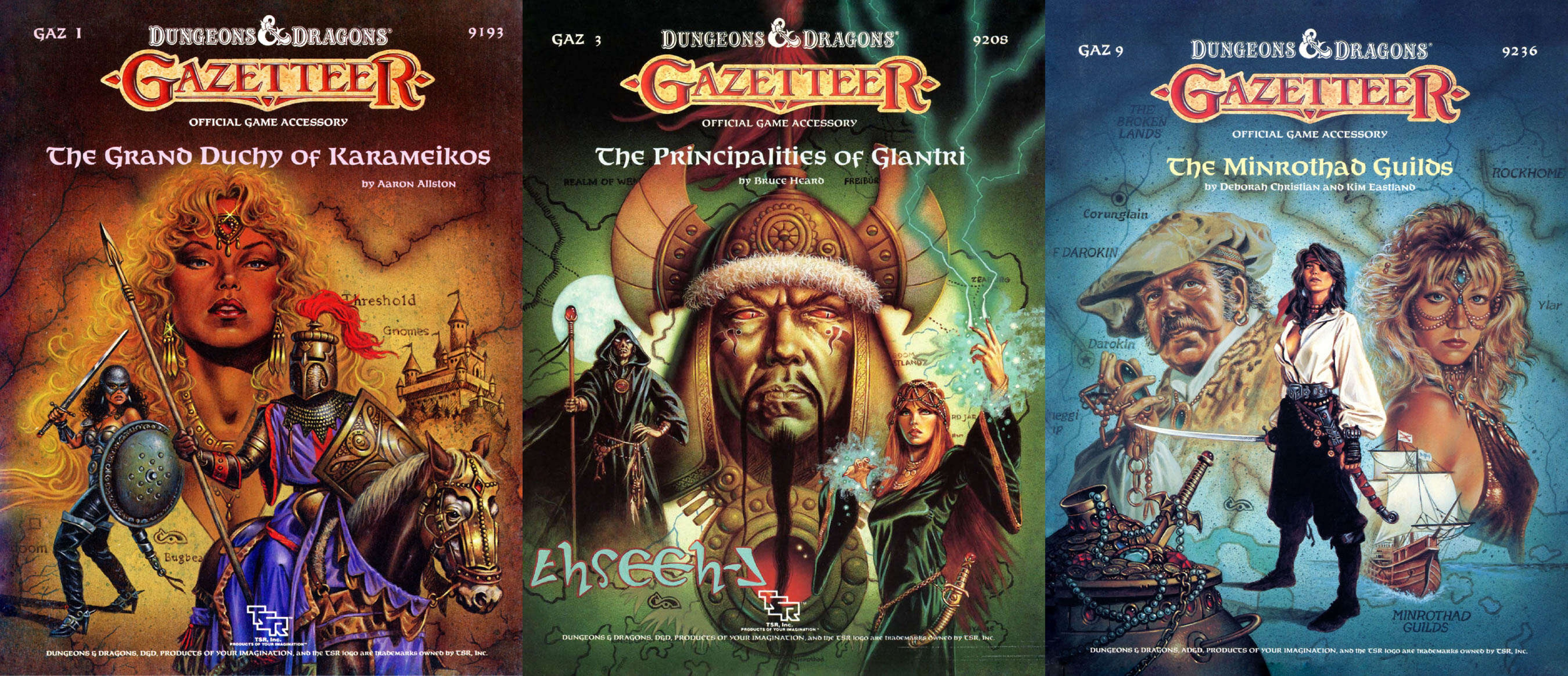
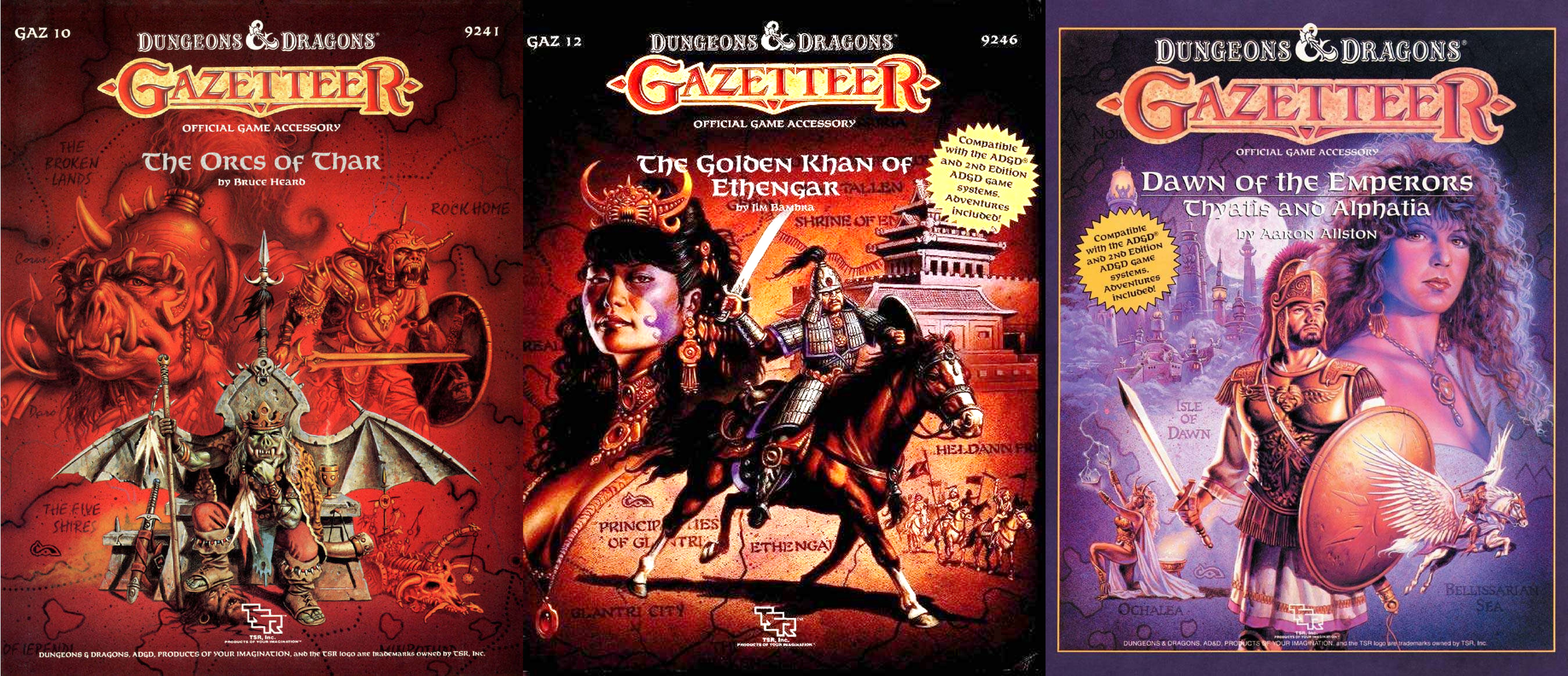
For me, his covers encapsulated what each region of the world represented, even if the Shadow Elf on the cover of the Elves of Alfheim was drawn as a Drow. Mistakes happen!
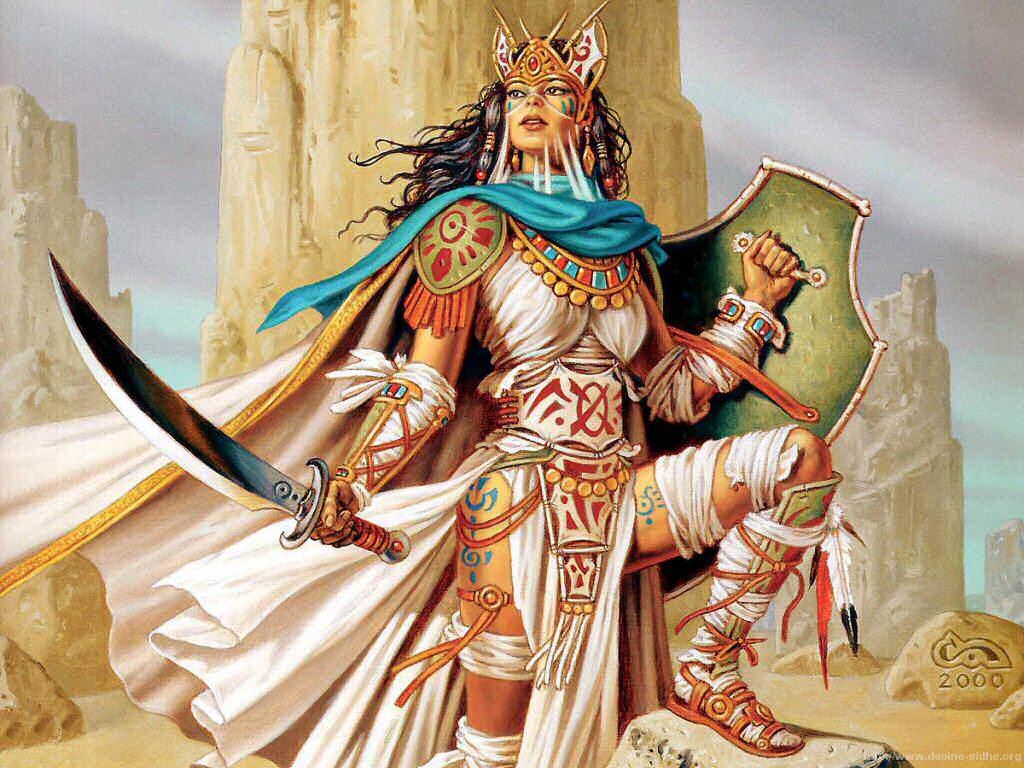
Later, his Resilient Wanderer art from Magic: The Gathering directly inspired the look of an entire culture in one of my campaigns.
Then there is…
Keith Parkinson
If Elmore was my favorite of the four as a young gamer, Parkinson would become my favorite of the four as an adult.
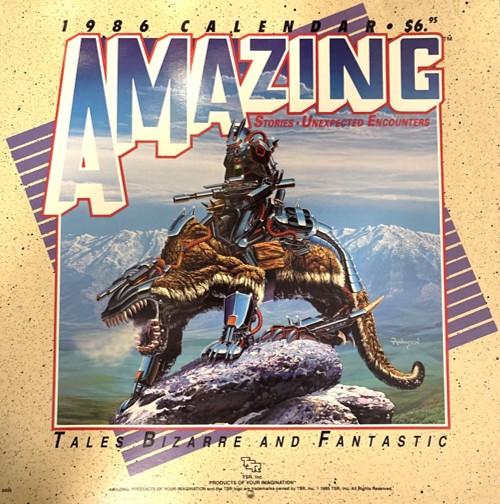
I actually saw his art before playing D&D, inside the Amazing Stories 1986 calendar I got in late 1985. It featured work from all the artists in this post. I remember staring at the art, trying to invent stories to match the scenes. While the fantasy art was great, it was the post-apocalyptic sci-fi (even if I didn’t know to call it that back then) that really caught my eye.
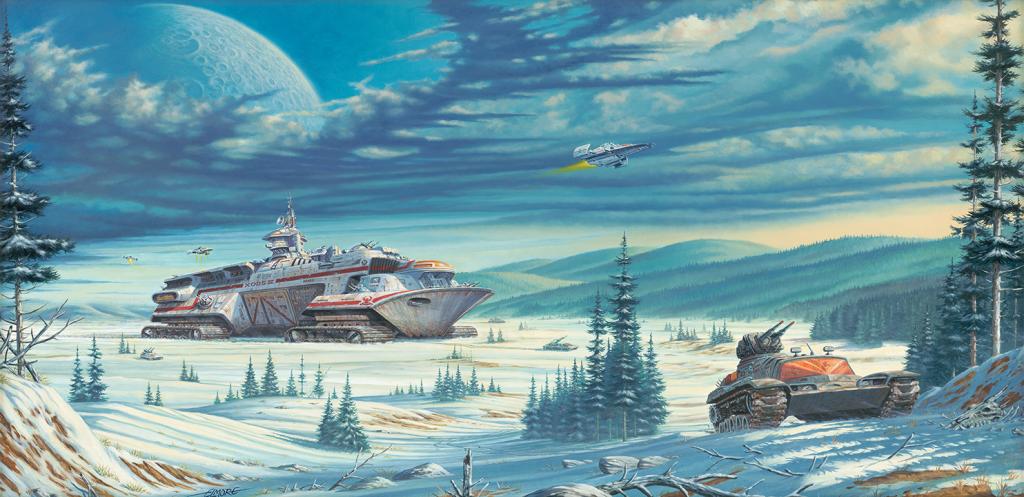
There was an Elmore piece (Epsilon Cyborgs from Gamma World, see above) and an Easley painting (The Fallen, featuring a man in power armor defeating a dinosaur while another attacks, an image I frustratingly cannot find anywhere online). But it was Parkinson’s art—the cover of the calendar, which would later become the cover of Gamma World 3rd Edition featuring the Ultimate ATV —that I remember most vividly.
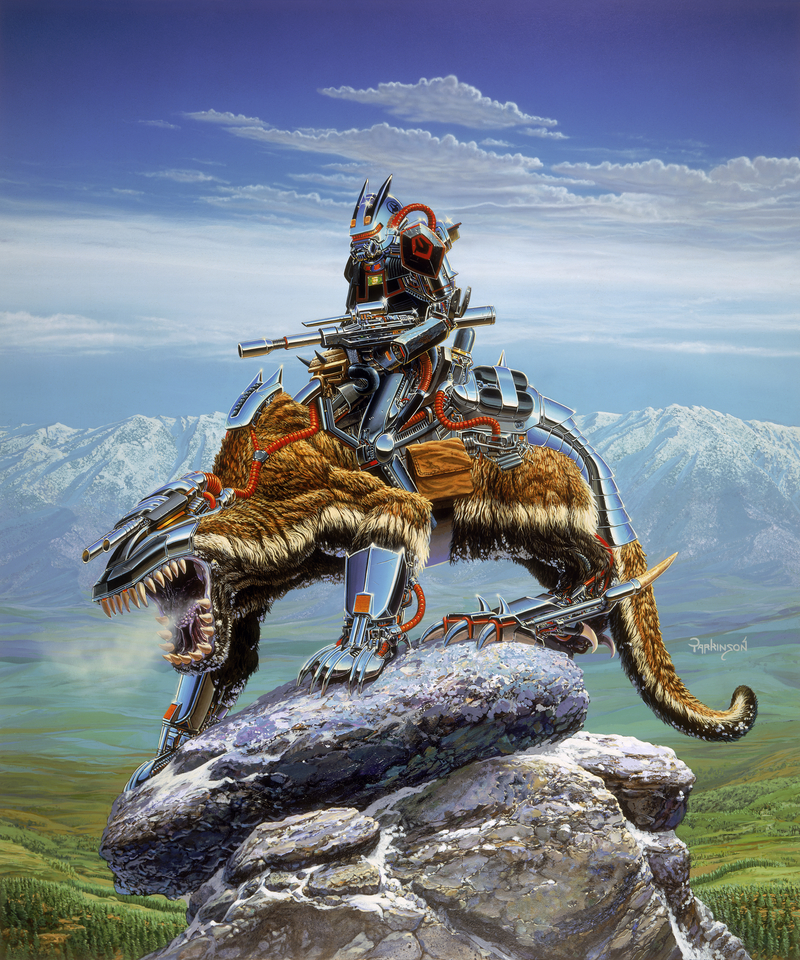
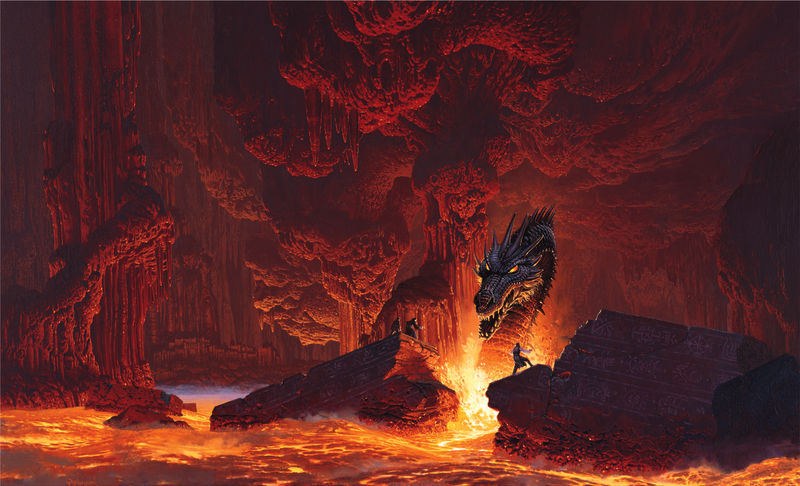
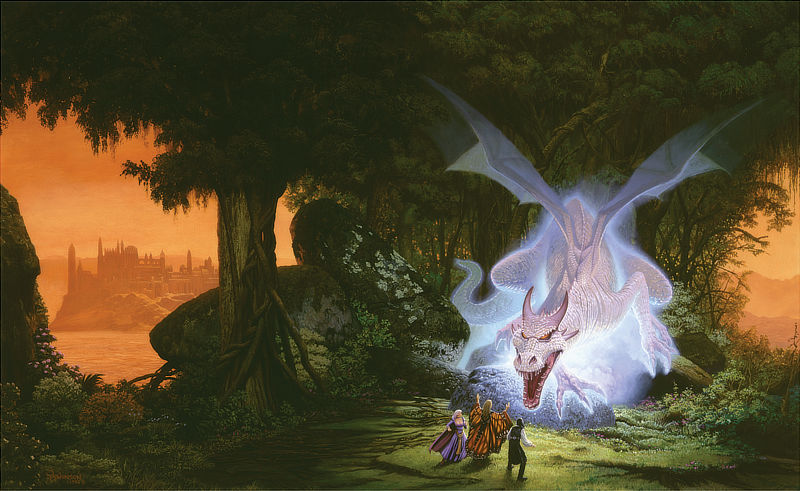
I absolutely love his fantasy work, too. Lord Soth’s Charge is amazing (and he remains one of my favorite D&D villains). The North Watch from Dragon magazine issue 137 is breathtaking.
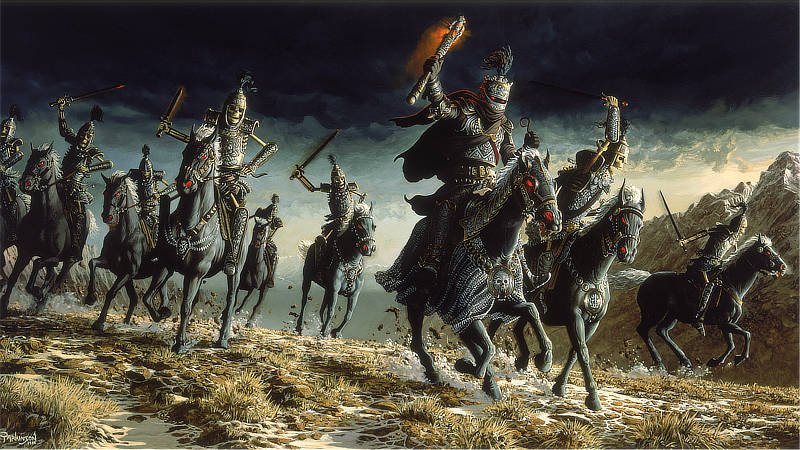
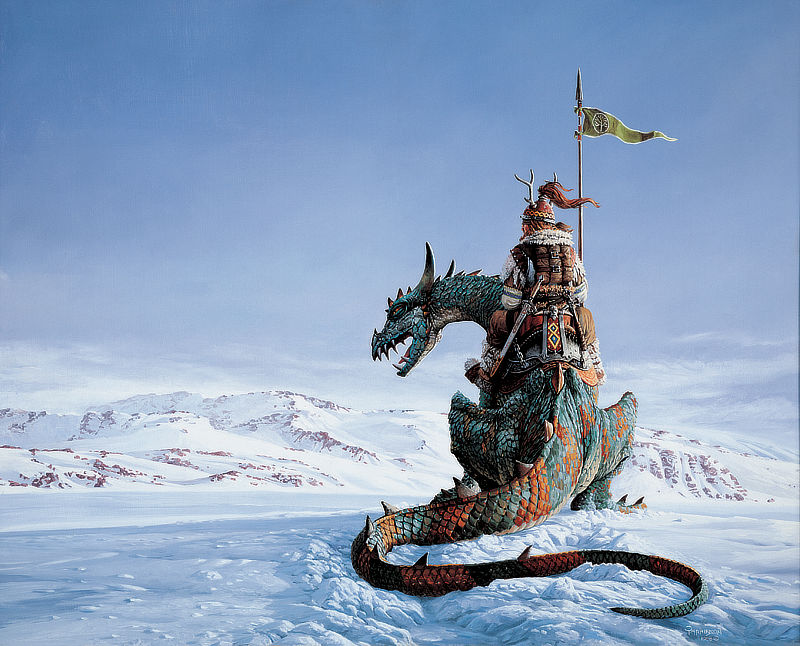
And, of course, the seven covers he did for the Death Gate Cycle books.
Then there are his Rifts covers! The original edition features the Splugorth Slaver, Mutants in Orbit, and Atlantis. I was a massive Rifts fan in the 1990s, and seeing his art in those books completely blew my mind.
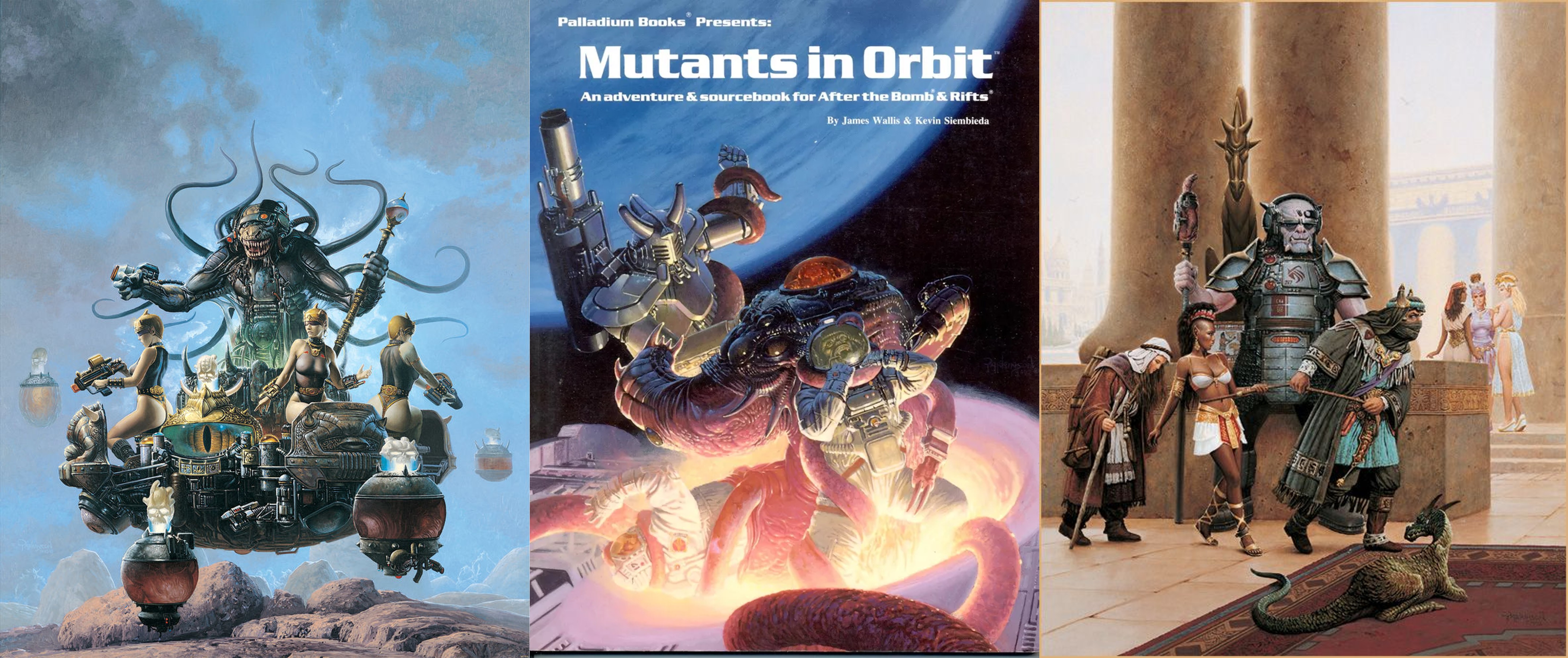
Sadly, he passed away in 2005 at only 47 years old. But his art continues to inspire me today.
I love the work of all four of these artists. They were incredibly formative to me as a young fan of fantasy and sci-fi, and as a burgeoning Game Master. Even now, when a scene takes shape in my mind, when I describe a location or NPC to my players, or when I write about my campaign world, the images created by these four men shape my imagination. I am forever grateful for their art, which has so deeply enriched my life, and this hobby I enjoy so much.
Categories: Tabletop Gaming Blogs
Pages
