Your wildly multifarious home!
Tabletop Gaming Feeds
OSR Commentary - Overview and Look At Interbellum Red Rpg published by The Red Room
Interbellum is a tabletop roleplaying game published by The Red Room, heavily rooted in the OSR (Old School Renaissance) style of play. It was originally launched as Wretched Interbellum in late 2023 and later updated and re-released simply as Interbellum in June 2026.Here is a detailed breakdown of the game's setting, themes, and Needleshttp://www.blogger.com/profile/11243274667834930867noreply@blogger.com0
Categories: Tabletop Gaming Blogs
Deathbringer Doesn't Need an Apology

I wasn't planning to write about Deathbringer. Then I started reading the reactions to it.
I honestly couldn't believe what I was reading.
Apparently fantasy has beautiful women now, and this requires a symposium.
Several months ago I wrote a post called Frazetta Armor. It had absolutely nothing to do with Deathbringer. Truth be told, I'd been making the same joke on social media for years. While working on my Hyborian themed Shadowdark campaign, I finally turned it into a blog post.
The joke was simple. The less armor the hero wore, the harder they were to kill.
Everybody got it.
Because that's been part of fantasy for as long as I can remember.
I grew up on painted paperback covers. Every bookstore had a fantasy shelf full of warriors with impossible muscles, forgotten temples, giant snakes, skulls, sorcerers, and yes, beautiful women. Nobody stood there wondering whether the armor met OSHA PPE regulations. You picked up the book because the cover promised adventure.
That's what fantasy looked like. That's still what fantasy looks like to me.
So when I see people calling Deathbringer embarrassing because it has attractive women wearing revealing clothing, I honestly wonder where they've been. This isn't some shocking new direction. This is one of the oldest visual traditions the genre has.
I've seen people say the women are too attractive.
Too attractive? I didn't realize fantasy was supposed to stop celebrating beauty.
Then there's the clothing. Really?
We're talking about a genre where Conan wandered around in a hardly there loincloth, where Red Sonja became one of fantasy's most recognizable characters, where every other wizard somehow owns a robe with sleeves long enough to trip over. Fantasy has never dressed its characters for practicality. It dresses them to create an image you'll remember.
That's the whole point.
The criticism that really puzzles me is the claim that this somehow makes Deathbringer shallow.
Why? Because it has beautiful women?
Fantasy has always dealt in ideals. Bigger monsters. Greater heroes. Darker villains. The artwork isn't trying to convince you this is real life. It's trying to convince you this world is worth visiting.
There's a difference.
Look, you don't have to like the art. Maybe it isn't your thing. Maybe you think you've seen it all before. Fair enough.
What I don't understand is acting like this aesthetic is somehow foreign to fantasy.
It isn't.
It's one of the reasons a lot of us fell in love with fantasy in the first place.
When I look at Deathbringer, I see a game that's perfectly happy to admit where it came from.
Apparently a lot of other people were looking for exactly that.
Judging by the BackerKit numbers, I'd say they found it.
Categories: Tabletop Gaming Blogs
The Mine at Mt. Morris
By Greg Ferris
Talaraska
Generic/Universal
Level ... 3?
Talaraska
Generic/Universal
Level ... 3?
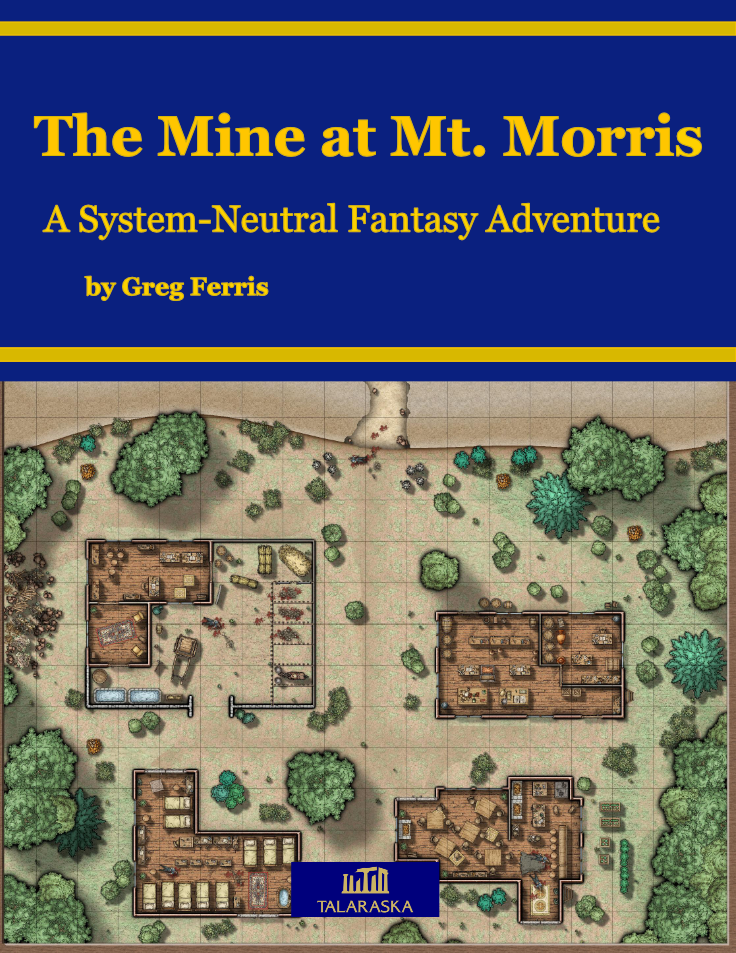
The hills making up the Archian border with Caledos are pocked with dozens of abandoned mines. These leave a lasting reminder of the rush for silver in the years prior to the rise of the Graun Empire. Without drawing much attention from local officials, a nebulous consortium of investors has been purchasing old dig sites throughout the region. The mine at Mt. Morris was one such purchase. About 12 months ago, a group of ten men reopened the dig, which locals were sure was folly. After spending a couple of weeks repairing the base camp, the team resumed the dig. None but the foreman had any previous mining experience. Most of the “miners” were farmhands or former members of the stevedores’ guild. None were strangers to hard work, but they were a motley crew to be certain. However, the strangers who came and offered them the job assured them that they would be paid handsomely. The past year had been difficult. The team had failed to find any substantial amount of ore and they often assumed that their work would soon come to an end. Despite this, the paymaster and his retinue of guards would appear every month and the dig continued.
This nine page adventure presents eleven rooms in an old mining camp & camp that has been “overrun” with undead. It’s pretty basic, with not much going on.
I’m not super sure how this made it on my list. It must have either been in the OSR section on DriveThru or a request? I don’t think I see a request, so it must have been in the OSR section at DriveThru at one time, even though it’s labeled Generic/Universal. The marketing blurb advertises it as a flesh out adventure hook, but the adventure, proper, lists itself as an adventure. I don’t know, some way of framing it not having stats? I don’t think that matters. In any event, it has more life to it than the vast majority of adventures and even manages to present more rooms than the number of pages in the adventure. How far have we fallen to have that be some standard of success? What’s a spud to do? Anyway, ignoring most of the intro there’s a small adventure hidden in here that is relatively inoffensive. There’s not much interesting about it either, but, hey, it’s 2026 and I’m in a morose mood because somehow an uninteresting adventure with eleven rooms in nine pages somehow is better than most if the garbage I review. So, no stats and no treasure, just some “place treasure appropriate to your system” notes here and there.
There are some pretext reasons here for exploring, nothing very interesting. Hired to do blah blah blah, or local priest has visions blah blah blah. Getting to the site you find four outbuildings and then seven rooms in the mine. There are bodies about, partially eaten. A stable has horse bodies, and one stall padlocked with a living horse in it and extra water that has run out. One of the buildings has a survivor barricaded inside of it with a confusing story that doesn’t make sense. The idea is that the party will use the stable clue, as well as another clue in the bunkhouse, to understand that the dude knows more than he is saying and that they’ll press him for details. The details are not altogether interesting given the small size and stand along nature of the adventure combined with the generic/unival vibe. He was hired to run a mining crew, looking for a diary in a buried complex. He did some research on his own and found out that the dude was a necromancer and used animated bodies as guards. When the miners found a wall he gave his horse some water and locked himself in, fearing the worst. The miners break in, undead get out, the worst happens, everyone dies but him and his horse. It’s an interesting way to present a clue, without having to resort to a diary or monologue. And by interesting” I mean “correct.” We get to see the results of actions taken in the past that help explain the now, rather than listen to a droning monologue. The players gets to use their brains to put things together. Or not.
The rooms inside the mine are uneventful. Generic alter room. Generic crypt. “There are 8 sarcophagi in this room. Four of these are open and empty. The remaining four are closed and hold inanimate skeletons. There is a small stone altar along the western wall. Beside it rests an open chest filled with gold and any treasures that would be appropriate for your game. “ Nothing really evocative about them, inside the mine or out. Nothing really stands out. A few ghouls/ghasts. Entries are padded out with things like “As the party moves in this direction, they are assailed by [an odor.]” There’s like five pages of intro to go with the four pages of room keys. There’s just nothing to this. “First, do no harm”, the slogan goes. And, for the most part, that was accomplished here. Sure, some padding, a decent amount of it. But, also, the rooms are still relatively terse and easy to scan. There’s still no way I would run this, there’s just nothing to it, but it IS still better than most adventures because it IS doing no harm.
This is $2 at DriveThru. There is no preview.
https://www.drivethrurpg.com/en/product/571820/the-mine-at-mt-morris?1892600
Categories: Tabletop Gaming Blogs
[Parsulan] Zagartha

Zagartha is a floating island wandering some 1000 feet above Berlaith. Like the other floating rocks of Parsulan, it contains large amounts of thaumatite. It was ejected from the surface during the early years of the Demon War owing to the magical surge from the weakening of the Great Barrier.
Zagartha, when it was an earthbound mountain, contained a large temple complex and was the site of a famous oracle, but it was abandoned after it was desecrated by demonic forces. At least two conflicting stories are told regarding its reinhabitation. The first holds that the Seven Great Sages, disputing some obscure points of the oracles last series of pronouncements, journeyed there with their followers and were holding a symposium there when Zagartha rose into the sky, stranding them. The second holds the Sages led a group to a place of (relative) safety from the Fomori on the already skybound island with a magical conveyance that was wrecked upon landing. Even among Zagartha's inhabitants, both stories have their adherents.
The original sages passed long ago, and the number of students their successors enjoy have dwindled over time as they tend to be drawn from outsiders, not from the ranks of locals who feel a sense of duty to the sages and support them materially but have little time for their ascetic lifestyles and philosophical arguments. Both groups dwell in and among the ruins of the previous temple complex. Either the buildings have been repurposed or their materials used to build new structures. The locals are mostly craftsmen, farmers, and merchants. They maintain the all-critical cisterns, tend the small fields, and conduct trade with the "ground-folk."
One important aspect of their lives is the capture over other floating rocks. Some of these are added to Zagartha to expand it. Others are mined for materials. In both cases the rocks are reached through the use of the skywires and skywire harnesses that use small thaumatite to shoot lines at force. The skill necessary to employ them effectively takes years to master but makes many Zagarthans skilled aerialists.

Categories: Comic Book Blogs, Tabletop Gaming Blogs
'Grroovvy' Bad Ash from Army of Darkness & The Evil Dead Films For Sword of Cepheus 2nd Edition With New Sword of Cepheus Adventure!
Here is a complete, ready-to-use stat block and profile for Evil Ash from Army of Darkness, built specifically for the Sword of Cepheus (2nd Edition) ruleset. This blog post picks right up from 'I'll Swallow Your Soul '- The Necronomicon Ex-Mortis (also referred to as "Naturom Demonto" and "Book of The Dead") for Sword of Cepheus 2nd edition & Adventure EncounterIn Sword of CepheusNeedleshttp://www.blogger.com/profile/11243274667834930867noreply@blogger.com0
Categories: Tabletop Gaming Blogs
Dead Wizards Design Log 02

Last post was about Cunning and Prowess, which are the stats PCs roll against to accomplish almost everything. But that's not the first part of character creation.
First, you come up with two Marks, or "specials". There's a list of 20 fleshed-out examples to build from. Here are a few to give you an idea what I'm talking about.
"2. You have a silver flute that was given to you “for luck” by an old woman on her deathbed. Playing it clears your mind and lets you focus. Sometimes playing the flute allows you to see solutions to problems or divine facts you could not otherwise have known."
"17. A vicious vulture plucked out one of your eyes. You know its name and nature. A desert devil, it is. A supernatural monster with part of your soul inside it. When you close your good eye and concentrate, you can see through the evil old vulture’s eyes. You can often make it fly where you like so you can see distant places. One day it may find you and try to finish the job."
Marks don't include game mechanics. The way they work is to be sorted out between player and Judge, but usually comes down a modifier to an Action Roll (Prowess or Cunning) or an Oracle (1d6)... the two mechanics used in the game.
I'm trying to keep this focused on the setting's theme, on characters, and the stuff that develops naturally through play. The mechanics underpin it, but I wouldn't call this a crunchy or fiddly system at all.
Categories: Tabletop Gaming Blogs
Building The Red Planet Empire - Mixing Warriors of the Red Planet (WotRP) with the Domain-level Architecture of ACKS II Rpg - the Archeon Slave Market for Warriors of the Red Planet and ACKS II
The Archeon Market is a massive, multi-tiered commercial meat-grinder hidden deep within a jagged obsidian chasm on the dying planet. Heavily inspired by the cosmic horrors of Rifts Atlantis, this market is not run by mere desert outlaws; it is a trans-dimensional and hyper-technological bazaar controlled by an ancient, multi-eyed alien cabal known as the Grand Taskmasters. This picks rightNeedleshttp://www.blogger.com/profile/11243274667834930867noreply@blogger.com0
Categories: Tabletop Gaming Blogs
Dead Wizards Design Log 01

Dead Wizards is a sword and sorcery RPG set in a sandy land. A bit of sand and sorcery, if you will.
The idea came up about ten years ago as an OD&D hack inspired by Corben, Howard, and Tanith Lee. Revamped it later and it changed into something completely different, becoming GOZR.
But now I'm back to the original concept. I started with GOZR mechanics as a base and I've been working from there. I stripped a few things away, added other things.
I'll try to do this as a series of posts over time, just talking about one aspect of the game or another. If you read this, feedback is greatly appreciated.
First up, the core character "stats": Prowess and Cunning. Prowess for all things physical and Cunning for everything else. Why just these two? Because in all the sword and sorcery tales I enjoy, characters deal with their world through only these two modes. I don't think any more are needed.
You roll for your stats. But like GOZR, lower is better because the stat is the target number to meet or beat on a 1d20 roll.
The roll to set the stat is 1d4+2 for each, so you can only get 3-6. A very narrow range, which is extremely on purpose and I spent a lot of time thinking about it, running simulations, and all that. It means the guy who gets a 3 and the guy who gets a 6 are still fully compatible in terms of skill.
The rolled target number is for a Basic level of difficulty. Then each level higher adds 3 to that target number. The difficulties are Basic, Arduous, Grueling, and Epic.
So if your Basic Prowess is 5, then you'd have a spread like this:
Basic 5
Arduous 8
Grueling 11
Epic 14
As with GOZR, this simply means you look at your sheet to see what your target number is. Quick and dirty. But here the Judge has options for increasing difficulty. The Judge can decide case-by-case how difficult a task is.
Bonuses to rolls are low. In most cases, you're not getting one. But you can get a +1 for some things and maybe even +2. That makes those target numbers more challenging, but not daunting. You are playing heroic, capable sword and sorcery characters... not farmers and zeroes.
Once your target numbers are set, they do not easily change. There's a way you can swap points between adventures, making Prowess 1 better and Cunning 1 worse, for example. But 3 is the hard limit. Nobody has a stat target lower than 3.
Characters are more differentiated by their histories and their special traits. More on that later.
Categories: Tabletop Gaming Blogs
The Old Man
By Kirk Kahoe
Crimson River Games LLC
Generic/Universal
Levels: Any
Crimson River Games LLC
Generic/Universal
Levels: Any
Warning! This is as close as you can get to being a Heartbreaker without actua;;y being a Heartbreaker.
An eternal horror haunts the woods, reaping an endless harvest of woe from those foolish or desperate enough to travel through them. Tired and injured, the party will have to not only face an endless onslaught from the horror but fatigue and madness as well, for there is no sleep in the Old Man’s realm other than the sleep of death.
This 169 page adventure is an overwritten railroad in which the best solution is leaving the table to have explosive bloody diarrhea in your hosts bathroom and then going home. Ok, that was mean. It’s a 169 pages of railroaded atmosphere in which you have no choices to make as a player and the DM must wade through an excruciating amount of text to run even the simplest encounters.
Page twenty of the intro text tells the DM that they should Describe, not define and then follows this statement up with “A shambling and decaying humanoid creature that stinks of ammonia is scary. Labeling this creature “Zombie” and adding specific statistics is a game mechanism. It is thus no longer a scary monster but a set of numbers to crunch and probabilities to consider.” This is 100% correct. Not only does it follow the show and don’t tell mantra, but it adds that air of mystery that RPGs thrive on. I’m a big big fan of this attitude and it bolstered my spirits seeing it.
Oh! Oh! I forgot! You can get Hep! That’s right! Hep! That’s BAD AZZ! “So, what did I get? Another plague? Yellow squirting zombie fever or something?” “No, you got Hep.” Fucking christ ma! That’s great! I love it! Next time you roll through a village you find out 15% of them are dead from cholera. That’s nicely visceral and I do love a reaction from the players. Which, I might note, is exactly what the adventure is trying to do with its horror.
Great, I’ve said something nice, even if I did include the backhanded “page twenty” reference.
There’s a dude who is the only worshipper of a god and he’s constructed this obtuse parallel reality death trap in a forest to select sacrifices worthy of his god. As the adventure tells us “Due to the depth of role-playing required to deliver the Old Man and the complexity of fatigue’s impact on gameplay …” It’s a test/challenge dungeon. That’s it. 169 pages of test/challenge dungeon. You know how those things work. It’s an alternate reality blah blah blah, you can’t leave, blah blah blah, he controls everything blah blah blah. “In the event (which happens often) that the Old Man (or his copies) are somehow killed in any of the encounters before the final encounter at his hovel, he is instead fully healed and moved to the subsequent encounter.” Cause hes wearing this fucking ring that brings him back. Worry not, DM afraid the railroad will stop, “In all cases, the presence of the ring should not be noted due to the grime and darkness until the last encounter.” Ain’t nothing like having no choices that really brings home the immersion. Time and again we see this. This reliance on a test/challenge environment as a pretext for all of the setup the baddie has done. Time and again we see these mechanical contrivances, like the ring, used as an excuse to justify an effect. Time and again we see these railroads as an attempt to tell a story and get an effect. You can’t fucking do it that way. One of the keys to a roleplaying game is the ability to make choices. Once you take that away you might as well be watching a movie with a predetermined outcome. Sure, I can roll a die. Will the DM let me die or force me to suffer through the entirety of their story? Players check out when they can’t do anything. When they can’t make a decision. Sure, there’s a time and a place for “the RPG adventure as an Activity” instead of “the RPG adventure as a Game”, but, Baron Munchhausen did this a long long time ago.
In spite of the adventures words implying it’s a show don’t tell piece, it relies on mechanics and read-aloud to bring the horror, telling instead of showing. A fatigue mechanic. Mountains and mountains and mountains of read-aloud. No one wants to listen to your half page read-aloud man. You don’t set a mood by using a lot of read-aloud. Yes, the writing should be evocative, but it should not be lengthy. You get a few sentences, three or four, and that’s it. You need to really work those sentences to bring the effect, the impact you are going for. Yes, it is not easy. It is, I think, the hardest part of adventure writing. More is not better. Player attention drifts. You make it harder on the DM to focus. You can’t use mechanics to fill in either. Sanity, in CoC, is just another pull of hit points, campaign hit points, as to say. It is up to the designer to put something together that FEELS like fatigue without relying on mechanics to accomplish that.
So, yeah, railroad. The adventure starts at a little trade town. Caravans leaving, to go over the pass. Wanna join? SURE you don’t want to join? Ok, so, no, you decide to wait at the trade town over the winter? Ok, then bandits keep attacking. Eventually you see over a 100 bandits about to attack and the entire town, whats left, flee in to the hill. Along the caravan route. Heh. So, yeah, you’re going on the adventure. Then you’re in the alternate reality shit where the dude controls everything and you’ve got exactly one path to go on. Just follow it and make skill check after skill check as: there’s a rock fall. There’s a bridge collapse. The wagon is stuck. Blah blah blah. I don’t know, there’s about fifty locations, between the overland and like a manor and such.
There is an EXTENSIVE amount of information presented for each area. There’s a section for environment, then a section for topography. Then a boxed text section for the read-aloud, then a section for monsters/traps, then a section for encounter mechanics, then a section for notes, and a section for treasure, and a section for game master notes. There is EXTENSIVE repetition, which is great because with so much information, a long paragraph or more for each section, the area is then spread across multiple pages. There is NO WAY a DM can keep this shit together for a meaningful encounter. And this stuff is present for almost every area. Time and again, DO NOT use such a rigid format. Leave shit out if you don’t need it. Do NOT do shit like tell us the door, walls, light, smell, taste for each and every room. The purpose of formatting is to help bring clarity and help a DM when they scan the adventure looking for pertinent information. Used in mechanical fashion though, as it is here, is instead obfuscates and works against the goals it is trying to achieve.
It’s just weird, the way things come together in this. In one read-aloud section it says “They have knowledge of the mountains and what supplies are needed, and they can provide basic information about the mountain road. This sound slike DM notes, not read-aloud. And that’s not an isolated example, I’m not cherry picking. In another section there is a Treasure heading that reads “Treasure – Supplies from the abandoned wagons (See Treasure section).” Isn’t THIS the treasure section? (Turns out, no. It’s _A_ treasure section. FLipping to an appendix we can find a Treasure appendix with a listing for “Wagon Contents” which is full of mundane supplies.)
It’s just crammed with so much extraneous and repetitive information. And then the encounters are so humdrum. Oh, make a skill check! Ok, get a fatigue. Yawn. The final battle with th dude is anticlimactic as fuck. He attacks, eventually you drive him off. You find him in his hut and kill him there. End. Given this is 170 pages long and like almost fifty railroad encounters I would have expected just a little more in the way of flavour than a couple of sentences saying “he attacks you.” The horror element here just doesn’t work, hardly anywhere in the adventure. Mechanics and read-aloud doesn’t do it. The Hep C cant save an overwritten adventure in which the horror element is reduced to mechanics.
This is $5 at DriveThru. The preview is the first seventeen pages. Which doesn’t show any of the encounters because there’s a LONG intro and background info and so on and so on and so on. A preview needs to show some of the encounters so a buyer can make an informed decision about the purchase. That’s the purpose of the preview.
https://www.drivethrurpg.com/en/product/564568/the-old-man-of-the-woods?1892600
Categories: Tabletop Gaming Blogs
Kull-era Atlantean campaign Random Encounters table For Sword of Cepheus 2nd edition
Here is a 2d6-based random encounter table for a Kull-era Atlantean campaign utilizing the mechanics of The Sword of Cepheus 2nd Edition. This blog post picks right up from D100 Kull Era Atlantean Relics and Monster Encounter Tables For A Sword & Sorcery Sword of Cepheus 2nd edition Part IIIn the Thurian Age, Atlantis is not yet a sunken realm; it is a harsh, mountain-ringed Needleshttp://www.blogger.com/profile/11243274667834930867noreply@blogger.com0
Categories: Tabletop Gaming Blogs
Building The Red Planet Empire - Mixing Warriors of the Red Planet (WotRP) with the Domain-level Architecture of ACKS II Rpg - Using Space Noble PC Within The ACKII rpg
In ACKS II, managing an estate and a private army is a core part of the game. For a planetary romance or space opera setting, the standard medieval ruler translates into a Space Noble. Instead of managing medieval peasants and wooden castles, a Space Noble commands high-tech orbital fiefs, handles interplanetary trade logistics, and maintains a private standing army of high-tech infantry orNeedleshttp://www.blogger.com/profile/11243274667834930867noreply@blogger.com0
Categories: Tabletop Gaming Blogs
Fantasy Superheroes

A common criticism of later editions of D&D from fans of older editions is that they produce "fantasy superheroes." I don't agree with that characterization. In fact, I wonder why we don't see many rpg examples of fantasy superheroes because, like Stargazer here, I think it could be an interesting idea.
For clarity, I don't mean characters in a fantasy world that have secret IDs and codenames and fight crime wearing costumes--though I think a Zorro or Iron Monkey sort of frame of masked fighters for justice could easily fit what I am thinking of. Mostly, though, I'm just thinking of comic books like Battle Chasers or Dreadstar (the latter is really space fantasy, but its basic setup is a useful example) and animated series like He-Man and the Masters of the Universe (2002, particularly). Epic fantasy stories featuring super-powered characters.

So what makes those examples "superheroic" in a way a 4e campaign isn't necessarily? In Superhero: The Secret Origin of A Genre, Coogan lays out his "MPI" definition of a superhero. That is, a superhero is a person with Mission, Powers, and Identity. He also has the fallback of "generic distinction" to catch characters (like the Hulk) that might fail by the initial test and to exclude characters that might seem at first blush to fit but are better accounted for in another genre.
Regardless of whether the fantasy heroes I'm thinking of would be superheroes in Coogan's estimation, I'm think about characters that:
- Have a mission, which might be something like "defeat Sauron," but could be something more like "overthrow the God-King who betrayed us." This wouldn't be the place for picaresque wanderings or "get rich or die trying."
- Have powers that are beyond reach of regular folks to a notable extent. Those powers would tend to require explanation and come with an origin of sorts. That could be as simple as "born an air bender," but whatever it is, it would set a character apart from most people. While this pillar is where there is the most overlap with modern D&D, I think D&D's approach to powers that largely makes then originless (other than being a particular class) and outside of spells, more an artifact of game rules than a setting element, fails to place it within the proposed genre.
- Have an identity, in the sense of being distinct, likely from other heroes in the party, but certainly from broader humanity. The difference between characters a normal D&D party is something like the difference between the members of the Fellowship of the Ring, but here the difference would be more like the differences between the members of the X-Men or Legion of Super-Heroes. I feel like a lot of identity is in a distinctive visual, but that probably comes from this subgenre being mostly a thing of visual media. Still, I feel like it would be something to think about in an rpg.
Categories: Comic Book Blogs, Tabletop Gaming Blogs
A d100 Kull era Atlantian Artifacts table for Castles & Crusades rpg Campaign Set in Kull's Thurian Age
Here is a d100 Atlantean Artifacts table tailored for a Castles & Crusades campaign set in Robert E. Howard’s pre-cataclysmic Thurian Age (the era of Kull of Atlantis). This blog post picks right up D100 Kull Era Atlantean Relics and Monster Encounter Tables For A Sword & Sorcery Sword of Cepheus 2nd edition Part IIIn thisNeedleshttp://www.blogger.com/profile/11243274667834930867noreply@blogger.com0
Categories: Tabletop Gaming Blogs
'I'll Swallow Your Soul '- The Necronomicon Ex-Mortis (also referred to as "Naturom Demonto" and "Book of The Dead") for Sword of Cepheus 2nd edition & Adventure Encounter
The Necronomicon Ex-Mortis (loosely translated as "Book of the Dead"), also known as the Naturom Demonto, is an ancient, sentient tome of ultimate black sorcery. Bound in human flesh and inked in human blood, it acts as a gateway to the dark, chaotic dimension of the Kandarian Demons (or "Deadites"). This blog post picks right up 'Hail To The King Baby!' Ashley 'Ash' Williams From The Needleshttp://www.blogger.com/profile/11243274667834930867noreply@blogger.com0
Categories: Tabletop Gaming Blogs
A Sword & Sorcery d100 Serpent Men Encounters & Ruins Table For The Castles & Crusades rpg
Here is a d100 table designed for Old School Renaissance (OSR) campaigns. It blends classic science-fantasy, cosmic horror, and ancient, decaying civilizations—perfect for dropping straight into your wilderness hexes, deep under-empires, or forgotten jungle ruins.The encounters are divided into active Encounters (01–50) and strange Ruins & Relics (51–00).d100 Serpent Men Encounters &Needleshttp://www.blogger.com/profile/11243274667834930867noreply@blogger.com0
Categories: Tabletop Gaming Blogs
Integrating Adventurer Conqueror King System II (ACKS II) with the legendary, chaotic, and maximum-gonzo DNA of Dave Hargrave’s Arduin Grimoires - Arduin Caravan ACKS II rpg
To run a caravan in an Arduin campaign using ACKS II, you must merge David A. Hargrave's gonzo, trans-dimensional trade items with Alexander Macris's strict logistical and economic simulation. This blog post picks right up from Integrating Adventurer Conqueror King System II (ACKS II) with the legendary, chaotic, and maximum-gonzo DNA of Dave Hargrave's Arduin Grimoires - ACKS II Needleshttp://www.blogger.com/profile/11243274667834930867noreply@blogger.com0
Categories: Tabletop Gaming Blogs
'Hail To The King Baby!' Ashley 'Ash' Williams From The Evil Dead Films For Sword of Cepheus 2nd Edition
Here is a 2nd Edition Sword of Cepheus write-up for Ashley "Ash" Williams, custom-built to reflect his descent into a sword-and-sorcery, "weird science" planetary-romance, or dark fantasy campaign.In Sword of Cepheus 2e, characters utilize a streamlined 2d6 task resolution, slot-based inventory (you can carry items equal to your Strength), and standard characteristics. Below is Ash'sNeedleshttp://www.blogger.com/profile/11243274667834930867noreply@blogger.com0
Categories: Tabletop Gaming Blogs
Danger in the Delta
By Demi ElGato
Possum Print Games
OSE
Level 1?
Possum Print Games
OSE
Level 1?
The Delta has long been a dangerous place. Most citizens tend not to stray too far from the port city of Mirkell. When times were not so tough, barges, caravans and other travelers braving the wilds of the province would be well staffed with armed guards. However, as coin purses lightened, the extra expense couldn’t always be justified. Opportunists, both men and monsters, take every chance for an easy payday, or an easy meal.
This 120 page adventure presents a small region with about ten adventuring sites (taking about forty pages), a couple of towns, and a few other locations. I love the premise and setup of the region but the core dungeon locations are beset with clumsy writing and lacks a certain life to the encounters.
Ok, look, I’ll get to the review, but I need a moment to diatribe first. In this we’ve got a new king, a Good Guy” “He established a parliament, limiting his own powers, and fully recognized the citizens of the Delta as members of the kingdom.” Kings don’t do this. Well, they do, but only when their barons have quite strong armies and are not pleased with the king. That’s just not what the job of king entails, giving away your absolute rights derived from god. But, then, also “Recently talks of secession have been heard in the Delta. King Nicolai will not abide such murmurings.” Well king dipshit, what the fuck does your parliment have to say about that? After all, you ceded rights to them. We’re gonna ignore this little bit of contradictory realpolitik for the rest of the review; it’s really the only truly dumb ass thing the adventure says. Not being internally consistent breaks immersion. Pick a direction and go, for real reasons that are relatable, not this scattershot shit. But, again, not a big deal, which is why I’m leading off with it and ranting about it ?
The really strong point to this adventure is the factions and their timelines. You’ve got loyalists and successionists, anti-humans, researchers, nihilist death cult, and the Old Guard Rich & Powerful. Oh, look, the Teamsters (The Delta works best when we say Union Yes!) want more money and better conditions. Oh, look, the old boys club isn’t happy about changes to the status quo. Oh, and some agtators who think the Delta would be better without a remote king. And the kings men who disagree. Oh, and now there’s a death cult type thing mixing in with crowds and throwing firebombs, literally and metaphorically. This amps up feelings on all sides. And mixed in to this we’ve got some rc town assholes and dedicated researchers and the usual array of bandits. There’s a rough timeline of events that can kind of help set the tone during the game, such as “A police force, only answering to the Noble Stewards, is established in Mirkell. The Secessionists have a protest outside of Town Hall in Mirkell. The Cult of Saint Hideo will begin attacking and burning barges on the river. The Segregationists will begin importing mass amounts of arms and armor.” This isn’t a set of specific events but it does outline the general situation and the vibe. I SUSPECT thats enough. Just reading that I can think of a lot of things I can drop in to a game as little side things, and that’s generally what I’m looking for from a designer: enough to get ME going to create and drop in things. We can see crackdowns, brutality both accidental and intentional, accidents that are real and imagined. What do you do when a crate of bows spills out of a wagon? “Uh, it’s for fishing” says the fisherman hailing it. It’s a great little set up thing and a good way to use a death cult. “Yeah, there were death cult agitators in the crowd.” “Yeah, that’s what you WOULD say! Death cult! As if!” I love it when the party explores “Big Als Fireworks & Open Barrel of Gasoline Emporium.”
There are other tidbits here and there that are great as well. There’s a rival adventuring party that shows up form time to time in the wanderers table and in other places. “They are always kind and helpful unless given reason not to be. They travel with their mule, Bee,and little treasure (hoard type D).” Their mule, Bee. That’s a nice touch. Good grounding. And good job sprinkling them in to places to give the world that lived in feel. Good design. And, here’s a magic item “The Golden Eel Mouthpiece An exquisite, hollow golden eel. When held in the mouth, the wielder can breath underwater and swim twice as fast as usual. However, these effects only work in saltwater.” That feels real, yeah? The description, proper, is quite short but great, and while it mentions an effect it doesn’t belabour mechanics. Great magic item!
There are a few things that seem out of place, before I get to my major issue.
There are these graves of saints scattered around. Maybe twenty of them? Basically if you show up and do something for them then you get a magic item or boon or something. It feels a little … I don’t know, video-gamey? In that they are all basically the same mechanic? Or slight variations on the same mechanic? It’s like you’re touching all the totems on the map in Far Cry 19. And, then, one of them has a very specific morality test they ask you. “A poor beggar child is caught stealing bread. He is arrested by the town guard and hung for his crimes. Who committed wrong here? The child? The guard? The hangman?” Bonus test: this is a saint of the god Zakon, who believes that “cultural tradition and legal authority are inherently holy.” Make a guess. Did you guess? I SAID FUCKING GUESS! The child and guard are wrong but the hangman acted justly. I guess there’s room for interpretation in the holy tenets, even among the sainted of Zakon.
All of the intro and supporting information (and there is a lot of it, given that only about forty pages are dungeon) in this is either easily ignored or pretty decent. I wish, perhaps, it were trimmed back. A LOT. But, it is what it is and it’s generally inoffensive when its not great.
The dungeons, though, are something else. Maybe, I don’t know, about twenty rooms in each of the ten dungeon locations? There’s something weird going on with the entries, but, also, it’s hard to point to what exactly. Here’s an example “Bloody Hall The scrabble on the floor here
makes quiet movement nearly impossible. The stalactites here are smaller and are not dripping.
There is a bloody Drag mark here, leading to Room 4. There is also a Pile of stones along the northern wall.” (Bold has more information) So, this should be pretty chill. Bloody drag marks. The text above is the “at a glance’ information, so, not exactly read-aloud. It’s just … blah. “There is a …” repeated multiple times. The tites are smaller and not dripping. “Here makes quiet movement …” I don’t know. Here is a blah Here is a blah Here is a blah. Here is not a blah. The core here, though, I think you can recognize from what I’ve pasted in, is not bad. Hard to be quite, tites, and bloody tracks. Somehow, though, the language, and the follow up language, diminishes the interactivity in te room. Or the evocative nature? It’s weird. I’m not sure I see this too often.” It’s like having a decent idea and putting it down on paper in the most uninspiring manner possible while the concept still comes through. It’s not padded out in a meaningless way, maybe just in an … ignorant way? As in the designer didn’t know a better way to phrase what the room looked like in a more dynamic manner? And room after room is like this. The neato things going on are just so … BLEH. The follow on, for the bolded words, are fine, and the formatting is fine. It’s just all so, I don’t know, both padded out with pad phrasing and then, uninspiring? The formatting is fine. The interactivity is varied. I just have NO desire.
The dungeons, and the adventure might be fine but I’d rather run something else. It’s all just cumbersome. The NPC’s are listed in the back of the book, and are relatively terse, but there’s no way I’m flipping back there to run them. The dungeon are ok, but lack enthusiasm. Even something like the stricture of the regions and adventures. There are hooks for the ten adventures, or, perhaps, ways to get involved. I’d just list them all up front, rather than right in front of the adventure, as shit going non in town or the village or something. Everything all at once, or tied to the timeline. Cut a shit load of text and instead focus on putting the NPC’s together with the timeline together with the hooks, to make the entire regional flow together better as a cohesive flow.
This is, I think, the designers first real adventure/publication. And, given that, it shows. The rooms are not overly written, while the regions is perhaps a little excessively written. The rooms ARE padded out with simple language padding while the regional data has some decent specificity here and there. A strong focus on specificity in the region, trimming a lot of the boilerplate fantasy stuff, and reworking the rooms in the dungeons to eliminate padded out phrasing and bring in more adjective and specificity would make this pretty decent.
This is Pay What You Want at DriveThru with a suggested price of $7.77. The preview is 25 pages and mostly fluff. Page 19/14 has the factions and their timeline, which is the best of the more interesting possibilities with this. It should really have had a few dungeon pages as well.
https://www.drivethrurpg.com/en/product/569417/danger-in-the-delta?1892600
Categories: Tabletop Gaming Blogs
Wednesday Comics: DC, October 1985 (week 3)
I'm reading DC Comics' output from January 1980 (cover date) to the end of Crisis! This week, I read the comics on sale on July 18, 1985.
Talent Showcase #19: We arrive at the last issue of this title, and it doesn't really go out with a bang, but just with a kind of sense of obligation. There are more 1 page humor pieces than usual. There's a Western written by Rowlands about a writer who becomes his character, only to have the role taken up by a fan when he grows weary of it. That Darwyn Cooke is back with a story called "Private Eye" that already stands out visually, showing promise if not being terribly interesting otherwise. Dennis Yee is back with another installment of his Texan superhero team, the Desperados.
DC Comics Presents Annual #4: Maggin and Baretto/Ordway bring back Maggin's creation, Superwoman. Historian Kristen Wells, still eager to learn more about the mysterious Superwoman's career (particularly since she now knows she is Superwoman!), travels back to 1985. Baretto/Ordway show us that women history professors in the 29th Century dress like the movie version of an 80s pop star with a Mad Max theme. In fact, she and Stiletta in Hex may shop the same boutiques. Anyway, time travel being inherently risky, she loses her memory. As she struggles to regain it having various minor misadventures, Superman faces certain doom by Green Kryptonite at "Luthorcon III", in a deadly game of "monkey-in-the-middle" (like "keep away," I guess) between Luthor cosplayers who don't know that he's the real Superman or that the fake Kryptonite they had was secretly replaced by the real thing by the real Luthor. It's silly, but in a fun way, the issue's only flaw perhaps being it didn't need the pages allotted to it by annual length.
In the epilogue, we see Wells' colleague in the future (some point more in the future than when we last saw him) staring at a statue of Superwoman and wondering what was his friend's ultimate fate in the past. He's surprised by the appearance of Wells who has just returned from the 20th Century prepared to relate her adventures as a superheroine in the past. Maggin clearly hoped comics would chronicle those adventures, but that was not to be, certainly not with the dawning of the post-Crisis universe. Outside of one more tale--an obscure "imaginary story" by Moore in 1986 you probably haven't heard of--Wells hasn't really appeared again.
Batman and the Outsiders #26: Kobra sends his agents to ambush the Outsiders as they go about their lives, and the goons all fail utterly. Batman even stops one agent from suicide using his cyanide filled tooth to interrogate him with "truth serum." Apparently Kobra's thought of that and given the goon a drug that kills him when a truth serum is introduced to his system. Either that or Batman misjudged the dose and killed him and is just covering up. Luckily with some forensic detective work and a knowledge of pine straw, they trace Kobra to the commune, realizing that Halo must be in his hands. They've barely started exploring the hidden (and now deserted) base when Kobra appears on a screen, boasting that he has taken control of the satellite missile defense program (thanks to the general he mind-controlled last issue) and is threatening to give it to the Soviets if the U.S. doesn't surrender Fort Knox to him.
Blue Devil #16: Mishkin/Cohn and Kupperberg/Farmer give us essentially the Blue Devil Swimsuit Issue as the whole cast goes to the beach. The fun doesn't last though as the Fisherman (in his first appearance since 1977, and his last pre-Crisis, outside of the Who's Who--see below.) shows up to rob the partygoers. Blue Devil manages to capture him while battling a horde of mini-monsters that rain down as a side-effect of cloudseeding. There might also be some effect of the weird, red skies (allow this to be an official Crisis tie-in) which the people of L.A. take in stride without all the doom and gloom hitting Gotham and Metropolis. Anyway, no sooner has Cassidy defeated the villain than he is recruited by Green Lantern to the go to the Justice League satellite.
Green Lantern #193: Engelhart and Staton/Patterson pick up where last issue left off. The 3 Lanterns on Zamoran have to leave because Star Sapphire hasn't really committed any crimes yet. On the way back to Earth, Stewart and Katma encounter a creature that looks sort of like a winged gargoyle composite being like the Super-Adaptoid or Composite Superman. He's Replikon, a guy who fought Hal Jordan before, as he wants to make the Earth into a replica of his destroyed home world so his species eggs can be incubated there. The fact that that would kill life on Earth is of no consequence. Stewart defeats him but then gets the Guardians' permission to make a planet suitable to the creature's needs. In doing so, he passes another test in his training. Katma Tui also tells him her backstory, and the two express their love for one another. They also get word the Guardians are becoming involved with this whole Crisis thing, with the issue telling us this is effectively the point where Crisis #1 comes in.
Meanwhile, Hal Jordan is sitting on Earth alone, regretting his life choices.
Infinity, Inc. #19: As the cover tells us, this is part of the last "Justice Society-Justice League Team-Up" in this continuity. It's also a Crisis tie-in and catches the title up to those events. Commander Steel and Mekanique show up from Earth-One and convinces the Infinitors (except Obsidian who has disappeared for Crisis) to help him take out the "criminals" who have usurped the name of the JLA. I have to say, repeated storylines regarding them getting duped into helping a badguy do not make the team look very smart. Once they have mostly helped him defeat the Detroit League, his behavior and the little details don't quite add up, so they realize they have made a mistake. Commander Steel orders Mekanique to attack them too.
This issue also introduces Beth Chapel, the physician treating Jade's poisoning and former student of Charles "Dr. Midnite" McNider.
New Teen Titans #13: This is another of this month's Crisis tie-ins and the most continuity conscious. Wolfman starts where last issue left off and works his way up to the "present" (in terms of this month's issue of Crisis) telling us what the Titans did along the way. First, we see the Tamaranians coming for Kory slowed down by the anti-matter wave. After Cyborg finally has his talk with Sarah, he is whisked away by Harbinger and is missing for much of the story. The Titans deal with the time disruption, and we see their brief team-up with the Outsiders depicted in COIE #3 rescuing people from the anti-matter wave.
About a month after the issue's beginning, Cyborg is reunited with his teammates, and the heroes get a bit of respite from fighting the disaster in the nearly rebuilt Titans Tower. Suddenly, Captain Karras and his crew arrive, announcing that Koriand'r must return with them to Tamaran at once.
Sgt. Rock #405: This storyline was heavily advertised in comics leading up to its publication, but I've never read it before. "Angels with Black Wings" may well be the last in a long line of anti-racism stories Kanigher did in his career, many of which, unfortunately, haven't aged well. We'll see how this one goes. We start off with a double frame of sorts. The story opens in a postwar civil rights march where a black former soldier recognizes one of the police barring the marchers' way from the war. We then flashback to Rock and his Lieutenant meeting Captain George Dennis, one of the Tuskegee Airmen as Easy is camping near their airbase. The lieutenant means to keep his distance, but Rock is interested in how the airman got here. He also offers the first explanation I've seen of how he has a black man in his unit: paperwork mishap. Anyway, most of the issue is Dennis telling his story and the story of the Tuskegee Airmen to Rock. It's more didactic than the typical Sgt. Rock story, but we'll see how it develops in the next installment.
Saga of Swamp Thing #41: Moore and Bissette/Alcala bring Swamp Thing back to Louisiana, where a night-time soap about the antebellum South is in production at a plantation nearby. Abby gets a job there and is a witness to the growing darkness as the past refuses to stay the past, and ghosts begin to influence the behavior of the actors playing their parts. She asks Swamp Thing to look into it, and they arrive as the extras are conducting a voodoo ritual in the fields, and the stars seem prepared to re-enact a gruesome murder inside the old house.
Warlord #97: I reviewed this issue here.
Who's Who #7: It's fitting that Flash (drawn by Infantino) appears in Who's Who the same month his series ends. The Fisherman also happens to appear here, looking much more menacing under Luke McDonnell's pencils than he does in the pages of this month's Blue Devil. Beyond that we've got Felicity from Omega Men and the Floronic Man from Swamp Thing. The Forgotten Heroes and Forgotten Villains aren't yet forgotten as they get a page each. Both Firebrands from the pages of All-Star Squadron are here as well. Fire Jade (recently deceased) from Amethyst shows up drawn by Dan Jurgens. The entry on Firehawk doesn't really make a big deal of her romantic relationship with Firestorm, following the comic's lead in just kind of dropping the previous love triangle (or quadrangle, if we consider Firestorm is a composite of two people). She's drawn by Rafael Kayanan.

Talent Showcase #19: We arrive at the last issue of this title, and it doesn't really go out with a bang, but just with a kind of sense of obligation. There are more 1 page humor pieces than usual. There's a Western written by Rowlands about a writer who becomes his character, only to have the role taken up by a fan when he grows weary of it. That Darwyn Cooke is back with a story called "Private Eye" that already stands out visually, showing promise if not being terribly interesting otherwise. Dennis Yee is back with another installment of his Texan superhero team, the Desperados.

DC Comics Presents Annual #4: Maggin and Baretto/Ordway bring back Maggin's creation, Superwoman. Historian Kristen Wells, still eager to learn more about the mysterious Superwoman's career (particularly since she now knows she is Superwoman!), travels back to 1985. Baretto/Ordway show us that women history professors in the 29th Century dress like the movie version of an 80s pop star with a Mad Max theme. In fact, she and Stiletta in Hex may shop the same boutiques. Anyway, time travel being inherently risky, she loses her memory. As she struggles to regain it having various minor misadventures, Superman faces certain doom by Green Kryptonite at "Luthorcon III", in a deadly game of "monkey-in-the-middle" (like "keep away," I guess) between Luthor cosplayers who don't know that he's the real Superman or that the fake Kryptonite they had was secretly replaced by the real thing by the real Luthor. It's silly, but in a fun way, the issue's only flaw perhaps being it didn't need the pages allotted to it by annual length.
In the epilogue, we see Wells' colleague in the future (some point more in the future than when we last saw him) staring at a statue of Superwoman and wondering what was his friend's ultimate fate in the past. He's surprised by the appearance of Wells who has just returned from the 20th Century prepared to relate her adventures as a superheroine in the past. Maggin clearly hoped comics would chronicle those adventures, but that was not to be, certainly not with the dawning of the post-Crisis universe. Outside of one more tale--an obscure "imaginary story" by Moore in 1986 you probably haven't heard of--Wells hasn't really appeared again.

Batman and the Outsiders #26: Kobra sends his agents to ambush the Outsiders as they go about their lives, and the goons all fail utterly. Batman even stops one agent from suicide using his cyanide filled tooth to interrogate him with "truth serum." Apparently Kobra's thought of that and given the goon a drug that kills him when a truth serum is introduced to his system. Either that or Batman misjudged the dose and killed him and is just covering up. Luckily with some forensic detective work and a knowledge of pine straw, they trace Kobra to the commune, realizing that Halo must be in his hands. They've barely started exploring the hidden (and now deserted) base when Kobra appears on a screen, boasting that he has taken control of the satellite missile defense program (thanks to the general he mind-controlled last issue) and is threatening to give it to the Soviets if the U.S. doesn't surrender Fort Knox to him.

Blue Devil #16: Mishkin/Cohn and Kupperberg/Farmer give us essentially the Blue Devil Swimsuit Issue as the whole cast goes to the beach. The fun doesn't last though as the Fisherman (in his first appearance since 1977, and his last pre-Crisis, outside of the Who's Who--see below.) shows up to rob the partygoers. Blue Devil manages to capture him while battling a horde of mini-monsters that rain down as a side-effect of cloudseeding. There might also be some effect of the weird, red skies (allow this to be an official Crisis tie-in) which the people of L.A. take in stride without all the doom and gloom hitting Gotham and Metropolis. Anyway, no sooner has Cassidy defeated the villain than he is recruited by Green Lantern to the go to the Justice League satellite.

Green Lantern #193: Engelhart and Staton/Patterson pick up where last issue left off. The 3 Lanterns on Zamoran have to leave because Star Sapphire hasn't really committed any crimes yet. On the way back to Earth, Stewart and Katma encounter a creature that looks sort of like a winged gargoyle composite being like the Super-Adaptoid or Composite Superman. He's Replikon, a guy who fought Hal Jordan before, as he wants to make the Earth into a replica of his destroyed home world so his species eggs can be incubated there. The fact that that would kill life on Earth is of no consequence. Stewart defeats him but then gets the Guardians' permission to make a planet suitable to the creature's needs. In doing so, he passes another test in his training. Katma Tui also tells him her backstory, and the two express their love for one another. They also get word the Guardians are becoming involved with this whole Crisis thing, with the issue telling us this is effectively the point where Crisis #1 comes in.
Meanwhile, Hal Jordan is sitting on Earth alone, regretting his life choices.

Infinity, Inc. #19: As the cover tells us, this is part of the last "Justice Society-Justice League Team-Up" in this continuity. It's also a Crisis tie-in and catches the title up to those events. Commander Steel and Mekanique show up from Earth-One and convinces the Infinitors (except Obsidian who has disappeared for Crisis) to help him take out the "criminals" who have usurped the name of the JLA. I have to say, repeated storylines regarding them getting duped into helping a badguy do not make the team look very smart. Once they have mostly helped him defeat the Detroit League, his behavior and the little details don't quite add up, so they realize they have made a mistake. Commander Steel orders Mekanique to attack them too.
This issue also introduces Beth Chapel, the physician treating Jade's poisoning and former student of Charles "Dr. Midnite" McNider.

New Teen Titans #13: This is another of this month's Crisis tie-ins and the most continuity conscious. Wolfman starts where last issue left off and works his way up to the "present" (in terms of this month's issue of Crisis) telling us what the Titans did along the way. First, we see the Tamaranians coming for Kory slowed down by the anti-matter wave. After Cyborg finally has his talk with Sarah, he is whisked away by Harbinger and is missing for much of the story. The Titans deal with the time disruption, and we see their brief team-up with the Outsiders depicted in COIE #3 rescuing people from the anti-matter wave.
About a month after the issue's beginning, Cyborg is reunited with his teammates, and the heroes get a bit of respite from fighting the disaster in the nearly rebuilt Titans Tower. Suddenly, Captain Karras and his crew arrive, announcing that Koriand'r must return with them to Tamaran at once.

Sgt. Rock #405: This storyline was heavily advertised in comics leading up to its publication, but I've never read it before. "Angels with Black Wings" may well be the last in a long line of anti-racism stories Kanigher did in his career, many of which, unfortunately, haven't aged well. We'll see how this one goes. We start off with a double frame of sorts. The story opens in a postwar civil rights march where a black former soldier recognizes one of the police barring the marchers' way from the war. We then flashback to Rock and his Lieutenant meeting Captain George Dennis, one of the Tuskegee Airmen as Easy is camping near their airbase. The lieutenant means to keep his distance, but Rock is interested in how the airman got here. He also offers the first explanation I've seen of how he has a black man in his unit: paperwork mishap. Anyway, most of the issue is Dennis telling his story and the story of the Tuskegee Airmen to Rock. It's more didactic than the typical Sgt. Rock story, but we'll see how it develops in the next installment.

Saga of Swamp Thing #41: Moore and Bissette/Alcala bring Swamp Thing back to Louisiana, where a night-time soap about the antebellum South is in production at a plantation nearby. Abby gets a job there and is a witness to the growing darkness as the past refuses to stay the past, and ghosts begin to influence the behavior of the actors playing their parts. She asks Swamp Thing to look into it, and they arrive as the extras are conducting a voodoo ritual in the fields, and the stars seem prepared to re-enact a gruesome murder inside the old house.

Warlord #97: I reviewed this issue here.

Who's Who #7: It's fitting that Flash (drawn by Infantino) appears in Who's Who the same month his series ends. The Fisherman also happens to appear here, looking much more menacing under Luke McDonnell's pencils than he does in the pages of this month's Blue Devil. Beyond that we've got Felicity from Omega Men and the Floronic Man from Swamp Thing. The Forgotten Heroes and Forgotten Villains aren't yet forgotten as they get a page each. Both Firebrands from the pages of All-Star Squadron are here as well. Fire Jade (recently deceased) from Amethyst shows up drawn by Dan Jurgens. The entry on Firehawk doesn't really make a big deal of her romantic relationship with Firestorm, following the comic's lead in just kind of dropping the previous love triangle (or quadrangle, if we consider Firestorm is a composite of two people). She's drawn by Rafael Kayanan.
Categories: Comic Book Blogs, Tabletop Gaming Blogs
Bella Epoque Rpg & Victorious Rpg Adventure Location - The Bermuda Triangle UFO Base - Station Victor-Nine (The Abyssal Caldera)
For a Victorious role-playing game campaign (a system of Victorian-era superheroes and steampunk powered by the SIEGE Engine), setting a cosmic horror/sci-fi threat in the Bermuda Triangle fits perfectly into the "Gilded" or "Grim" settings.Historically, the late 19th century saw the birth of modern ocean liner routes crossing the Needleshttp://www.blogger.com/profile/11243274667834930867noreply@blogger.com0
Categories: Tabletop Gaming Blogs
Pages
