Your wildly multifarious home!
Tabletop Gaming Feeds
[Parsulan] The Madding Plains

The old road east from Ervessos to Grancazarel skirts the northern edge of the Madding Plains, but no major roads pass through the heart of it. The Madding Plains are the only place where the frensy flowers grow and when those flowers bloom, madness reigns.
The flowers with colors reminiscent of dancing flames have a pollen that can intoxicate most humanoids. In low doses it is consumed recreationally in honey or alcoholic beverages, particularly popular in Mayura. When it is breathed in a concentrated form or for an extended period, individuals can enter an enter a state of ecstatic mania. Those that seek out this experience repeatedly are called Madders.
Madders eke out a meager living on the plains, foraging edible plants and stealing the eggs of the flightless owu (and sometimes getting killed or injured) for sustenance, but when the blooming of flowers peak, they in the heart of the area for a raucous festival. On some years they stay there, but on others the revelers breakup into smaller bands that rove wider region becoming a nuisance and sometimes a danger.
Halflings are the other group which live in the plains. Of all the mortal peoples, they alone seem immune to the frensy flowers powerful effects. They do much of the collecting of the honey made from the flowers and brew the mead made from it. The Madders can sometimes be an impediment to this, but the halflings don't let this deter them from their chosen livelihood.
More than merely an economic endeavor, the halflings view the harvesting and brewing as a sacred duty to a god that did not abandon the Earth with the others but instead sleeps (perhaps sleeping off a hangover) beneath the plain. Bok, as they name him, is the god of intoxication and the brewer's art. They depict him as halfling-like in stature, with an un-halfing-like girth (Parsulan halflings are un-Hobbitishly thin) and shaggy-fetlocked, cloven hooves.
Categories: Comic Book Blogs, Tabletop Gaming Blogs
Skeletor, The Overlord of Evil & Beast Man For Sword of Cepheus 2nd Edition Rpg
To adapt Skeletor for Sword of Cepheus 2nd Edition (the 2D6-based classic fantasy RPG), we need to translate his iconic Saturday-morning cartoon profile into a terrifying, high-tier sorcerer-warlord. In Sword of Cepheus, high-tier threats are lethal due to the bounded accuracy of the 2D6 system. This blog post picks right up from Darkness From The Cultclassic film Legend 1986 For SwordNeedleshttp://www.blogger.com/profile/11243274667834930867noreply@blogger.com0
Categories: Tabletop Gaming Blogs
d100 Black Magick & Profane Sword & Sorcery Artifacts Table For Castles & Crusades Rpg
These tables pick right up from D100 Sword and Sorcery Wastelands and Ruins Table For Castles & Crusades rpg with Treasures
Categories: Tabletop Gaming Blogs
An Interview with Angel Miranda: Puerto Rican Game Designer and YouTuber
Like last Sunday’s post, today’s feature focuses on someone I met through the Puerto Rico Role Players community. Angel and I have crossed paths in a couple of different fields; since we both work in the education sector, albeit in very different roles, we’ve always had plenty of ground to cover.
He is a longtime gamer who, much like my own compulsive homebrewing habits, absolutely loves tinkering with systems and creating his own rulesets. Let me share my interview with him so you can get to know him and his work a little better.
Introduce yourself! Who are you and what do you create?
I’m Angel Miranda, better known as Enyol. I’m a full-time teacher and part-time TTRPG designer.

How would you describe your creative endeavor?
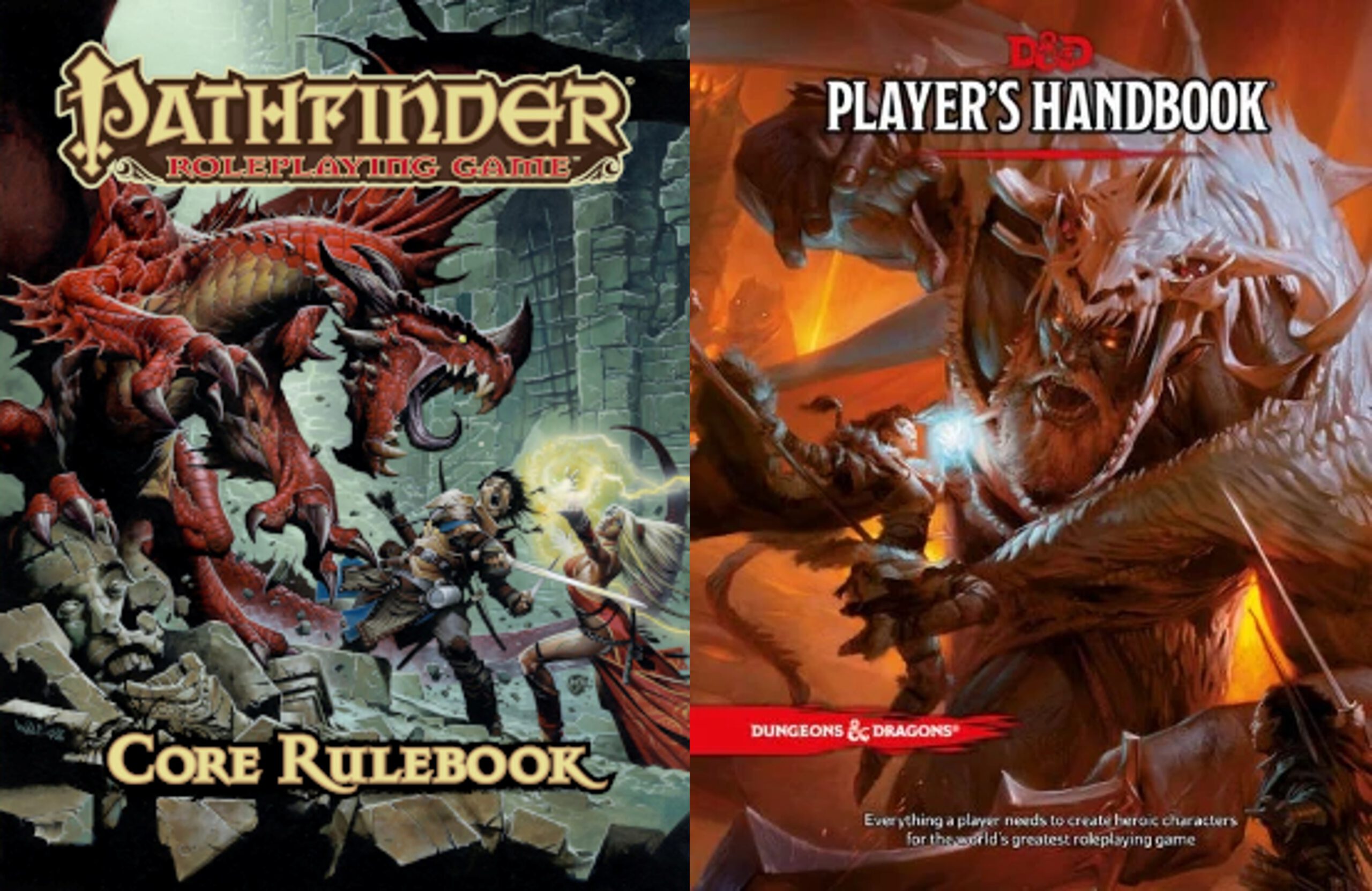
I design all sorts of things for different TTRPGs. I’ve designed 4 different game systems and published one. I’ve designed monsters, classes, and rules for Pathfinder 1e and D&D 5e; most of these have been self-published.
How did you discover TTRPGs?
I discovered TTRPGs in college, when I saw a group of people playing at a table. I was immediately interested in it. I’ve been playing and running games since 2006.
Do you actively play TTRPG? What are you playing?
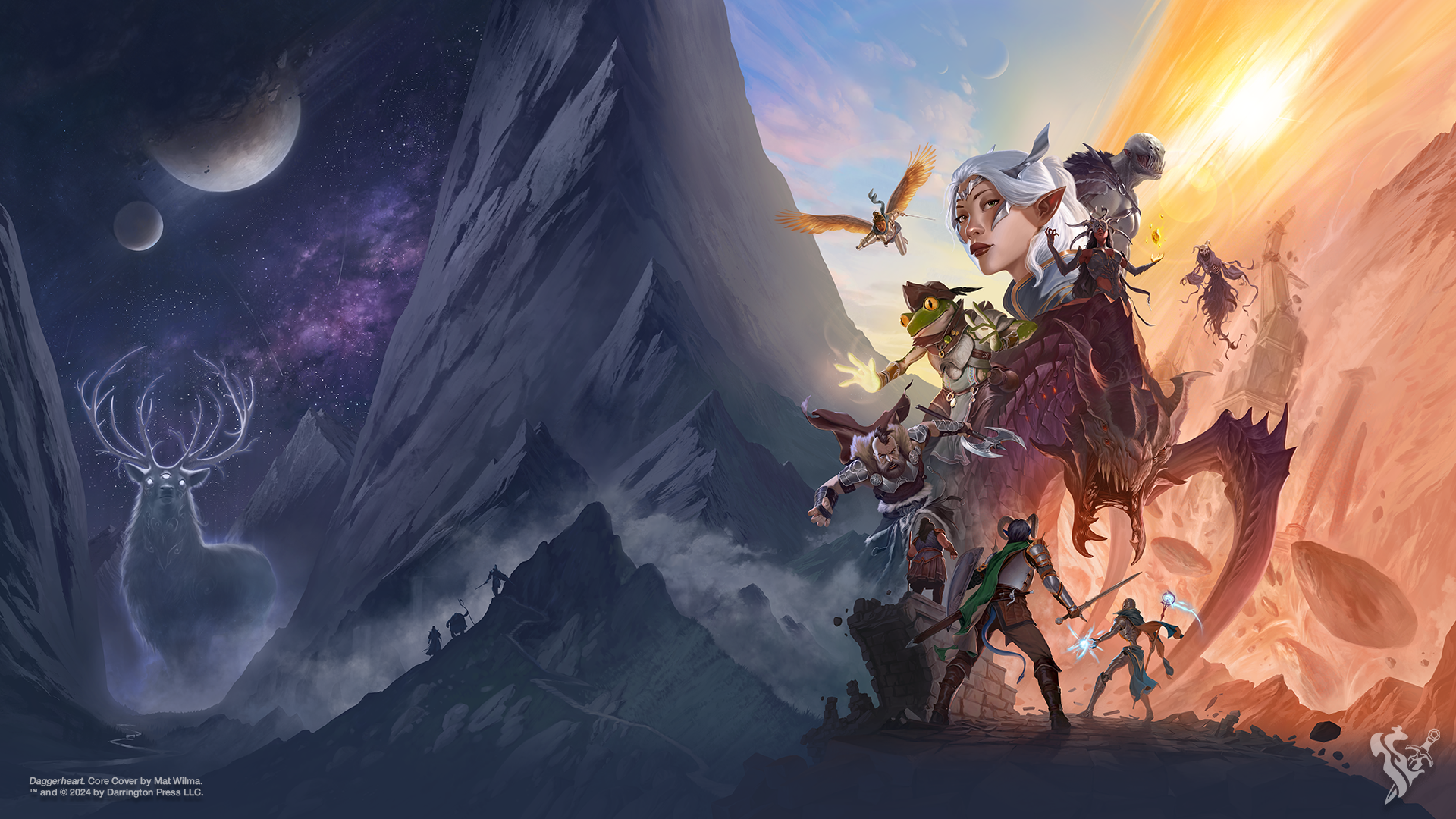
I’m actively playing at the moment. I’m running a Paradigm Odyssey campaign (a system of my design and my baby), and I’m a player in a Daggerheart campaign and in a D&D 5e Campaign.
What do you want to play next?
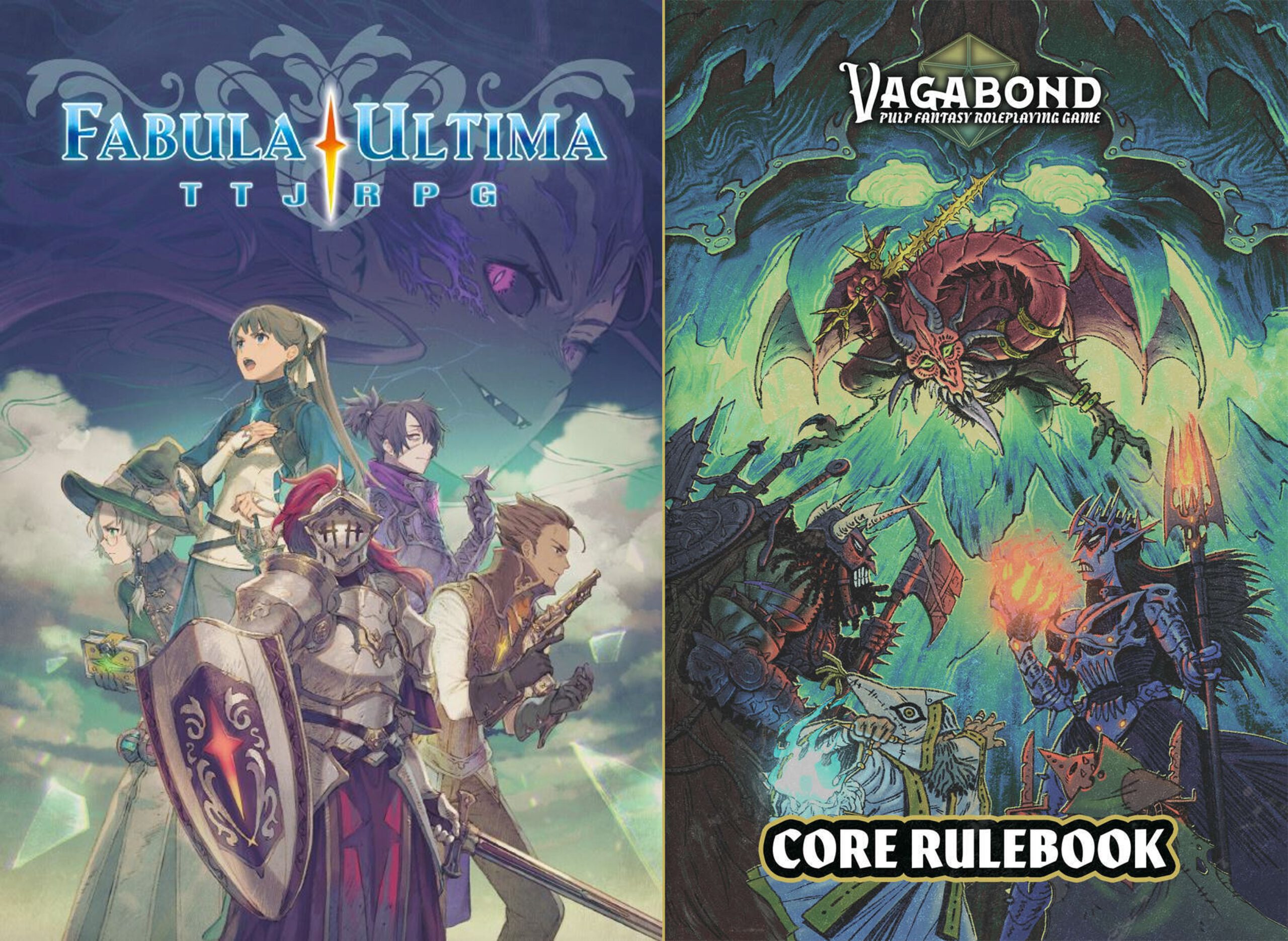
Next, I’d like to keep playing and polishing my Paradigm Odyssey system with friends and strangers, and I’d love to test out Fabula Ultima and Vagabond.
What projects are available, and what are you working on next?
I’m currently working on a Spanish-language TTRPG YouTube channel for my local audience, and I’m always looking to take Paradigm Odyssey to different stores across the island.
Where can people get your project?
People can find me on YouTube at: Roleplayers de Boriken and on Instagram at @Paradigm.Odyssey.
Any closing thoughts? Final commentary: Remember rule #1, always have fun
Thank you, Angel, for sharing your time and your creations with us. You can check Angel’s DriveThruRPG page here: https://www.drivethrurpg.com/en/publisher/31128/enyol
Categories: Tabletop Gaming Blogs
Adapting Two Githyanki-like races for the Troll Lord Games Victorious & Red Room Bella Apoque rpg- The Aether-Born & The Khaos-Bane
In classic fantasy, Githyanki are astral-sailing, sword-wielding, psionic zealots who escaped mind-flayer enslavement. To make them fit the Victorian aesthetic of Victorious, we can reimagine them as The Aether-Born : an ancient, aristocratic race of planar travelers who view Earth’s British Empire as a crude, amateurish imitation of their own cosmic dominion. This blog entry picks right upNeedleshttp://www.blogger.com/profile/11243274667834930867noreply@blogger.com0
Categories: Tabletop Gaming Blogs
Dead Wizards Ground Zero
.jpg)
Going on 10 years ago I got inspired by various sword and sorcery things to create a game called Dead Wizards. It's set in a sandy desert city. Very much a "sand and sorcery" idea inspired by mummy movies as well as Lankhmar and Conan and a bit of Al-Qadim.
My first pass at it was a hack of Swords & Wizardry where I think the main difference was that spells were cast by burning hit points. I ran that a couple of times.
A bit later I revised it and ran it again, briefly. Then I changed the whole system to be based on the image above, using the old to-hit matrix as the core mechanic of the game. Partly, this was a grognard response to anti-THAC0 folks. Just a bit of tongue in cheekiness.
I sometimes went hard to defend descending AC...
The idea shifted in 2020 and became a "let me see if I can make this a game based on those animalistic goons from the movie Heavy Metal." So I did. And it was called GOZR. I say all this because I've been working on Dead Wizards again after a lot of years in limbo. I want back to the last and fullest draft of the game, which was pretty good, actually. The rules in that version are essentially GOZR. I've abandoned the THAC0 matrix, mostly. But there is a small "to hit" matrix on the character sheet. Much simplified, it has 4 categories of difficulty (Basic, Arduous, Grueling, and Epic) with target numbers for each of them for only 2 basic skill areas (Cunning and Prowess). I think this is a really nice amalgam of GOZR's simple target number system and the old to-hit matrices. It's easy on the eyes and intuitive. You're trying to do a daring leap to grab a sacred relic off the giant demon's head? Sounds like an Arduous task, at least. You roll 1d20 vs. your Arduous Prowess target. Once set, the targets never change. But you can pick up various benefits here and there and acquire situational boosts. The idea here is to keep it player-facing and as math-less as possible. Target is 9, you need to roll a 9. You have an advantage? +1 to the roll. Oh, the demon takes notice and now is actively protecting the sacred relic from your grasp? It's now a Grueling task. So those are just some thoughts about the game in development. Clever observers will note that I still haven't produced that space fantasy game, ZSF. Hell's bells, West... you already playtested it, you already have Troika! based books about the same setting. What's the hold up? Yeah, I'll get to it. Inspiration is fickle, you know.
Categories: Tabletop Gaming Blogs
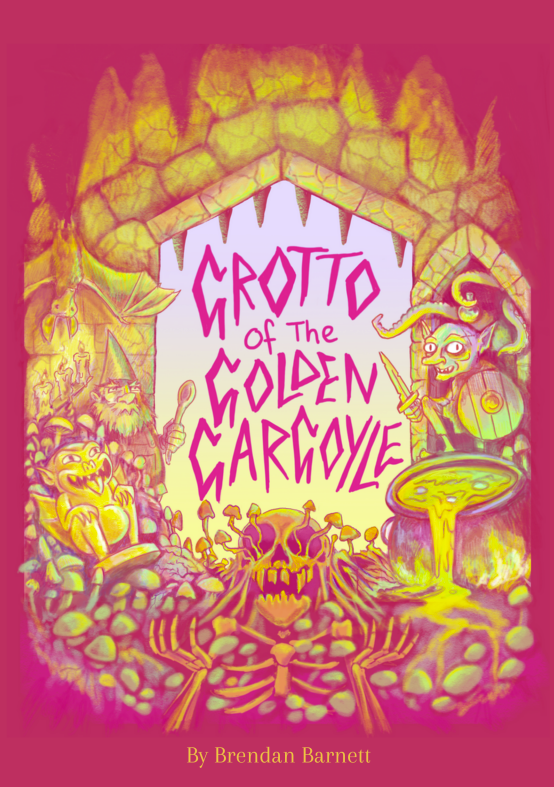
Grotto of the Golden Gargoyle
By Brendan Barnett
Self Published
Generic/Universal
"Lower Levels"
Self Published
Generic/Universal
"Lower Levels"
If legends of the Golden Gargoyle are true it could mean infinite wealth for any who possess it. Trouble is, nobody has a clue where to find it. That is, until a goblin falls out of the sky with a pouch of gold dust and a map to a hidden cave, high in the mountains. What you can make out amongst the blood splatters is very promising.
This forty page adventure uses sixteen pages to describe eight rooms in a low-conflict cave full of goblins. It’s meh, mostly because it uses forty pages to describe eight rooms in a low-conlift cave full of goblins.
Great looking little pdf. And I assume print book? Nice cover. Pretty little isometric map inside that is itself an art piece, like you might see as a two page special insert in Dragon or Mad Magazine. Nice illustrations and a layout style that looks pretty with its use of word color and boxes and highlights and so forth. And not garish, in spite of its use of pinks and purples. Nice accomplishment there!
Did you want to buy a coffee table book? Cause this is an awfully nice looking coffee table book.
It’s just real hard to take this seriously as an actual adventure given the page count to encounter ratio. Forty pages. Eight rooms. In spreads, of course. What is it that the designer wanted to do? DId they want to write an adventure or did they want to make a great looking book? Room one. This is all of the text on the first page of room one: A large rectangular chamber. In the centre a stone gargoyle statue sits atop a tall pillar with the word ‘umop’ roughly carved into it. The word ‘uado’ is scratched above each of two sealed stone doors to the north and west. The ceiling (30′ up) is covered in spikes. The floor is littered with broken bones. Searching the floor yields 10gp in assorted coins and a silver ring (40gp). It bears the image of a human figure immersed in a river.” There’s some line breaks in there. The second page has open and down in normal and reverse print. Yeah, the words are mirrors and one opens the doors while the other does an anti-gravity. Two fucking pages. Two fucking pages for this. And this is the norm for the adventure. Simple rooms, spread out over two pages.
We can, I suppose, ignore this. We can simply accept that the designer decided two pages per room. What we get, then, is eight (or nine, for an A/B room) are some relatively simplistic rooms. The interactivity here is basic. I’m pretty sure there’s one ‘fight’, with Vampire Kinght[sic] Armour. Nobody present really cares that you are nosing around in the caves. I can’t help but think that this could have been much better i it were larger. The goblins, cultists, bats, tomb, all with zones in the dungeon, expanding the thing to something with more going on and room for the adventure to breathe.
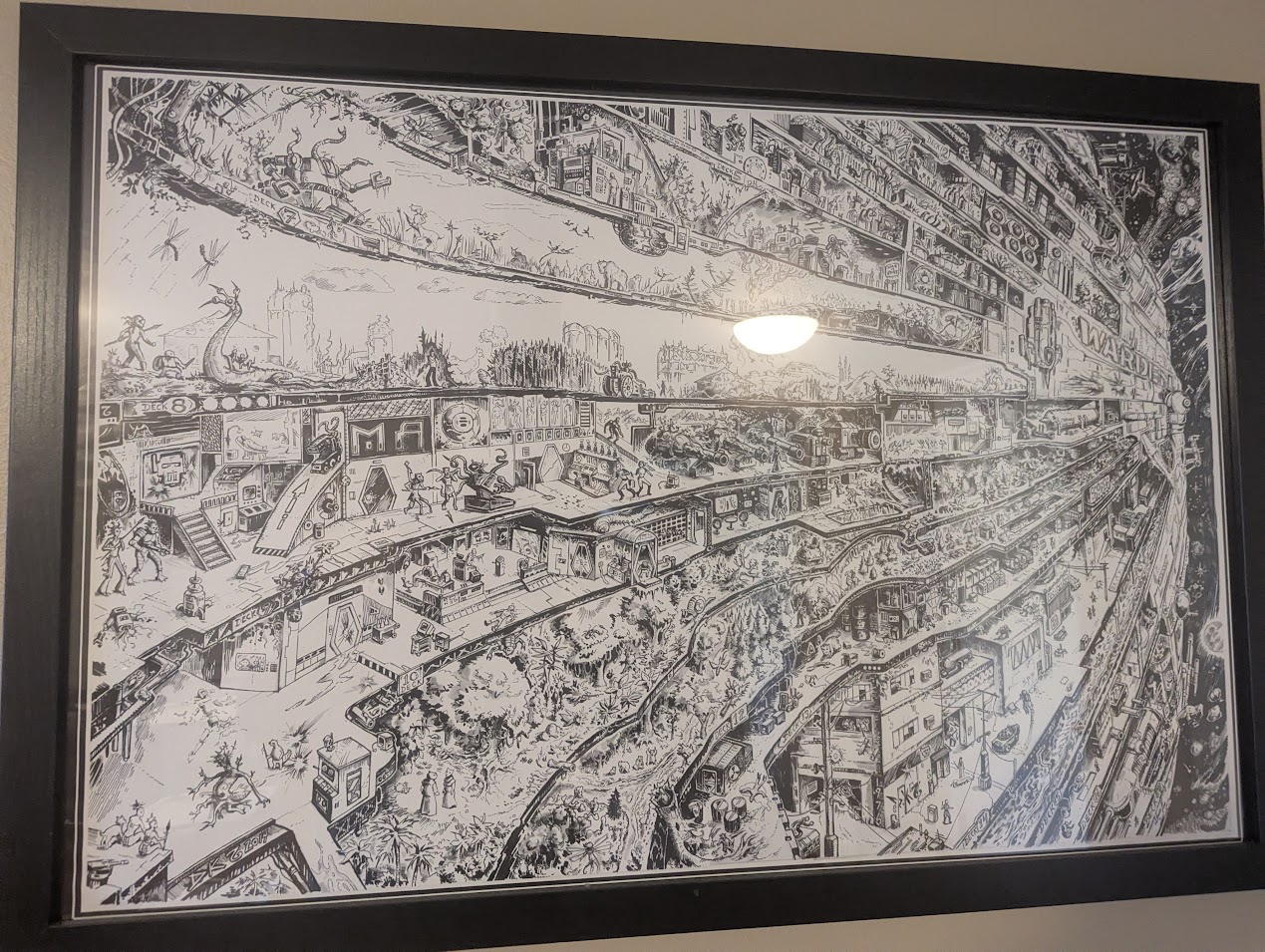
The language used, for the room descriptions. Is rather plain. A large rectangular room. THis is not the height of language use to evoke imagery. The exception is the isometric map. It’s a pretty great art piece, harkening back to all of those Bat Cave and Hall of Justice isometric pieces from comics, or, the Starship Warden piece I have hanging on my call. Very evocative, but not exactly something you can run from. (There is a more traditional map as well, to run from, the isometric piece not being the most clear on room connections.)
I can’t say it’s true or not, but it certainly FEELS like the isometric map was the starting point of this adventure. As if it were created and then the rooms followed on. Like the adventure, proper, was secondary to this and/or inspired by the art piece. That doesn’t have to be bad, but in this case the adventure just doesn’t feel worked enough.
It remains interesting to me the many ways that the various subcultures produce bad adventures. Starting from bland, or assembly line, or wordy, or mini combats, or rote, or art, or layout, or, or, or.
https://pocket-sized-perils.itch.io/grotto-of
This is $5, Aussie, at Itch.io
Categories: Tabletop Gaming Blogs
Integrating Adventurer Conqueror King System II (ACKS II) with the legendary, chaotic, and maximum-gonzo DNA of Dave Hargrave’s Arduin Grimoires - The Deodanth & The Phraint
In ACKS II, classes are built using a point-allocation system distributed across four categories: Fighting, Thieving, Divine, and Arcane. Demi-human races require purchasing a "Race slot" that modifies these allocations and establishes baseline racial traits. This blog post entry picks right up from Integrating Adventurer Conqueror King System II (ACKS II) with the legendary, chaotic, Needleshttp://www.blogger.com/profile/11243274667834930867noreply@blogger.com0
Categories: Tabletop Gaming Blogs
[Parsulan] The Prismatic Lake

In the Berlaith region of the content of Parsulan, there is a magical body of water known as the Prismatic Lake. The reason for the name is obvious: clear as it is (and its waters as remarkable pellucid), they are tinted with a rainbow of colors. The reason for the lake's unusual appearance is the naturally occurring manastones that are embedded in its depths that leak arcane energy into the water.
The lake covers nearly 40 acres and is near circular. Scholars believe it was formed by the unlikely interaction of a shadow cyst emergence causing a collapse into an underground space beneath, possibly an attenuated dungeon root. The heart of the cyst was lost, causing it to burst, but the resultant magical release altered the landscape.
However, it came to be the Prismatic Lake draws wizards and other adventurers hoping to harvest the manastones within. It's not an easy task, given the strange effects the magical energies can have on divers in addition to the problem of working the stones free underwater. Monsters are also attracted to the stones, so they pose another danger.

A (somewhat) easier target for adventurers out to make quick coin is catching the lake's fish. Several highly unusual varieties live there, each with magical properties. Alchemists and magical researchers will pay handsomely for specimens, particularly alive. Would-be fishers should beware: many of the fish are dangerous due to the same magical properties that make them sought after.
Categories: Comic Book Blogs, Tabletop Gaming Blogs
Darkness From The Cultclassic film Legend 1986 For Sword of Cepheus 2nd Edition Rpg
In the gritty, sword-and-sorcery framework of The Sword of Cepheus 2nd Edition, Lord Darkness from Ridley Scott’s 1986 film Legend functions perfectly as a lesser god, an arch-fiend, or a manifestation of absolute Eldritch Chaos.True to the simulationist, highly lethal nature of the Cepheus Engine, Darkness is not just a high-stat brick to be fought in an open field. He is an Needleshttp://www.blogger.com/profile/11243274667834930867noreply@blogger.com0
Categories: Tabletop Gaming Blogs
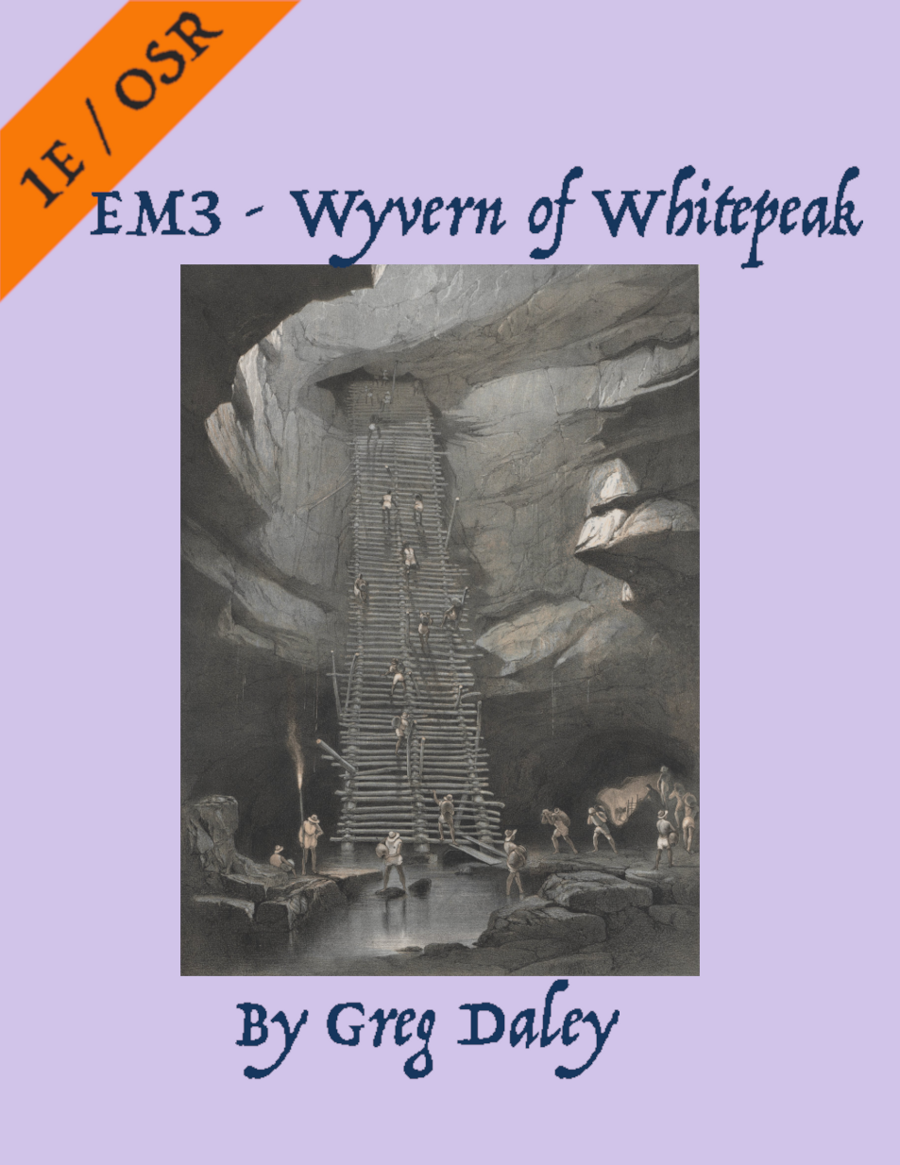
Wyvern of Whitepeak
By Greg Daley
Tarichan Games
1e
Levels 2-3
Tarichan Games
1e
Levels 2-3
Dead bodies turn up, purple with poison. Word reaches the village that a pair of bodies have been found at the ford of a lonely vale, slashed and bloated. A wyvern has been seen on the mountain nearby. The adventurers explore the valley below the mountain, on the search for the killer. Can the characters defeat a threat from the frigid mountains? Will they defeat the creature and overcome the curse of the peak?
This 55 page adventure presents a small wilderness area and a four level dungeon with about 75 rooms, with the dungeon proper using about sixteen pages. There’s a conspiracy afoot, or two, all caused by the dwarves in the dungeon that the party will no doubt get mixed up in. You might think of this as a “normal” dungeon that then has some framing to it to spice it up by way of the conspiracies. While not particularly evocative, it’s a solid little bit of adventure that perhaps illustrates how to add emerging plot to an otherwise “normal” dungeon.
The marketing blurb above lays out the basic situation that the party stumbles upon. Two imperial tax collectors turn up dead, fat with poison and covered in wounds and a wyvern has been seen flying about in the mountains nearby. If you poke about the wilderness some you find a few unusual things. A stream full of grey silty runoff. A farm near the mountains has had some improvements. A nerid is pissed her pond is now polluted with the grey runoff. There’s also a trio of ogres and their minions who have taken up residence on a small hill, waylaying passersby that the party can run afoul of.
In the mountains there was an old dwarf diamond mine that suffered a cave in and has been shut for a long time. A clan has moved back in and restarted the mine, surreptitiously. That’s causing the runoff. The farmer is working with them in exchange for his brand new roof and some new dwarf tools he has, as well as a future payoff. So far, just run of the mill stuff. But, the dwarves DID poison the tax collectors, who were getting too close to their secret, and have been flying a wyvern kit to scare folk off. Which is a tad complicated because there IS a young wyvern nearby as well. So, the party can kill a wyvern and the killings continue, which puts the party in bad with th (not really detailed) town. Not nice dwarves. Talking to the dwarves reveals a problem, there are monsters in the mine, could you pretty please? This is a trap, with the dwarves planning, through several subterfuges (including drugged food; breaking Host law! Forshame!) to kill off the party. The monster in the mine is a rock dude who is overseeing a nursery of rockling eggs that the dwarves fucked with and thus he’s been causing tremors to drive the dwarves away. Finally, the dwarves stole of “gem seeds” from him, and they are playing to make the underlying kindof dormant magma/volcano erupt to score a big diamond haul from the gem seeds. Which is also going to result in the nearby town and settlements getting ravaged from the eruption. And then, a dimensional dude is going to show up who wants the gem seeds also to create a gem warrior army for his rebellion efforts back home in his own dimension.
It sounds like a lot going on and maybe a bit convoluted, but I assure it is not. Instead, it is CONSTRUCTED, with what’s going on being the goals of the various entities. Let’s start by, say, building a dwarf mine/home/dungeon. They’ve moved back in to reopen a family holding and, being greedy fucks, don’t want to pay taxes and want to keep their secrets. So we’ve got a level or so of their clanhome and workings. And then have some abandoned parts with more verminy type creatures and a creature on the bottom causing them major problems. All pretty standard, yeah? And grounded in some real motivations, those yahoos who hate the gubberment and their taxes. Which fits in perfectly with the greedy dwarf thing. I love that it is playing to that, not just stout humans, but greedy fucking dwarves. And this is causing the killings, the wyvern thing, the fucking with the rock dudes nursery, the trick violations of host law, and finally the potential eruption. Who gives a fuck about the people nearby? We care about our clan .. and gems. Really nice implementation of demihumans as an alien culture that LOOKS normal until you dig deeper, and, one of the dwarf themed adventure I think I’ve ever seen.
Then, lets take that and build in the killings as a hook, and the required wilderness/overland portion to support the investigation of the “wyvern” attacks. We put in some clues for those paying attention, and dump in the nearest farmer as a further clue as they need a little support in their mine and have paid him off ‘in kind.’ We expand that wilderness a little also with the ogre fort to throw in some extra danger as the party tools around and then add the real juvenile wyvern as a decoy/aside to complicate the situation further. Everything is built around and supports the initial idea: the dwarf clan home/mine. Really excellent job constructing the supporting situations around the central conceit, which is itself built on the solid greedy dwarf foundation.
The encounter style is relatively terse. There some summary up front of the overall situation which helps frame the terse encounters. That summary could be clearer, it’s a little scattered, but it’s fine; one read through and you’ve got it. This allows for a wilderness encounter that reads: “3/Grey Brook- This stream is filled with a grey, cloudy silt. Dwarves or other underground creatures may identify the contaminant as dust from crushed rock. Those who have mined previously may identify this as mine tailings, from a process which pulverises rock.” That’s it. It’s a clue to more going on, a fact for the DM to build on. Or, a freshly hewn fence at the farm. A creek near the farm with a gangway hidden in bushes on one side and a cart hidden on the other side. Hmmm. Why’s that there? A body, killed by the “wyvern” may reveal stomach swelling … ingested poison. But you’ve got to pay attention, both as a player and as a DM to build on these little dropped facts and make it your own … in exactly the way a DM should in an adventure.
On the downside, the summary/intro is a little bit of a mess. It’s not a disaster, but things are scattered, repeated, and so on. It needs a hard edit with some laser focus to make it really stellar, but, again, not a disaster by any means. There’s not much for the town AT ALL, and a little bit more there in terms of personalities or complications would have gone a long way to supporting this part of the adventure. It’s essentially nonexistent. And the “adventures” presented in this section are really more of telling the DM the arc of how the designer expects things to happen. Investigating the killings, hunting the wyvern, finding the dwarves, getting fucked over by them maybe, the rock dude and dimension guy showing up … potentially the party being led there by the dwarves, and the potential eruption. The dwarves don’t really have an organized order of battle for when/if things go south with them. More of arcs or milestones than “adventures.” And, then the scale on the overland map is fucked up I think? It’s putting everything pretty much on top of each other if the “one square equals 20 feet” legend is to be believed. The writing could be a bit more evocative also. The rooms are fact based, maybe with a sentence or two on usage which is not supremely relevant. For example “7/Ablution Rooms These are a set of sparse washing rooms, divided for female and male dwarves. “Beard” dwarves wash with their sisters, for modesty. The rooms contain each contain three sets of chambers. The first is for dry clothes and towels, the next contains (cold) showers, and baths. The final room is for necessary (if unpleasant) functions. All of the rooms are solid, stone hewn, and work with hidden mechanisms, hiding unnecessary pipes, levers, or drains. “ No great sins here, but also nothing too evocative. The greater situations in the complex lend themselves to this fact-based descriptions, still allowing the greater play opportunities.
Pretty solid. Maybe a little cumbersome in places, which more focus would help with, but I suspect that comes with time and practive.
This is $3.50 at DriveThru. The preview is fifteen pages with a decent variety in there. Good preview.
https://www.drivethrurpg.com/en/product/553089/em3-wyvern-of-whitepeak-old-school?1892600
Categories: Tabletop Gaming Blogs
Wednesday Comics: DC, August 1985 (week 5)
I'm reading DC Comics' output from January 1980 (cover date) to the end of Crisis! This week, I read the comics on sale on May 30, 1985.
The "Meanwhile..." feature this month mentions work continuing on new Batman project that isn't named but is clearly Dark Knight Returns. There's also discussion of a Matt Wagner project that is the forthcoming Demon limited series from the following year. Interestingly, there's also mention of a Jason's Quest revival that never came to fruition.
Detective Comics #552: Moench and Janson pick up the Black Mask story from this month's Batman. Black Mask recruits more members into his gang and takes more deadly reprisals against people he feels have wronged him, which are mostly newly installed Janus execs. He also has Circe, the model who jilted Sionis when his fortunes turned, kidnapped and subjects her to a diluted portion of the cosmetic. After that torture, he gives her an ultimatum: join him or get the full treatment. Circe accepts a mask without the tainted cosmetic in it. Batman figures out Sionis is Black Mask just as the False Face Society, but he can't find out where his hideout is or what his ultimate plans are.
Cavalieri and Moore/Patterson have Green Arrow and Black Canary facing a rash of tenement fires, arsons that Arrow believes were committed by the owners for the insurance and redevelopment. The meat of the story, though, is about what happens when Black Canary confronts a fire-throwing super-villain arsonist, Bonfire, and the Canary is strangely frozen with fear. After her rescue, she later tells Ollie that she had a strange episode of deja vu while in the blaze. Later, she's looking through her scrapbook at old pictures of her mother, the first Black Canary, and she's struck by a revelation.
Action Comics #570: The first story by Kupperberg and Schaffenberger/Hunt has a Superboy vibe, except that it has Jim Olsen as its focus instead of some random Smallville kid. A blast of cosmic energy splits off Jim's inflated ego into a super-villain who calls himself Alter Ego. The bit of mystery here isn't in Alter Ego's identity. Superman figures that out early on. Rather it's in how Jim got split and how to fix it.
The second story by Boldman and Bender/Marcos is more "humorous" than the first. One might say "silly," even. After saving a man's life, Superman accepts the guys invitation to dinner for beef bourguignon, but then stays and stays, making a complete annoyance of himself. This could have easily turned to horror as having a super-powered bore for a house guest might in real life, but once the man blows his top at the super-freeloader, Superman drops the act and reveals the truth: the man had been infected by some alien something or other in the initial incident and only making him angry could cure him.
I mention the "stuck in the past" nature of this era of Superman a lot but should also point out this isn't inertia or ossification. Superman was different at points in the 70s ("Kryptonite No More," and all that). Superman was different just a few years prior with stories by Wein and Starlin and Wolfman. This was a choice editorial made.
Ambush Bug #3: Giffen, Fleming, and Oksner deliver their funniest issue yet, provided you like silly, absurdist humor goofing on silly DC characters of the past. It's actually kind of clever, structurally, we get vignettes in text and comic form uncovering what happened to a lot of obscure and best forgotten in the estimation of Fleming and Giffen DC characters like Egg Fu, The Green Team, and Binky. It's also sneakily taking a swipe at Crisis on Infinite Earths and the rationale for it, as all of the segments point to a mysterious woman being involved in their disappearances or deaths. In the end, we find out who is responsible: Jonni DC, Continuity Cop. Just as she confesses, she's blasted by Darkseid for the recurring "next issue, a fight with Darkseid" gag.
Arion Lord of Atlantis #34: Kupperberg and Duursema get Arion and Chian back to the City of the Golden Gate and into the business of selecting a new king. In Atlantis, that's done by a council of wizards presided over by Arion. These days the wizards have only the barest magic except Arion, but still tradition. There's one scheming wizard up to no good, though, and he disrupts the proceedings and gets Arion trapped by shadow bat things. Meanwhile, Wyynde is reunited by Mara. He finally returns her affections in a leering sort of way which puts her off. Apparently, having a dog head for a while changes a guy! Who isn't put off by the new Wyynde is the princess and potential successor to the king, T'Galla. She and Wyynde get along quite well to the irritation of Mara.
All-Star Squadron #48: Mike Harris takes over as artist. This is his first work for the Big Two. He goes on to do a fair amount of work at Marvel in the '90s on grittier titles like The 'Nam, The Punisher, and Cops: The Job. Here, the All-Stars travel to the UK, meeting the Blackhawks on the way. Churchill wants them to find the Shining Knight who disappeared investigated something at the site of Camelot. The All-Stars find Shining Knight in the company of other Arthurian characters who turn out to robots. Our heroes are captured, and they learn that Dr. Fate's old enemy, Wotan, is behind it all.
World's Finest #318: Cavalieri and Delbo/Alcala bring back Sonik who had his debut and only appearance to date back in issue 310. Beyond that the issue is very much of its era. Lilanne Stern is now on RTV. There's a wealthy popstar named Marlon Monroe (a Michael Jackson stand-in) who is menaced by robots made by one of his staff, and a boy in a bubble with an immunodeficiency syndrome someone may be trying to kill. Superman and Batman are on the case though, and everything works out in the end.
Tales of the Legion #326: We start the reprint era this month, so I won't be reviewing this title anymore, but I wanted to note it.
V #7: Newell steps in as writer, and we an issue that focuses solely on Julie as she goes back to her now empty hometown, trying to get some time to herself to go to terms with everything that has happened. A mother and father get mentioned and the implication is that perhaps both are dead due to the Visitors, though based on the V wiki, this appears to be new material. Anyway, she's followed by an assassin that has the appearance of a high school friend, but when a Visitor patrol attacks them, the assassin seems to have a change of heart and saves her life. The issue is rather ambiguous on several points, which was perhaps Newell's intention.
The "Meanwhile..." feature this month mentions work continuing on new Batman project that isn't named but is clearly Dark Knight Returns. There's also discussion of a Matt Wagner project that is the forthcoming Demon limited series from the following year. Interestingly, there's also mention of a Jason's Quest revival that never came to fruition.

Detective Comics #552: Moench and Janson pick up the Black Mask story from this month's Batman. Black Mask recruits more members into his gang and takes more deadly reprisals against people he feels have wronged him, which are mostly newly installed Janus execs. He also has Circe, the model who jilted Sionis when his fortunes turned, kidnapped and subjects her to a diluted portion of the cosmetic. After that torture, he gives her an ultimatum: join him or get the full treatment. Circe accepts a mask without the tainted cosmetic in it. Batman figures out Sionis is Black Mask just as the False Face Society, but he can't find out where his hideout is or what his ultimate plans are.
Cavalieri and Moore/Patterson have Green Arrow and Black Canary facing a rash of tenement fires, arsons that Arrow believes were committed by the owners for the insurance and redevelopment. The meat of the story, though, is about what happens when Black Canary confronts a fire-throwing super-villain arsonist, Bonfire, and the Canary is strangely frozen with fear. After her rescue, she later tells Ollie that she had a strange episode of deja vu while in the blaze. Later, she's looking through her scrapbook at old pictures of her mother, the first Black Canary, and she's struck by a revelation.

Action Comics #570: The first story by Kupperberg and Schaffenberger/Hunt has a Superboy vibe, except that it has Jim Olsen as its focus instead of some random Smallville kid. A blast of cosmic energy splits off Jim's inflated ego into a super-villain who calls himself Alter Ego. The bit of mystery here isn't in Alter Ego's identity. Superman figures that out early on. Rather it's in how Jim got split and how to fix it.
The second story by Boldman and Bender/Marcos is more "humorous" than the first. One might say "silly," even. After saving a man's life, Superman accepts the guys invitation to dinner for beef bourguignon, but then stays and stays, making a complete annoyance of himself. This could have easily turned to horror as having a super-powered bore for a house guest might in real life, but once the man blows his top at the super-freeloader, Superman drops the act and reveals the truth: the man had been infected by some alien something or other in the initial incident and only making him angry could cure him.
I mention the "stuck in the past" nature of this era of Superman a lot but should also point out this isn't inertia or ossification. Superman was different at points in the 70s ("Kryptonite No More," and all that). Superman was different just a few years prior with stories by Wein and Starlin and Wolfman. This was a choice editorial made.

Ambush Bug #3: Giffen, Fleming, and Oksner deliver their funniest issue yet, provided you like silly, absurdist humor goofing on silly DC characters of the past. It's actually kind of clever, structurally, we get vignettes in text and comic form uncovering what happened to a lot of obscure and best forgotten in the estimation of Fleming and Giffen DC characters like Egg Fu, The Green Team, and Binky. It's also sneakily taking a swipe at Crisis on Infinite Earths and the rationale for it, as all of the segments point to a mysterious woman being involved in their disappearances or deaths. In the end, we find out who is responsible: Jonni DC, Continuity Cop. Just as she confesses, she's blasted by Darkseid for the recurring "next issue, a fight with Darkseid" gag.

Arion Lord of Atlantis #34: Kupperberg and Duursema get Arion and Chian back to the City of the Golden Gate and into the business of selecting a new king. In Atlantis, that's done by a council of wizards presided over by Arion. These days the wizards have only the barest magic except Arion, but still tradition. There's one scheming wizard up to no good, though, and he disrupts the proceedings and gets Arion trapped by shadow bat things. Meanwhile, Wyynde is reunited by Mara. He finally returns her affections in a leering sort of way which puts her off. Apparently, having a dog head for a while changes a guy! Who isn't put off by the new Wyynde is the princess and potential successor to the king, T'Galla. She and Wyynde get along quite well to the irritation of Mara.

All-Star Squadron #48: Mike Harris takes over as artist. This is his first work for the Big Two. He goes on to do a fair amount of work at Marvel in the '90s on grittier titles like The 'Nam, The Punisher, and Cops: The Job. Here, the All-Stars travel to the UK, meeting the Blackhawks on the way. Churchill wants them to find the Shining Knight who disappeared investigated something at the site of Camelot. The All-Stars find Shining Knight in the company of other Arthurian characters who turn out to robots. Our heroes are captured, and they learn that Dr. Fate's old enemy, Wotan, is behind it all.

World's Finest #318: Cavalieri and Delbo/Alcala bring back Sonik who had his debut and only appearance to date back in issue 310. Beyond that the issue is very much of its era. Lilanne Stern is now on RTV. There's a wealthy popstar named Marlon Monroe (a Michael Jackson stand-in) who is menaced by robots made by one of his staff, and a boy in a bubble with an immunodeficiency syndrome someone may be trying to kill. Superman and Batman are on the case though, and everything works out in the end.

Tales of the Legion #326: We start the reprint era this month, so I won't be reviewing this title anymore, but I wanted to note it.

V #7: Newell steps in as writer, and we an issue that focuses solely on Julie as she goes back to her now empty hometown, trying to get some time to herself to go to terms with everything that has happened. A mother and father get mentioned and the implication is that perhaps both are dead due to the Visitors, though based on the V wiki, this appears to be new material. Anyway, she's followed by an assassin that has the appearance of a high school friend, but when a Visitor patrol attacks them, the assassin seems to have a change of heart and saves her life. The issue is rather ambiguous on several points, which was perhaps Newell's intention.

Categories: Comic Book Blogs, Tabletop Gaming Blogs
Survive This!! Vigilante City & New Flesh Rpg = Survive This New Flesh City Campaign Part I
Yes, they can be played together, and mechanically, they are a surprisingly smooth fit.SURVIVE THIS!! Vigilante City (Bloat Games) is a street-level supers game built on an OSR d20 engine derived from the d20 SRD and classic B/X D&D foundations. New Flesh (The Red Room) is a biopunk body-horror future-noir game built on theNeedleshttp://www.blogger.com/profile/11243274667834930867noreply@blogger.com0
Categories: Tabletop Gaming Blogs
Who Are the Five Writers Who Made You? And five more! (Expanded Edition)
I saw this list format posted by Angus Abranson on Facebook, and I originally thought I’d be able to complete it easily. It ended up taking a bit more thought than I expected.
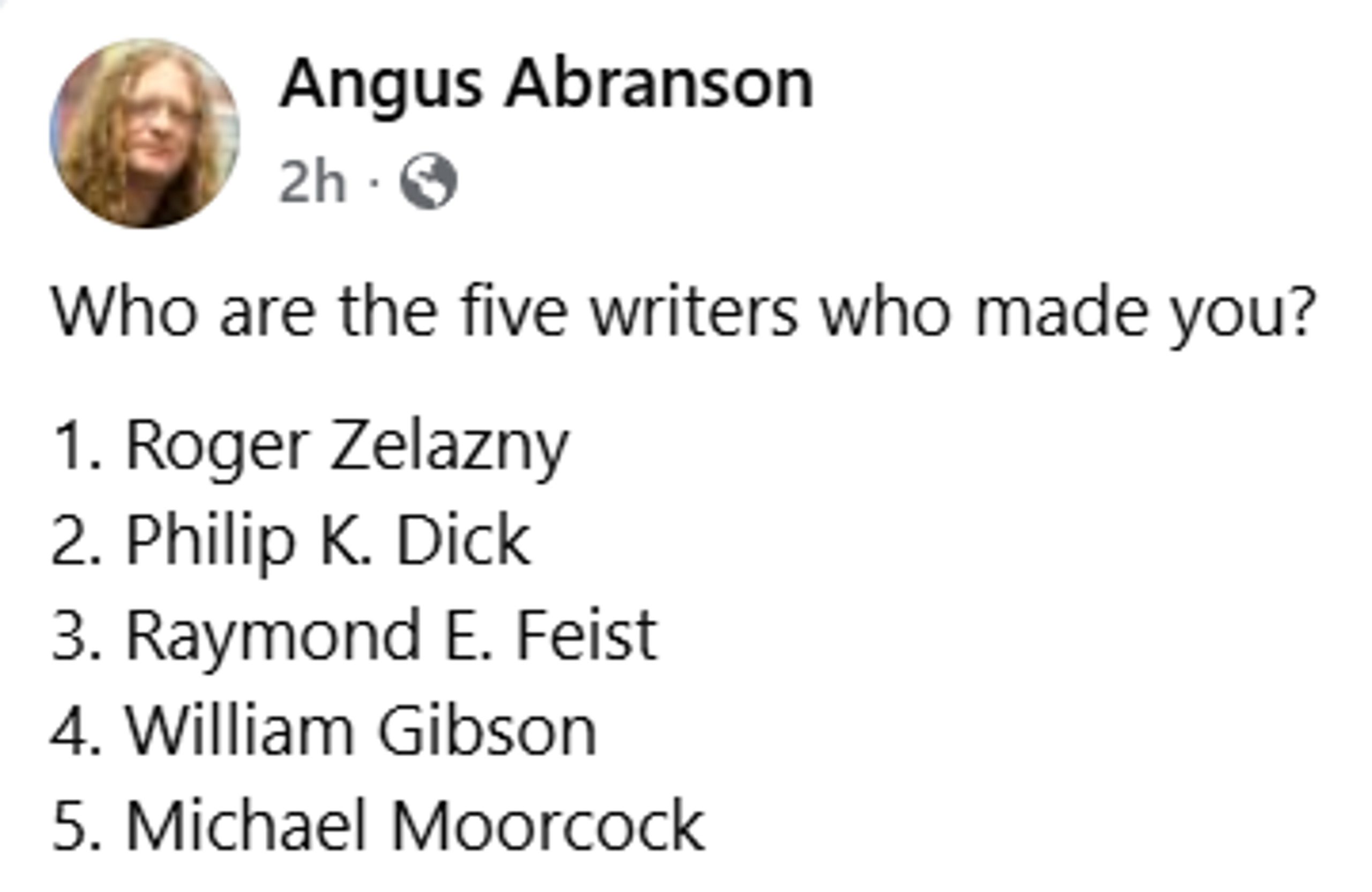
Despite my deep love for TTRPGs, fantasy, and sci-fi, my cultural reference points differ from those of many in my generation. Growing up in Puerto Rico, I had early exposure to Puerto Rican authors and literature in Spanish. When I eventually started reading the classics of the fantasy and sci-fi genres, my literary tastes shifted and expanded.
Here is my list of the top five writers who made me, in no particular order; these five are all equally influential. I know you’re traditionally not supposed to explain your choices on these lists, but I realize not all my friends may know every name here, so I’m adding some notes and links.
1. René Marqués: A Puerto Rican writer best known for his plays and short stories. I greatly enjoy his corpus. https://en.wikipedia.org/wiki/Ren%C3%A9_Marqu%C3%A9s

2. Jorge Luis Borges: The brilliant Argentinian short story writer and poet, who also translated major authors into Spanish. I find myself returning to re-read his short stories periodically. https://en.wikipedia.org/wiki/Jorge_Luis_Borges

3. Douglas Adams: His work really needs no introduction. The Hitchhiker’s Guide to the Galaxy fundamentally changed my taste in literature, but his entire bibliography remains among my favorite and most influential reads. https://en.wikipedia.org/wiki/Douglas_Adams

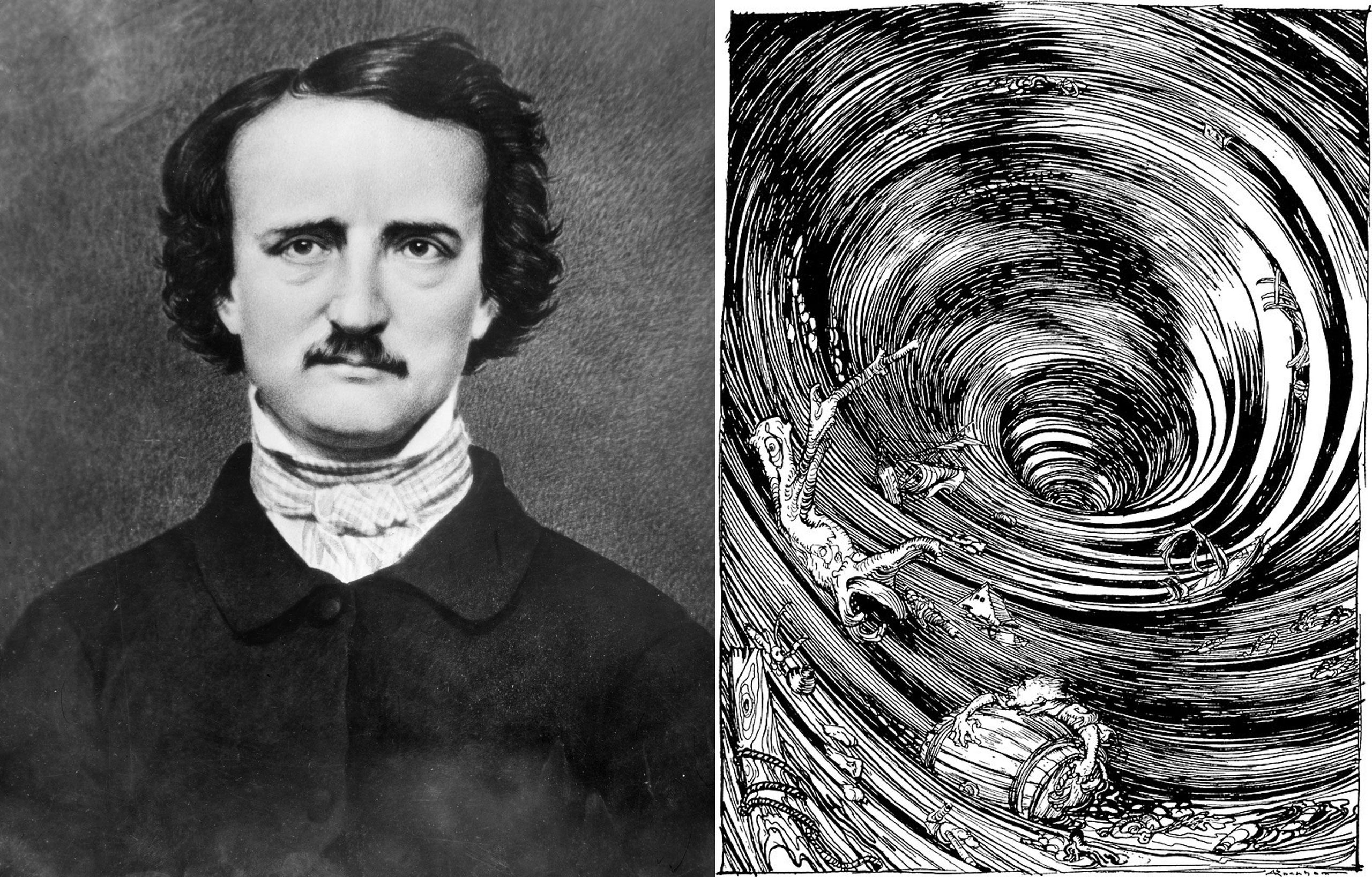
4. Edgar Allan Poe: I first read A Descent into the Maelström in a literature anthology in 8th grade, and it was a genuinely life-changing moment for me as a reader. His body of work continues to influence my writing and Gamemastering. https://en.wikipedia.org/wiki/Edgar_Allan_Poe
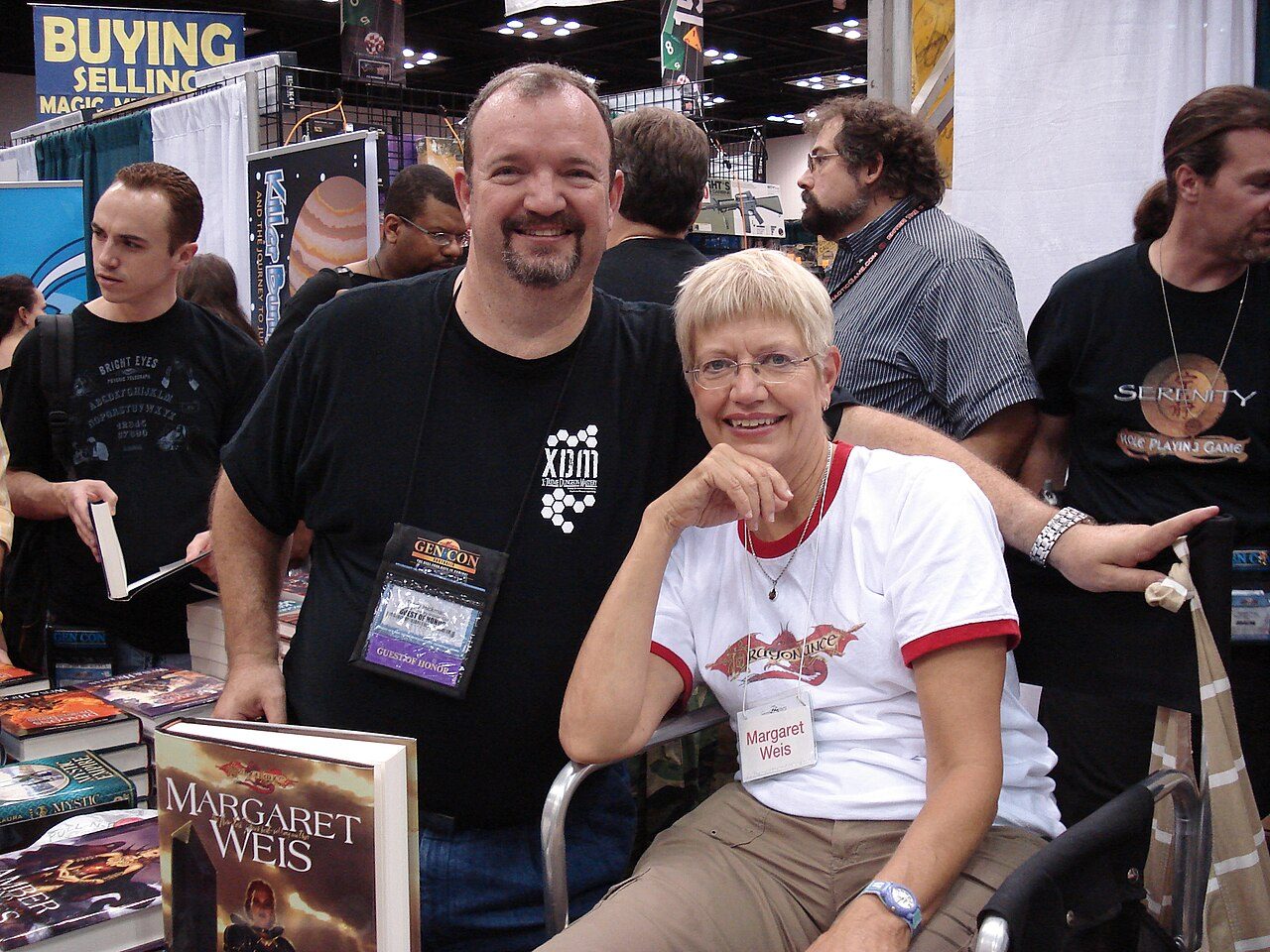
5. Margaret Weis & Tracy Hickman: Yes, this is cheating! I know it is two authors, but their truly influential work is decidedly what they create together. Their world-building defined exactly what fantasy was for me. https://en.wikipedia.org/wiki/Margaret_Weis https://en.wikipedia.org/wiki/Tracy_Hickman
The Five Runners-Up
And here are the runners-up. These authors are no less important than the previous five. When I sat down and considered who influenced me the most, the previous five (well, six, really!) just happened to come out on top. And yes, I know I promised five runners-up, but I am listing six here because I cannot leave any of them out!
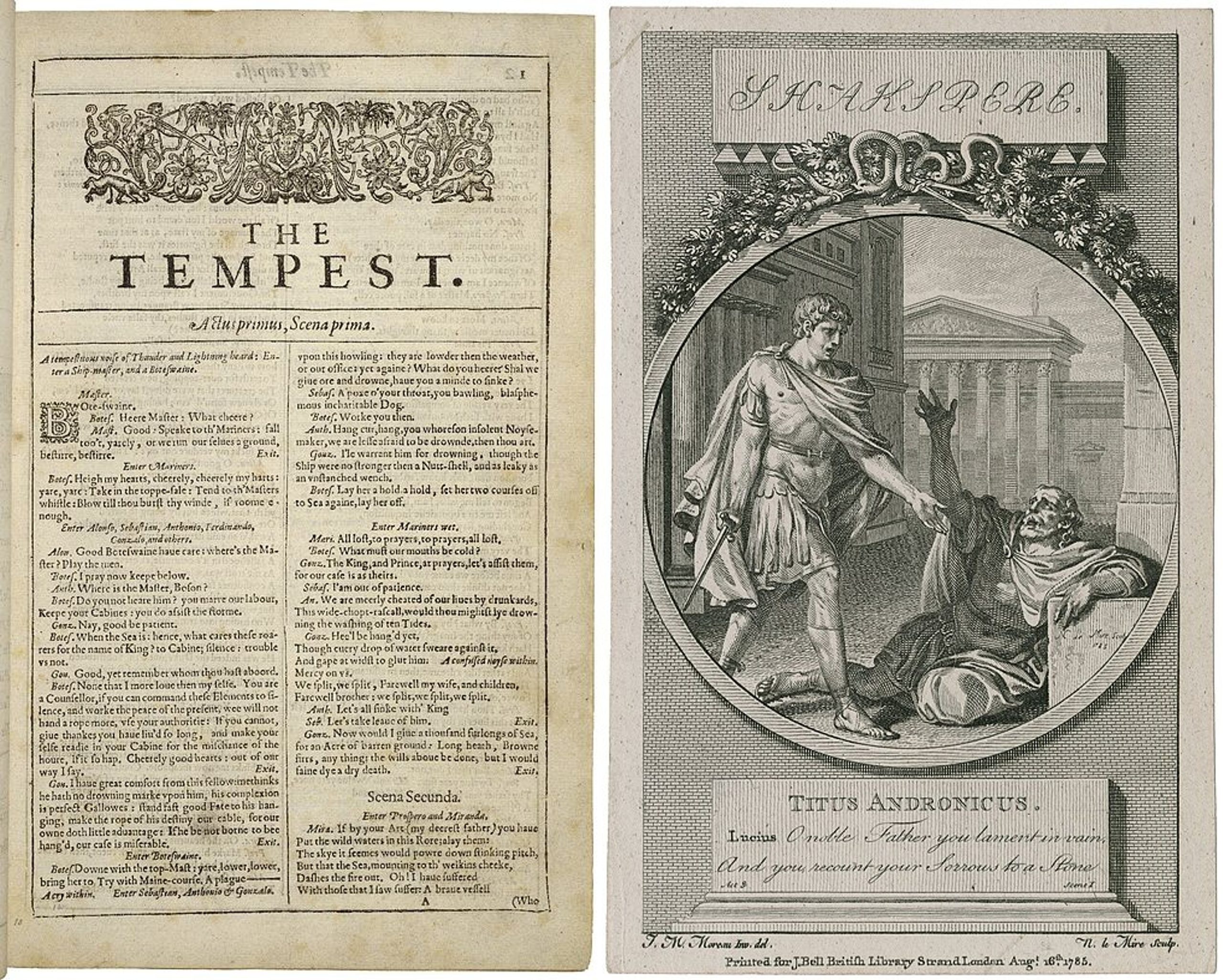
William Shakespeare: The Bard! Any list like this is built partly on his work and its massive influence on world literature. From the first time I read Julius Caesar in 10th grade, through all the plays I read during my undergraduate and graduate studies, his impact on me is undeniable. No general Wikipedia link needed here, but I will link to my two personal favorite plays: The Tempest: https://shakespeare.mit.edu/tempest/full.html Titus Andronicus: https://shakespeare.mit.edu/titus/full.html
Enrique Laguerre: Another Puerto Rican author who greatly influenced me. His entire corpus is worth your time, but his novel La Llamarada is my ultimate comfort book. It is one I return to periodically for a re-read, much like another book further down this list. https://en.wikipedia.org/wiki/Enrique_Laguerre

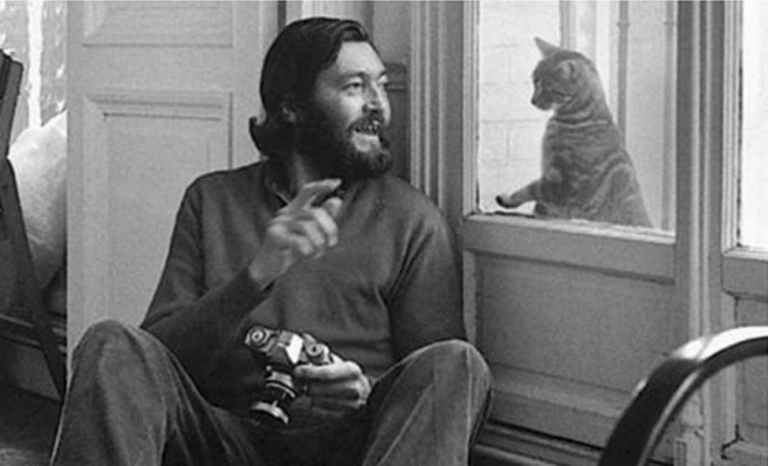
Julio Cortázar: Another Argentine genius. His novels and short stories were incredibly influential to my understanding of narrative, even though I discovered him a bit later in life. https://en.wikipedia.org/wiki/Julio_Cort%C3%A1zar
H.P. Lovecraft: I originally started reading his work because of the Call of Cthulhu TTRPG, and his writing was hugely influential to me as a reader, writer, and storyteller. I’ve re-read his stories numerous times. As I learned more about who he actually was, his racism and bigotry rightfully made me reconsider his works. Still, his literary influence on the genre is undeniable, and reading him opened the door to other authors and genres I wouldn’t have known otherwise. https://the-artifice.com/lovecraft-racism/

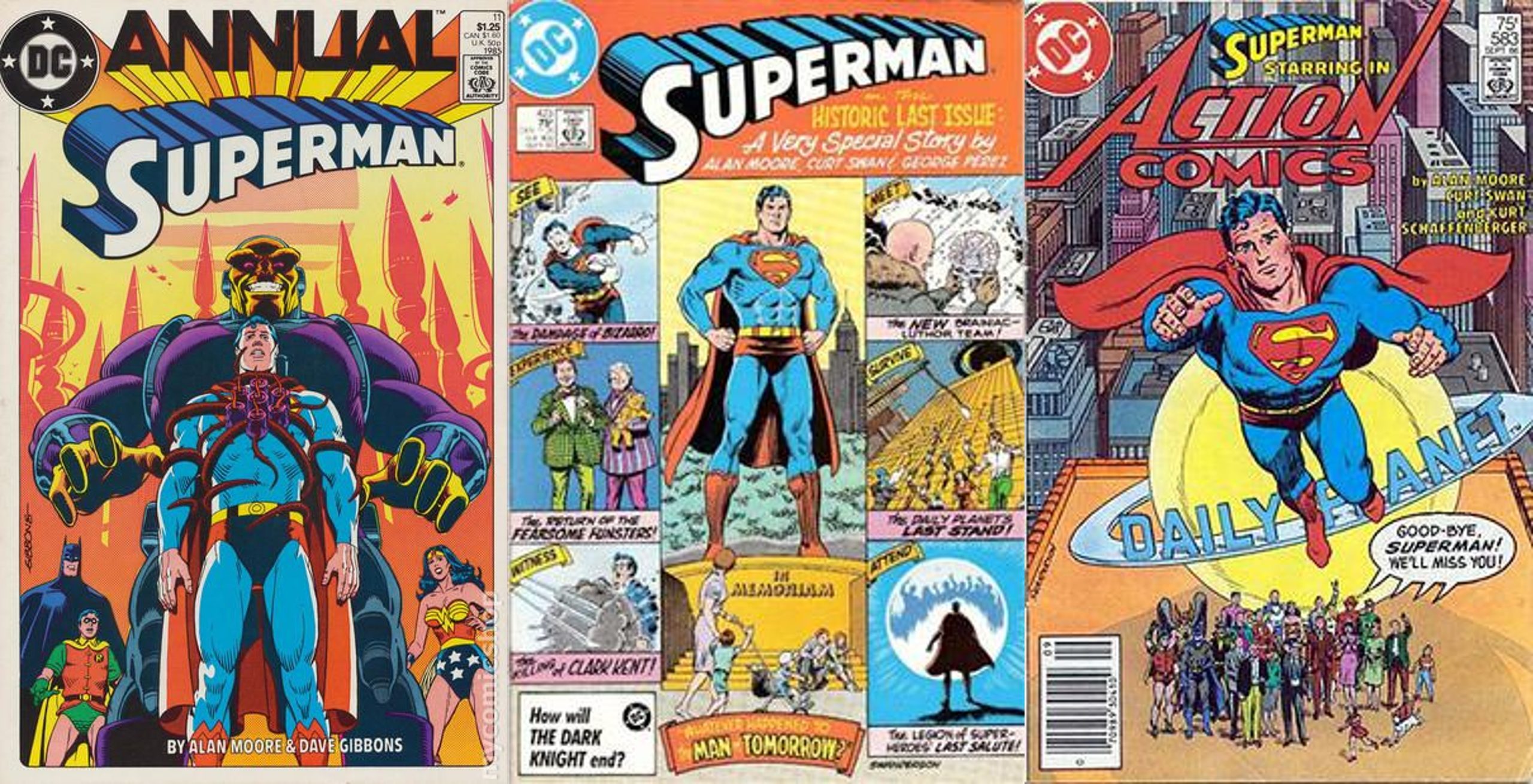
Alan Moore: I loved Moore’s work before I even knew who he was. For the Man Who Has Everything (Superman Annual #11, 1985), Mogo Doesn’t Socialize (Green Lantern #188, 1985), and Whatever Happened to the Man of Tomorrow? (Superman #423 and Action Comics #583, 1986) These were all comics that touched me deeply and showed me the true possibilities of the medium. I later discovered his monumental works like Watchmen, V for Vendetta, Marvelman, and From Hell. The man has written my favorite comics, period. https://en.wikipedia.org/wiki/For_the_Man_Who_Has_Everything https://en.wikipedia.org/wiki/Superman:_Whatever_Happened_to_the_Man_of_Tomorrow%3F https://dc.fandom.com/wiki/Green_Lantern_Vol_2_188
Margaret Atwood: Of everyone on this list, she is the one I read most recently, but she has influenced me the most as an adult. The Handmaid’s Tale is my most re-read book. It has affected me more profoundly than anything else I’ve read in recent years and led me to explore her impressive, extensive output. Atwood is an author we should all read. https://en.wikipedia.org/wiki/Margaret_Atwood https://en.wikipedia.org/wiki/The_Handmaid%27s_Tale

Categories: Tabletop Gaming Blogs
Running Gary Gygax’s S4: The Lost Caverns of Tsojcanth using the Adventurer Conqueror King System II (ACKS II)
Running Gary Gygax’s S4: The Lost Caverns of Tsojcanth using the Adventurer Conqueror King System II (ACKS II) creates a beautiful, violent friction. Tsojcanth was built for AD&D 1e—a modules-as-tournament-grounds framework filled with ecologically bizarre monster hotels, vast mountains, and a hoard of unique magic items.ACKS II, conversely, is a precision-engineered simulation of Needleshttp://www.blogger.com/profile/11243274667834930867noreply@blogger.com0
Categories: Tabletop Gaming Blogs
Verith Maw is a claustrophobic, vertical slum-district anchoring the lower-industrial rings of a high-gravity Megastructure For 13 Parsecs rpg
Verith Maw is a claustrophobic, vertical slum-district anchoring the lower-industrial rings of a high-gravity megastructure. In 13 Parsecs, it serves as an ideal "underbelly" hub—a place where players go to disappear, fence stolen cyberware, or pick up high-risk, low-legality corporate sabotage contracts.The Concept: The Sinking CityVerith Maw is built directly over a massive, unshielded Needleshttp://www.blogger.com/profile/11243274667834930867noreply@blogger.com0
Categories: Tabletop Gaming Blogs
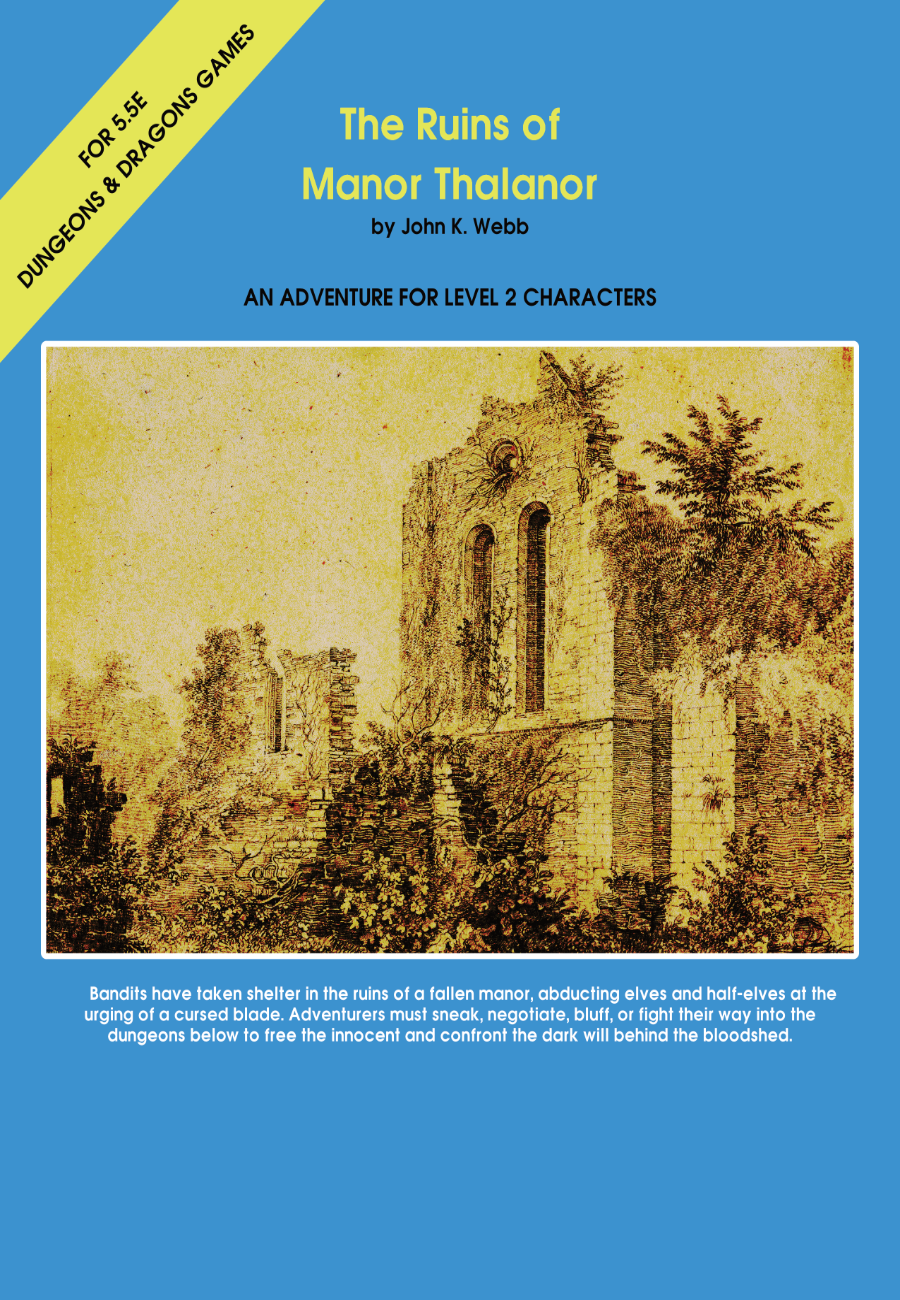
The Ruins of Manor Thalanor
By John Webb
Self Published
OSR/5E
Level 2
Self Published
OSR/5E
Level 2
[…] Years later, a band of opportunistic brigands took shelter in the manor ruins. In the depths below, their leader, Halren Pike, discovered the dagger and fell under its influence. Compelled by its will, he now seeks out elves and half-elves, testing their blood in search of a surviving bastard heir to House Thalanor. Though the bandits themselves are not uniformly cruel, their leader’s fixation has led to kidnappings, imprisonment, and worse. Some captives are released after being “tested.” Others are not so fortunate.
This twenty page adventure uses about seven pages to present sixteen rooms, six above and the rest below, in the ruins of a manor occupied by bandits. It’s a tactical deathtrap as your small band charges in to a mesatop fortress with a lot of lookouts and bandits present. It’s a raid, with nothing going on beside that.
I dunno know. Either the designer asked for a review or it was in the OSR category trying to Puffery its way in to a few more sales. Ok, so, a long time ago there was an elf noble house that was mean to its subjects. People rise up and the lord kill himself and his family when things go south. His god is pissed at that. (So, you can be a despot and have a chill god but killing yourself and family so you won’t be taken is just a step too far.) Bandits move in a long time later. Their leader finds a dagger, cursed, that makes him test elves and half-elves by cutting them to see if they are the heirs to the elf noble house. This entire nonsense of stuff I find lame, with despotic elf nobles and the like. Man, just make them human. The whole “Demihumans are humans with pointy ears” thing is kind of lame. Where’s Jorune when you need it?
Back to this, the designer tells us, up front: “With a mere sixteen rooms, this adventure’s complexity lies not in a vast sprawl, but more so in the behavior of its inhabitants and the unpredictability of its emergent narrative. Will the party fight, bluff, negotiate, or sneak their way into the lower level? Will they seek a peaceful resolution, or simply kill all in their path? Will they rescue prisoners at the expense of time and stealth, or leave them to an unjust fate? These are the questions that must be answered, Gamemaster, over the course of play. Alas, I cannot prescribe them nor would I, even if I were so capable! “ Just to be clear, none of that really exists in any practical manner. I mean, yes, there are prisoners to rescue, but they are not really troublesome other than wanting to leave, just like all prisoners freed are. Nothing mentioned in that section is anything other than the normal course of play. Nothing special is going on. In fact, there’s a lot less special in this adventure than in most adventures. I don’t know. I guess if you play Napoleonic Miniatures and someone introduces a dungeon it might be remarkable, so, if you play D&D in hardcore 4e tactics mode then “Look! You can roleplay also!” might be interesting?
“Wood Door: AC 13, 18 Hit Points, and immunity to Poison and Psychic damage.” Oh, how I have missed this nonsense. There’s nothing funnier than then when pay-per-word padding becomes the de rigueur standard because people grow up with it. But doctor… I am Pagliacci!. And, of course, married to that are explicit illumination notes in each room. This is so dumb. I’m not sure who these things are being written for that this kind of garbage has to be included. Well, no, I guess I stated it above. It’s written for someone paying by the word. But the designer writing THIS adventure doesn’t know that. They think that’s how you write an adventure. The sins of PF Changs Pad Thai run deep. That’s not real Pad Thai, but you don’t know that. Once you have the real thing you’ll never be fooled again.
This is a frontal assault. There are nineteen bandits present, but six start not-at-home and return 10-40 minutes after the party starts fucking shit up. There’s not a super good description of the outside ruins environs, but from the map it looks like a cliff face with a landing on it ten or twenty feet up with fortress ruins on it. There’s a broad stair case up running parallel to the cliff face that then turns 90 degrees to run perpendicular to in to it. There are the remains of three watchtowers on the cliff “landing” ruins. There’s a bandit in the towers watching the approaches. There’s guard dogs sniffing shit out. The bandits have planted shriekers on the “unused” cliff edges as an alarm bell. There’s also a patrolling bandit, watching specifically the approach of the stairs, walking along the cliffside it is on looking for intruders. I’m afraid this is a tough nut to crack, even for my “burn it down and reroute the river method of murder-hoboing. There is a 10% chance a guard is asleep. Yeah? And, there is a secret door in. Right in playing view of all of the guards, on the stair landing where it turns 90 degrees. You gonna have to search for it and then make a history check at DC14 to recall the password. I don’t see how you do this under the guards’ noses. This all seems a bit much at level two. Well, for anything other than a pitched battle. Which is fine, but, it looks like a death trap to me with that approach. You could silence the shriekers … if you knew about them? And had access to level two spells? The secret door doesn’t seem reasonable. I guess that leaves bluffing your way to the top? I don’t know man. This feels like a hack … with the odds stacked against the party.
Inside it’s more of a hack, although not quite in the same “its a trap!” set up. There IS a curse you can break. You need to make an offering to a goddess of the correct type. Then commune with here. Then make a DC14 check. Then you’ll get a scroll that of remove curse. Then you gotta figure out that there IS a curse on the bandit leader and use the scroll. Yeah! Now they are just a normal group of bandits instead of a group of bandits that also “test” elves and half-elves by cutting them. Uh. Ok? Or, just stab the bandits? Oh no! The bloodthirsty demon has acne! Good thing you have him some zit creme, now he can get on with his reign of terror AND look good for his portraits!
None of this shit makes much sense, and, it’s just a hack. I have no idea why it is in the OSR section of DriveThru. Usually that means Shadowdark, but not this one. I mean, it’s basically just a 4e adventure. And you KNOW that’s not a compliment. More minis combat min-maxing then RPG.
This is $5 at DriveThru. The preview gets you eight real pages, including some keys. Good preview.
https://www.drivethrurpg.com/en/product/564113/the-ruins-of-manor-thalanor?1892600
Categories: Tabletop Gaming Blogs
XNOO is Nearly Upon You!

The latest Kickstarter from the Merry Mushmen is XNOO #1, a 276 page "aperiodical" fantasy comics anthology. It features work by several rpg and comic artists, among them James West, Stefan Poag, and Jason Sholtis. Of interest to readers here, it also features the debut of the Land of Azurth comic "The Runaway Shadow" written by me and featuring art by comics veteran Mike Kazaleh. There's also great stuff by artists like Alexey Gorboot. Kennon James and Tim Molloy, and more!
In addition to the comics stories, it's filled out with articles by the likes of James Maliszewski and myself on related topics. My text piece is on comics adaptations of literary Sword & Sorcery characters.

You're going to want to check it out.
Head over to Kickstarter now to be notified on launch tomorrow.
Categories: Comic Book Blogs, Tabletop Gaming Blogs
OSR Commentary Meditations on the N1Cult of the Reptile God module By Doug Nile for Adventurer, Conqueror, King Rpg II
Adapting the classic TSR module N1: Against the Cult of the Reptile God into the economic and structural framework of Adventurer, Conqueror, King System II (ACKS II) transforms it from a localized low-level mystery into a hyper-rationalized, high-stakes sandbox scenario.ACKS II demands that an economic and ecological ecosystem underpin every settlement and dungeon. When running a Needleshttp://www.blogger.com/profile/11243274667834930867noreply@blogger.com0
Categories: Tabletop Gaming Blogs
D100 Sword and Sorcery Wastelands and Ruins Table For Castles & Crusades rpg with Treasures
Here is a d100 encounter and discovery table tailored for a gritty Sword & Sorcery wasteland or ruin, complete with classic Castles & Crusades (C&C) monster stats.The mechanics utilize standard C&C terminology: HD (Hit Dice), HP (Hit Points), AC (Armor Class), BtH (Base to Hit), and Primary Attributes for Saves (Physical/Mental). This blog post picks right up from Two Needleshttp://www.blogger.com/profile/11243274667834930867noreply@blogger.com0
Categories: Tabletop Gaming Blogs
Pages
