Your wildly multifarious home!
Feed aggregator
D100 Random Slave and illicit cargoes table For the Clement Sector rpg & Outlaw: Crime in Clement Sector Campaign
Here is a customized D100 Random Table for Slaves and Illicit Cargoes tailored specifically for the Clement Sector setting. This blog post picks right up from A d100 Dark Artifact table for The Clement Sector role-playing game especially for The Unmerciful Frontier: The CCA Sourcebook Third EditionThis table blends the distinct flavor of Clement Sector—featuring Uplifts (Bears, Alphas,Needleshttp://www.blogger.com/profile/11243274667834930867noreply@blogger.com0
Categories: Tabletop Gaming Blogs
Integrating Adventurer Conqueror King System II (ACKS II) with the legendary, chaotic, and maximum-gonzo DNA of Dave Hargrave’s Arduin Grimoires - Converting Arduin's Welcome to Skull Tower (1978) To ACKS II
Converting Dave Hargrave’s The Arduin Grimoire Vol. II: Welcome to Skull Tower (1978) to Adventurer Conqueror King System II (ACKS II) involves bridging two very distinct Old-School Revival (OSR) philosophies.Arduin was chaotic, gonzo, high-lethal, and rule-breaking (introducing hit location tables, high-damage criticals, Needleshttp://www.blogger.com/profile/11243274667834930867noreply@blogger.com0
Categories: Tabletop Gaming Blogs
OSR Adventure Location - The Slave Market on the Tantus Nine Space Station for Wretched Space Rpg
Deep in the lawless outer fringes, Tantus Nine is a decaying, hollowed-out mining station where Galactic Federation authority is a joke and credits talk loudest. At the station’s rusted lower hub lies The Flesh Bourse—commonly known as the Slave Market of Tantus Nine.In the gritty, anti-heroic spirit of Wretched Space, this isn't a place for shining knights; it’s a meat market for corporateNeedleshttp://www.blogger.com/profile/11243274667834930867noreply@blogger.com0
Categories: Tabletop Gaming Blogs
Paizo News
From the desk of the Paizo Press office.
July 13th – July 17th Paizo & the Seattle Mariners Present….Operation Salmon RunAugust 9th, 2026. T-Mobile Park. 1:10pm start.Join Paizo & the Mariners at T-Mobile Park for Operation Salmon Run Day! Tickets purchased for this special event include an exclusive Pathfinder Adventure module and a Mariners-themed 7 piece dice set.Get Tickets!13 Omens Preview at Gen Con!With just two weeks left until Gen Con, we’re excited to reveal the full slate of 13 Omens Preview products available at the show! Alongside the 64 page, softcover, digest sized 13 Omens Preview Edition rulebook, we’re also releasing: Bequeathed, A 13 Omens Story by James Jacobs. The passing of the family patriarch brings the Salazar siblings home for the reading of the will, but they will soon learn that far darker secrets than wine formulas await them.13 Omens Premium Resin Dice Set & Bag. A full set of 21 six-sided dice: 8 white-inked Safe Dice and 13 red-inked Omen Dice, plus a fabric bag to conceal your dice pulls.
All of these products will be exclusively available in limited quantities at Gen Con 2026.Join the 13 Omens Mailing ListExperience the horror… LIVE!Paizo Publisher Erik Mona leads a crew of intrepid tourists on an authentically haunted tour of the Seattle Underground in the FIRST EVER 13 Omens Live Show! Featuring B. Dave Walters, Luis Carazo, Rue Dickey, and Maya Coleman.Get Tickets!Paizo Printables Season 2: High Seas!Find your sea legs or walk the plank!
This month launches Season 2 of Paizo Printables, our monthly STL miniature subscription. Season 2’s theme, High Seas, focuses on nautical creatures, characters, and adventures!Join on PatreonJoin on MyMiniFactory!News from Paizo PartnersBring immersive audio to your table with Syrinscape! Join today to try Syrinscape Nova, a new toolset in early access!Shop NowStart playing Starfinder with professional GMs today on Start Playing Games! Sort games by time, VTT platform, theme, and more!Join a Game!
Categories: Tabletop Gaming Blogs
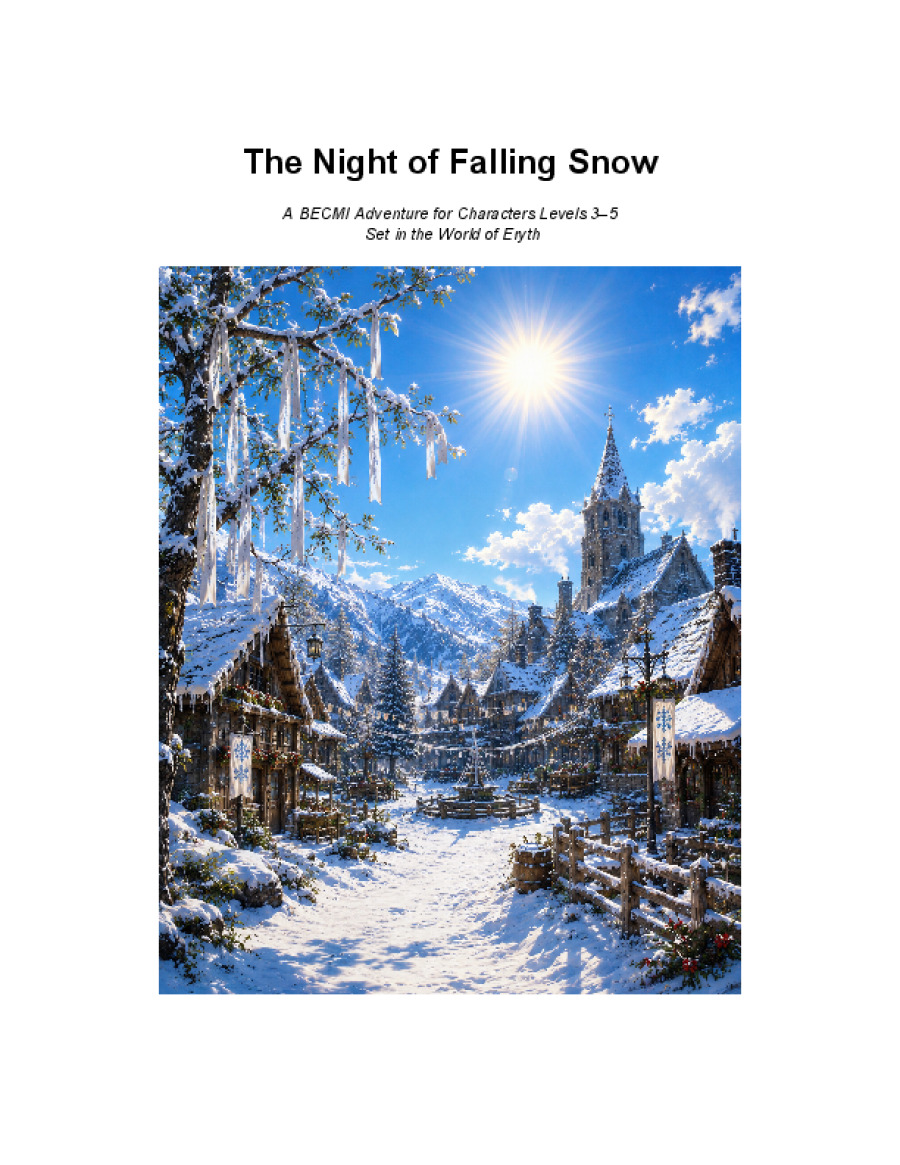
The Night of Falling Snow
By Jon Brackin
Brackin Adventuring Company
BECMI
Levels 3-5
Contains stone tablets.
These preserve the complete ritual.
Reading them aloud causes spectral figures to appear.
Most are harmless.
Three become Snow Wraiths.
Brackin Adventuring Company
BECMI
Levels 3-5
On the hottest night of summer… it begins to snow. For as long as anyone can remember, the quiet village of Frosthollow has celebrated The Night of Falling Snow, an ancient midsummer festival unlike any other. White ribbons flutter from old trees. Candles burn in every window. Gifts are exchanged beneath a blazing summer sun while soft snow falls from a cloudless sky. The villagers call it a miracle. They have forgotten that it is a warning. This year, the snow arrives early… and it does not stop. As impossible winter spreads across the countryside, travelers find themselves drawn into a mystery buried beneath centuries of tradition. Forgotten journals, hidden chambers, and an ancient ritual reveal a terrifying truth: the festival was never meant to celebrate the snowfall. It was created to keep something from crossing the threshold into the world. And at the center of it all waits a smiling traveler known only as The Pale Guest. Will the heroes uncover the truth before midnight, restore a ritual no one remembers, or unknowingly open the door to an ancient horror?
This seventeen page adventure uses about eleven pages to describe about ten areas in a village about to reawaken an ancient entity. It’s sparse, with little specificity. There is an outline of an adventure but little to ground the characters actions or the DMs responses.
I am continually mystified at the lack of adventure that passes for adventures. The barest outline of an adventure is somehow expanded to twenty pages and then a few dollar price tag slapped on it. We get little more than DM notes, time and again, the kind scribbled on my party tracker page ten minutes beforehand to run tonight’s game. What ends up being published is just anything that anyone could come up, with all of the specificity and adventure just not present, the stuff the designer SHOULD be working on to help the DM bring the game alive. Yes, the DM needs to do work, but the designer is there to inspire them to greatness and provide the tools to do so.
There’s this village where it snows on a day in the summer every year. The villagers hold this festival with a couple of traditions attached to it. Well, wouldn’t you know it, the snow doesn’t stop this year and gets VERY heavy. The party is there for [the usual lame reasons.] Oh no, people are missing! Poking about you find the basement of the inn has some old records, and the traditions are bastardized versions of a yearly ritual that has to be done to keep THE VISITOR away. The party must convince everyone in the village does a Whoville song and dance number and the entity will sleep for another year. Or, just stab the 12HD dude till it dies.
The most specific thing in the adventure is, what a coincidence, also the most interesting. The villagers hang ribbons from a tree in the village with their names on it. (And, the missing villagers have ribbons there also, with their names faded away. I’m not sure how you know that given that the names are no longer there, but the concept is decent.) This is great. It’s like a line of text. It’s specific. It grounds the DM and gives them something to build on. This is by far the most interesting thing in the adventure.
The actual locations are given this description style that is … poetic? An attempt to be poetic? Let’s look at “Chamber Two: The Ice Archive”
A chamber sealed within magical frost.Contains stone tablets.
These preserve the complete ritual.
Uh. Ok. How about another room, for comparison? The Hall of Forgotten Names:
Thousands of names carved into walls.Reading them aloud causes spectral figures to appear.
Most are harmless.
Three become Snow Wraiths.
Meh. This borders on pretension. It’s the fucking idea for a room being sold as a room. Put in a fucking description. Look, I’m supportive of new ideas but also you gotta recognize when they don’t work and this don’t work. There’s nothing there! At some point we’re told “Eventually clues point toward old records beneath the inn.” What are these clues? Not present. Nothing. The DM gets to make them up. This is just some notes on a napkin about some major beats in a potential adventure. How about monsters? Here’s notes about an attack by Candle Guardians. Or,, maybe, Frostbound Remnants, both phrases are used: “Four Frostbound Remnants attack as soon as the door closes behind any person entering. “ What the fuck is a Candle Guardian?
This is a ridiculously low effort adventure. I’m sure some work was put in to it, but its like the designer has somehow never seen what an actual adventure is and what one needs to run an adventure. Like what the fuck a monster is.
This is Pay What You Want at DriveThru with a suggested price of $2. There is no preview. You gotta put in a preview man, so we can make an informed decision to purchase or not.
https://www.drivethrurpg.com/en/product/573268/the-night-of-falling-snow?1892600
Categories: Tabletop Gaming Blogs
Wednesday Comics: DC, October 1985 (week 4)
I'm reading DC Comics' output from January 1980 (cover date) to the end of Crisis! This week, I read the comics on sale on July 25, 1985.
All-Star Squadron #50: I suspect both the Crisis tie-in banner, and the character-filled Ordway cover attracted my attention on the stands. This wasn't the first issue of the All-Stars I picked up as a kid, but it was the beginning, I believe, of a short period of getting it more frequently. Reading it again now, though, it's apparent how much of this story is just plugging continuity holes. Even the Crisis tie-in portion is showing how and when Harbinger recruited Firebrand, and then using Harbinger's presence to advance the next story Thomas has planned. Beyond that, we get the Quality Comics characters leaving for Earth-X and Steel displayed to Earth-One so he can be the grandfather of the JLA's Steel there.
Several JSA members are also captured and put into rockets by the Nazi's to launch into space. Seems it would be easier just to kill them, but no, this becomes a way to do a modern version of some Gardner Fox stories from the Golden Age in upcoming issues.
Action Comics #572: This issue has three quaint stories that continue the trend of this book feeling like editorial is burning inventory before Crisis finishes and things are different. The first by Boldman and Boring/Hunt has a scientist revealing to Clark Kent the moon is suddenly inhabited by a bunch of copies of Clark! Investigating, it turns out to be Gollo and his pals, derpy-looking green saurpodish aliens with chameleon powers that Superman has met before. They are exiled due to aggressive other creatures on their homeworld, but it turns out their hero-worship of Superman (and taking on the form of his secret ID) is why the predators suddenly took interest.
The second story by Sabbatini and Bender/Oksner, has Superman safe was fluffy, cute animal creatures from an obsessed alien trophy hunter, and then is rewarded by their time traveling evolution descendants for his compassion.
The third is the first DC work by Mark Waid. It's got art by Hoberg/Mitchell and is one of those "can you solve the mystery first?" stories involving the contents of the Fortress of Solitude disappearing after a close call with an unusually magnetized meteor.
Detective Comics #554: Moench and Colan/Smith have Batman and friends setting up a sting to catch Boomerang and Mirror Master. Using his Matches Malone identity, Batman sets the bait by spreading word that Bullock will be transporting a valuable museum piece solo. Boomerang sends the supposedly hypnotized Mirror Master to steal it. The trap fails, and he kidnaps Bullock. In the hideout, Mirror Master reveals he was merely pretending to be hypnotized, and he and Boomerang start fighting. Batman and Robin show up to arrest them both.
In the Green Arrow backup by Maggin and Giordano, Ollie is pickpocketed on the way to pay his rent. When he pursues the thief as Green Arrow, he stumbles on to a gang stealing an ancient Greek artifact. He manages to stop them, then grab his rent money back when he happens to see the pickpocket at the police station.
Legion of Super-Heroes Annual #1: Levitz and Giffen, Kessel, and a host of other inkers, get around to solving the mystery of who shot Laurel Kent. The team of investigating Legionnaires figure out that other murders and attempted murders are related. Brainiac 5 deduces the murder is going after descendants of JLA members. They eventually track the murder to his cryogenic chamber where he has been only periodically awakening since the 20th Century and directing a robot.
It's good to see Giffen back with the Legion, and I think the story is good in concept, but stumbles a bit in execution. I get the idea that each chapter, focusing on a different part of the investigation, is meant to be in the style of a different sort of mystery subgenre, but only Shrinking Violet's hardboiled narration, and Chameleon Boy's Holmesian turns of phrase give a hint of this. The styles of the other chapters are obscure to me. Also, they frustratingly never reveal the identity of the murderer. From what they did say, I thought Professor Ivo was a possibility, and that's who the internet is certain it was, but it seems a mistake just not to name him in the story.
Nathaniel Dusk II #1: MacGregor and Colan are back with another hard-boiled detective story with the same colors over pencils art style that makes the whole thing look like you're viewing the images through a rain spattered window. A lot of basic shapes and blobs of color. In this installment, Dusk is hired by Amanda Cooper, a wealthy woman, to act as a bodyguard for her father, Cranston, a former businessman reduced to selling apples from a cart on the street corner after losing his fortune in the stock market crash. Someone tries to shoot Cranston as a hurricane remnant hits the city (placing this round September 8, 1934) and Dusk has to fight the guy, but the would-be assassin gets away.
Star Trek Annual #1: Barr and Ross/Smith present a story of Kirk's earliest days in command of Enterprise. This is first of two annuals Barr did telling "untold tales" of Star Trek history. We get to exactly how he took over from Pike, the fate of Number One (injured in an accident), and Gary Mitchell's introduction to the crew. In fact, this issue marks the first ever comic appearance of Pike, Number One, Dr. Boyce, Mitchell, and Kelso. The aliens which appear in the story and have a history with Pike are beyond the budget of the TV certainly but fit in well with the short of things we see in tie-in novels. In fact, the novels will tackle this same idea in 1986 with McIntyre's Enterprise: The First Adventure, but Barr got their first.
V #9: The cover of this issue is weird because it doesn't seem to relate at all to the contents. Donovan, Parrish, and Willie go to the New York City to offer to train the locals in resistance fighting to deal with a Visitor attack they believe is coming. The Mayor is completely dismissive of the possibility, and we find out (though our heroes don't) that that's because she's a Visitor herself. She sends some goons to ambush the LA crew, but when they defeat them, the demonstrable presence of Visitors in New York only serves to make the people come to them for training.
Meanwhile, there continues to be rivalries and jockeying for position among the aliens. Lydia convinces the brutish Walter than the human Donovan is in the way of him being with Diana, and she convinces Diana of a plan to send Walter to New York to stalk and kill Donovan.
World's Finest #320: Continuing the story from last issue, Batman manages not only to survey his plummet from an airplane into the reservoir but to wrap the cannister full of drugs in his insulated cape so it doesn't release in water. We get Rem's origin as a therapist turned super-villain after his mind in damaged using a device that allowed into to enter his psychotic patient's psyche. When Batman reaches the Fortress of Solitude, Rem has made Superman a sleepwalker under his command. Batman uses the Phantom Zone Projector to send Superman into the Phantom Zone, which has the effect of freeing him from Rem's control. Batman and Superman defeat Rem, but unbeknownst to them, the villain known as Chronos starts planning his attack on the world's mightiest heroes. There's also so more of the shadowy Power Broker talking to folks viagrainy monitors.

All-Star Squadron #50: I suspect both the Crisis tie-in banner, and the character-filled Ordway cover attracted my attention on the stands. This wasn't the first issue of the All-Stars I picked up as a kid, but it was the beginning, I believe, of a short period of getting it more frequently. Reading it again now, though, it's apparent how much of this story is just plugging continuity holes. Even the Crisis tie-in portion is showing how and when Harbinger recruited Firebrand, and then using Harbinger's presence to advance the next story Thomas has planned. Beyond that, we get the Quality Comics characters leaving for Earth-X and Steel displayed to Earth-One so he can be the grandfather of the JLA's Steel there.
Several JSA members are also captured and put into rockets by the Nazi's to launch into space. Seems it would be easier just to kill them, but no, this becomes a way to do a modern version of some Gardner Fox stories from the Golden Age in upcoming issues.

Action Comics #572: This issue has three quaint stories that continue the trend of this book feeling like editorial is burning inventory before Crisis finishes and things are different. The first by Boldman and Boring/Hunt has a scientist revealing to Clark Kent the moon is suddenly inhabited by a bunch of copies of Clark! Investigating, it turns out to be Gollo and his pals, derpy-looking green saurpodish aliens with chameleon powers that Superman has met before. They are exiled due to aggressive other creatures on their homeworld, but it turns out their hero-worship of Superman (and taking on the form of his secret ID) is why the predators suddenly took interest.
The second story by Sabbatini and Bender/Oksner, has Superman safe was fluffy, cute animal creatures from an obsessed alien trophy hunter, and then is rewarded by their time traveling evolution descendants for his compassion.
The third is the first DC work by Mark Waid. It's got art by Hoberg/Mitchell and is one of those "can you solve the mystery first?" stories involving the contents of the Fortress of Solitude disappearing after a close call with an unusually magnetized meteor.

Detective Comics #554: Moench and Colan/Smith have Batman and friends setting up a sting to catch Boomerang and Mirror Master. Using his Matches Malone identity, Batman sets the bait by spreading word that Bullock will be transporting a valuable museum piece solo. Boomerang sends the supposedly hypnotized Mirror Master to steal it. The trap fails, and he kidnaps Bullock. In the hideout, Mirror Master reveals he was merely pretending to be hypnotized, and he and Boomerang start fighting. Batman and Robin show up to arrest them both.
In the Green Arrow backup by Maggin and Giordano, Ollie is pickpocketed on the way to pay his rent. When he pursues the thief as Green Arrow, he stumbles on to a gang stealing an ancient Greek artifact. He manages to stop them, then grab his rent money back when he happens to see the pickpocket at the police station.

Legion of Super-Heroes Annual #1: Levitz and Giffen, Kessel, and a host of other inkers, get around to solving the mystery of who shot Laurel Kent. The team of investigating Legionnaires figure out that other murders and attempted murders are related. Brainiac 5 deduces the murder is going after descendants of JLA members. They eventually track the murder to his cryogenic chamber where he has been only periodically awakening since the 20th Century and directing a robot.
It's good to see Giffen back with the Legion, and I think the story is good in concept, but stumbles a bit in execution. I get the idea that each chapter, focusing on a different part of the investigation, is meant to be in the style of a different sort of mystery subgenre, but only Shrinking Violet's hardboiled narration, and Chameleon Boy's Holmesian turns of phrase give a hint of this. The styles of the other chapters are obscure to me. Also, they frustratingly never reveal the identity of the murderer. From what they did say, I thought Professor Ivo was a possibility, and that's who the internet is certain it was, but it seems a mistake just not to name him in the story.

Nathaniel Dusk II #1: MacGregor and Colan are back with another hard-boiled detective story with the same colors over pencils art style that makes the whole thing look like you're viewing the images through a rain spattered window. A lot of basic shapes and blobs of color. In this installment, Dusk is hired by Amanda Cooper, a wealthy woman, to act as a bodyguard for her father, Cranston, a former businessman reduced to selling apples from a cart on the street corner after losing his fortune in the stock market crash. Someone tries to shoot Cranston as a hurricane remnant hits the city (placing this round September 8, 1934) and Dusk has to fight the guy, but the would-be assassin gets away.

Star Trek Annual #1: Barr and Ross/Smith present a story of Kirk's earliest days in command of Enterprise. This is first of two annuals Barr did telling "untold tales" of Star Trek history. We get to exactly how he took over from Pike, the fate of Number One (injured in an accident), and Gary Mitchell's introduction to the crew. In fact, this issue marks the first ever comic appearance of Pike, Number One, Dr. Boyce, Mitchell, and Kelso. The aliens which appear in the story and have a history with Pike are beyond the budget of the TV certainly but fit in well with the short of things we see in tie-in novels. In fact, the novels will tackle this same idea in 1986 with McIntyre's Enterprise: The First Adventure, but Barr got their first.

V #9: The cover of this issue is weird because it doesn't seem to relate at all to the contents. Donovan, Parrish, and Willie go to the New York City to offer to train the locals in resistance fighting to deal with a Visitor attack they believe is coming. The Mayor is completely dismissive of the possibility, and we find out (though our heroes don't) that that's because she's a Visitor herself. She sends some goons to ambush the LA crew, but when they defeat them, the demonstrable presence of Visitors in New York only serves to make the people come to them for training.
Meanwhile, there continues to be rivalries and jockeying for position among the aliens. Lydia convinces the brutish Walter than the human Donovan is in the way of him being with Diana, and she convinces Diana of a plan to send Walter to New York to stalk and kill Donovan.

World's Finest #320: Continuing the story from last issue, Batman manages not only to survey his plummet from an airplane into the reservoir but to wrap the cannister full of drugs in his insulated cape so it doesn't release in water. We get Rem's origin as a therapist turned super-villain after his mind in damaged using a device that allowed into to enter his psychotic patient's psyche. When Batman reaches the Fortress of Solitude, Rem has made Superman a sleepwalker under his command. Batman uses the Phantom Zone Projector to send Superman into the Phantom Zone, which has the effect of freeing him from Rem's control. Batman and Superman defeat Rem, but unbeknownst to them, the villain known as Chronos starts planning his attack on the world's mightiest heroes. There's also so more of the shadowy Power Broker talking to folks viagrainy monitors.

Categories: Comic Book Blogs, Tabletop Gaming Blogs
OSR Commentary - Jason X or Uber Jason NPC for the Cepheus Engine rpg & 2d6 Science Fiction Games
Adapting Jason Voorhees (specifically his 25th-century upgraded form from Jason X) to the Cepheus Engine presents a classic survival-horror threat for sci-fi starship crews. In Cepheus Engine terms, Jason functions not as a standard NPC, but as an environmental hazard with a health pool—an unyielding, cybernetically augmented apex stalker.
Categories: Tabletop Gaming Blogs
Construction in Indianapolis During Gen Con
From the Gen Con Press info.
We’re Spreading Our Wings!Downtown Indianapolis is growing—and fast. From new hotels and expanded infrastructure to refreshed public spaces, the city is transforming in big ways. Here’s a closer look at what’s underway, why it matters, and how you can navigate the changes.When you arrive at the Indiana Convention Center this coming July 30 through August 2 for The Best Four Days in Gaming, you’ll notice ongoing construction work in the building and all-around downtown Indy as improvements continue to expand and enhance the future of tourism and hospitality in our host city.Most notably, during Gen Con, you will see:A near-completed 38-story high, 800+ room Signia by Hilton hotel adjacent to the ICC, which will provide an additional 143,000 square feet of convention center space in 2027.Construction work inside and outside the convention center’s Georgia Street entrance (aka The Glass Cube) as crews are building a new skywalk connecting the Signia to the ICC.Continued construction work on Georgia Street, where work is underway to redesign the street to be more pedestrian and event-friendly along the west block.Circle Center Mall’s continued renovations into a mixed-use development called Traction Yards, which will feature an open-air promenade.Things will look and sound a bit different than what you’ve seen at Gen Con in years past, but we hope you share in our excitement with how this expansion will allow for new possibilities and enhanced experiences for our attendees, partners, and exhibitors as we spread our wings into Gen Con’s 60th anniversary, taking place in August 2027!For more information on Indy construction updates and redevelopment projects, visit here. Stay tuned to our newsletters, Facebook, and Instagram channels for further updates.
Categories: Tabletop Gaming Blogs
Video of the Day – Doctor Who: Deleted Scenes from Series 2, 2006
The post Video of the Day – Doctor Who: Deleted Scenes from Series 2, 2006 appeared first on Blogtor Who.
Categories: Doctor Who Feeds
The Zutarian Dominion Faction For Stars Without Number Rpg & it's Expanding Conquest
Zutarians, also called Imps, were an alien race native to the planet Zutarn. They possessed technology a thousand years advanced of Earth such as monocars, rocket-powered air transports, as well as long-range ray guns, and powerful knockout gas guns. The Zutarians also had an organized military but were not an aggressive race until the human known as Tyrno conquered them. Since the Needleshttp://www.blogger.com/profile/11243274667834930867noreply@blogger.com0
Categories: Tabletop Gaming Blogs
Welcome to BattleTech Week
With the refit upon us I have decided to do a week of BattleTech. This week Through Wargaming Goggles will bring you Product unboxings on The Starter Box, The Core Box, The Leopard Class and Union Class Dropships. A Flip Through on the Core Rule Book. Plus reviews and comparisons of which products are the right ones for you.
Check back daily for more content!
Categories: Tabletop Gaming Blogs
Through Wargaming Goggles July Update
There has been a lot going on this summer. I have been busy helping my father, writing and filming. TWGG currently has fourteen #Starwarslegion box breakings in the Que, and this week is BattleTech Refit week. You can expect to see one new video a day plus written content written throughout the week. Plus, next week is Gen Con! If you have anything you want me to ask at Gen Con or look into please let me know.
Categories: Tabletop Gaming Blogs
Minecraft: The Official Crochet Book - Review and Giveaway
Minecraft: The Official Crochet Book by Lee Sartori and Nadia Oxford features "more than 20 official patterns for wearables, decor, plush amigurumi and more!" Take a peek inside, and enter to win your own copy of this creative collection below! Disclaimer: I was given a copy of this book for review; all opinions are my own. […]
The post Minecraft: The Official Crochet Book - Review and Giveaway appeared first on moogly. Please visit www.mooglyblog.com for this post.
0
Categories: Crochet Life
Video of the Day – FAN EXPO Denver, 2026
The post Video of the Day – FAN EXPO Denver, 2026 appeared first on Blogtor Who.
Categories: Doctor Who Feeds
SDCC 2026: Eisner Award Winner Christian Ward Inks Three-Book Deal with Oni Press
Following THE FOREVER HOME #1 – Debuting in September with Mind-Bending Artist Sami Kivelä – Superstar Writer & Artist Christian Ward Extends Relationship with Groundbreaking Independent Publisher Across Three Top-Secret…
Categories: Comic Book Blogs
FILTHY LAMBS Coming this October
A Generational Pact With Hell Begins to Unravel in a Sinfully Twisted New Horror Series From Mad Cave Studios JULY 20, 2026 (PORTLAND, OR) — Every family has its secrets.…
Categories: Comic Book Blogs
THE ART AND SOUL OF DUNE: PART THREE
Written by Stefanie Broos with Tanya Lapointe Foreword by Denis Villenueve –On-Sale December 22, 2026– From the mind of visionary director Denis Villeneuve — who brought Frank Herbert’s celebrated…
Categories: Comic Book Blogs
CRUSADE COMICS SDCC 2026 EXCLUSIVES PRESALE IS NOW LIVE
VIA WWW.BILLYTUCCI.COM! FOR THOSE WHO CANNOT ATTEND COMIC-CON, JUST CLICK HERE FOR SDCC LIMITED EXCLUSVES! The mecca of comics – Comic-Con International in San Diego begins Wednesday and for the…
Categories: Comic Book Blogs
ROB LIEFELD ANNOUNCES SAN DIEGO COMIC CON GIVEAWAY AND LAUNCHES NEW AVENGELYNE COMIC COMING THIS OCTOBER FROM IMAGE COMICS
Comic book Legend Rob Liefeld is returning to San Diego Comic Con for a panel and signings. All attendees of his ROBSERVATIONS LIVE panel on Thursday July 23rd at 5…
Categories: Comic Book Blogs
Red Sonja & Barbarella Tangle in the Stars in New Comics Piloted by Homero Rios in Dynamite Debut!
July 20, Mt. Laurel, NJ: Two legendary heroines, icons in their respective genres for over half a century each, Red Sonja and Barbarella are crossing paths for the first time ever…
Categories: Comic Book Blogs
Pages
