Your wildly multifarious home!
The Viridian Scroll

Ray Otushttp://www.blogger.com/profile/18398394072713660199noreply@blogger.comBlogger27125
Updated: 6 years 11 months ago
Solo Gaming Part 1: Why Not/Why?
TLDR: I try to shatter some assumptions about solo RPG play and discuss reasons for trying it.
Prejudices and misunderstandings abound when it comes to solo gaming, and it would try my patience to address all of them here. Snap judgments like "I guess it's okay to just try out the rules" or "Sure, but it's not like really role-playing" are, as of this moment, gently but firmly set aside. I want to begin from a place of no assumptions.
It seems strange to me and totally incongruous with the notion of using one's imagination NOT to enjoy playing alone. – Stephen GilbertWhy are the majority of wargames played by more than one person in the first place? – Stuart AsquithThese quotes are from blog posts on the hobby of solo wargaming, but I think they are legitimate and disarming questions from which to approach solo RPG play. They invert the assumptions that solo play is something you only do when you can't find other players or that it is inherently weaker, qualitatively, due to the lack of other players.
When playing RPGs what do others bring to the table? More, and more diverse imagination, sure. Also a kind of surprise factor – ideas that originate from outside of our own experiences. Other players help us increase bandwidth so that there can be more things going on and more characters acting simultaneously, with a low cognitive load on each individual player. Other plays allow us to immerse in a single role and to not try to imagine what other characters, villains, or monsters are doing, or how the world itself reacts to our probings. Other players make RPG play a social event.
That seems like a lot!
But it would be wrong to think that you can't take on a character role (or roles) on your own or achieve some of the same diversity and surprise with other tools – dice and tables, primarily. Before you dismiss this idea, think of gamers you have played with before. Can you not imagine what they would do, in character, given certain situations? I won't say that replacing other players is easy, but a sufficiently complex "model" in our heads or in some table-driven programmatic form can give us very similar results. After all, Game Masters do this all the time – jumping from one NPC to another with sometimes radically different backgrounds and agendas. Additionally, playing alone removes most time constraints, making bandwidth less of an issue. And a degree of social interaction, of a different kind, can be had by sharing your play narratives with others.
You can worry when your characters start talking back. :)
All this amounts to a "why not?" argument, but let's switch to the "why" of solo RPG play.
To deal with a lack of players.
We might suffer from a lack of other willing participants. Of course, the online world has made this less of a problem. With a decent Internet connection and a little exploration to find the right groups on social media platforms, you can find other gamers willing to play with you. However, getting an online game started usually requires you to be reasonably flexible in arranging times and chosen systems. Your "why" could be that you have lots of available free time at odd or unpredictable hours and that you want to play a specific system or setting that doesn't capture the interest of others.
To learn or practice.
Solo play is an ideal way to learn rules, test modules, practice voices, etc. There are tools out there for working either end of the scenario – tools that simulate parties of adventurers so that you can practice running a game or scenario, as well as tools that emulate the game master so that you can try those same systems or modules out in character.
To entertain.
We can't overlook the argument that it's just plain fun. Maybe you already have a gaming group, but you want to play more than you do currently. Maybe you are looking for something to do when you suffer from insomnia or when you are stuck in a hotel while traveling for work or as a quiet-time respite from all the computer, tablet, and phone screens you stare at the rest of the day. Don't be embarrassed to embrace solo play. Why is telling yourself stories somehow pathetic but passively absorbing stories through the television an acceptable pastime?
I seriously doubt this list is exhaustive. Feel free to add your own reasons "why" or your "why not" reasons – the things that keep you from solo play – in the comments below.
Prejudices and misunderstandings abound when it comes to solo gaming, and it would try my patience to address all of them here. Snap judgments like "I guess it's okay to just try out the rules" or "Sure, but it's not like really role-playing" are, as of this moment, gently but firmly set aside. I want to begin from a place of no assumptions.
It seems strange to me and totally incongruous with the notion of using one's imagination NOT to enjoy playing alone. – Stephen GilbertWhy are the majority of wargames played by more than one person in the first place? – Stuart AsquithThese quotes are from blog posts on the hobby of solo wargaming, but I think they are legitimate and disarming questions from which to approach solo RPG play. They invert the assumptions that solo play is something you only do when you can't find other players or that it is inherently weaker, qualitatively, due to the lack of other players.
When playing RPGs what do others bring to the table? More, and more diverse imagination, sure. Also a kind of surprise factor – ideas that originate from outside of our own experiences. Other players help us increase bandwidth so that there can be more things going on and more characters acting simultaneously, with a low cognitive load on each individual player. Other plays allow us to immerse in a single role and to not try to imagine what other characters, villains, or monsters are doing, or how the world itself reacts to our probings. Other players make RPG play a social event.
That seems like a lot!
But it would be wrong to think that you can't take on a character role (or roles) on your own or achieve some of the same diversity and surprise with other tools – dice and tables, primarily. Before you dismiss this idea, think of gamers you have played with before. Can you not imagine what they would do, in character, given certain situations? I won't say that replacing other players is easy, but a sufficiently complex "model" in our heads or in some table-driven programmatic form can give us very similar results. After all, Game Masters do this all the time – jumping from one NPC to another with sometimes radically different backgrounds and agendas. Additionally, playing alone removes most time constraints, making bandwidth less of an issue. And a degree of social interaction, of a different kind, can be had by sharing your play narratives with others.
You can worry when your characters start talking back. :)

All this amounts to a "why not?" argument, but let's switch to the "why" of solo RPG play.
To deal with a lack of players.
We might suffer from a lack of other willing participants. Of course, the online world has made this less of a problem. With a decent Internet connection and a little exploration to find the right groups on social media platforms, you can find other gamers willing to play with you. However, getting an online game started usually requires you to be reasonably flexible in arranging times and chosen systems. Your "why" could be that you have lots of available free time at odd or unpredictable hours and that you want to play a specific system or setting that doesn't capture the interest of others.
To learn or practice.
Solo play is an ideal way to learn rules, test modules, practice voices, etc. There are tools out there for working either end of the scenario – tools that simulate parties of adventurers so that you can practice running a game or scenario, as well as tools that emulate the game master so that you can try those same systems or modules out in character.
To entertain.
We can't overlook the argument that it's just plain fun. Maybe you already have a gaming group, but you want to play more than you do currently. Maybe you are looking for something to do when you suffer from insomnia or when you are stuck in a hotel while traveling for work or as a quiet-time respite from all the computer, tablet, and phone screens you stare at the rest of the day. Don't be embarrassed to embrace solo play. Why is telling yourself stories somehow pathetic but passively absorbing stories through the television an acceptable pastime?
I seriously doubt this list is exhaustive. Feel free to add your own reasons "why" or your "why not" reasons – the things that keep you from solo play – in the comments below.
Categories: Tabletop Gaming Blogs
Initiation Dungeon!
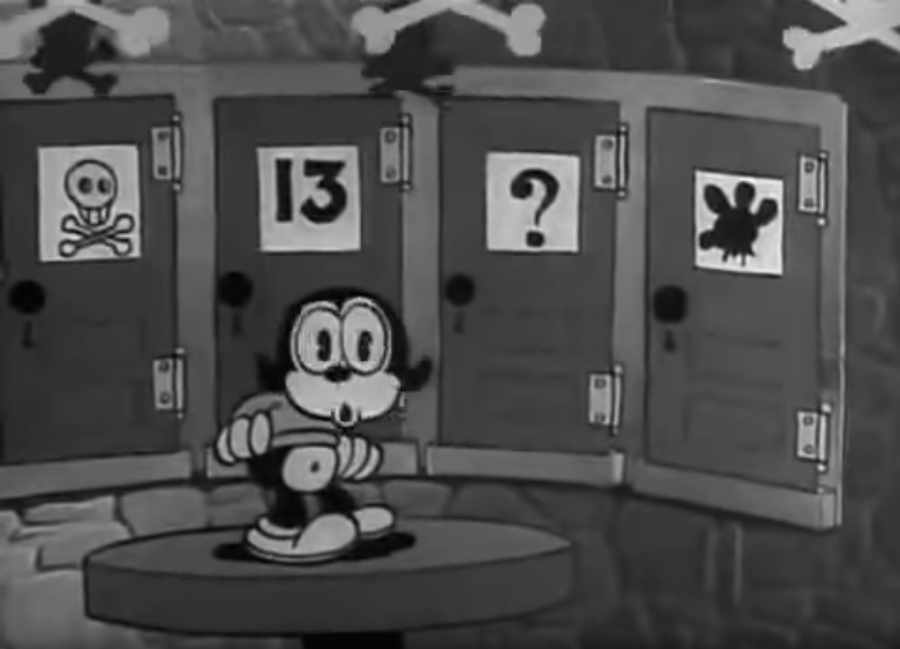
Glen Robinson shared this wonderful old cartoon in response to Dungeon Logic. Here we have a dungeon designed for "initiation" and lots of cool (and lethal) ideas. It's also fairly trippy.
Betty Boop: Bimbo's Initiation, 1931
Betty Boop: Bimbo's Initiation, 1931
Categories: Tabletop Gaming Blogs
On Art and Innovation
TLDR: same old art = same old ideas; challenge yourself.
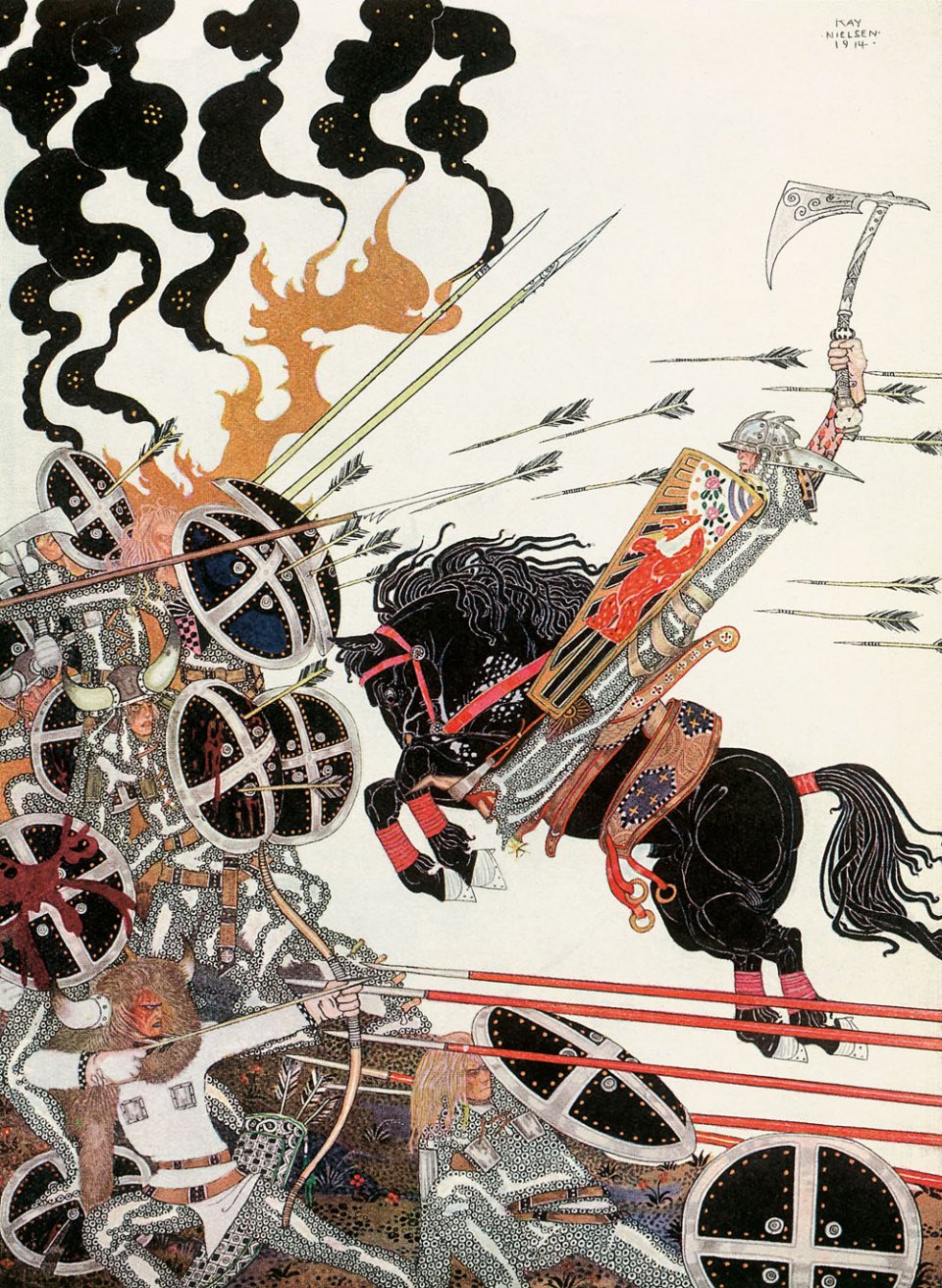
I was recently re-discovered the art of Kay Rasmus Nielsen and Virginia Frances Sterrett. In their work you can see the illustrative qualities of Arthur Rakham mixed with the design sense and Art Deco stylings of Erté!
Kay NielsenVirginia Sterrett
Take a moment (or a few dozen) to absorb the art styles I'm talking about here with some quick Google image searches, it will feed your soul.
Looking at these artists started me thinking about the range of styles, or relative lack of range, in modern fantasy art. You don't see works like this very often! Why not? This next paragraph is the result of a good deal of rumination and, frankly, the result of writing more than 4,000 words and then erasing them.
Where you find innovate art, you will find the innovative words they inspired. Where you find innovative words, you will find the innovate art they inspired. Conversely, the "same old art" – speaking stylistically – will give rise to the same old ideas, and the same old ideas to the same old art.
I have so much more to say about this, but it's all messy and sounds like a value-laden manifesto. The take-away is this. Look at your RPG book shelf. Consider the art you find there. Are you programmed, or being programmed to think about fantasy in only certain ways? Challenge yourself! I could tell you where to look, but part of the joy is in the exploration. Different things are out there! Exciting things, innovative things, weird things. Things that will make you uncomfortable but which will help you grow and pull your imagination out of long-established ruts.
I was recently re-discovered the art of Kay Rasmus Nielsen and Virginia Frances Sterrett. In their work you can see the illustrative qualities of Arthur Rakham mixed with the design sense and Art Deco stylings of Erté!
Kay NielsenVirginia Sterrett

Take a moment (or a few dozen) to absorb the art styles I'm talking about here with some quick Google image searches, it will feed your soul.
- Erté
- Arthur Rakham
- Kay Rasmus Nielsen
(Download public domain East of the Sun and West of the Moon.) - Virginia Frances Sterrett
(Download public domain Tanglewood Tales.)
Looking at these artists started me thinking about the range of styles, or relative lack of range, in modern fantasy art. You don't see works like this very often! Why not? This next paragraph is the result of a good deal of rumination and, frankly, the result of writing more than 4,000 words and then erasing them.
Where you find innovate art, you will find the innovative words they inspired. Where you find innovative words, you will find the innovate art they inspired. Conversely, the "same old art" – speaking stylistically – will give rise to the same old ideas, and the same old ideas to the same old art.
I have so much more to say about this, but it's all messy and sounds like a value-laden manifesto. The take-away is this. Look at your RPG book shelf. Consider the art you find there. Are you programmed, or being programmed to think about fantasy in only certain ways? Challenge yourself! I could tell you where to look, but part of the joy is in the exploration. Different things are out there! Exciting things, innovative things, weird things. Things that will make you uncomfortable but which will help you grow and pull your imagination out of long-established ruts.
Categories: Tabletop Gaming Blogs
Scrolling for Moon-Powered Monsters?
TLDR: imagining spirit-monsters that are bound by circadian rhythms.
The Bakemono Zukushi Scroll
Check out this Edo-period Japanese Monster Manual ... er, I mean painted scroll featuring shape-changing Bakemono. The artist and date is unknown, though it is thought to hail from the 18th or 19th century.
A portion of the Bakemono Zukushi Scroll
One of the great things that comes out in the discussion of this scroll is the way whole classes of monsters are distinguished by the time of day in which they are active.
The founding father of minzokugaku (Japanese folklore studies), Yanagita Kuno (1875–1962), drew a distinction between yurei (ghosts) and bakemono: the former haunt people and are associated with the depth of night, whereas the latter haunt places and are seen by the dim light of dusk or dawn.It reminds me of the three spirits that visited Ebenezer Scrooge in Dickens' Christmas Carol, each one appearing only when the other had disappeared. Of course they represented a sort of chronology (past, present, future) and they could only appear on Christmas night. But the association for me is that gateways to the spirit world may operate a bit like a time-lock vault that is regulated by the calendar, the moon, or the day/night cycle.
Circadian rhythms would be a really interesting twist to put on creatures in your RPG adventures. The characters might be in an otherwise safe place, and then twilight comes, or the witching hour, and things get dicey (literally). This idea also works as a pacing mechanic. In the "off-hours" characters could run around in relative safety, trying to find some formula or weapon to use against the creature(s), but the clock is ticking and they must assemble the right things and perhaps even be at the right location to drive off or destroy the monster(s).
Perhaps a villain who is invincible except at sunrise and sunset. Or malformed spirit creatures that can only break through to the material world when someone harbors violent thoughts at midnight.
Another parallel, in my mind, is the play of light and dark in The Lord of the Rings. Orcs went all weak-in-the-knees in sunlight, so there was a measure of safety while during the day – or at least while abroad under a sunny sky. At night you wanted to be behind fortified walls if you could. And, I believe it is Gandalf who says "look for my coming at first light" and Aragorn who calls down to the Uruk Hai "None knows what the new day shall bring him ... Get you gone, ere it turn to your evil." Of course that sense of safety was soon to be eroded by the blanket of dark clouds Sauron sent forth to shield his troops.
There's a lesson to be had there. Once the characters figure out that the evil sorcerer comes at twilight, because that is when his powers are strongest, how can you surprise them? How could you artificially induce twilight? An eclipse, perhaps?
There's a lot of meat on this bone. And a lot of cool ideas for creatures embedded in that scroll, as well as ready-made, copyright free illustrations!
The Bakemono Zukushi Scroll
Check out this Edo-period Japanese Monster Manual ... er, I mean painted scroll featuring shape-changing Bakemono. The artist and date is unknown, though it is thought to hail from the 18th or 19th century.
A portion of the Bakemono Zukushi Scroll

One of the great things that comes out in the discussion of this scroll is the way whole classes of monsters are distinguished by the time of day in which they are active.
The founding father of minzokugaku (Japanese folklore studies), Yanagita Kuno (1875–1962), drew a distinction between yurei (ghosts) and bakemono: the former haunt people and are associated with the depth of night, whereas the latter haunt places and are seen by the dim light of dusk or dawn.It reminds me of the three spirits that visited Ebenezer Scrooge in Dickens' Christmas Carol, each one appearing only when the other had disappeared. Of course they represented a sort of chronology (past, present, future) and they could only appear on Christmas night. But the association for me is that gateways to the spirit world may operate a bit like a time-lock vault that is regulated by the calendar, the moon, or the day/night cycle.
Circadian rhythms would be a really interesting twist to put on creatures in your RPG adventures. The characters might be in an otherwise safe place, and then twilight comes, or the witching hour, and things get dicey (literally). This idea also works as a pacing mechanic. In the "off-hours" characters could run around in relative safety, trying to find some formula or weapon to use against the creature(s), but the clock is ticking and they must assemble the right things and perhaps even be at the right location to drive off or destroy the monster(s).
Perhaps a villain who is invincible except at sunrise and sunset. Or malformed spirit creatures that can only break through to the material world when someone harbors violent thoughts at midnight.
Another parallel, in my mind, is the play of light and dark in The Lord of the Rings. Orcs went all weak-in-the-knees in sunlight, so there was a measure of safety while during the day – or at least while abroad under a sunny sky. At night you wanted to be behind fortified walls if you could. And, I believe it is Gandalf who says "look for my coming at first light" and Aragorn who calls down to the Uruk Hai "None knows what the new day shall bring him ... Get you gone, ere it turn to your evil." Of course that sense of safety was soon to be eroded by the blanket of dark clouds Sauron sent forth to shield his troops.
There's a lesson to be had there. Once the characters figure out that the evil sorcerer comes at twilight, because that is when his powers are strongest, how can you surprise them? How could you artificially induce twilight? An eclipse, perhaps?
There's a lot of meat on this bone. And a lot of cool ideas for creatures embedded in that scroll, as well as ready-made, copyright free illustrations!
Categories: Tabletop Gaming Blogs
Troika's Strong Bones
TLDR: when writing new material for a system like Troika!, don't be fooled by system simplicity. Simpler systems are often more tightly crafted and therefore easier to screw up.
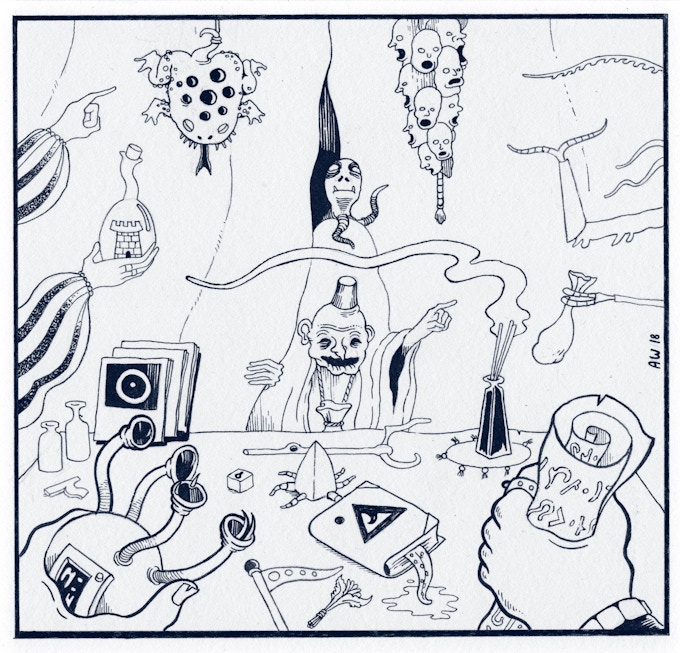
Troika! art by Andrew Walter
I recently ran a session of Troika! by Daniel Sell (order it here) for the first time. Having read it over a several times, made my own notes/cheat sheets, and even written some material for the game as well as having run it, I feel like I can make some comments on the system's core architecture. It's not a deep system, or I wouldn't even attempt this kind of statement after only one outing at the table!
That's the "what" of this article. The "why" is because Troika! is very "hackable" and I see people out there writing material for it, mainly new backgrounds or creatures, with almost no understanding of the system. By that I mean, they are writing things in such a way that it runs counter to the spirit of the system, is not intuitive within the context of the system, and ultimately may be destructive to the play environment of the game.
Here are the core tenets as I see them, in no particular order, each concluding with a statement about how they should affect your design-brain.
Based on 2d6
Perhaps it would be more accurate to say the game uses only d6s to accomplish all of its goals. Most player actions are resolved with a roll of 2d6, usually under a skill or versus an opposing roll. In addition to that, all randomness in the game is based on simple six-sided dice. Creature reactions (miens), for instance, are expressed in a d6 table. And one rolls for a background using d66 (two d6s rolled in the manner one rolls two d10s to get d100, which is to say one die for tens and one for the singles).
Rolling 2d6 gives you a curve whereas rolling d66 (or d6, or even d36) generates an even distribution. But since rolls other than 2d6 are used exclusively for random table stuff, not task or combat resolution, I think we can safely say that the success of actions in the game are more predictable than in a flat d20 style curve. (It's easier to figure your "odds" in a d20 universe as every 'pip' represents a 5% swing, but it's easier to predict success or failure when a curve is in play, since results of 6-8 occur 44.5% of the time.) That's aside from the main point I want to make, however, which is...
Don't create material for Troika! that uses dice other than d6s.
Backgrounds over Setting
Troika! builds an implied setting using the 36 (d66) backgrounds included in the core book. We know there are "golden barges" that carry passengers between the "crystal spheres" primarily because there are references to them (barges) in the backgrounds for Cacogens, Lansquenets, and Thinking Engines. We encounter spell magic first in the Befouler of Ponds background, and in several dozen other backgrounds as well, before we get to the mechanics of spellcasting or the spell descriptions. Creatures, items, and spells are other places where one can create setting, but they are usually foreshadowed in backgrounds. (Gremlins are foreshadowed by the Gremlin Catcher, demons by the Demon Stalker, and guns by the Cacogen, Lansquenet, etc.) Consider that the Chaos Champion has in his possessions list ritual scars and a nearly full dream journal! Those add ideas as to what a Chaos Champion is (how he lives, thinks, acts).
There are no text-heavy passages of pure setting and every item that might be categorized as setting has direct rules implications. While a spell listing may or may not contain stats, it is something that directly affects the fictional world when brought into play. There are no instances that run contrary to the "Chekhov's Gun" principle. If a thing is represented, it is intended for use; there are no purely ornamental set decorations, which is a shock given how baroque Troika! feels.
Utilize backgrounds to build the world; don't write pages of setting lore.
[Edit: I think adding setting through d66 tables is within bounds as well.]
Skill Specificity
Some have described the skill system in Troika! as a mess. I don't believe that is the case. It is true that there is no exhaustive taxonomy of skills, as one sees in most traditional RPGs – any that feature skills at least. And the book encourages you to make up new skills as needed. However, in reviewing the skills you see a consistent level of specificity. There is no catch-all "fighting" skill, only skills like "hammer fighting," "wrestling," or "fist fighting."
One can assume a character that has advanced skill in fighting with fusils, would not be especially trained in bows, even though both are missile weapons. Hence the need for a default skill stat, which represents a kind of natural dexterity or deftness of mind, and advanced skills to represent training. Writing a new skill that is too broad; e.g. weapons or logic, erodes backgrounds (by trumping a more specific skill) and makes the game more boring (applies to too many situations).
Be mindful when you write skills! Make them sufficiently narrow/situational.
Interaction Over Combat
Only three spells specify damage and many backgrounds lack an advanced skill in any form of fighting. 'Nuff said? If players want to fight, they will. The Assassin's Dagger spell can be used to send a poisoned blade after a target, but it can also be used to send a message scroll. Troika! is heavily focused on exploration and imagination, partly because it leaves so much white space that players can/must fill with their own inventions and partly because what is provided is often already weird.
Whenever possible, create material that is flexible – without a narrow focus on combat.
Summary
Troika! is a different animal. You get that from the minute you pick up the book. While feeling very ornate with it's bizarre art, high-end production values, and exotic "classes," the underlying core is a lean, mean machine. And the two, exotic flavor and simple mechanics, are married like two sides of a coin. You can't write new mechanics without writing new flavor and vice versa. So be mindful when you create and hew closely to the established patterns unless/until you have a deep enough understanding of the game to break those patterns for a purpose.
Troika! art by Andrew Walter
I recently ran a session of Troika! by Daniel Sell (order it here) for the first time. Having read it over a several times, made my own notes/cheat sheets, and even written some material for the game as well as having run it, I feel like I can make some comments on the system's core architecture. It's not a deep system, or I wouldn't even attempt this kind of statement after only one outing at the table!
That's the "what" of this article. The "why" is because Troika! is very "hackable" and I see people out there writing material for it, mainly new backgrounds or creatures, with almost no understanding of the system. By that I mean, they are writing things in such a way that it runs counter to the spirit of the system, is not intuitive within the context of the system, and ultimately may be destructive to the play environment of the game.
Here are the core tenets as I see them, in no particular order, each concluding with a statement about how they should affect your design-brain.
Based on 2d6
Perhaps it would be more accurate to say the game uses only d6s to accomplish all of its goals. Most player actions are resolved with a roll of 2d6, usually under a skill or versus an opposing roll. In addition to that, all randomness in the game is based on simple six-sided dice. Creature reactions (miens), for instance, are expressed in a d6 table. And one rolls for a background using d66 (two d6s rolled in the manner one rolls two d10s to get d100, which is to say one die for tens and one for the singles).
Rolling 2d6 gives you a curve whereas rolling d66 (or d6, or even d36) generates an even distribution. But since rolls other than 2d6 are used exclusively for random table stuff, not task or combat resolution, I think we can safely say that the success of actions in the game are more predictable than in a flat d20 style curve. (It's easier to figure your "odds" in a d20 universe as every 'pip' represents a 5% swing, but it's easier to predict success or failure when a curve is in play, since results of 6-8 occur 44.5% of the time.) That's aside from the main point I want to make, however, which is...
Don't create material for Troika! that uses dice other than d6s.
Backgrounds over Setting
Troika! builds an implied setting using the 36 (d66) backgrounds included in the core book. We know there are "golden barges" that carry passengers between the "crystal spheres" primarily because there are references to them (barges) in the backgrounds for Cacogens, Lansquenets, and Thinking Engines. We encounter spell magic first in the Befouler of Ponds background, and in several dozen other backgrounds as well, before we get to the mechanics of spellcasting or the spell descriptions. Creatures, items, and spells are other places where one can create setting, but they are usually foreshadowed in backgrounds. (Gremlins are foreshadowed by the Gremlin Catcher, demons by the Demon Stalker, and guns by the Cacogen, Lansquenet, etc.) Consider that the Chaos Champion has in his possessions list ritual scars and a nearly full dream journal! Those add ideas as to what a Chaos Champion is (how he lives, thinks, acts).
There are no text-heavy passages of pure setting and every item that might be categorized as setting has direct rules implications. While a spell listing may or may not contain stats, it is something that directly affects the fictional world when brought into play. There are no instances that run contrary to the "Chekhov's Gun" principle. If a thing is represented, it is intended for use; there are no purely ornamental set decorations, which is a shock given how baroque Troika! feels.
Utilize backgrounds to build the world; don't write pages of setting lore.
[Edit: I think adding setting through d66 tables is within bounds as well.]
Skill Specificity
Some have described the skill system in Troika! as a mess. I don't believe that is the case. It is true that there is no exhaustive taxonomy of skills, as one sees in most traditional RPGs – any that feature skills at least. And the book encourages you to make up new skills as needed. However, in reviewing the skills you see a consistent level of specificity. There is no catch-all "fighting" skill, only skills like "hammer fighting," "wrestling," or "fist fighting."
One can assume a character that has advanced skill in fighting with fusils, would not be especially trained in bows, even though both are missile weapons. Hence the need for a default skill stat, which represents a kind of natural dexterity or deftness of mind, and advanced skills to represent training. Writing a new skill that is too broad; e.g. weapons or logic, erodes backgrounds (by trumping a more specific skill) and makes the game more boring (applies to too many situations).
Be mindful when you write skills! Make them sufficiently narrow/situational.
Interaction Over Combat
Only three spells specify damage and many backgrounds lack an advanced skill in any form of fighting. 'Nuff said? If players want to fight, they will. The Assassin's Dagger spell can be used to send a poisoned blade after a target, but it can also be used to send a message scroll. Troika! is heavily focused on exploration and imagination, partly because it leaves so much white space that players can/must fill with their own inventions and partly because what is provided is often already weird.
Whenever possible, create material that is flexible – without a narrow focus on combat.
Summary
Troika! is a different animal. You get that from the minute you pick up the book. While feeling very ornate with it's bizarre art, high-end production values, and exotic "classes," the underlying core is a lean, mean machine. And the two, exotic flavor and simple mechanics, are married like two sides of a coin. You can't write new mechanics without writing new flavor and vice versa. So be mindful when you create and hew closely to the established patterns unless/until you have a deep enough understanding of the game to break those patterns for a purpose.
Categories: Tabletop Gaming Blogs