Your wildly multifarious home!
Tabletop Gaming Feeds
Chess is not about the rules (D&D isn't either) (new substack post)
Already five posts published and there's a shitload of Notes out as well. Just to give you guys an impression what's going on over there. Already more engagement then I have here or on X. All good and positive, so make sure to join the party. My latest post is about what rules are and what the must do in order to work properly. A lot of it is explained via chess, but I'm eventually making my way to D&D and role-playing games in general.
Here's the first paragraph:
Rules are a prerequisite to play. But it is not so much about using the rules to play, it is about playing the game within the restrictions the rules are offering. That is such a key difference that not seeing it will lead to wrong design choices when writing your own rules. Or, a more subtle point, you’ll put the wrong focus when explaining how your game works. This very much applies to role-playing games, but let me explain it using chess first, as it makes the better point without trying too hard.
That's four essays linked here in April, including my introduction over there (three proper, then). There's another meaty one for those with at least a free subscription for the Substack. I'll try to have one for paying members up soon, too (they don't exist yet, but will eventually and they will have something to discover).
Among my next essays will be stuff about looting (bad) movies for their content and one with setting up a sandbox for ORWELL, hopefully with some play-reports building on that (it has to come together on the play side, but I'm working on it).
The Substack will focus a lot on my publishing endeavors, but that usually brings up a lot of adjacent topics and the lively community over there will do its own inspiring.
First time in a long time that blogging brings me joy again.
Categories: Tabletop Gaming Blogs
Wednesday Comics: DC, August/July 1985 (week 1)
My mission: to read DC Comics' output from January 1980 (cover date) to the end of Crisis. This week, I'm looking at the comics that were on stands in the week of May 2, 1985.
Sword of Atom Special #2: This issue actually has a July cover date, but there is some discrepancy in the sources regarding when it came out. Anyway, Strnad and Kane are back with another Lost World/Sword & Planet-ish tale. A bird-riding group of raiders called Skul-Riders attack New Morlaidh and kidnap women, including Laethwen. At around the same time, Paul Hoben and Norman Brawler have arrived with an accidentally shrunk Jean, intending to find Atom and get his help to restore her, but she too is kidnapped by the raiders. Atom, Voss, and Paul join forces to track the riders to their city where it turns out a dictator using mind control technology is responsible for the raids as he seeks breeding stock to bolster his cities ranks to realize his dreams of conquest. When his people are freed from control, they kill the tyrant themselves, and our heroes return home. Atom gives Jean and Paul the shrinking belt as he can't use it anymore.
Atom will appear in several issues of Crisis but that's it until 1988.
DC Comics Presents #83: Rozakis is the writer on this team-up of Superman and the Challengers of the Unknown. The artists are a bit of a puzzle: We have both Kirby and Toth, both with inks by Theakston. Toth's work only appears over a couple of pages in a flashback sequence. It seems weird to engage two such celebrated artists in this way, which makes me think the issue as we got it was a "plan B." Anyway, this is Kirby's last major work for DC, though his last actual work (a cover) won't come until after Crisis.
Zo-Mar, a Kryptonian criminal from the pre-Phantom Zone days, escapes from a prison space capsule and infiltrates the Earth with a mystic card that gives him the power of mind control--including those of Superman and the Challengers of the Unknown. It also (handily) keeps him from developing Kryptonian super-powers. Our heroes manage to get the card from him, but then he gains powers! They ultimately use a trick to defeat him and destroy the card. Zo-Mar is sent to the Phantom Zone.
Shadow War of Hawkman #4: The limited series comes to a close just as it seems it was getting started, but Isabella makes it clear at the end that this was merely the first battle in a potentially longer war. We open with several examples of the Absorbacon being used to still secrets from humans, and thus economic and political spoils. The Shadow War is to be an infiltration and covert coup rather than a fledged-fledged invasion. The Hawks are still in the fight, though. They sneak back onto their own ship, defeat the Thanagarian agents, then destroy the ship so it can't be taken again. They track down the Absorbacon, but fate takes a hand as Rab Mekir, enslaved to the machine, takes his revenge on Fell Andar, leading to his own death. This vanguard defeated, Katar and Shayera can return to their secret IDs and cover lives, but we see there are still Thanagarian deep cover agents on Earth.
Wonder Woman #326: This one has a July cover date, too, though likely released in May. Newell takes over as writer with Heck still on art, and we're back to the stuff that was going in back in issue 316. Wonder Woman follows Keith Griggs and Lauren Haley back to the Central American nation of Tropidor and again encounters the Aztec god Tezcatlipoca. Also, Etta is really angry with Diana for some reason.
V #6: This is another issue with a July cover date. Bates and Infantino/DeZuniga wrap up the whole Meagan arc. The rebellion rescues Meagan, ironically to keep him from blowing up the alien mothership as they fear the severity of reprisals, and they are helped by a scheming faction of Visitor leadership looking to undercut Diana. Unfortunately, Meagan's head-bomb starts to malfunction, so he takes a ship and heads back toward the Mothership on his own. He explodes before he gets there, though, taking out some Visitor fighters and thwarting Diana's plans to recapture him. She remains unaware of the bomb throughout the whole incident.
On Earth, the Visitor experimentation facility is taken out, and Ham and friends force the lead scientists to inject themselves with their own mutagen.

Sword of Atom Special #2: This issue actually has a July cover date, but there is some discrepancy in the sources regarding when it came out. Anyway, Strnad and Kane are back with another Lost World/Sword & Planet-ish tale. A bird-riding group of raiders called Skul-Riders attack New Morlaidh and kidnap women, including Laethwen. At around the same time, Paul Hoben and Norman Brawler have arrived with an accidentally shrunk Jean, intending to find Atom and get his help to restore her, but she too is kidnapped by the raiders. Atom, Voss, and Paul join forces to track the riders to their city where it turns out a dictator using mind control technology is responsible for the raids as he seeks breeding stock to bolster his cities ranks to realize his dreams of conquest. When his people are freed from control, they kill the tyrant themselves, and our heroes return home. Atom gives Jean and Paul the shrinking belt as he can't use it anymore.
Atom will appear in several issues of Crisis but that's it until 1988.

DC Comics Presents #83: Rozakis is the writer on this team-up of Superman and the Challengers of the Unknown. The artists are a bit of a puzzle: We have both Kirby and Toth, both with inks by Theakston. Toth's work only appears over a couple of pages in a flashback sequence. It seems weird to engage two such celebrated artists in this way, which makes me think the issue as we got it was a "plan B." Anyway, this is Kirby's last major work for DC, though his last actual work (a cover) won't come until after Crisis.
Zo-Mar, a Kryptonian criminal from the pre-Phantom Zone days, escapes from a prison space capsule and infiltrates the Earth with a mystic card that gives him the power of mind control--including those of Superman and the Challengers of the Unknown. It also (handily) keeps him from developing Kryptonian super-powers. Our heroes manage to get the card from him, but then he gains powers! They ultimately use a trick to defeat him and destroy the card. Zo-Mar is sent to the Phantom Zone.

Shadow War of Hawkman #4: The limited series comes to a close just as it seems it was getting started, but Isabella makes it clear at the end that this was merely the first battle in a potentially longer war. We open with several examples of the Absorbacon being used to still secrets from humans, and thus economic and political spoils. The Shadow War is to be an infiltration and covert coup rather than a fledged-fledged invasion. The Hawks are still in the fight, though. They sneak back onto their own ship, defeat the Thanagarian agents, then destroy the ship so it can't be taken again. They track down the Absorbacon, but fate takes a hand as Rab Mekir, enslaved to the machine, takes his revenge on Fell Andar, leading to his own death. This vanguard defeated, Katar and Shayera can return to their secret IDs and cover lives, but we see there are still Thanagarian deep cover agents on Earth.

Wonder Woman #326: This one has a July cover date, too, though likely released in May. Newell takes over as writer with Heck still on art, and we're back to the stuff that was going in back in issue 316. Wonder Woman follows Keith Griggs and Lauren Haley back to the Central American nation of Tropidor and again encounters the Aztec god Tezcatlipoca. Also, Etta is really angry with Diana for some reason.

V #6: This is another issue with a July cover date. Bates and Infantino/DeZuniga wrap up the whole Meagan arc. The rebellion rescues Meagan, ironically to keep him from blowing up the alien mothership as they fear the severity of reprisals, and they are helped by a scheming faction of Visitor leadership looking to undercut Diana. Unfortunately, Meagan's head-bomb starts to malfunction, so he takes a ship and heads back toward the Mothership on his own. He explodes before he gets there, though, taking out some Visitor fighters and thwarting Diana's plans to recapture him. She remains unaware of the bomb throughout the whole incident.
On Earth, the Visitor experimentation facility is taken out, and Ham and friends force the lead scientists to inject themselves with their own mutagen.
Categories: Comic Book Blogs, Tabletop Gaming Blogs
Uprising on Antares-9
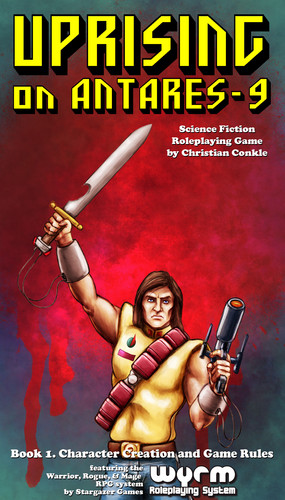
Back in 2010 (wow, has it been 16 years already?) I released a little game called Warrior, Rogue & Mage. It had some modest success and quite a few people have high regards for it because it’s simple, easily hacked and dirt cheap since it’s free. I also released the rules portion under a Creative Commons Attribution license so everyone can create new games using these rules as long as they give credit.
One of the games created using these rules is Christian Conkle’s Uprising on Antares-9. It’s a roleplaying game based on a TSR Sci-Fi minigame called Revolt from Antares designed by Tom Moldvay. I have to admit that I never even heard about this minigame before Christian told me about his project. The game consists of six small booklets available for free on itch.io but you can also order physical copies from Lulu. You’ll find all further information on the game’s itch.io page.
The whole project started as a thread on the rpg.net forums back in 2021 when Christian asked for help finding a system suited for a Revolt on Antares RPG. The thread is still active and if you enjoy Uprising on Antares I recommend you go there and post about it.
If you are either a WR&M fan looking for more stuff to play with or someone who has fond memories of Revolt from Antares you should definitely check out Christian Conkle’s game.
Categories: Tabletop Gaming Blogs
New OSR Monster - The Devil Monkey For Burrows & Borderslands Rpg
In the world of Burrows & Borderlands, the Devil Monkey isn't just a myth—it’s the primate nightmare of the northern woods. While most beasts in the Kingdom are relatable mammals, the Devil Monkey represents an ancient, uncanny lineage that feels "wrong" to the average adventurer. The Devil MonkeyThe Shadow in the CanopyThe Devil Monkey is a lean, powerful simian roughly the Needleshttp://www.blogger.com/profile/11243274667834930867noreply@blogger.com0
Categories: Tabletop Gaming Blogs
OSR Commentary & Deep Dive Into the Castles & Crusades Adventurers Armory For Castles & Crusades rpg System
The Adventurers Armory is a staple supplement for the Castles & Crusades RPG, designed to expand the horizon of equipment, weaponry, and specialized gear beyond the standard listings in the Players Handbook. It serves as a comprehensive catalog for players looking to customize their characters and for Castle Keepers (CKs) aiming to add flavor to their world's economy.### Core Contents &Needleshttp://www.blogger.com/profile/11243274667834930867noreply@blogger.com0
Categories: Tabletop Gaming Blogs
Moldvay Basic finally available in Print on Demand

Great news: The "B" of "B/X", the rulebook of the 1981 D&D Basic Set, commonly known as the Moldvay Basic, is finally available in print-on-demand (POD) from DrivethruRPG, 13 years after it originally appeared in PDF, and three years after its partner "X" (the Expert Set rulebook) POD was released.
Find it here:
Moldvay Basic rulebook on DrivethruRPG
(all links to DrivethruRPG include my affiliate number)
The B/X ruleset has become extremely popular in recent years as the source of rules for the Old School Essentials retroclone, but now you can get an official reprint of the original.
While this site is primarily devoted to the Holmes Basic set, I am also a big fan of the Moldvay Basic rulebook, which took Holmes' pioneering work as a base and developed it further. And I love the Sample Dungeon, The Haunted Keep, which I've written about here.

The module that was included in the Moldvay Basic Set, the 1981 revision of Gary Gygax's B2 The Keep on the Borderlands, is already available in POD, so together these products constitute the printed contents of the 1981 Basic Set (no dice and crayon, of course).
Find it here:
B2 The Keep on the Borderlands on DrivethruRPG
While this is great news for availability of this particular rule set, the Holmes Basic rulebook frustratingly remains completely unavailable, either in PDF or print, for unknown reasons. The newly available Moldvay Basic POD means that they are still releasing/updating the available products, so this does give a bit of hope. Perhaps they are saving it for the 100th anniversary in 2077?
See also these previous posts on the Zenopus Archives related to Moldvay Basic:
Original Known World Campaign Documents (2022)
Chronology of D&D Sample Dungeons: The Haunted Keep by Tom Moldvay (1981) (2020)
M1 Blizzard Pass: Dungeon Design (2020)
Zargon Beckons (2015)
Ur-Known World (2015)
Expert Set rulebook: PDF notes (2013)
Categories: Tabletop Gaming Blogs
The Herculoids & Crew NPC Adapted To Sword of Cepheus 2nd Edition Rpg
Adapting the classic 1967 Hanna-Barbera series The Herculoids into the Sword of Cepheus (2nd Edition) system requires a blend of high-fantasy tropes and "lost world" science fiction. This blog entry picks right up from Thundarr the Barbarian & Crew NPC Adapted To Sword of Cepheus 2nd Edition RpgIn this setting, the Herculoids function as powerful, sentient "Monstrous Allies" or Needleshttp://www.blogger.com/profile/11243274667834930867noreply@blogger.com0
Categories: Tabletop Gaming Blogs
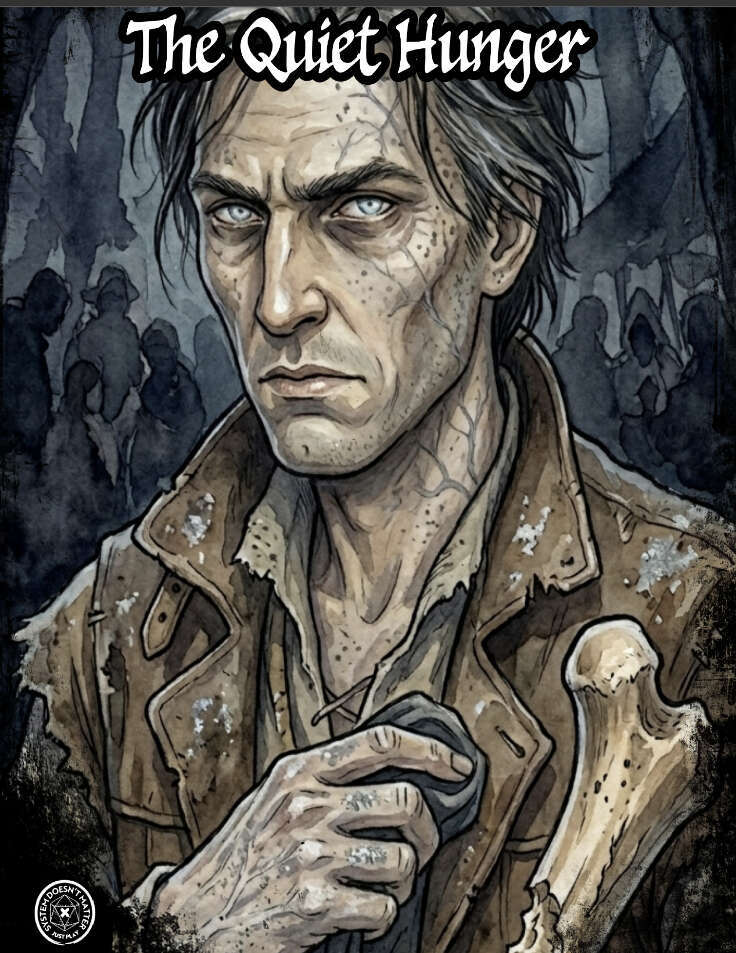
The Quiet Hunger
By Craig Turner
Aspire2Hope
Generic/Universal
Levels: Ghouls as an ememy
Aspire2Hope
Generic/Universal
Levels: Ghouls as an ememy
In Faynford at the Staple, tension simmers beneath the smell of hearth smoke and fresh bread. Old fears stir as food grows scarce, livestock go missing, and whispers spread—of sickness, of shadows, of the dead no longer resting easy. Beyond the river bends and chalk downs, the Hundred is holding its breath. The boundaries between custom and survival, welcome and warning, are wearing thin. Something hungers in the dark, and the quiet strength of this land may not be enough to hold it back. Your road has led here. Whether by duty, kinship, or necessity, you have arrived on the edge of a story that will not wait. Will you uncover the truth before Faynford at the Staple falls to fear—and to what walks in its shadow?
This twenty page horror-ish adventure describes a bucolic village, and the refugee situation that is unfolding as they absorb villages who have been displaced by war. It is quite long-winded and verbose for what is essentially an outline of an adventure. The outline part is ok, but the long-windedness results in confusion of the overall situation. Too much time on vibes and not enough time on specifics.
I’m a sucker for Harn-like settings for adventures. Call something A Hundred and I’m drooling, for some reason. I guess it was 100 Bushels of Rye. Whatever. We’re here today because of that. And, then, we mix in, from the marketing blurb, what appears to be a horror element. I think horror translates well because of the emphasis on situations that it fosters. I can restart a monster, but the vibes and plot and horror elements are for the designer. I love my classic exploratory dungeons, but the journey to and from the dungeon, and shit going on in town, has always been a part of D&D and these little situations are great for dropping in to spice up the “downtime.”
So, we got this village. Humans, halflings. The halflings were refugees about fifty years ago and have settled in. More war has caused an influx of new refugees. The locals kind of recognize kinship to them, accents, mannerisms, far less alien than the halflings were. Then a lamb goes missing. And a couple of people die from a new disease, ashskin. Things are tense. The local sheriff wants to relocate the refugees a little farther down the valley. This is the pretext for the adventure. It turns out that a local seedy patriarch is an agent for a foreign power and ashskin? That’s people turning in to ghouls. Did you recognize it by the name ashskin? I didn’t at first. And I love that kind of shit .Where you describe something to peoples faces and they don’t get it. They drop some gnawed bones and bodies here and there, and once you get to the graveyard and find out the graves were dug out from the INSIDE, well, the undead is up, so to speak.
The adventure wants to outline a situation. It’s trying to present a map with various locations on it and then explaining what is going on at those locales. It provides some NPC overviews with mannerisms and goals, for the DM to drop in to the game and use as the party comes across them or seeks them out. It flirts with doing the right thing. And then it fucks everything up.
The NPC descriptions fit, maybe, two to three to a column. There’s a bullet for Appearance, Personality, Goal/Motivation, Quick, Disposition, and What they know. Maybe somewhere from three words to a dozen or so, and then the person ends with a little quote. This is all too much. It’s on the right track, a quick, a goal, what they know, but then it muddies it up with too much information that one needs to dig through. And this is going to be a theme here.
The locales, a half dozen or so, stretch on for a column or page, and then have their NPC’s, in the same format as above. It starts with a setting prompt, in bullet form: Light, Sights, Sounds, Smells. This is too much. Shortening this to a sentence or two, including all of them in it, to give a little vibe would have been better. There’s a brief couple of paragraph description of the locations “the fields are well tended, it’s maintained through diligence.” Again, too much. The diligence comment it meta, and the whole location description is hard to sort through, I suspect, during play. Terse. Hit. Get out. We want a quick vibe if its not super-important to the location to have details. Then we have a section called Plot. I’m looking at seven paragraphs, one or two just a sentence, like “Corwin is dead” or “Pip knows what that means, even if he struggles to say it properly.” The plot section, what is happening, the meat of the location, what the party can find out and do and so on, is all muddled by this. This is NOT the time to get flowery with your language and clever with your descriptions. And yet it does, over and over again. This is a nightmare to dig through. This would have been the PERFECT time for all of those bullets.
The overall plot, what leads to what and who’s doing what, is confused because of all of this. Cognitively it’s a problem. After a couple of times through this I’m still not sure I can explain the hows and wherefore and whats connected. I THINK
The elements it wants to emphasize, the contention between the refugees, the more established refugees from fifty years ago and so on, these are not well handled at all. There’s little to bring these to life. The tension that should be going on isn’t added to by specifics. We’re not looking for everything spelled out and scripted, but vignettes, specificity, to drop in to make that tension come alive. Even the spying, it’s not really brought home.
This was a good idea. Blaming The Others should be relatable to the players. The mixing in of the ghouls and people turning. Great potential there. But this would need a lot of effort to bring to the table. It knows to outline a situation, and it knows the major elements to hit, it just fails in doing that in a way that can be run or in bringing it truly to life.
This is $4 at DriveThru. The preview is four pages, not quite enough to get a good vibe check on it. Only the last page really gives you an idea of what to start to expect in terms of writing and presentation.
https://www.drivethrurpg.com/en/product/562279/the-quiet-hunger?1892600
Categories: Tabletop Gaming Blogs
Using Original Dungeons & Dragons rpg with The Barrows & Borderlands Rpg
Barrows & Borderlands (B&B) is a "Weird Science Fantasy" tabletop RPG designed specifically to bridge the gap between the Original 1974 Dungeons & Dragons (OD&D) and 1st Edition Advanced Dungeons & Dragons (AD&D).While it is heavily inspired by the "Little Brown Books" of the 70s, it isn't a mere clone; it's a "Needleshttp://www.blogger.com/profile/11243274667834930867noreply@blogger.com0
Categories: Tabletop Gaming Blogs
Adapting Fel As an NPC From Campfire Cooking in Another World with My Absurd Skill For The Primal Order Rpg
Bringing Fel (Fenrir) from Campfire Cooking in Another World with My Absurd Skill into The Primal Order (TPO) requires translating his overwhelming "cheat-level" power into the language of Primal Base, Divine Rank, and Essence. This entry picks up from OSR Commentary - Can Castles & Crusades rpg be played with The Primal Order Rpg?!In TPO terms, Fel isn't just a high-level monster;Needleshttp://www.blogger.com/profile/11243274667834930867noreply@blogger.com0
Categories: Tabletop Gaming Blogs
In Alignment

Mostly discussions about alignment (probably since time immemorial) seem to circle around 3 opens about it: it is just a suggestion for roleplay; it represents cosmic teams of some sort and isn't about character morality; and most commonly its bad and we just ignore it.
Gareth Hanrahan's The Gutter Prayer suggests to me an interesting tweak to idea 2, one I haven't seen before. I mention previously the saints in that world who were empowered by the gods not due to faith or ideals, but rather due to be somehow psychic compatible with the deity, making passing divine power through them possible. You might say the saints are in alignment with the deity.
So, what if alignment was a bit like that? It does present being on a cosmic team but not a team the character chose, a team that they were born into. This connection would allow the character to speak alignment language and to be recognized as "marked" by that team, perhaps. Characters are free to behave whatever way they want, but they can't (or at least can't easily change) this affinity any more than they could change their bloodtype. It should probably be randomly generated or determined by class, I suppose.
For most characters, a lack of affinity with the ethics of the deity wouldn't be an issue under most circumstances, though for people like clerics and paladins who get more out of the connection, it would matter.
The metaphysical implications for a setting with this would be really interesting, I think. There are a lot of ways it could be operationalized.
Categories: Comic Book Blogs, Tabletop Gaming Blogs
40 Years a Gamer: The Artists Who Inspired Me – The Four Horsemen of TSR
In my early years as a gamer, four artists truly defined my conception of D&D and tabletop fantasy art: Larry Elmore, Jeff Easley, Clyde Caldwell, and Keith Parkinson.
I first recall them being referred to as the “Four Horsemen” in the excellent 2019 documentary Eye of the Beholder. Since I’ve been writing so much lately about the artists who inspire my games, I recently sat down to rewatch it. You can find where to stream it from the official website here. If you’re curious, here is the trailer:
But back to the artists. Elmore, Easley, Caldwell, and Parkinson completely defined D&D for me as a teenage gamer. Little by little, I discovered the early artists who originally shaped the game (and they’ll get their own post!), but when I first started playing, these four were the absolute pillars of fantasy TTRPG art. You probably know them, so I won’t recount their entire careers—others have covered them far more thoroughly than I ever could. Instead, I want to focus on how they left an impression on me and inspired my campaigns.
Larry Elmore
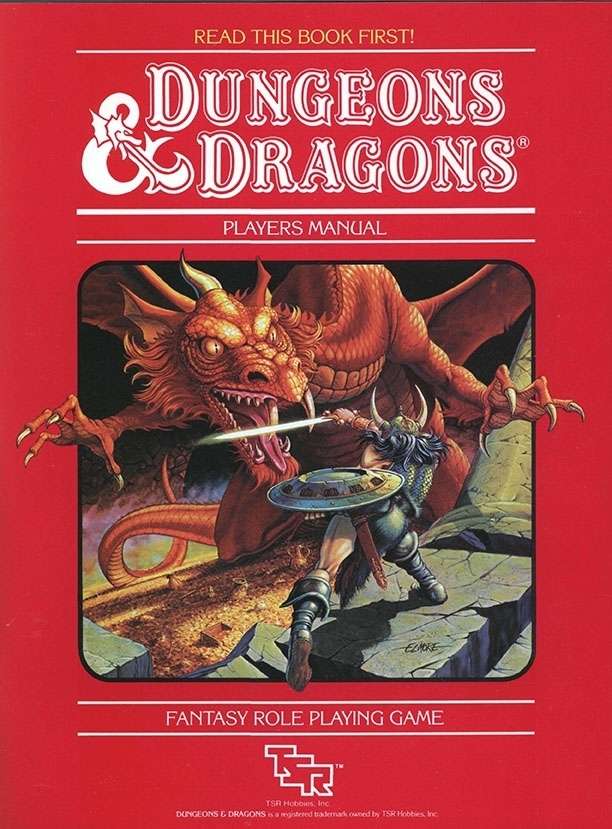
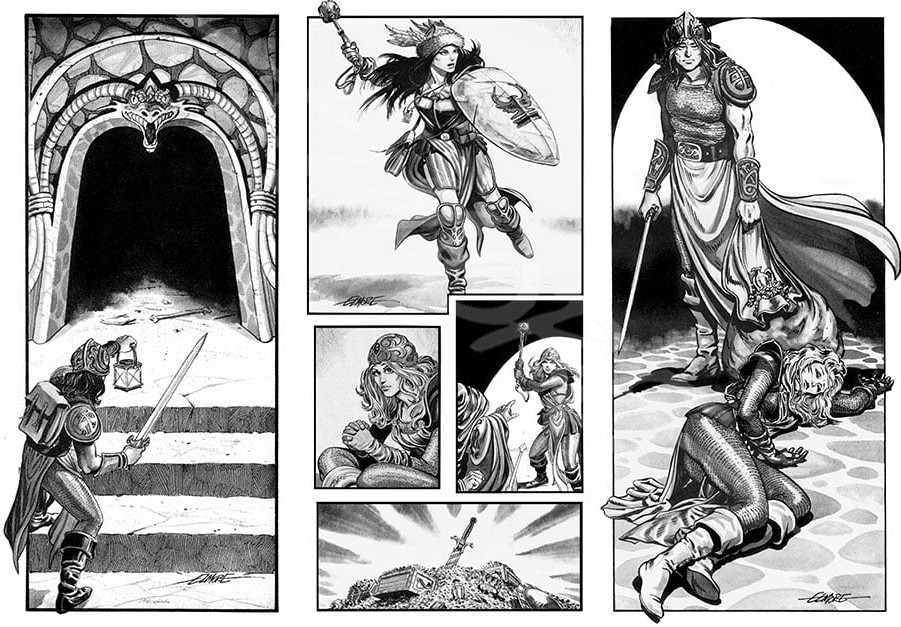
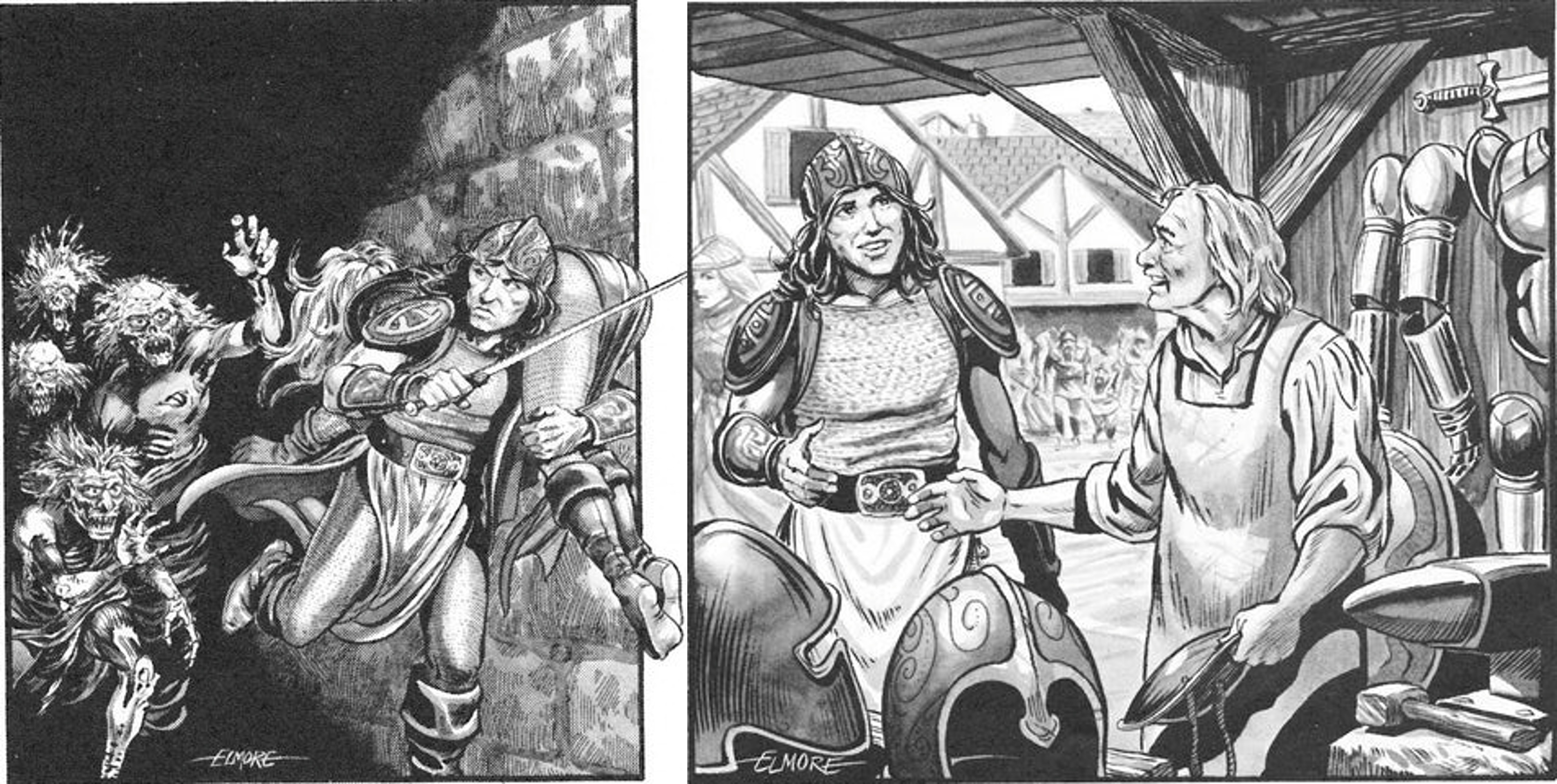
For a long time, Elmore was my absolute favorite fantasy artist! He drew the cover for the very first TTRPG book I ever bought. That archetypal red dragon of the Mentzer Red Box (and yes, it only has one horn, look closely at the art!) beckoned me into gaming. But his influence went far beyond the cover. He drew most of the art in the Players Manual inside that box, accompanied by some amazing standouts by Easley. The images of the adventurer entering the dungeon in the solo tutorial, the illustration of Aleena, Bargle attacking her, and the adventurer acquiring equipment—these visuals were fundamentally tied to learning the game, and they remain with me to this day.
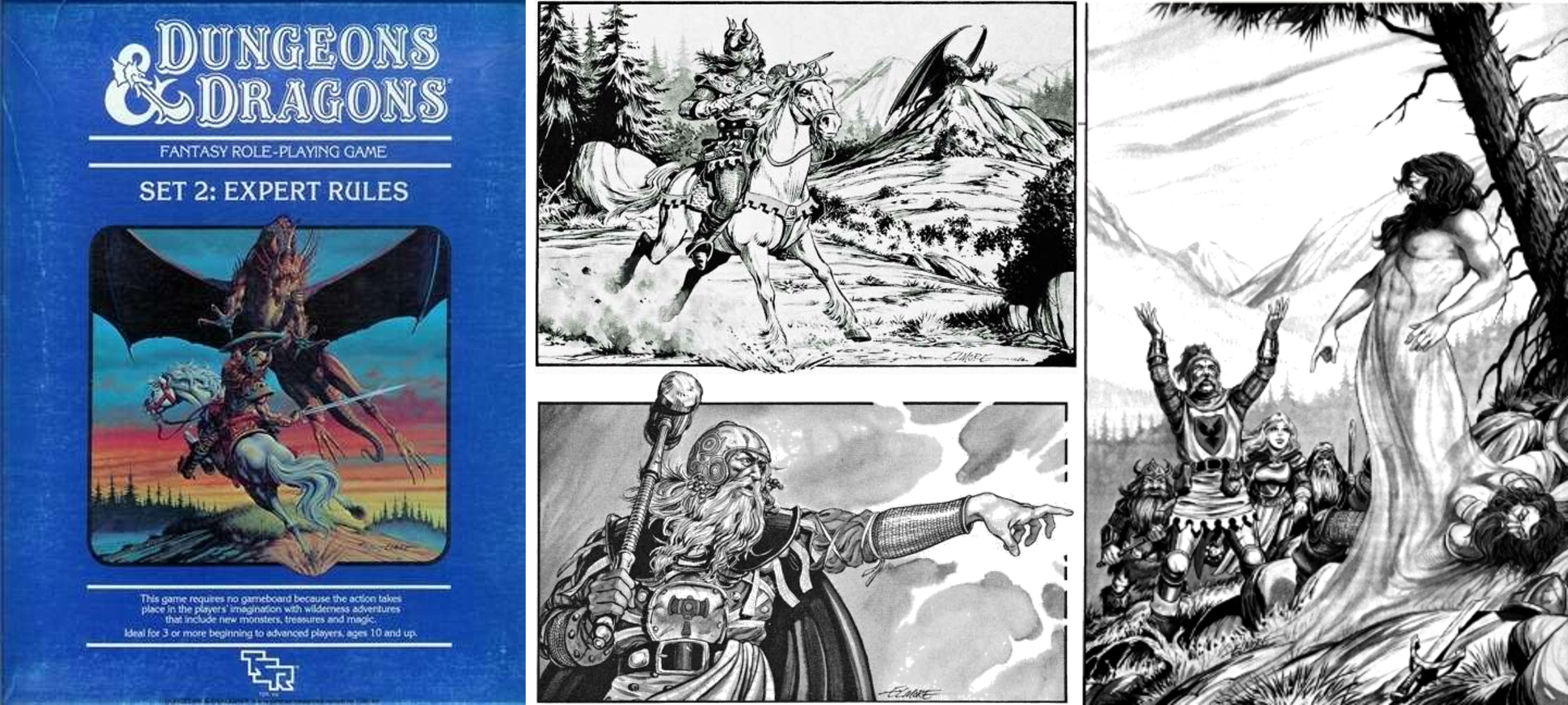
His art also graced the Expert set cover and most of the interior illustrations. I particularly love the one-page illustration of the duel.
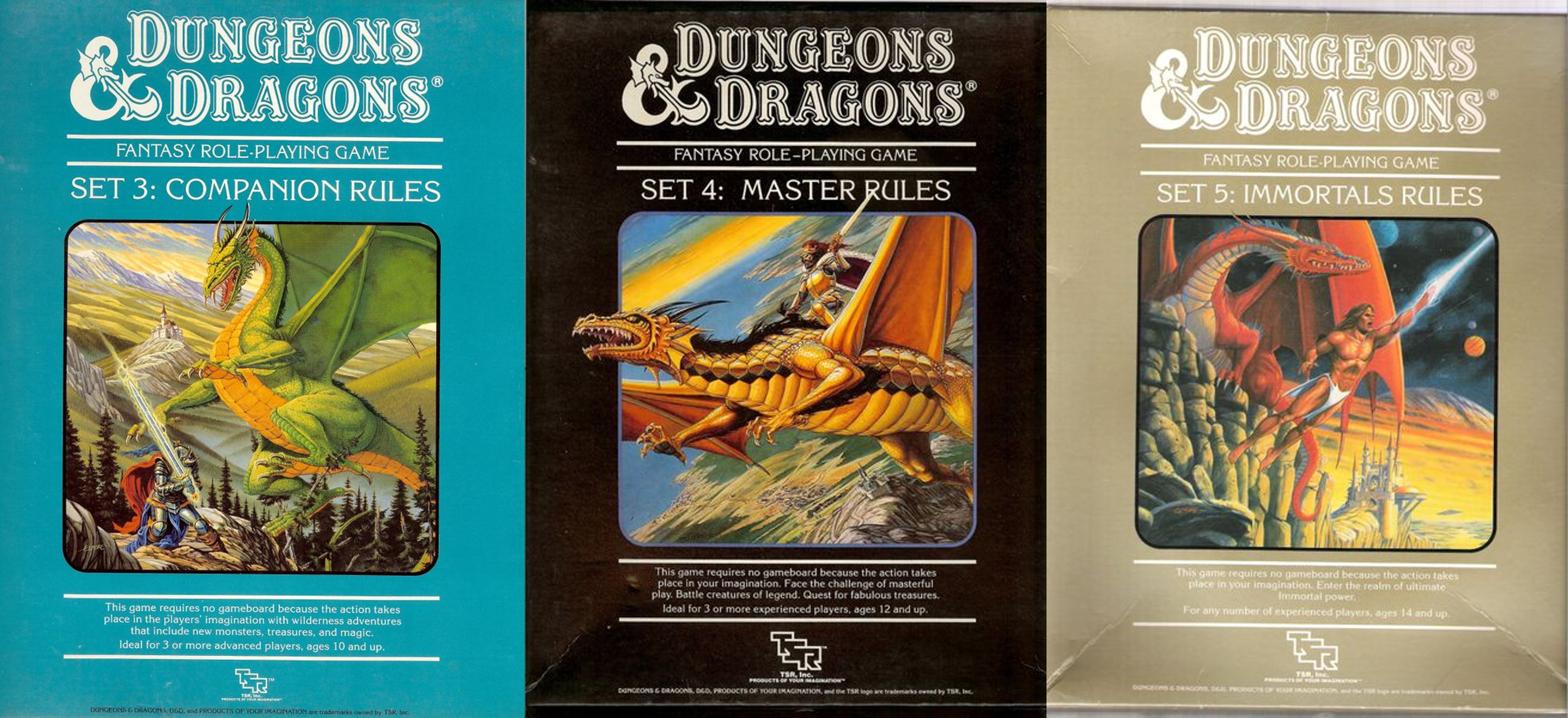
He went on to do the covers for the Companion, Master, and Immortal sets, and I vividly remember the weapons illustrations in the Companion rulebook.
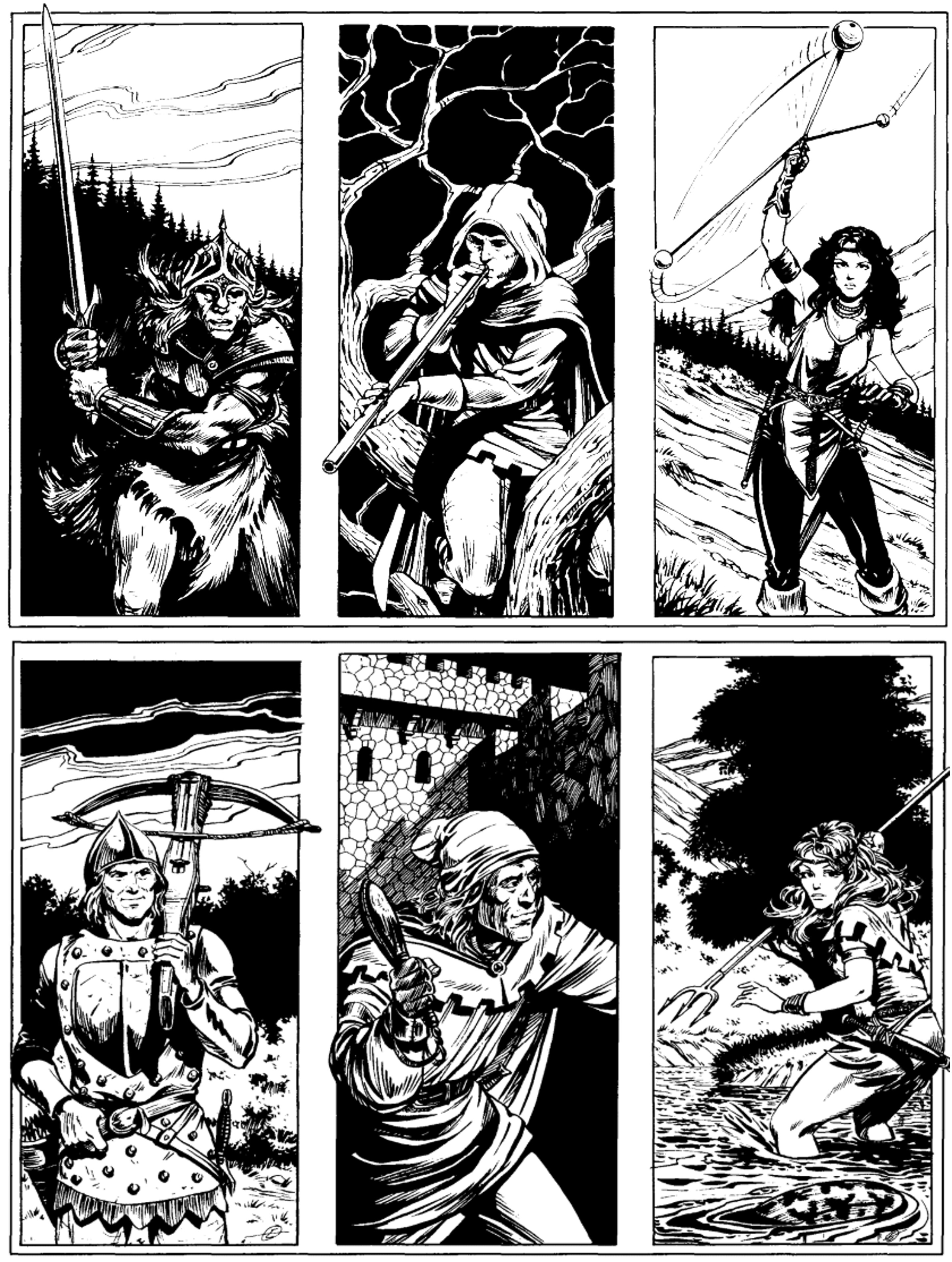
Whenever I saw Elmore’s art, I was entranced. His covers for the Dragonlance Chronicles and the Star Frontiers boxed set were undeniably a huge part of why I purchased those products. His aesthetics and clean lines defined civilization in D&D for me. When I thought of the classes and ancestries, I pictured them exactly as Larry Elmore painted them.
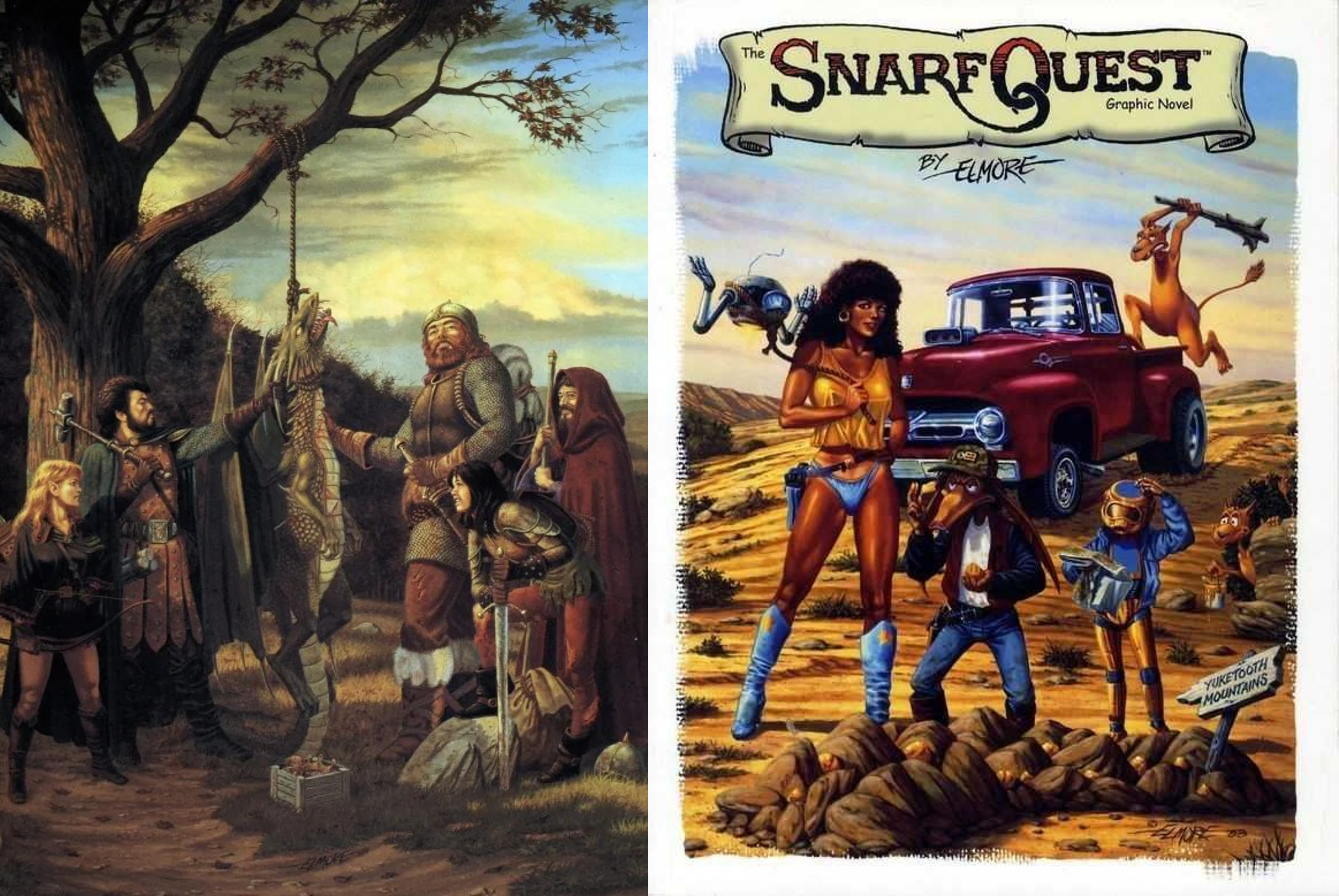
I know many people love his Dragonslayers and Proud of It piece from the AD&D 2nd Edition PHB, but I honestly wasn’t a fan. I understand what he tried to convey with the new heroes slaying a small dragon, but it didn’t catch my eye the way his other work did. I did, however, love a lot of his Dragon Magazine covers from this period. I read SnarfQuest, too, though I wasn’t a massive fan.
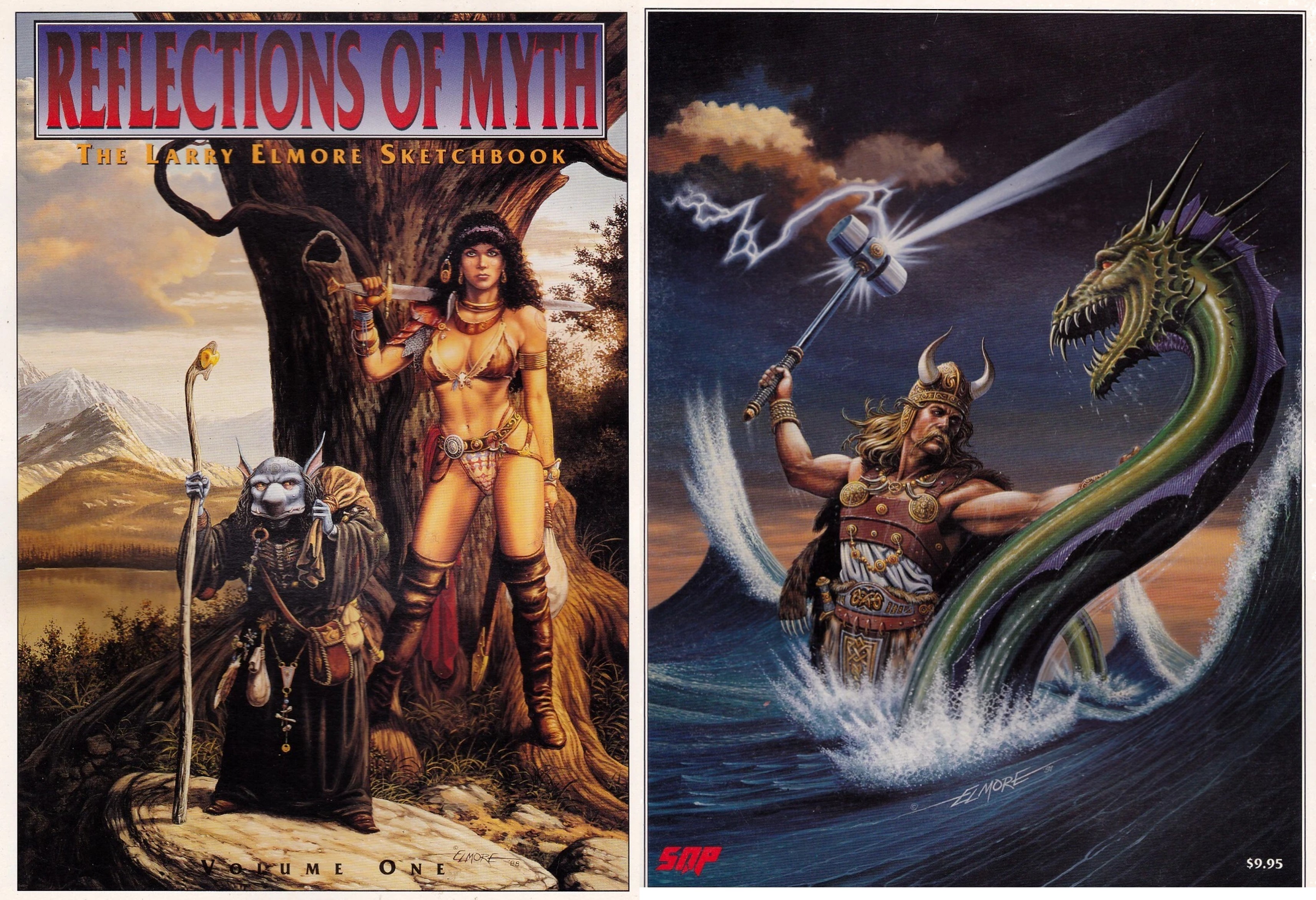
I still own a copy of Reflections of Myth: The Larry Elmore Sketchbook. I loved that book! I would often turn to a specific drawing in it and tell my players, “This NPC looks exactly like this.”
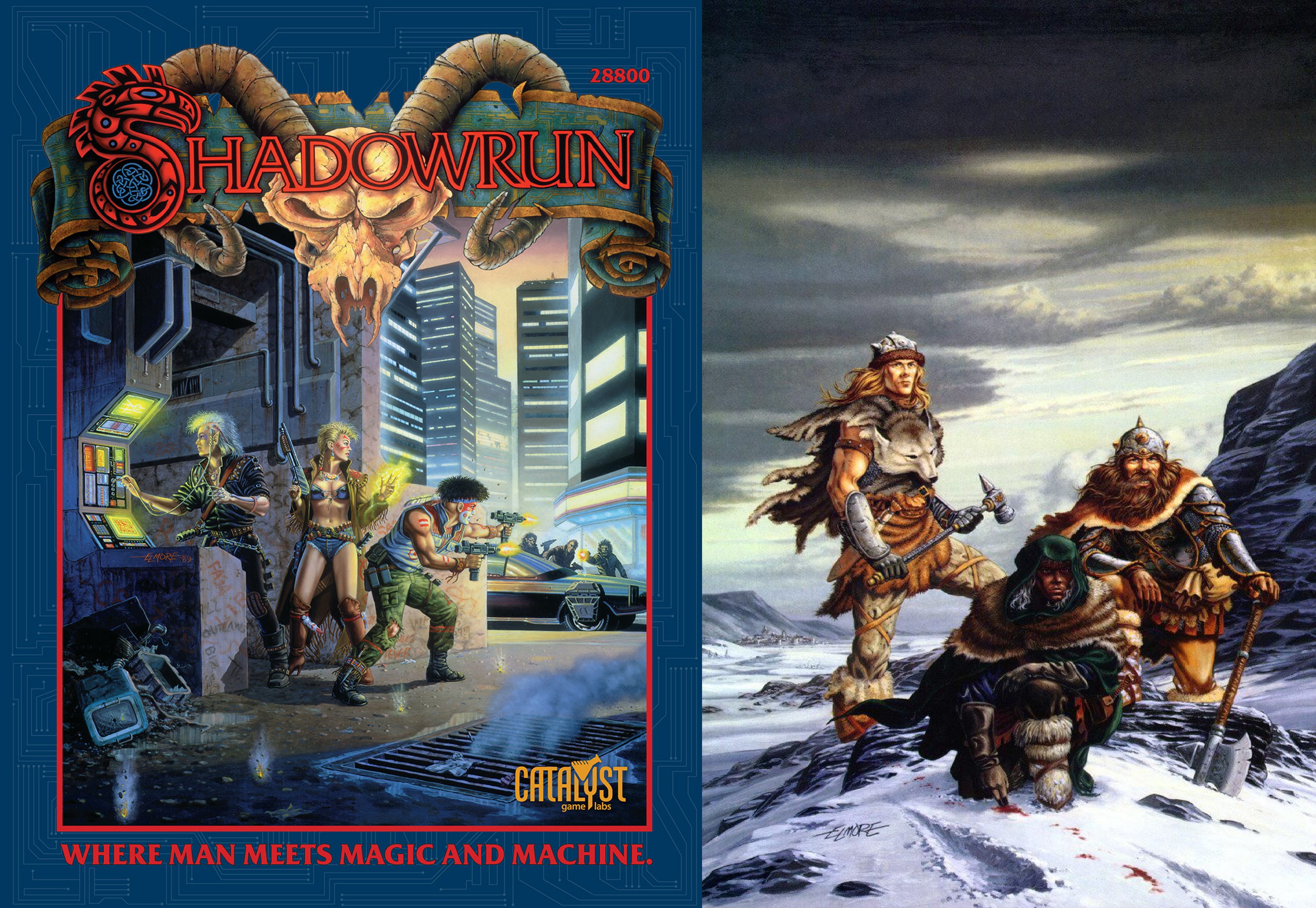
I probably would not have looked twice at Shadowrun if it hadn’t featured a cover by Elmore, and the same goes for The Crystal Shard novel. Larry Elmore’s art was my true gateway into Dungeons & Dragons and fantasy TTRPGs in general. In my imaginary, perfect D&D book, all the class and ancestry illustrations are drawn by him.
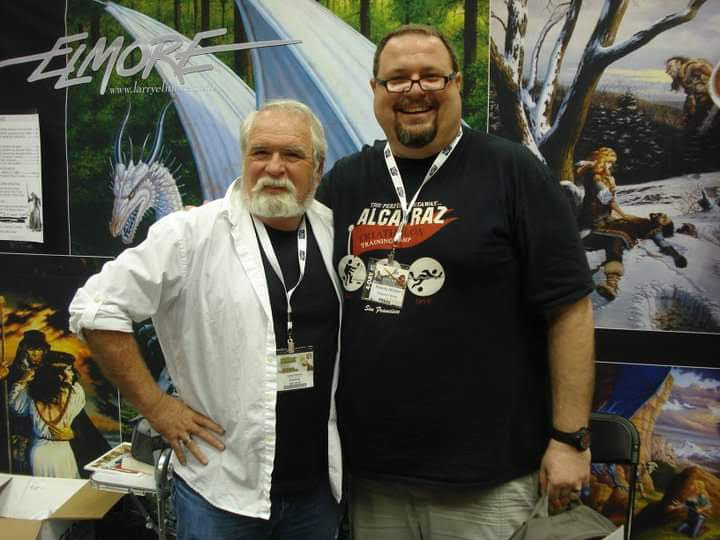
I was lucky enough to meet him and take the photo you see above at Gen Con 2010.
Jeff Easley
Elmore did all the covers for the BECMI boxed sets, but when I “graduated” to the Advanced version of D&D, all the covers for the orange-spine books were painted by Jeff Easley. While I later acquired copies of the original PHB, DMG, MM, and Deities and Demigods covers, when I first got the core books, it was Easley’s art gracing them.
His art seemed darker, more grown-up, and much more foreboding. This was definitely the “advanced” game. While his covers for the AD&D 2nd Edition books rarely come to mind as my all-time favorites, they were so prevalent that they heavily influenced the aesthetics of my growing fantasy world.
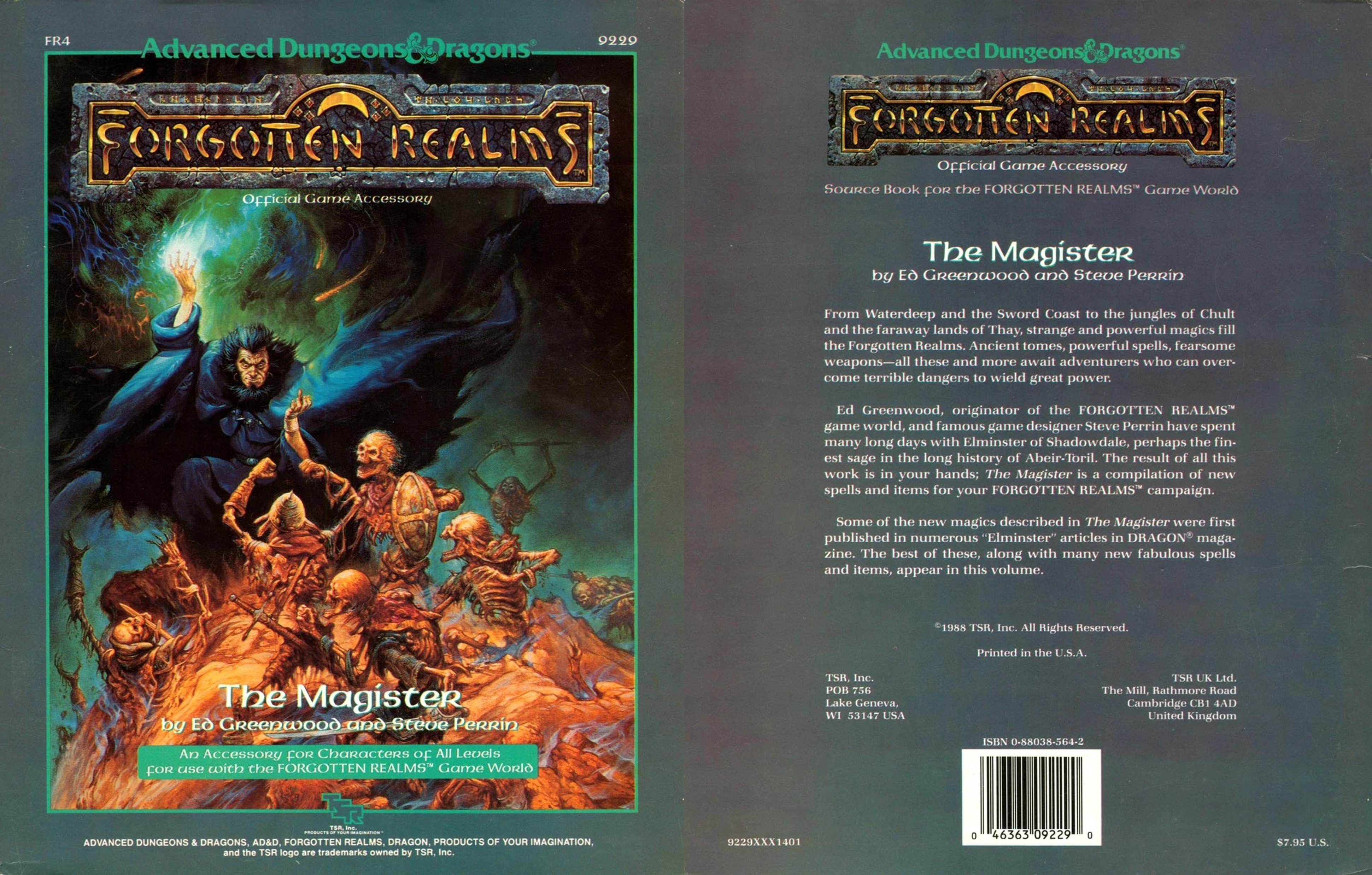
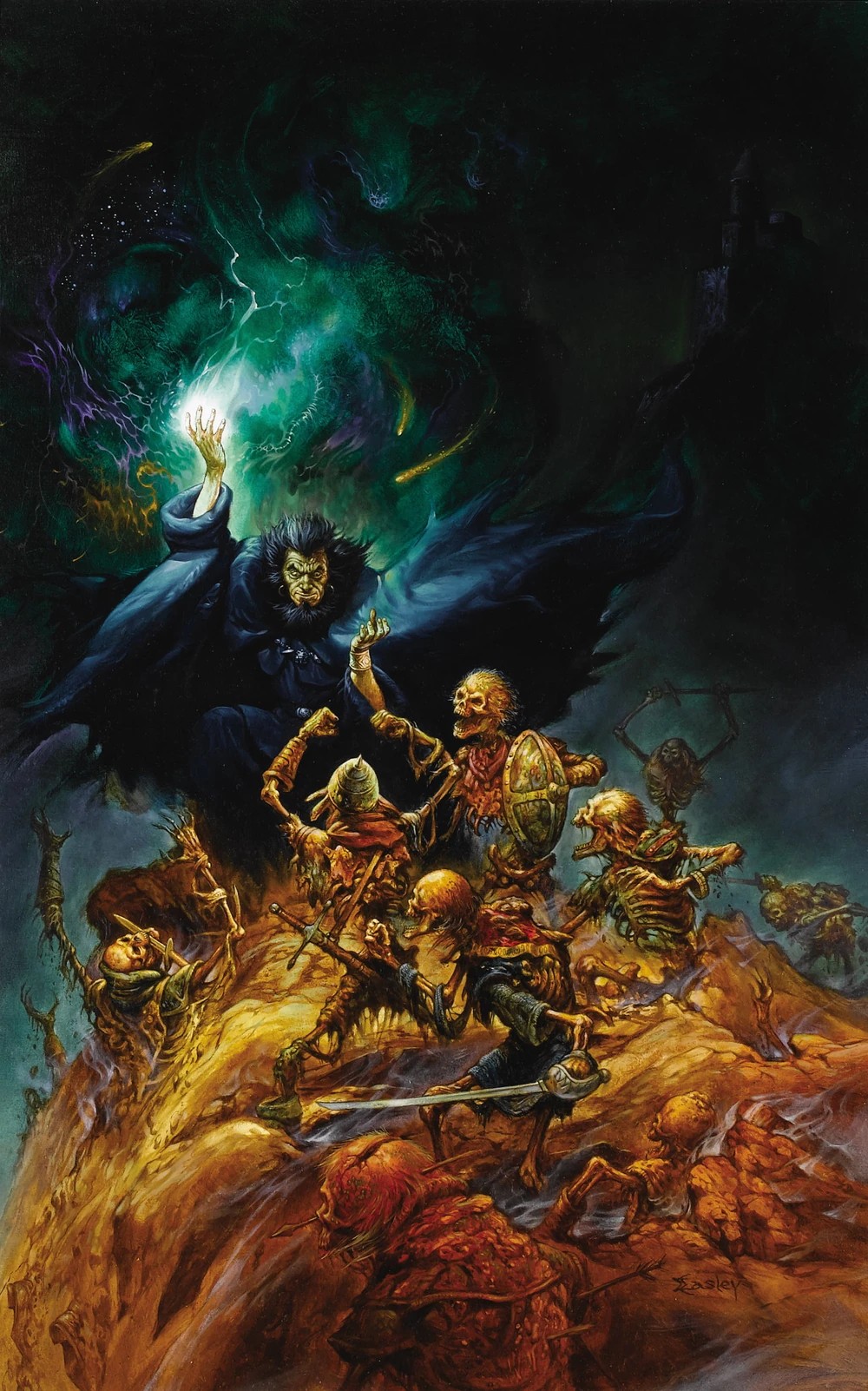
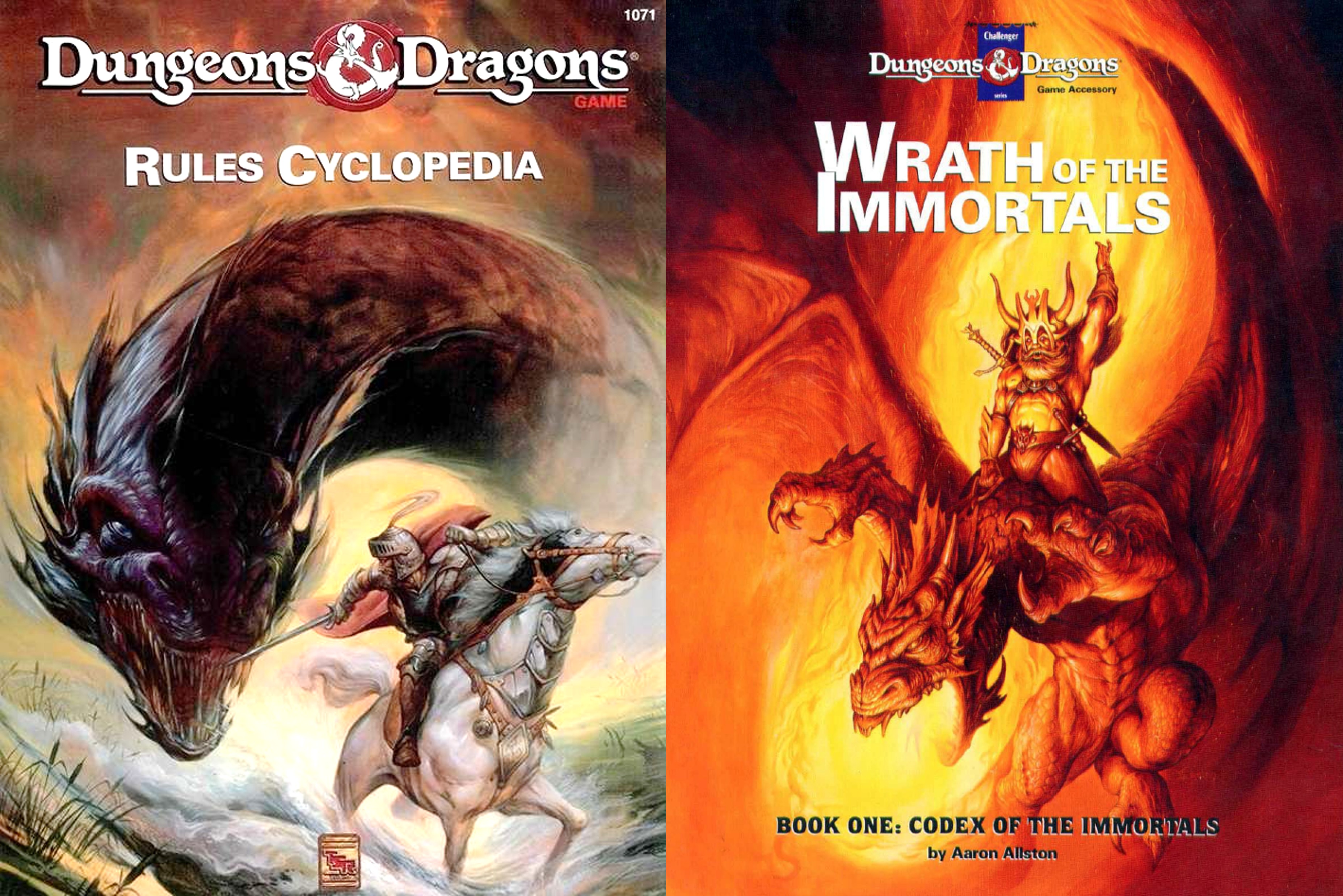
I loved The Magister supplement for Forgotten Realms, and Easley’s cover for it. That specific piece of art became the appearance of a major NPC in my campaign. His covers for the Rules Cyclopedia and Wrath of the Immortals are also pieces I treasure because of their connection to my favorite TSR-era campaign world, Mystara.
Clyde Caldwell
Caldwell is perhaps best known for his Ravenloft cover, featuring Strahd looking like a classic movie vampire, and that recognition is well deserved. But for me, he will always be the artist who drew the covers for my favorite series of supplements: the Gazetteer series.
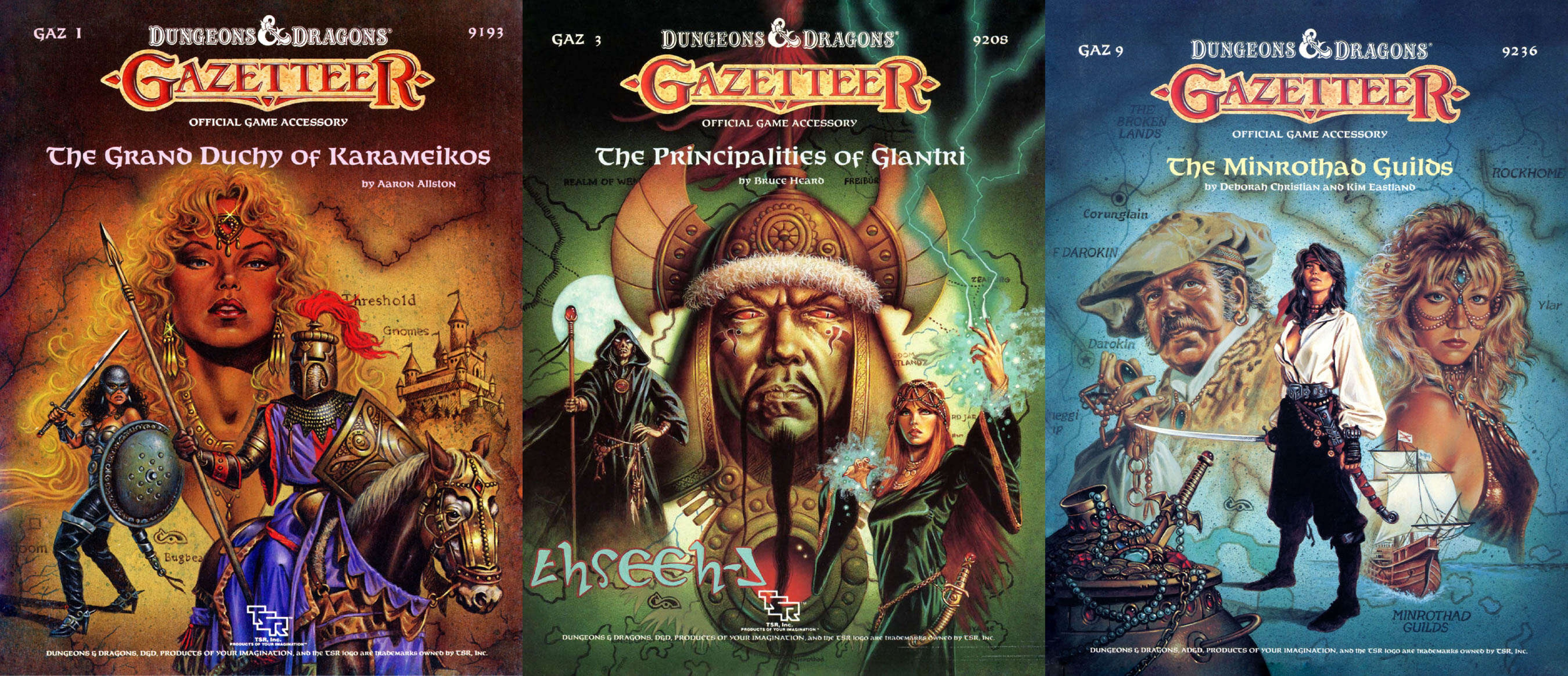
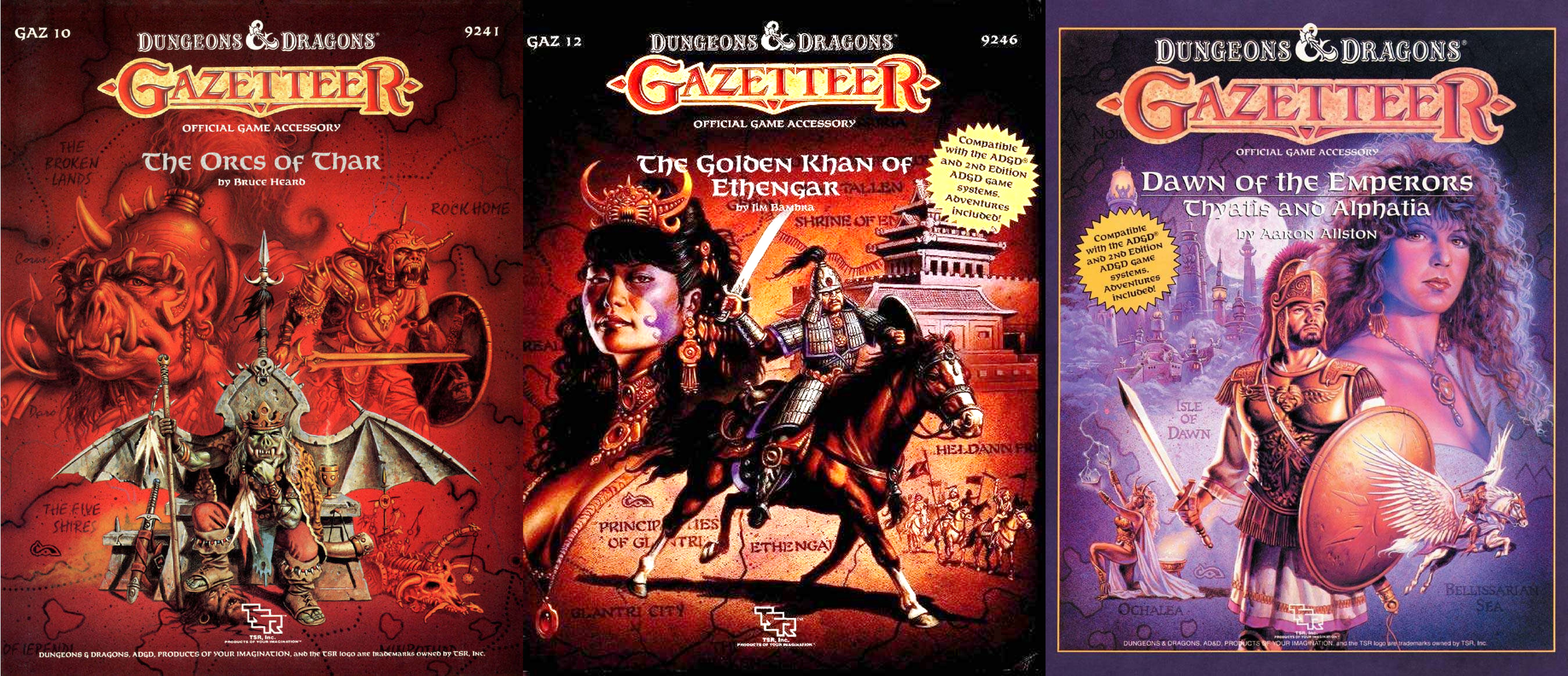
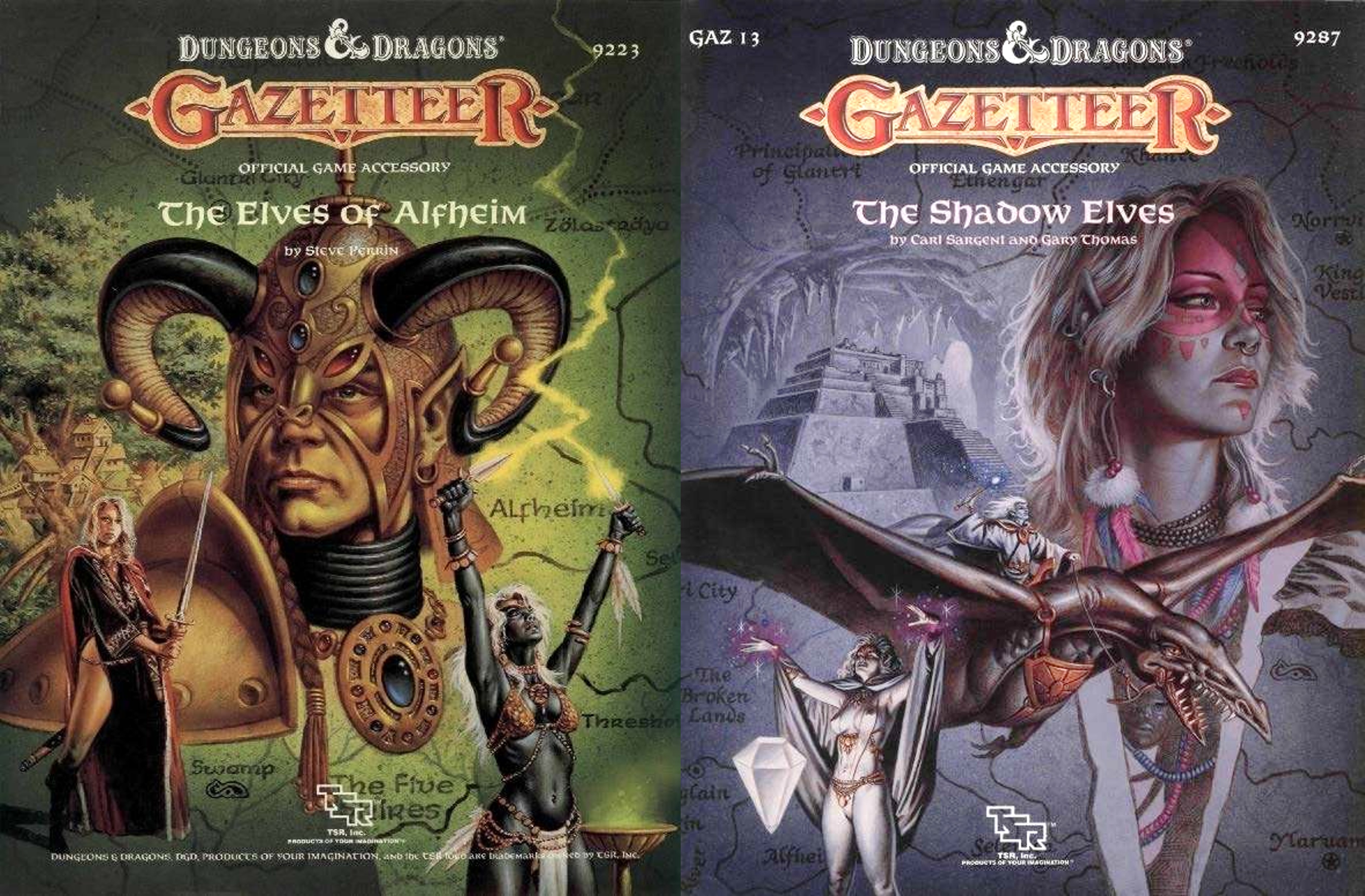
For me, his covers encapsulated what each region of the world represented, even if the Shadow Elf on the cover of the Elves of Alfheim was drawn as a Drow. Mistakes happen!
Later, his Resilient Wanderer art from Magic: The Gathering directly inspired the look of an entire culture in one of my campaigns.
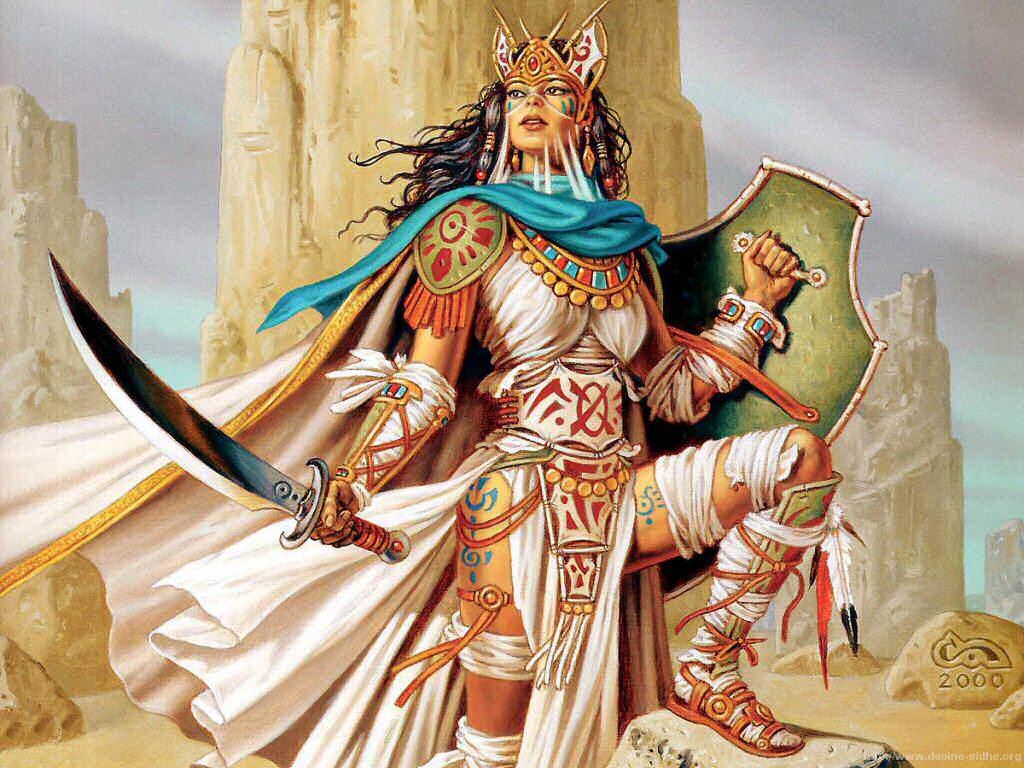
Then there is…
Keith Parkinson
If Elmore was my favorite of the four as a young gamer, Parkinson would become my favorite of the four as an adult.
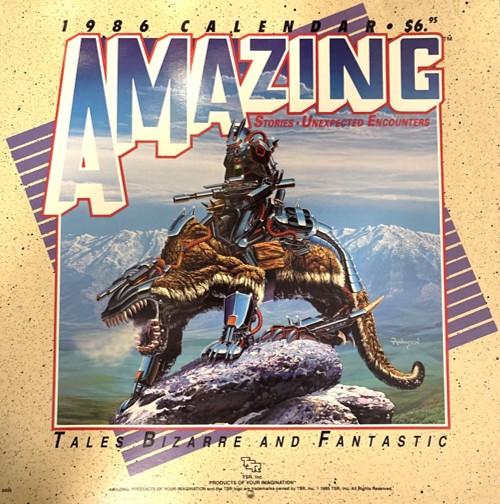
I actually saw his art before playing D&D, inside the Amazing Stories 1986 calendar I got in late 1985. It featured work from all the artists in this post. I remember staring at the art, trying to invent stories to match the scenes. While the fantasy art was great, it was the post-apocalyptic sci-fi (even if I didn’t know to call it that back then) that really caught my eye.
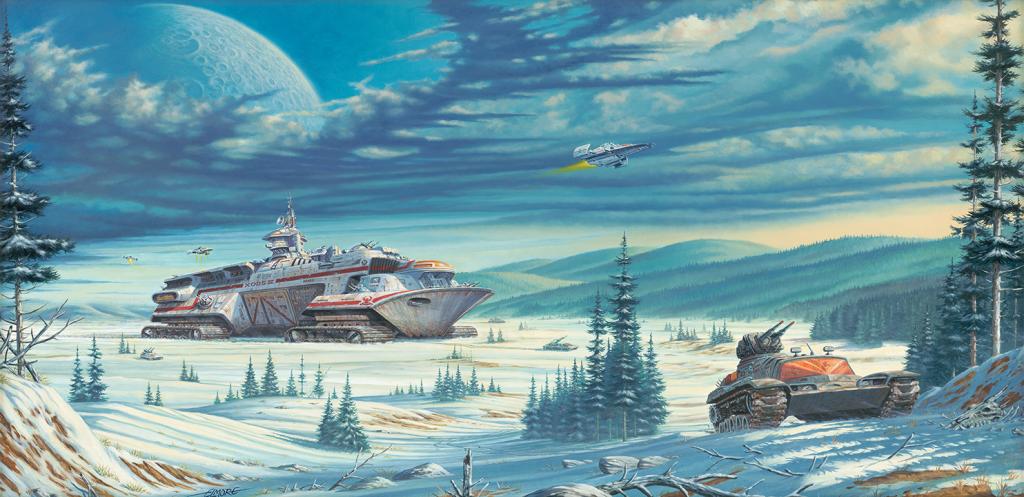
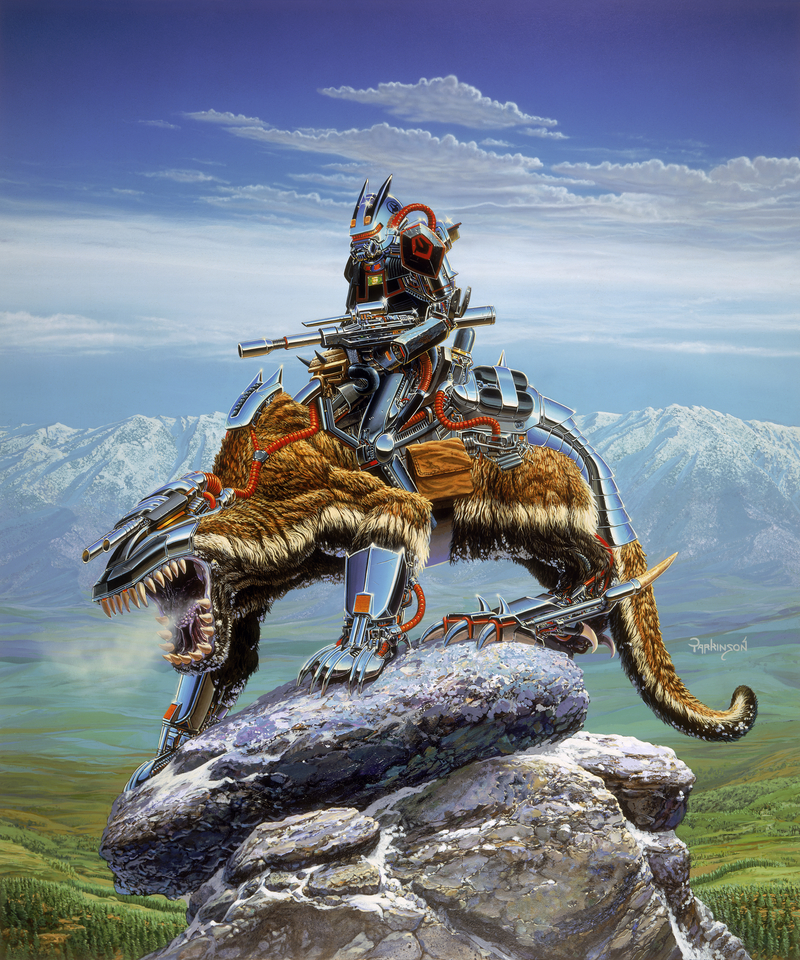
There was an Elmore piece (Epsilon Cyborgs from Gamma World, see above) and an Easley painting (The Fallen, featuring a man in power armor defeating a dinosaur while another attacks, an image I frustratingly cannot find anywhere online). But it was Parkinson’s art—the cover of the calendar, which would later become the cover of Gamma World 3rd Edition featuring the Ultimate ATV —that I remember most vividly.
I absolutely love his fantasy work, too. Lord Soth’s Charge is amazing (and he remains one of my favorite D&D villains). The North Watch from Dragon magazine issue 137 is breathtaking.
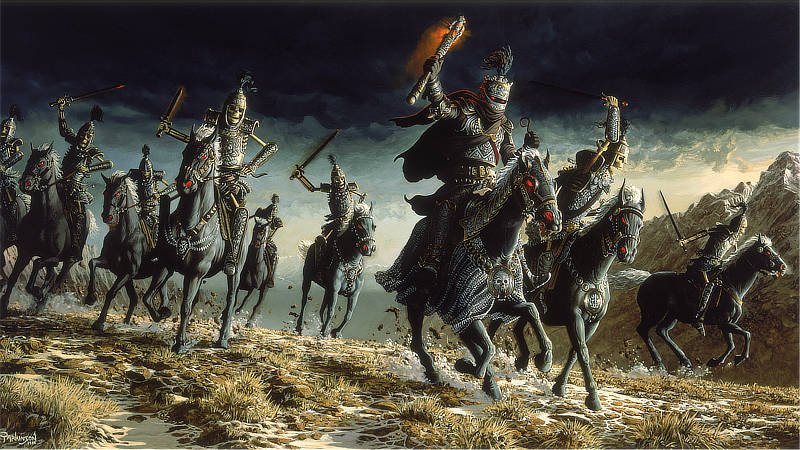
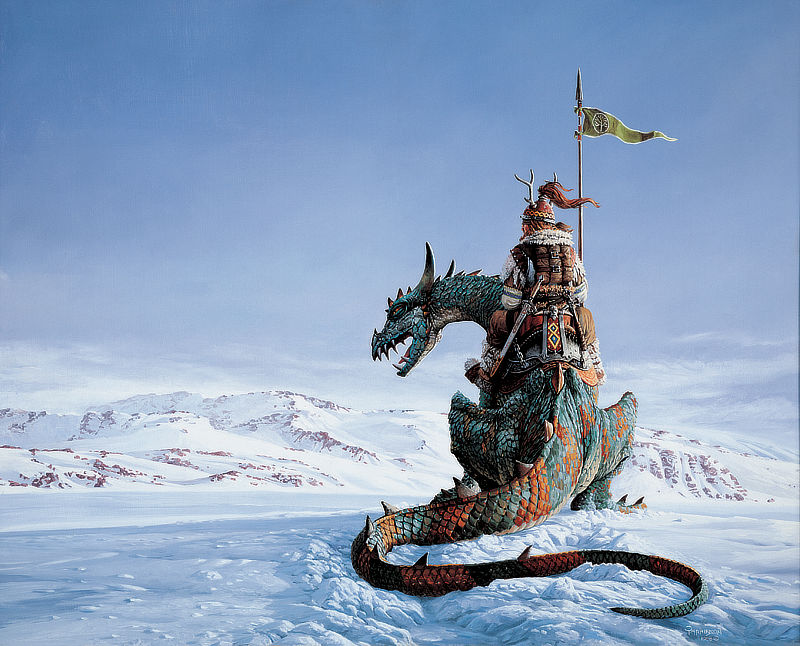
And, of course, the seven covers he did for the Death Gate Cycle books.
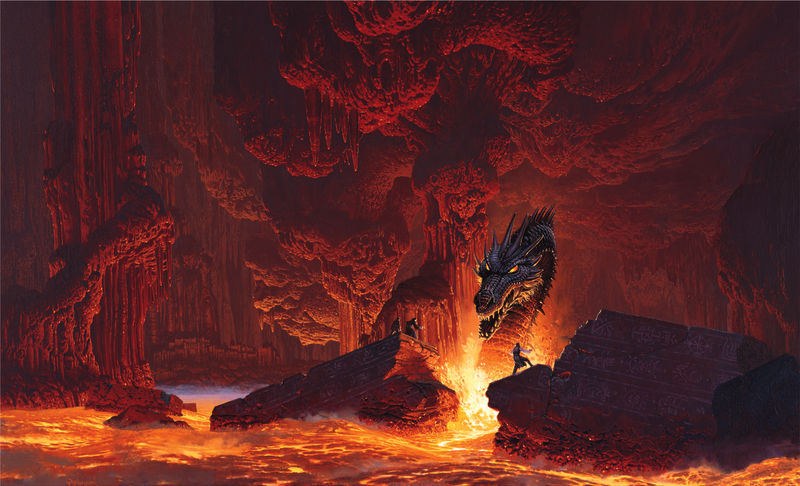
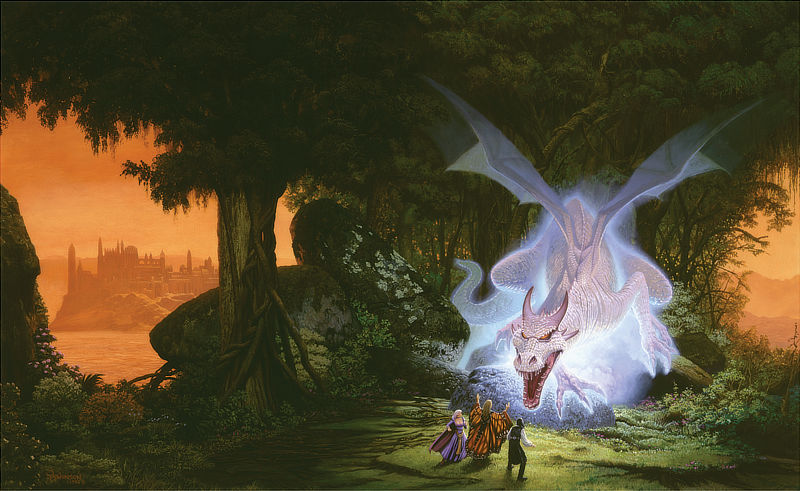
Then there are his Rifts covers! The original edition features the Splugorth Slaver, Mutants in Orbit, and Atlantis. I was a massive Rifts fan in the 1990s, and seeing his art in those books completely blew my mind.
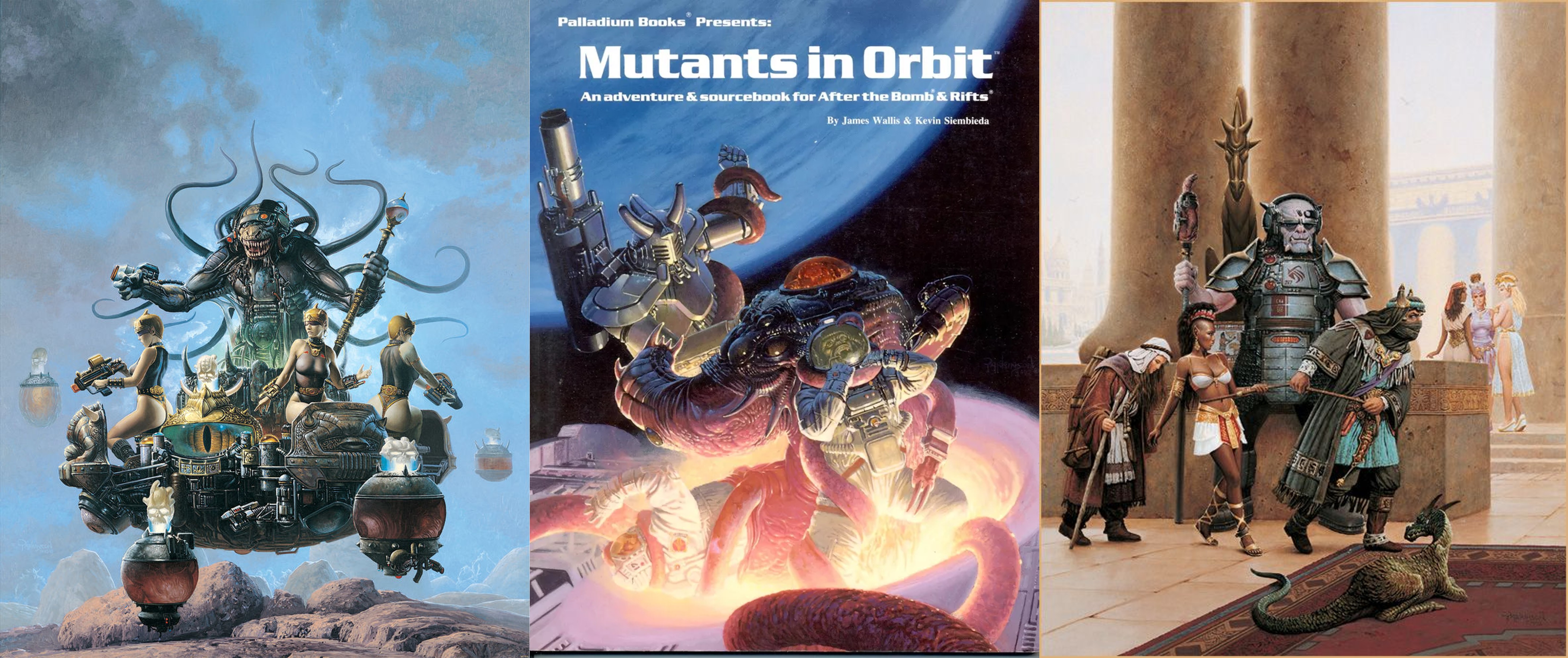
Sadly, he passed away in 2005 at only 47 years old. But his art continues to inspire me today.
I love the work of all four of these artists. They were incredibly formative to me as a young fan of fantasy and sci-fi, and as a burgeoning Game Master. Even now, when a scene takes shape in my mind, when I describe a location or NPC to my players, or when I write about my campaign world, the images created by these four men shape my imagination. I am forever grateful for their art, which has so deeply enriched my life, and this hobby I enjoy so much.
Categories: Tabletop Gaming Blogs
Thundarr the Barbarian & Crew NPC Adapted To Sword of Cepheus 2nd Edition Rpg
Converting the post-apocalyptic, "science-fantasy" vibes of Thundarr the Barbarian into Sword of Cepheus 2nd Edition requires leaning into the Heroic Fantasy rules. These characters are larger than life, surviving a world where "superscience" and sorcery collide.Here are the character profiles adapted for the Cepheus engine.Thundarr the BarbarianThundarr is a classic high-Stamina powerhouseNeedleshttp://www.blogger.com/profile/11243274667834930867noreply@blogger.com0
Categories: Tabletop Gaming Blogs
An Interview with Restless Geek, a Puerto Rican Creator
A few weeks ago, I published an interview with Eliana Falcón-Dvorsky, a local Puerto Rican artist who created a TTRPG supplement for her homebrew campaign world. Her work will be available for sale at the Puerto Rico Comic Con this year, and she will be crowdfunding a print run starting in May 2026. I am always thrilled to spread the word about Boricua TTRPG enthusiasts who create game- and geek-related art and content.
I want to use the platform and reach I have here on the blog and across my social media channels—like Sunglar’s Musings—to amplify the signal and showcase the immense talent of these creators. To do that, I put together a standard set of questions, rolled up my sleeves, and got to work. I revised my notes from the previous interview, reached out to creators I know, and began to plan.
Three creators have already replied to my initial contact, and I am waiting to hear back from three more. The first person I contacted to test this idea was Maite Rodríguez, a fellow gamer and great friend. We are both administrators of the Dungeons & Dragons Puerto Rico Facebook group and one-time co-workers. I am incredibly thankful to her for helping me polish this idea.
Moving forward, I plan to showcase local Puerto Rican creators on Sunday posts here on Stargazer’s World, on Sunglar’s Musings, the Puerto Rico Role Players Facebook page and Discord, the Dungeons & Dragons Puerto Rico group, and my other socials—for as long as I can find creators willing to share their stories and content!
If you are a Puerto Rican artist or creator working on TTRPG content, TTRPG-adjacent projects, or geek-related art that I have not contacted yet, and you’d like me to take a look and share your work with the world, please reach out to me here on the blog or via my social media channels.
Now, without further ado, let’s get to the interview!
Tell us about yourself! Who are you, and what are you creating?
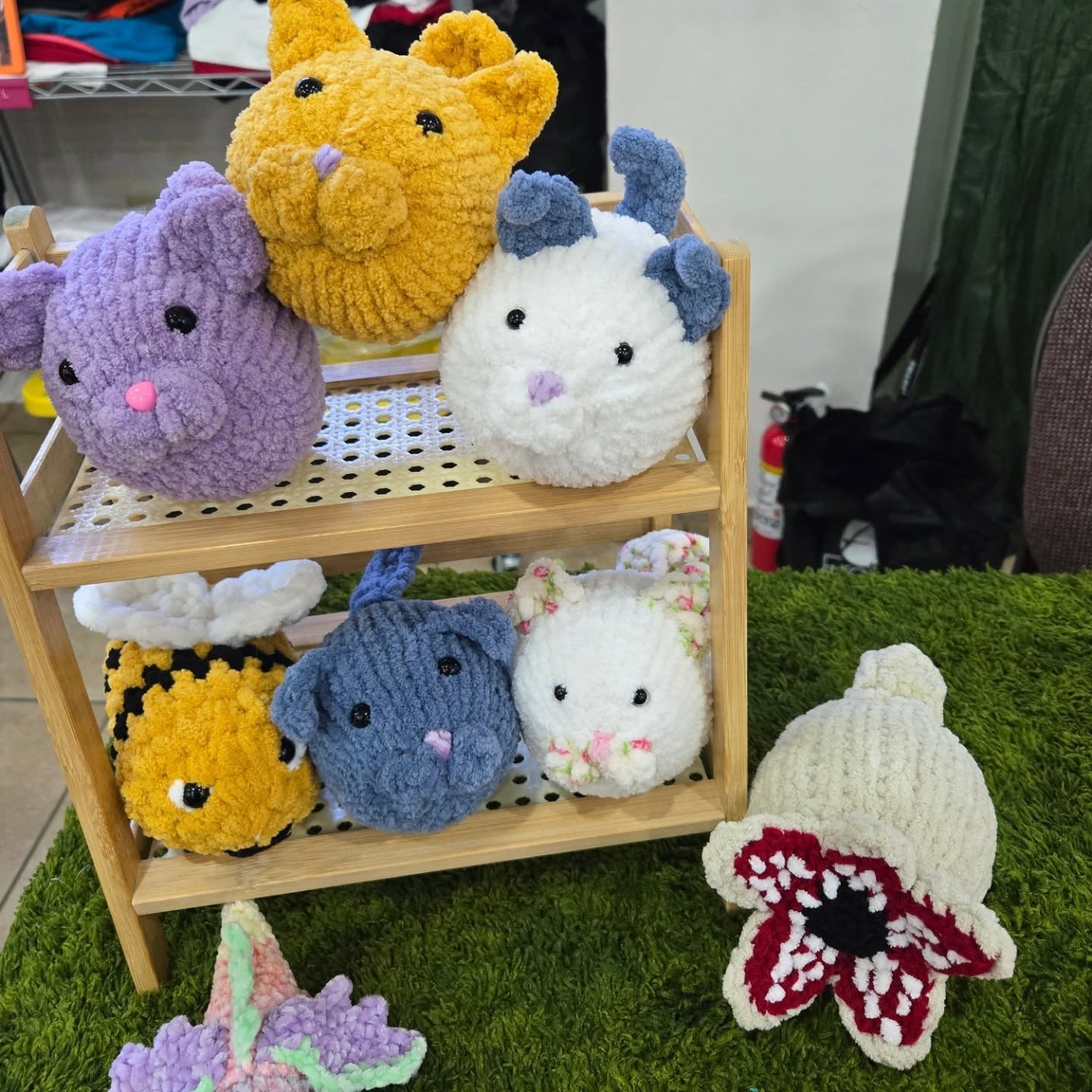
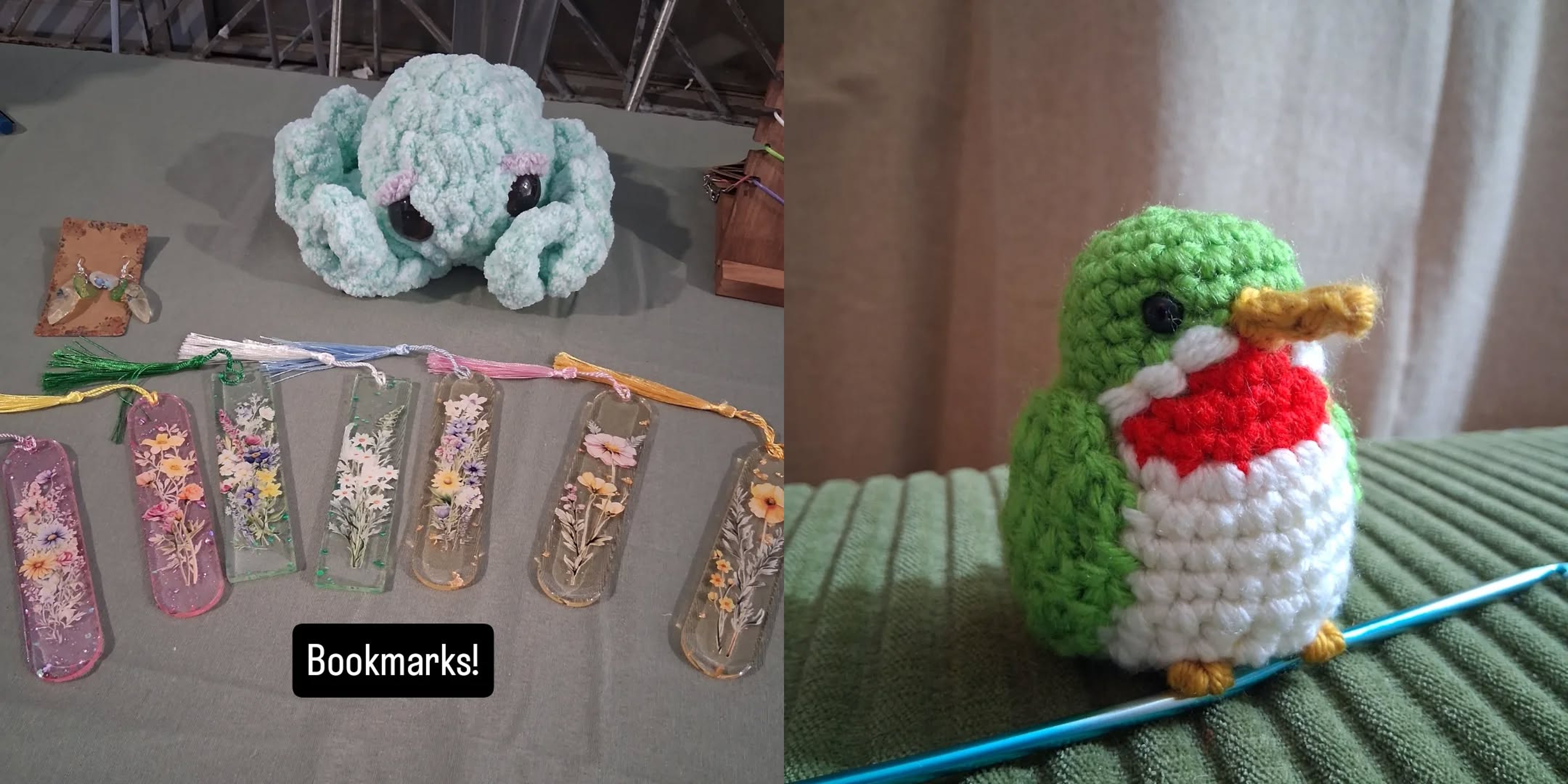
I’m Maite Rodríguez, also known as Restless Geek in the nerdy corners of the internet. I’m a full-time working mom who dabbles in every hobby imaginable. My artwork is best known for my crochet dolls and resin crafts, but my creativity doesn’t stop there. I constantly dream up projects across all kinds of media. I’m drawn to the whimsical and magical, inspired by the worlds I imagined as a kid: dragons, fairies, vampires, werewolves, epic heroes, and forest witches. I want to explore all of that and bring it to life through my art.

How would you describe your art or creative work?
My greatest joy comes from seeing people connect with something they love at my table. Kids run up to me at a market because they spot something they love, or adults get excited like kids over something I’ve made. I think the description “3D printing with yarn” is super accurate, and it’s something I do almost compulsively. I started selling my work partly because, if I didn’t, my house would be buried under all the stuff I create! Restless Geek was meant to be my space to explore all mediums and ideas, but crochet is what I’m most requested for and known for.
How did you discover TTRPGs?
I started playing board games seriously on April 5, 2014, for International Tabletop Day. While I’d of course played before, that’s where I found “my people.” From there, it was a natural leap into TTRPGs, and with my love of fantasy, I dove in headfirst.
Do you play actively? What are you playing right now?
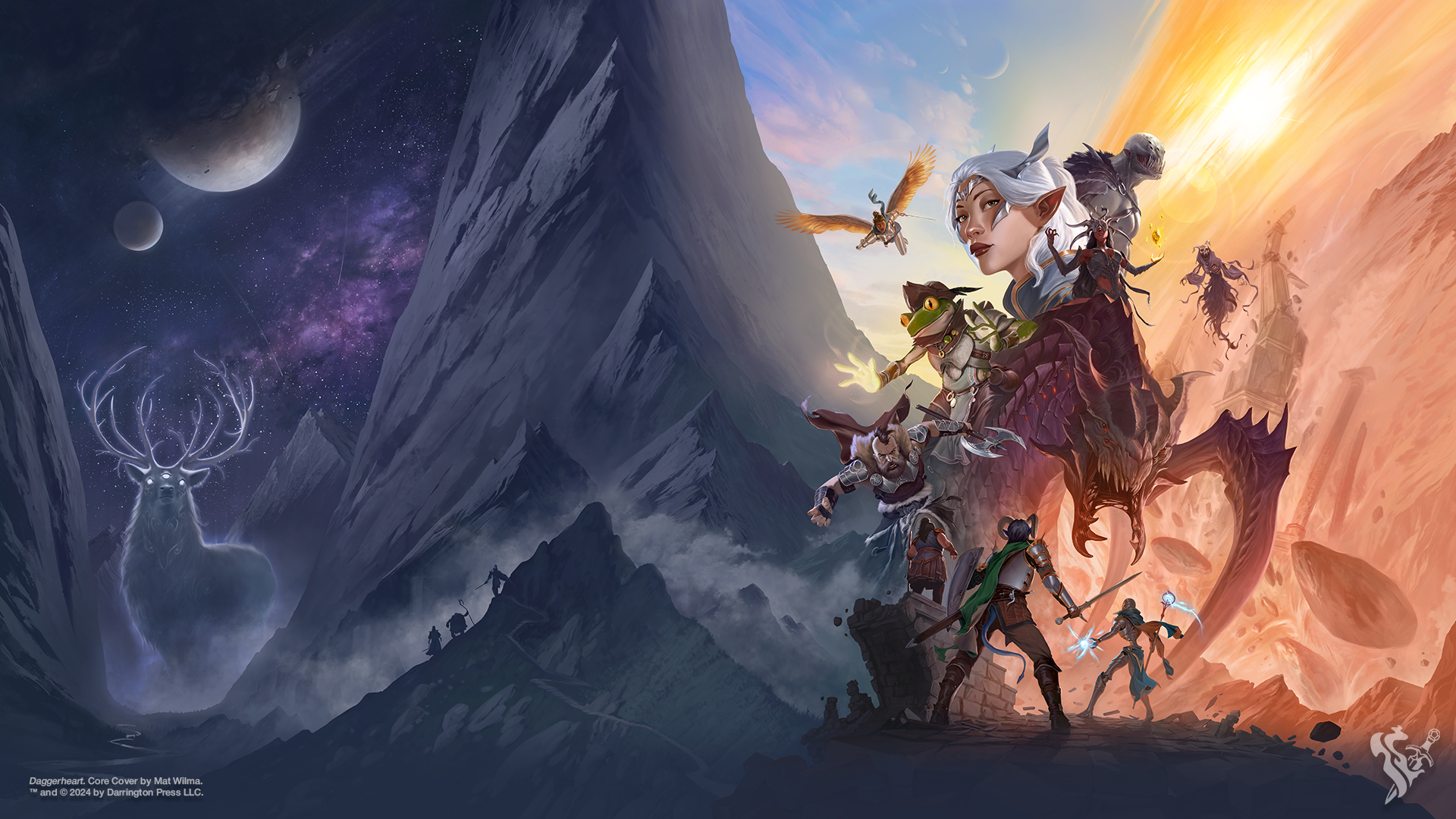
My group is currently paused on our Daggerheart campaign, and life has been pretty busy, but I’ve managed to catch the occasional game, like at a Geeknic or the online TTRPG weekends hosted on Discord. I also really want to host more Daggerheart demos with the Autumn Leaf Adventurers Guild.
What’s next on your list to play?
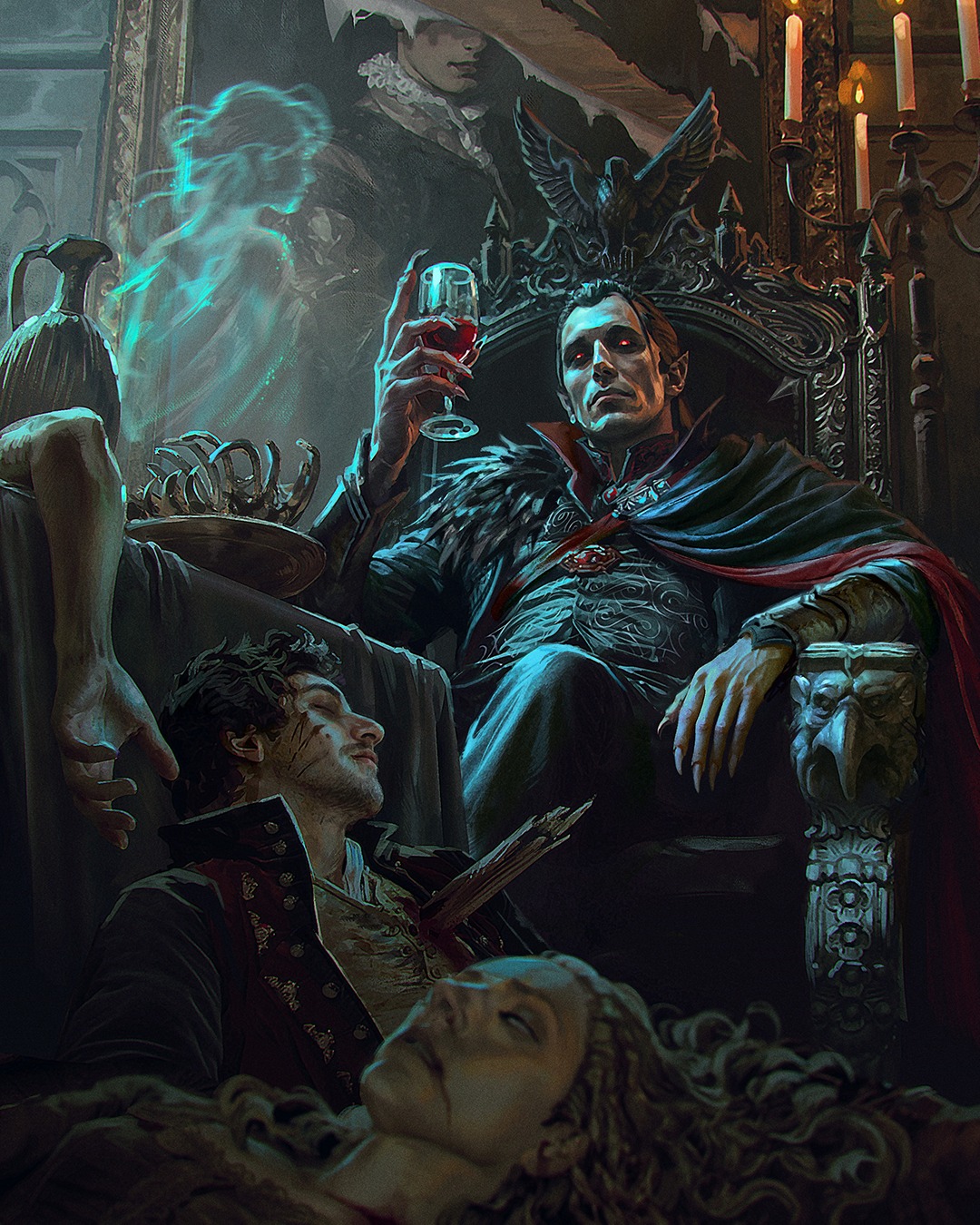
Oh, that’s a tough one! A friend recently got me interested in Faster, Purple Worm! Kill! Kill! It looks like a blast. I’d also love to play something spooky and scary. There’s new Ravenloft content out this year that’s calling my name.
What projects do you have available, and what are you working on now?
My next event is on October 31st at The Portal in Ponce. I’m also setting up my website, Restless-Geek.com, which will include an integrated online shop; it should be live this week! Right now, my inventory features dice bags, health potions, coasters, squishy dolls, and keychains. I also write spicy fiction (adults only), which I’ll be promoting more openly soon and publishing on Patreon.
Where can people find your projects?
For announcements, events, musings, and all things related to me and my art, you can find me on Instagram as @restless-geek. Everything I post there also goes straight to Facebook.
Any final thoughts?
Thank you for this initiative. I’m terrible at self-promotion; I wish I could create and have people magically find me, haha! But things like this help so much. Restless Geek is the dream, you know? Something I hope to do full-time someday, and to make my kid proud that I went for it.
Two quotes have been guiding me this past year as I have worked toward my goals:
“You can fail at something you hate, so you might as well try doing something you love.” — Jim Carrey
“It is possible to commit no mistakes and still lose.” — Captain Picard
They give me the “eff it” mentality I need just to get out there and do it. So yeah, thank you!
A huge thank you to Maite for her candor, for everything she does to support the local TTRPG community, and for helping me iron out the logistics for this new series. Stay tuned, and I’ll see you all next week for another interview with a talented Puerto Rican creator!
Categories: Tabletop Gaming Blogs
D100 Random Sword & Sorcery Countryside & Blasted Heath Encounters tables For Castles & Crusades Rpg
Sword and Sorcery is less about "random bears" and more about ancient ruins, desperate survivors, and the encroaching "weird." Here is a d100 table designed to capture that gritty, pulp-fantasy atmosphere for your countryside travels. This blog entry picks right up from OSR Commentary - Can Castles & Crusades rpg be played with The Primal Order Rpg?!d100 Sword & Sorcery Needleshttp://www.blogger.com/profile/11243274667834930867noreply@blogger.com0
Categories: Tabletop Gaming Blogs
House name: The Iron Vein (The Rust-Eaters) Faction For Nightshift Veterans of the Supernatural Wars Rpg
Welcome to the night shift. In the world of Nightshift Veterans of the Supernatural Wars, a "House" isn’t just a social club—it’s a survival strategy, a political faction, and a potential employer (or HR nightmare).Here is a unique vampire house designed to fit the gritty, blue-collar aesthetic of the game.House name: The Iron Vein (The Rust-Eaters)The Iron Vein is not composed of brooding Needleshttp://www.blogger.com/profile/11243274667834930867noreply@blogger.com0
Categories: Tabletop Gaming Blogs
Kingdom
By James Desborough
Portmortem Studios
LotFP
Levels 2-4
Portmortem Studios
LotFP
Levels 2-4
A high-concept adventure beneath the bone-white hills of Southern England:. […] The hearthstone tilts forward as the ground beneath it gives way, and the fire collapses inward with a choked sigh. A black seam splits across the floor, racing between boots and table legs, widening in the stretch of a blink. Tankards slide. A bench tips and crashes onto its side. The air fills with a grinding roar as chalk collapses in vast, dry heaves beneath the inn. The far wall lurches downward, its timbers shrieking and daub shattering to powder and horsehair as it tears loose. Cold night air floods briefly in through the widening fracture, carrying the smell of wet earth Elinor cries out as the boards beneath her feet dip and tear apart, and she vanishes into the dark. Outside, horses scream, their hooves beating against nothing […]
This 62 page adventure presents seventeen rooms of pitch blackness in a “lair of the sub-humans” tunnel complex. The designer had an idea and tried to implement it, but has no idea of what an adventure is or how to write one. Thus a confused over-wordy mess that, I think, doesn’t understand the Lamentations game system either. The pretension, in the face of this, is interesting to see.
You’re sitting in a bar. Oh no! The tavern collapses in to the earth. It’s very dark. TOTAL darkness, not even infravision or magical sight works. Subhumans start killing the other survivors who fell in also. Thus starts a little over a dozen rooms of groping about and smelling your way to the mystical ate that gets you back to freedom while you suffer -2 hit, +2 to be hit, blah blah blah.
This is garbage. It didn’t have to be.
The designer here is a Clever Boy. We know that because he tells us that in page after page of introductory text that amounts to See How Bad Ass I Am? I don’t know, he’s scared of the dark, he obviously met Raggi once somewhere and they are basically the same person and now he wants to suck him off by name dropping and it’s not a Fuck You dungoen its actually just hard the way OSR dungeons should be. “This is Atypical You’re not going to find any of the typical adventure-book fare here.” Uh huh. Listen to the voice saying Follow Me, says Frankie. As it has always been, the person shouting the loudest is generally engaged in flim-flam.
“Perhaps the best/ worst example of this was The Tomb of Horrors, but the ‘fuck you’ is now used as a condemnatory slur directed at anything with even slightly elevated deadliness or Old School sensibilities.” No asshat, it is not. But you didn’t write this for the OSR, did you? You throw some words down on paper, with painfully little care, in order to slap a price tag on it and make a buck or three from whatever followers you have and test the waters for more from the OSR crowd. Alas, at least from your viewpoint, you will find little purchase here. I suggest one of the more niche circles for your medicine show.
Name calling? Ad hominem attacks? That’s not this blog. Or, rather, it’s reserved for the worst of the worst, the money grab people. Let’s see just why this adventure is garbage.
There is, at a minimum, column long section of text up front defending hard dungeons ala the Fuck You dungeon, and, of course, noting that this is not a Fuck You dungeon. This is wrong. It is a Fuck You dungeon. Further, it’s a Fuck You dungeon that, I suspect, has never actually been much less playtested. The mechanics in this just don’t work. The presentation doesn’t work. That’s how I know this. Perhaps one of the very earliest examples of this, in the text, is what happens when the tavern collapses. You have to make a save or take 2d6 damage. That’s gonna be a 16+. We’re looking at between 5 and 18 HP for a party of mixed classes for levels two to four. And you’re gonna take seven damage. AND THEN YOU NEED TO MAKE ANOTHER 16+ SAVE OR TAKE ANOTHER 2d6! These are not optional. They represent the collapse of the inn into the chasm belowground. That is, on average, fourteen damage, with a fighter, on average, having eighteen hit points at fourth level. And you want me to believe that you have play tested this? Run this? Believe you know how D&D works? No. I loathe mechanics. I loathe an appeal to balance. But I also know that the lack of understanding of low hit points, saves, and turning undead are the absolute tells of fuckwit medicine men. [As in, all medicine men are fuckwits, not an adjective to describe certain medicine men.] The designer does not, in any non-trivial manner, understand the game system that they are writing for. The snake oil is strong with this one.
How else do we know? The read-aloud. The read aloud here is long. VERY long. Like, a page long in some sections. A column, or a good chunk of one, is not uncommon in most places. James Desborough has never read that text aloud to anyone playing this game. Because if they had then it wouldn’t be that long. James would have seen his players turning on their portable gaming systems, watching tiktoks, going to get a beer, swiping on tinder, or whatever. No one pays attention. We know this. It’s common knowledge. You don’t monologue a villain. The players don’t pay attention. You don’t write long read-aloud, the players get bored. This is not a player issue. This is a designer issue. The WotC study, the article about it read-aloud and attention spans, should be well known by this point. And, as I noted, even if it were not the complete lack of player attention as you spew more and more irrelevant flowery text at them should have been a major hint to the designer. If it has been play tested, of course. Or even run for someone. Does it work for the players? Do you CARE that it works for the players?
How about the DM? Do you even care if it works for the DM? Or is this just a payday for you? You see, gentle reader, the text here is in italics. And in a funky fucking font in italics. No one, ever, in the fucking history of the world has ever said “Oh boy! I hope I get to struggle through a long section of flowery text in a font that is hard to read!” Long sections of italics are hard to read. This is, or should be, common knowledge. Funky fucking fonts can be hard to read. Funky fucking font in fucking long sections of italics are VERY hard to read. It’s a fucking cognitive issue in much the same way that single-column text causes more fatigue than double-column. Not that YOU give a fuck.
Let us move on to formatting. The text here is in a kind of long conversational paragraph styling. The only straight appeal to formatting is a bolded word like “Smell” or “Taste.” That’s good. It helps direct the DM attention to those needs. You know what else the DM needs? To know how many creatures there are in the room. Room one in this is where the adventure starts, so to speak, the pit the tavern and everyone has fallen in to. There’s some vignette shit where the party hears gurgles and screams as the Bone Tomahawks slit throats and cut hamstrings and the like. And, of course, there’s a fight for the party to take part in. It doesn’t actually say. Ever. Some of the people in the inn survive the fall and there’s a little section for each of them that describes their current state. Related, there’s a brief “event” that is the attack, and in the text of one of them, relating the attack on one of the fallen NPC’s, there is a note that says “If they kill both the attackers …” That’s all you’re fucking getting. Pretty fucking basic, isn’t it? How many enemies are in the room? No? You wanted to write some story game bullshit and slap an OSR label on it? Or, are you just incompetent as a writer after all these years? Or, given up and doing a money grab?
How now brown cow, let us look at immersion. There is little. What there is, though, is designer fiat. Why can you not see in the dark? A Wizard did it. Why is X? A wizard did it. I’ve been writing three reviews a week for, what, fifteen years now? The amount of contempt the designer has for their audience is beyond compare. Yes, fuckwit, we are all playing D&D. We know that if we want to play D&D tonight then take the hook. We know that everything in the fucking game is made up. And we rely on designers to provide the verisimilitude that does not break the fourth wall and does not drag us out of the vibe. You didn’t even fucking try. You just wanted X to happen. I don’t need explanations. Those suck also. A contingency spell goes off that triggers a magic mouth that says a spell trigger word. That’s bullshit also. Explanations suck. But immersion in the game does NOT suck. It’s a major fucking point of RPG play. But you don’t give a fuck about that do you? Cha ching! Given that no one makes any money in RPG’s I must then assume this is and ego boost for your self-described “high concept” pretentious adventure of little imagination.
There’s a reference sheet at the end with some mechanics on it. That’s good. There are also a series of NPCs who you end up with in the tunnels/pit. The descriptions of these are in three parts. A read-aloud (ug) and a paragraph or so of information that is full of background as well as mannerisms. The mannerisms are good, the backgrounds less so, and in most cases could have been eliminated or GREATLY reduced. Then there’s “their condition after falling in.” The mannerisms and condition information should have, also, been included on the reference sheet, in an abbreviated manner. There’s a nod to this, but just in terms of a name and tracking their alive/dead status. A few extra words here, on mannerisms, would have gone a long way. IE: how to use them in play.
Otherwise, this is just a series of encounters in the dark with little interactivity beyond that. There’s a lot of room in the OSR, from the RAW 1e crowd to those smaller games that lean more towards streamlined mechanics. I don’t see this as fitting anywhere in the spectrum.
This is $13 at DriveThru. There is no level range mentioned until you get in to the meat of the product, that should have appeared on the cover or the marketing page on DriveThru. The preview is six pages, the first six, so you get to see a good deal of the initial pretension. It should have included a page or two of encounters to give the potential buyer an idea of what they are purchasing. That is the purpose of a preview.
https://www.drivethrurpg.com/en/product/561839/kingdom?1892600
Categories: Tabletop Gaming Blogs
Mission Profile: Operation Wolfsbane - Destroying the Protect Gear Prototype - Wretched Interbellum Adventure
In the smog-choked, alternate-history landscape of the Wretched Interbellum, the line between man and machine is blurring. Rumors have reached your cell of a terrifying breakthrough by the Special Armed Police Force (The Kerberos): the Protect Gear prototype.This isn't just armor; it’s a psychological weapon designed to turn a soldier into a faceless, unstoppable executioner. Your mission: Needleshttp://www.blogger.com/profile/11243274667834930867noreply@blogger.com0
Categories: Tabletop Gaming Blogs
[Parsulan] In The Red Wastes

In Southeast Parsulan, the Karkharoth badlands are an inhospitable, monster-haunted region of gullies and ravines between low, barren, red ridges, at times scarred by jagged rock formations like rows of fangs. In a broad canyon surrounding one of a rare oases is the fortress city-state of Kamazot.
The broken and desolate terrain isn't natural but instead due to the folly of man. In the Age of the Wizard Kings, attempts to push the then-fertile lands to even higher yields, coupled with sabotage from rival lands led to disruption of local fae elementals and a wounding of the land. The weakening of the polity made the region vulnerable to raids from the humanoid nations to the north serving to further depopulate the old kingdom.

The Demon War might have thoroughly returned the badlands to wilderness and ruin, but a warlord rose to organize disparate tribal groups and led them to re-occupy Kamazot. The armies unearthed ancient magitech weapons and restored them to the repaired fortress walls. The city they rebuilt developed into an autocracy organized along military lines, which persists to this day. Despite its regimented society, Kamazot has always been opened to outsiders who prove their worth. Even humanoids and those of monstrous ancestry are occasionally accepted into their society.
It is rare for rulership succession in the city-state to be passed hereditarily. Instead, the clan generals elect an Imperator. The current ruler, Dornon Gundark, is unusual in that he was a clanless outsider who rose through the ranks due to his battle prowess and canny out-maneuvering of rivals at a time when Kamazot had been weakened by poor leadership. He enjoys both popular support and the loyalty of most of the generals. Those less supportive are kept in line by his command of the Red Hawks, an elite force drawn mostly from those born outside the city and discriminated minorities such as humanoids and Darklings.
Dornon directs his forces to seek out magitech weapons to add to the state's arsenal. He is very fond of cannons, the bigger the better. He pays handsomely for the recovery of weaponry from ancient ruins and dungeons.
His interests in technology extend beyond weaponry, however. Recently a railroad line was completed linking Kamazot with the Northern Parsulan industrial hubs. The line passes a perilous route through humanoid territory, however, and must employ adventurers and mercenaries both the trains and crews effecting repairs. Another line is planned between Kamazot and the port of Ervessos, but interests in the rival states of the Lightbearer Republic and Grancazarel oppose to close and alliance between those regional powers.
Categories: Comic Book Blogs, Tabletop Gaming Blogs
70s Sword & Sorcery Comics Inspiration: Discovering Dagar the Invincible
Just when I thought I had uncovered all the hidden gems from my recent deep dive into 70s sword-and-sorcery comics, I stumbled across another one that I knew absolutely nothing about: Dagar the Invincible!
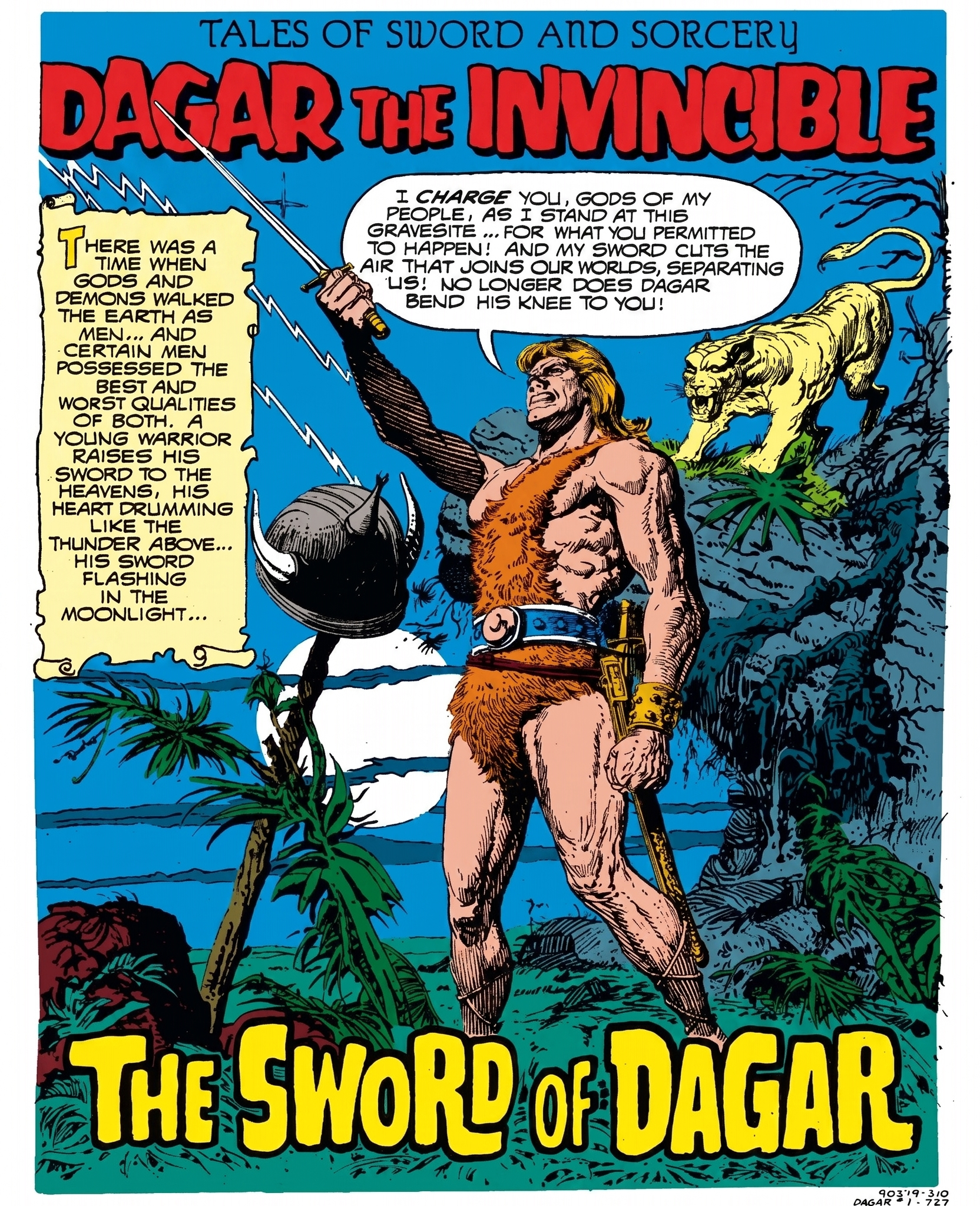
Published by Gold Key Comics, written by Don Glut, and featuring art by Jesse Santos, it hits all the classic high fantasy notes I’ve been looking at lately with characters like Claw the Unconquered and Stalker.
Looking at the art and the setting, my Game Master brain immediately started turning. This gritty, classic fantasy aesthetic is prime material to mine for a future Shadowdark, Old School Essentials, or even a Savage Worlds fantasy campaign. It is genuinely fascinating to see how much of this genre flourished in the 70s, driven by the massive success of the Conan comic books.
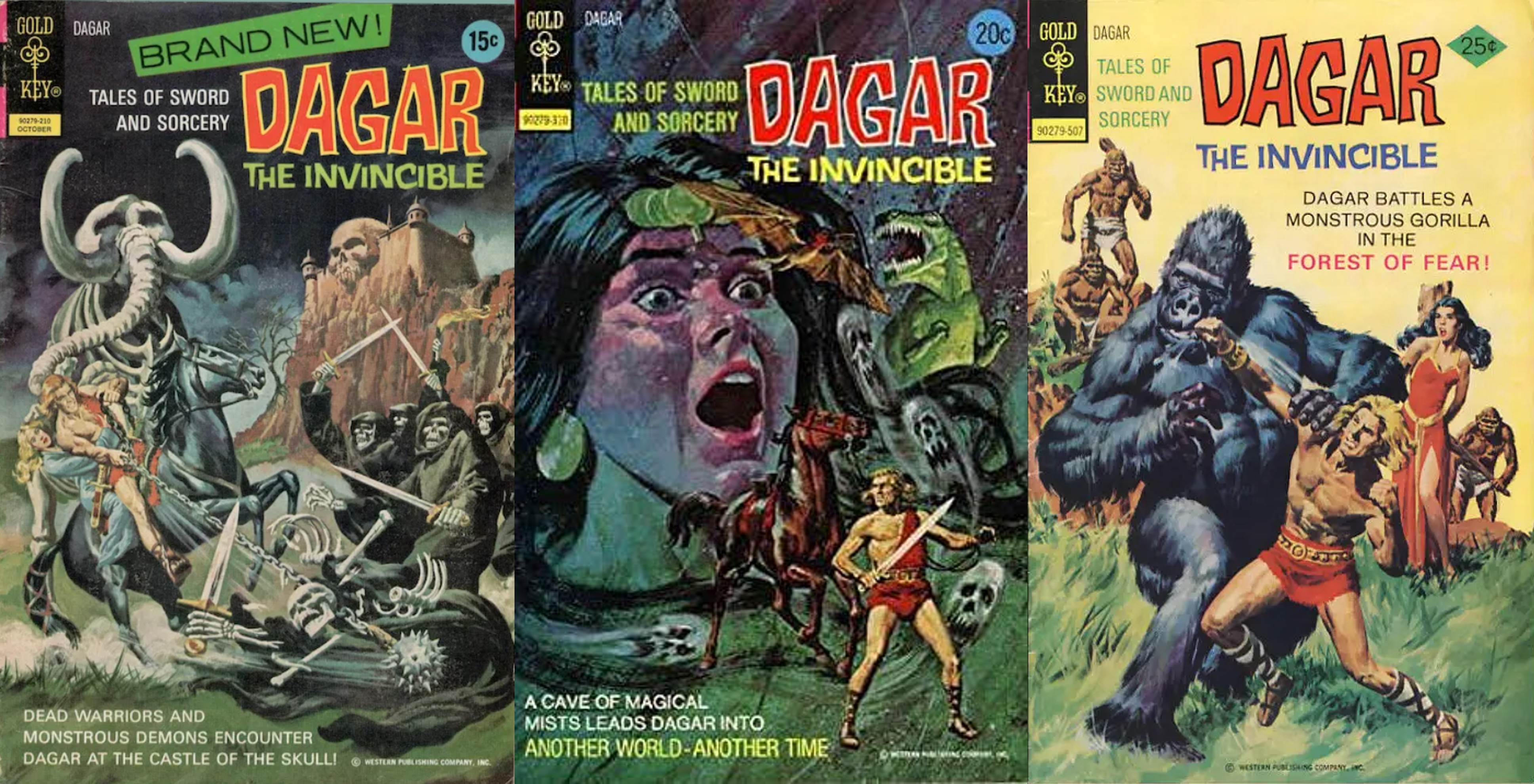
If you want to read up on the character and the world, here is the Wikipedia entry: https://en.wikipedia.org/wiki/Dagar_the_Invincible
And you must check out this fantastic blog post looking at some of the beautiful original Jesse Santos art: https://davekarlenoriginalartblog.blogspot.com/2012/02/gold-key-comicsdagar-invincible.html
With what little I know about him so far, I decided to take a shot at creating Savage Worlds and Shadowdark versions of the character. Check them out below:
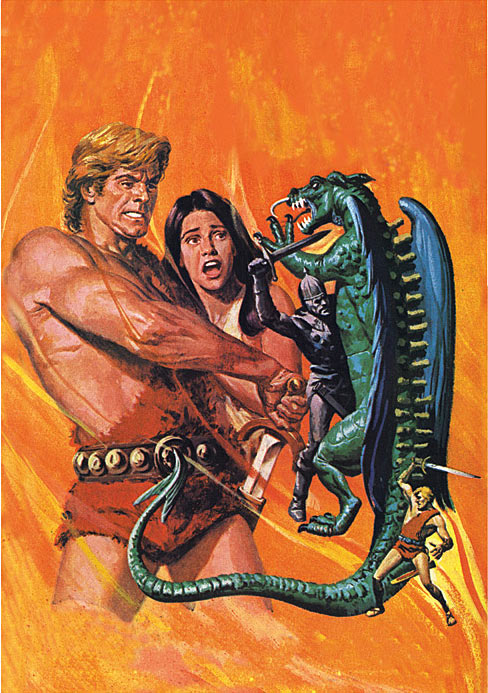
Dagar the Invincible (Savage Worlds)
Rank: Novice Ancestry: Human
ATTRIBUTES: * Agility: d4
- Smarts: d4
- Spirit: d6
- Strength: d10
- Vigor: d8
DERIVED STATISTICS: * Pace: 6
- Parry: 7 (6 with Great Sword)
- Toughness: 9 (2)
- Size: +1 (Brawny Edge)
SKILLS: Athletics d6, Common Knowledge d4, Fighting d10, Intimidation d6, Notice d4, Persuasion d4, Stealth d4, Survival d6.
HINDRANCES: * Heroic (Major): He cannot turn away from those in need.
- Outsider (Minor): A wanderer from a far-off land.
- Vow (Minor): Sworn to destroy evil sorcerers and tyrants.
EDGES: Brawny, Brute
GEAR: Great Sword (Str+d10, AP 2); Dagger (Str+d4); Leather Armor (+2 Armor); Adventurer’s Pack.
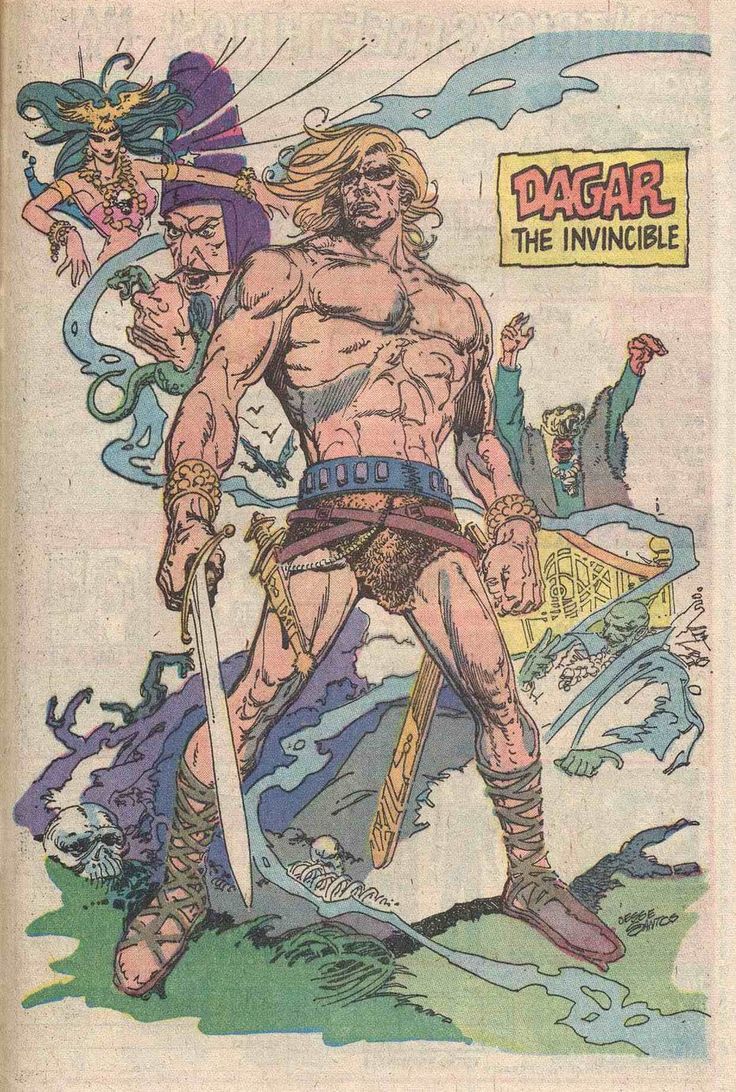
Dagar the Invincible (Shadowdark)
Class: Fighter | Ancestry: Human | Level: 1 | Alignment: Neutral
STATS:
- STR: 17 (+3)
- DEX: 13 (+1)
- CON: 15 (+2)
- INT: 8 (-1)
- WIS: 10 (0)
- CHA: 9 (0)
SECONDARY STATS:
- HP: 10 (1d8 + CON modifier)
- AC: 13 (Leather Armor + DEX modifier + Level 1 Talent)
- Attack Bonus: +4 (Strength + Level 1 Talent)
CLASS ABILITIES:
- Weapon Mastery: Bastard Sword. He has +1 to hit and damage with it.
- Grit: Strength
- Talent Rolls: +1 to Melee and Ranged attacks, and +1 to Armor Class (Leather).
GEAR:
- Bastard Sword: 1d8/1d10 two-handed, +5 Attack Bonus
- Dagger: 1d4 damage
- Leather Armor (AC 11)
- Crawler’s Kit: Backpack, flint and steel, 2 torches, 10 iron spikes, 50′ hemp rope, 10 items of iron ration, waterskin.
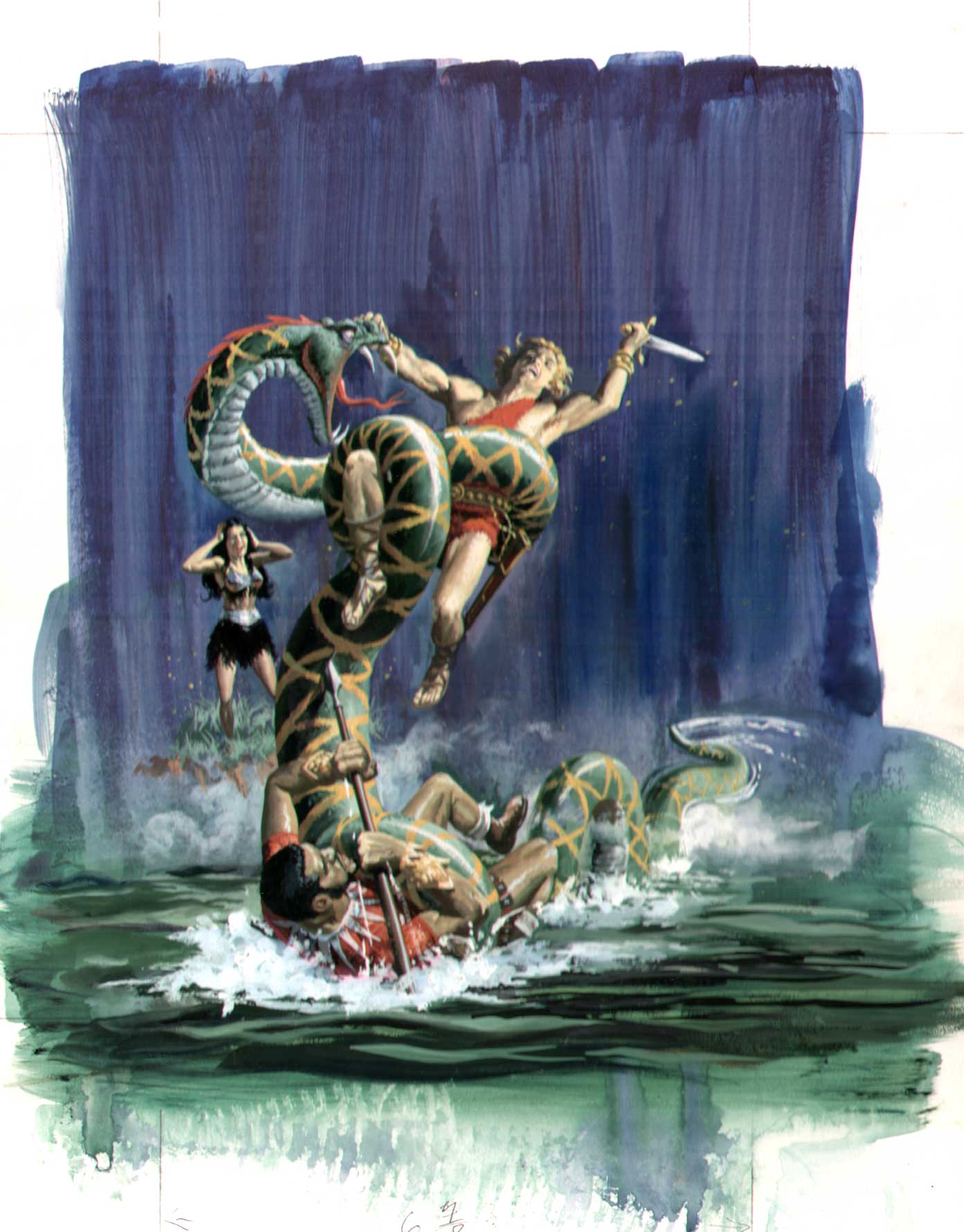
What do you think of Dagar for Savage Worlds and Shadowdark? Did anyone read these comics back in the day? If so, what did I miss?
Categories: Tabletop Gaming Blogs
Pages
